Houses by the lake
The lake was made between 1748 and 1757 by the Duke of Cumberland, and the settlement stands beside it.

Roofs beside the lake, the Great Park and a Grade I sanatorium
Virginia Water grew around a lake made in the 1750s, a railway of 1856 and a Victorian church with a stone spire. We survey each roof for its own faults.
The lake was made between 1748 and 1757 by the Duke of Cumberland, and the settlement stands beside it.
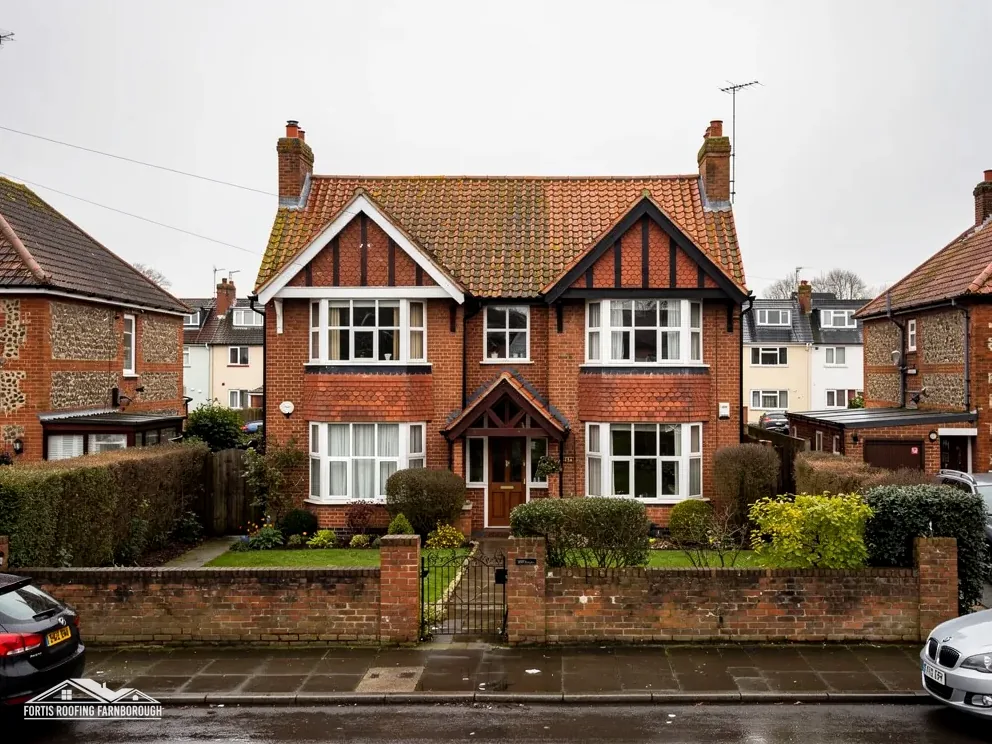
Christ Church was consecrated in 1838, cruciform, of brick with pointed arches, a tower and a stone spire.
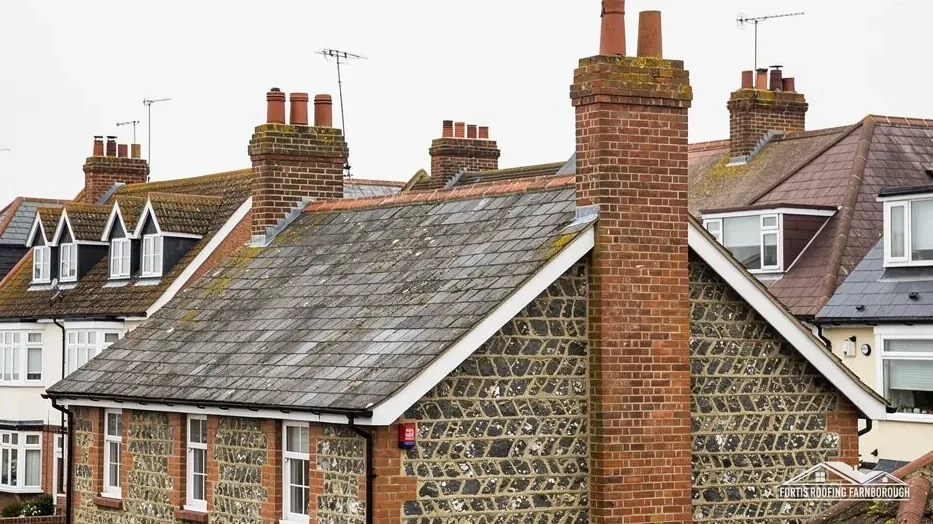
The former Holloway Sanatorium is listed Grade I, and its chapel is listed Grade II*.
Map of Virginia Water with Thorpe, Lyne, Englefield Green, Egham marked around it.
Map data © OpenStreetMap contributors. Loads only when you ask for it.
Virginia Water stands on the Bagshot sand beside its lake, on the edge of Windsor Great Park, with Farnborough 14.5 road miles to the south-west.
About 14.5 road miles north-east of Farnborough · Runnymede Borough Council and Surrey County Council.
Virginia Water, lake and sanatorium
The parties behind a Virginia Water roof job, the county history of the lake, the railway and Christ Church, and the Grade I sanatorium with its nearest conservation area all frame the repairs described here.
| No. | Chapter | The figure it turns on |
|---|---|---|
| 01 | Runnymede, Surrey and the licence clock | Runnymede plans, Surrey licenses poles |
| 02 | A lake of 1748 and a broken dam | Lake made 1748 to 1757 |
| 03 | Holloway Sanatorium and the nearest conservation area | Former Holloway Sanatorium, Grade I |
Chapter 01 of 03
Virginia Water's roof-job numbers
Virginia Water is part of Runnymede's unparished area, so Runnymede Borough Council is the body for planning and for building control, which it provides with its own team. Surrey County Council licenses the highways until 31 March 2027, when West Surrey Council succeeds both. At the 2021 Census the built-up area had 5,183 residents, and it lies 14.5 road miles from Farnborough, measured from the A325.
Runnymede's pages state no percentage for re-roofing, so three numbers from national guidance serve instead. Keep a re-roof under 25 per cent of the envelope and 50 per cent of the roof and an application is seldom needed, but a covering 15 per cent heavier brings one. We measure slopes and weigh coverings, and a registered building control approver is there for those who prefer a private route.
Compare quotes on what they include. On a large or high roof, scaffold can be the biggest single item, and a figure leaving it out cannot be compared with one that includes it. The same goes for VAT and for clearing old material away. Ours is one written price, set after the survey.
Treat a Surrey County Council licence as a clock that runs for 28 days at £208. The council asks for 10 working days of notice and says it processes applications within 10 days, so the order of events matters: apply first, then build once the licence is in place. If the job overruns, renewal costs the same again.
A house on the roads around the lake may sit well back, behind trees and a long drive, which lets scaffold stand on private ground and keeps the licence out of the plan altogether. A house on a through road does not have that choice. The survey includes a look at your frontage, and the order of events for your own address comes out of it. Whoever files the form is not named on the council's page, so that is asked of the scaffolder early.
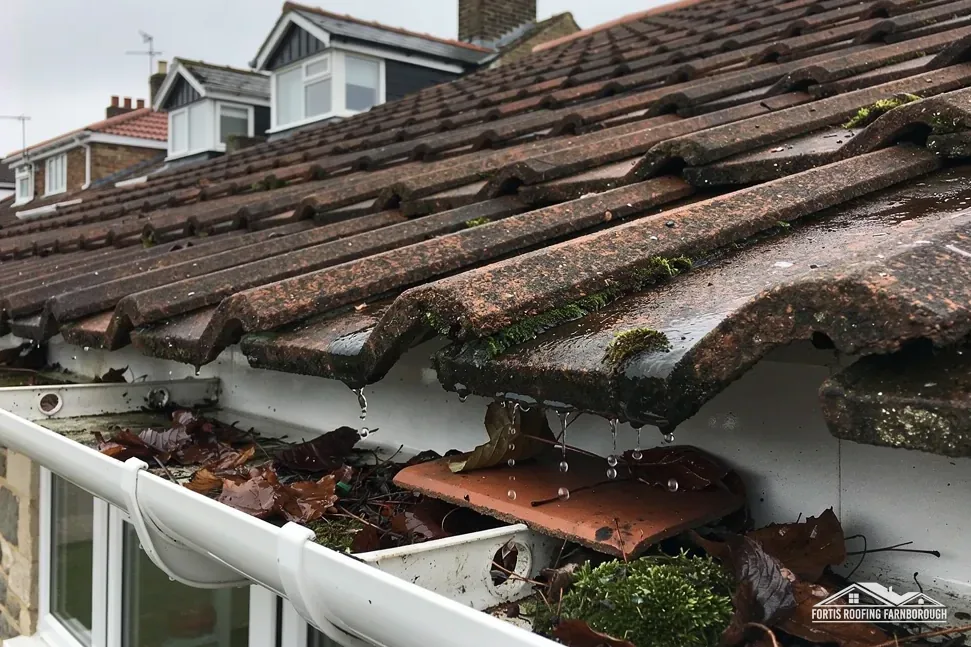
The lake and the Park mean trees, and trees mean leaves. Gutters and valleys are cleared before and after the roof work, and time is planned for that, so the finished roof does not start life under debris.
Chapter 02 of 03
| Year | What the history records |
|---|---|
| 1748 to 1757 | The lake made by William, Duke of Cumberland, ranger of Windsor Park |
| 1768 | The dam broke and caused a disastrous flood |
| 1838 | Christ Church consecrated: brick, cruciform, with tower and stone spire |
| 1856 | Railway opened, with stations at Egham and Virginia Water |
| 1857 | The National school built |
The 1911 county history records that the lake of Virginia Water was made by William, Duke of Cumberland, as ranger of Windsor Park, between 1748 and 1757, and laid out by his deputy ranger Thomas Sandby. Its dam broke in 1768 and caused a disastrous flood. A Reading and Wokingham branch railway opened in 1856, with stations at Egham and Virginia Water, and the village school followed in 1857.
A settlement made around an artificial lake, and a record of a dam failing, are a good frame for the simplest rule of roofing: water must be led away. Every roof is a collecting surface, and every gutter, hopper and downpipe is a small piece of drainage. When one blocks or sags, the water takes another route, usually down a wall or into a ceiling. A garden hose along each gutter, where safe, shows leaking joints, and the outlets go into the photographs.
Christ Church, consecrated in 1838, is described as cruciform and built of brick with pointed arches, a tower and a stone spire. A cruciform plan means valleys where the arms meet, and a tower rising from a roof means flashings where masonry meets the covering. Those are the details that fail on large Victorian buildings, and they are the details we photograph first on any building of similar design. For valleys and flashings in lead, our lead roofing and lead work page has the detail.
An 18th-century lake also means mature trees on its banks and across the Great Park, and large trees bring leaf fall, twigs and falling branches. If a bough lands on a roof, the roof is made safe first, under a temporary sheet where required, and the damage is surveyed afterwards. Photograph the damage, tell your insurer first, and remember that your policy's own storm definition governs the cover.
The railway and the school remind us that Victorian growth here came in stages. A house built in the 1850s and one added in the 1890s have different roof structures, and neither tells you what covers your own roof. Each slope's covering is named in the report after a close look.
Trees close to a house bring moss to shaded slopes, and the roof cleaning and moss removal page covers gentle treatment, since Marley advises against jet washing, which can damage tile surfaces.
Chapter 03 of 03
Virginia Water's listings and nearest designation
The former Holloway Sanatorium at Virginia Water is listed Grade I, and its chapel is listed Grade II*. The Sanatorium was first listed on 17 November 1986. Before any work that would affect either building's character, listed building consent from Runnymede Borough Council is needed. Two listed buildings stand within 500 m of the village centre.
The nearest conservation area in the national dataset is Thorpe, within about 2.5 km of Virginia Water. That does not put a Virginia Water house inside any conservation area, and it does not say there is none. Runnymede's map answers that question, and we consult it before the survey visit. Runnymede has published guidance on permitted development in conservation areas, a document to read before changing a roof's look.
Check whether an Article 4 direction applies with Runnymede Borough Council; we ask before pricing any work that changes a roof's look.
A chapel such as the sanatorium's, listed Grade II*, shows that a high grade is not only for the largest buildings, and on a listed roof every tile and every lead detail is part of the record. The principle is the same for a house, applied with more care: record first, repair like for like, and ask the council before changing anything visible.

The word Grade I deserves a moment. It is the highest grade on the national list, and a building at that level has a repair history worth keeping, so every roof repair on it is a decision about its future. For a house, the lesson is simply to respect what is there.
Large Victorian institutions give a roofer a sense of scale. Long roofs, tall chimneys, valleys, parapets and lead gutters make every defect more expensive to reach. The same features are found, in miniature, on big villas near the lake. We survey those with scaffold or a mobile platform in mind, and the written price follows from what we find.
Two listings
For an ordinary Virginia Water house that is unlisted and outside any area, the work is plain repair, and approvals follow the size of the job. A dated photographic record of the roof helps with a sale, with an insurer or with the next repair. Our gutters, soffits and fascias page explains how a failing roofline is renewed.
Often, yes. A valley collects water from two slopes, and any debris, cracked lead or lifted tile at the join sends water into the roof. Each valley is cleared and inspected, its lining and the adjoining tiles photographed, and you are told whether a repair or a new lining is the answer.
No, the listing covers that building alone, not its neighbours. Your own house is a separate case, and the questions to ask are whether it is listed, whether it is in a conservation area and whether any direction applies. We check each with Runnymede before the survey.
Raise the licence first. Surrey County Council (until April 2027) wants 10 working days of notice, then the licence runs for 28 days at £208, with renewal at the same fee. Poles cannot go on the highway before the licence is in place. Ask who applies, and agree the order with the scaffolder before booking.
Moss keeps tiles damp and can choke valleys, so removing it with care is often sensible. Marley advises against high-powered jet washes, which harm the tile surface. Gentle brushing or treatment, followed by gutter clearing and photographs of the finished slope, is the method we use, and we tell you if the tiles look too far gone to clean.
Get your free roof quote
Send the Virginia Water road and a sentence on the fault, and a surveyor will be booked.
10-year workmanship guarantee, in writing.