Windsor Street listed buildings
25 Windsor Street has been Grade II* listed since 26 September 1951.

Roofs in an abbey-founded market town below St Anne's Hill
The Benedictine abbey created Chertsey, and its stone bridge over the Thames dates from 1780. We survey the roofs of the market town slope by slope.
25 Windsor Street has been Grade II* listed since 26 September 1951.
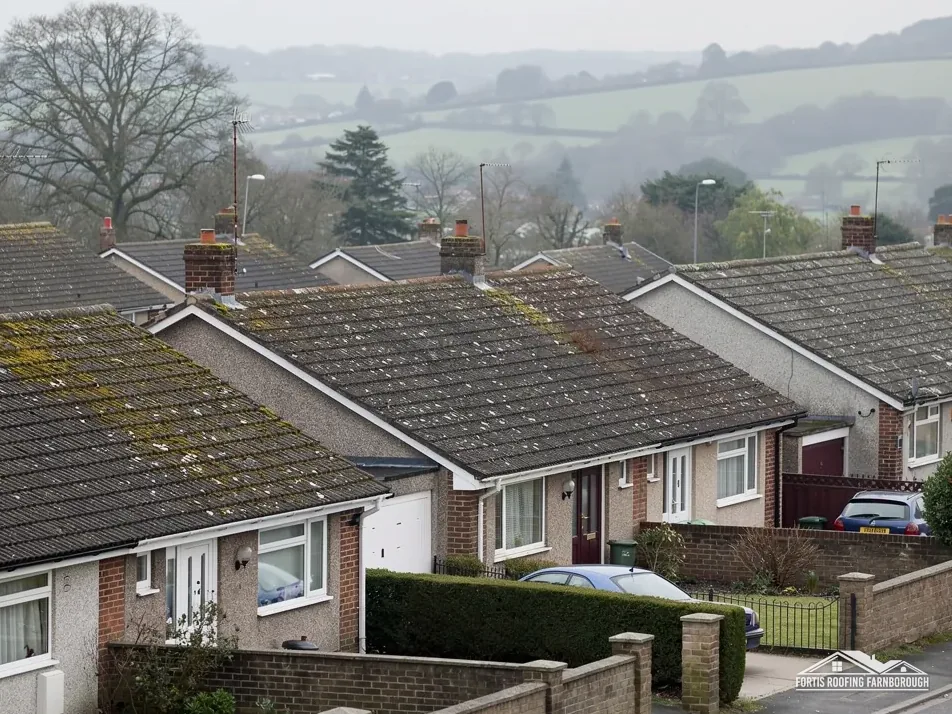
In 1911 the parish had agriculture, much market gardening and brick-making as its industries.

The county history names London Road, Windsor Street and Guildford Street as the town's three chief streets.
Map of Chertsey with Laleham, Addlestone, Thorpe, Lyne marked around it.
Map data © OpenStreetMap contributors. Loads only when you ask for it.
Laleham lies to the north-east, Thorpe to the north-west, Lyne to the west, Ottershaw to the south-west, Addlestone to the south-east and Weybridge beyond, with Farnborough to the south-west.
About 17.6 road miles north-east of Farnborough · Runnymede Borough Council and Surrey County Council.
Chertsey, abbey town record
What the April 2027 change in Surrey's councils means for a Chertsey roof booked now, how an abbey, a bridge and brickfields shaped the town, and how listed buildings on Windsor Street and a conservation area shape repairs.

| No. | Chapter | The figure it turns on |
|---|---|---|
| 01 | The April 2027 change and a Chertsey roof | 12 Surrey councils become two |
| 02 | A monks' island, a bridge and brickfields | Stone bridge built in 1780 |
| 03 | Eighty-six listed buildings and a Grade II* church | 86 listed buildings within 900 m |
Chapter 01 of 03
| Question | Until 31 March 2027 | From 1 April 2027 |
|---|---|---|
| Planning authority | Runnymede Borough Council | West Surrey Council (new) |
| Highway authority | Surrey County Council | West Surrey Council (new) |
| Scaffold licence on the highway | Surrey County Council | West Surrey Council (new) |
Chertsey is a Thames-side market town in Runnymede, 17.6 miles by road to the north-east of Farnborough, counted from the A325 Farnborough Road. Surrey County Council says that from 1 April 2027 Surrey's 12 councils will be replaced by two new unitary councils, East Surrey and West Surrey, and that Runnymede will be part of West Surrey Council. GOV.UK confirms that the Surrey (Structural Changes) Order 2026 creates the two councils from that date.
Surrey's page adds that nothing changes for now in how services reach you. A Chertsey roof booked this winter is therefore dealt with by Runnymede for planning and building control, and by Surrey County Council for the highway, exactly as today. A job that spans April 2027, for instance a scaffold licence that is renewed after the changeover, may meet the new council part-way, and the plan flags that so nobody is surprised. If a household wants a roof job finished before the changeover, the survey sets out the time each stage needs, so that the licence and any consent fall inside the present arrangements where that is possible.
The new council's procedures, fees and forms are for it to publish. What stays the same is the national rules: the Planning Portal's limits of 25 per cent of the building envelope and 50 per cent of the roof, the weight test for a heavier covering, and section 169 of the Highways Act 1980 for scaffold that obstructs the highway. Those travel with the job whoever runs the council.
Under Surrey County Council's page, a licence is needed wherever scaffold or hoarding occupies a public road, footway or other highway, charged at £208 for each 28-day period and requested at least 10 working days ahead. The page names no applicant, so who files is something the scaffolder and we agree. Where a front scaffold stands on one of the chief streets, the plan allows for the footway and for shop entrances.
For a flat or low-pitched shop roof, a rear scaffold may avoid the street altogether. Our commercial roofing page explains how a shop roof is planned around trading, and our pitched roofing page covers the repairs a safe scaffold allows on the pitched roofs above.
Chapter 02 of 03
Chertsey's story in four facts
The 1911 county history says the Benedictine abbey created Chertsey, which had been a marshy island enclosed by the Thames and its streams until the monks embanked the water. It names three chief streets, London Road, Windsor Street and Guildford Street, and notes a Jacobean house in Guildford Street, which was the Queen's Head Inn in 1911. The same history puts the north-eastern and eastern parts of the parish on the gravel, sand and alluvium of the Thames and Wey valleys, with St Anne's Hill, which it puts at only 240 ft high, rising to the west by north of the town. The 2021 Census counted 14,553 usual residents in the Chertsey built-up area.
The history records that Chertsey's stone bridge over the Thames was built in 1780, replacing a wooden bridge kept up by the counties of Middlesex and Surrey. It also says the parish's industries in 1911 were agriculture, much market gardening, and brick-making. A brick chimney stack, verge or parapet is a mortared structure standing on a roof, and mortar weathers. We start a Chertsey survey at the stack.
A stack carries a flaunching on top, which is the mortar bed that holds the pots and sheds water, and a flashing at its base where it meets the slope. Both weather. We photograph each stack once on the slope and once from inside the loft, where damp staining on the chimney breast shows where water has been entering. The survey also asks where a skip can stand and where materials can be lifted, so the plan does not depend on guesswork on the day.
Where shops and houses share a street, the roofs on it may range from a pitched tile roof over a house to a flat roof behind a shop. Neither is priced from the other. A flat roof is looked at for falls, outlets, upstands and the membrane, and a pitched roof for covering, ridge, verges, valleys and flashings.
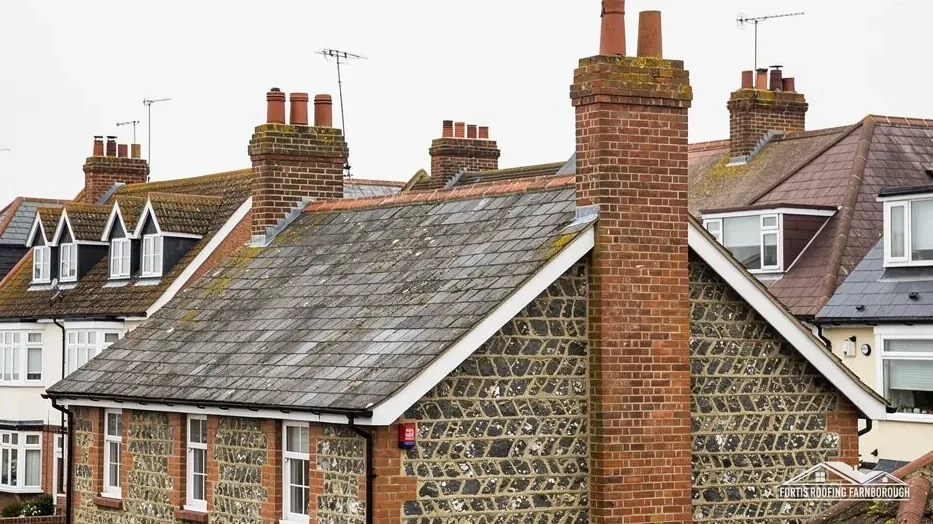
Where a pitched covering has worn out across a whole slope, our roof replacement page sets out the stages of a re-cover, and the survey photographs say whether it is the right step. A repair stays a repair when the evidence supports that, and a re-cover is proposed only when it does not.
Chapter 03 of 03
| Designation | In Chertsey | For roof work |
|---|---|---|
| Conservation area | Chertsey | Changes to the look checked with Runnymede |
| Grade II* listed church in use | Church of St Peter (NHLE 1029167) | Church of England faculty, not listed building consent |
| Grade II* listed | 25, Windsor Street (NHLE 1377931) | Listed building consent for works affecting its character |
| Grade II* listed | Curfew House (NHLE 1242226) | Listed building consent for works affecting its character |
| Grade II* listed | Pyrcroft House (NHLE 1377926) | Listed building consent for works affecting its character |
Historic England's list counts 86 listed buildings within about 900 m of the centre of Chertsey. The Church of St Peter, 25 Windsor Street, Curfew House and Pyrcroft House each carry a Grade II* listing, and the first two date from 26 September 1951. For any of them, listed building consent comes before work that changes the building's character, and consent is secured ahead of the first lifted tile.
St Peter's is a live Church of England parish church, and a faculty, not the council, governs work on its roof. The 1911 county history says the church was much rebuilt early in the 19th century, though the chancel and west tower keep some 15th-century work. Runnymede lists Chertsey among its conservation areas, and the council's map shows whether a given street is inside the boundary. Runnymede also publishes 2023 guidance on permitted development in conservation areas, which we read where it is relevant.
Section 55 of the Town and Country Planning Act 1990 puts repairs that leave the outward look alone outside planning control, but a new covering, reshaping the ridge or rebuilding a stack alters the look, so those go to Runnymede's planners before a price is fixed. We also check with Runnymede whether an Article 4 direction applies to the address.
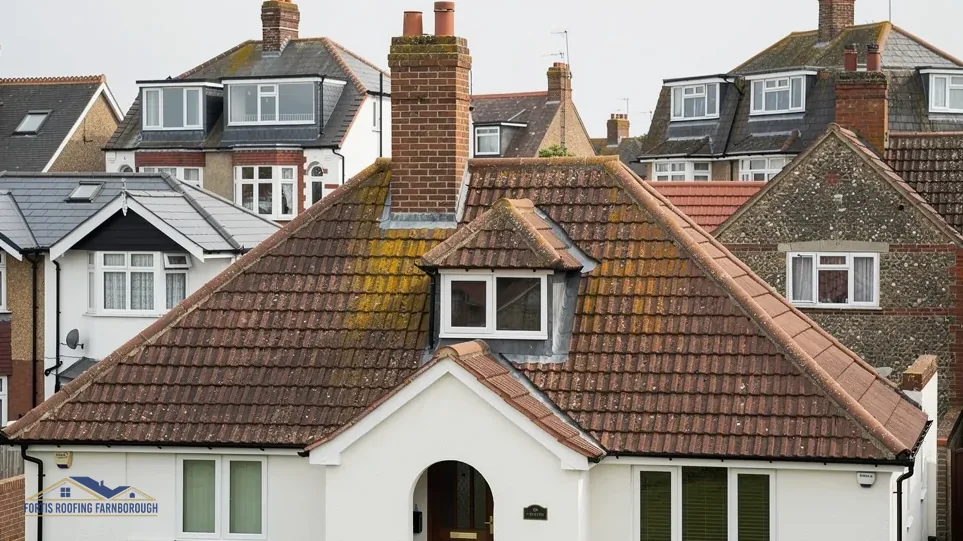
For a listed shop or house, the application starts from our survey: photographs of covering, ridge, verges, flashings and stacks, a note of the repair proposed and a reason for it. That is the evidence the conservation officer will want to see, and it is prepared before the application, not after it.
A listed building owner who applies should expect the council to ask three things: what is being done, why it is needed, and what the roof will look like afterwards. We write the first two from the survey, and show the third with before photographs and a note of the matching materials. The aim is for nothing to be left to interpretation, so the officer can decide on the facts.
On a listed house a chimney stack is part of the building's character, and repointing and flaunching are the lighter repairs. A rebuild is a bigger decision, and the consent has to cover it, so we ask for the consent reference before we agree a start date.
First, that listed building consent is in hand, because work that changes the building's character needs it before it starts. Second, whether the building is also in the Chertsey conservation area. We photograph the covering, ridge, flashings and stacks and prepare a written description that goes with the application to Runnymede.
Surrey's page says services carry on unchanged for now, and we plan around that. A job booked now runs under Runnymede and Surrey County Council as today. From 1 April 2027 Runnymede becomes part of West Surrey Council, and we flag any licence or consent that straddles that date in the written plan.
Runnymede lists Chertsey among its conservation areas, and its map shows whether your own house is inside, so look yours up. Section 55 of the Town and Country Planning Act 1990 leaves a repair that keeps the original look outside planning control, so a patch repair in matching material is the simple case. A new covering or stack is a change of look, and we ask Runnymede's planners first.
It depends on what the photographs show. If the bricks are sound, repointing, a new flaunching and fresh flashings can renew a stack. If bricks are loose or the stack leans, rebuilding is the sensible answer. The stack is photographed on the slope and in the loft, so the price rests on pictures you can see for yourself.
Get your free roof quote
Give us your Chertsey street and the symptoms you have seen, and we will set a survey day.
10-year workmanship guarantee, in writing.