Terraces around the church
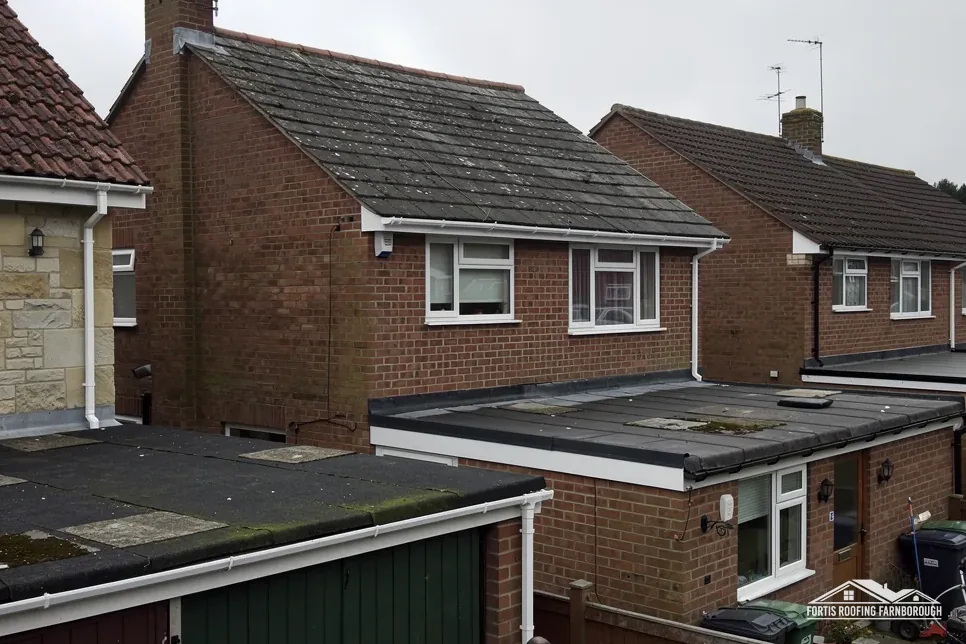
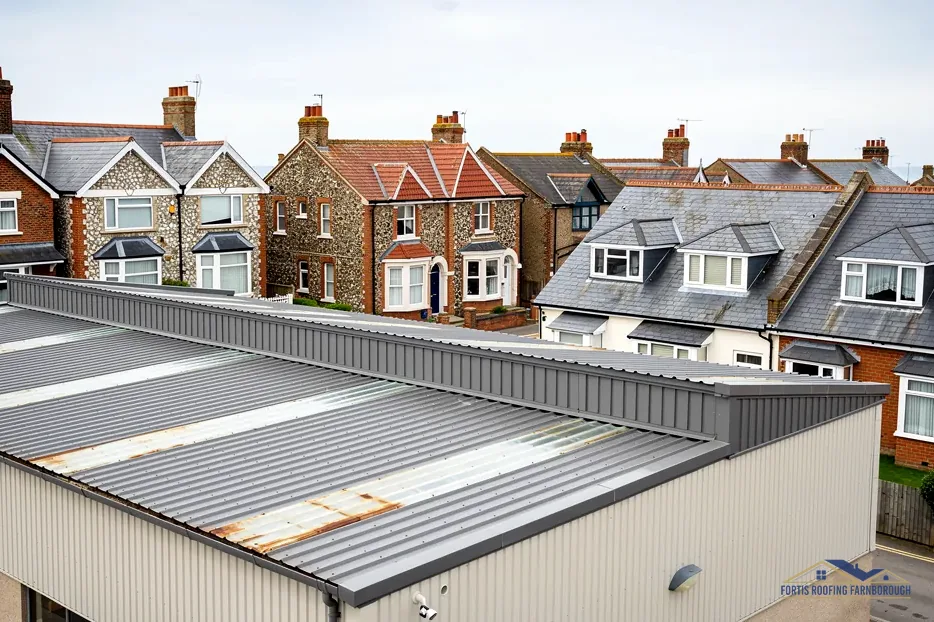
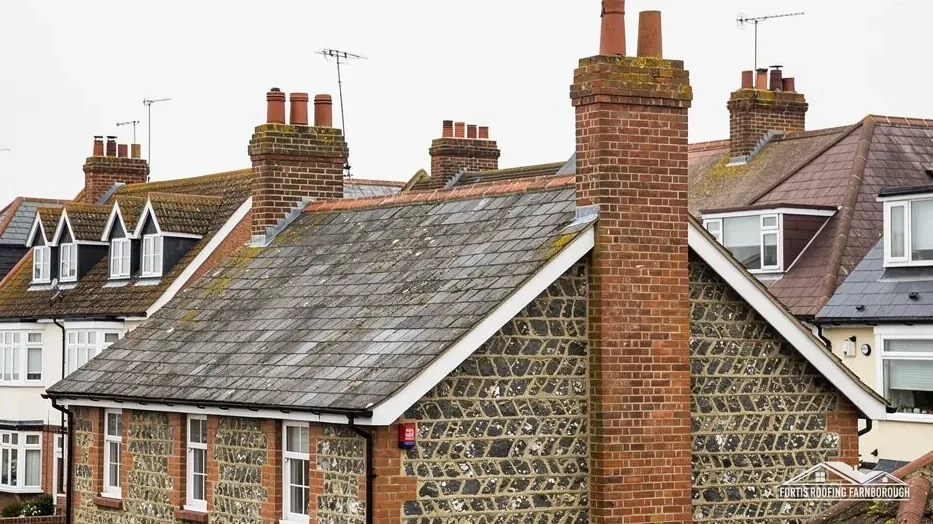
Small historic houses by the church stand in terraces of red or buff brick or render, under slate or tile.

Roofs on slate and tile terraces beside the Thames bridge
Spelthorne's 2023 appraisal describes Staines terraces of red or buff brick or render under slate or tile roofs. Each roof is judged on what is actually there.
Small historic houses by the church stand in terraces of red or buff brick or render, under slate or tile.

45 to 55 Church Street is a curved terrace with gothic brick arches infilled with hung tiles.

In the 1920s 94 council houses were built around Worple Avenue, according to the 1962 county history.
Map of Staines-upon-Thames with Egham, Laleham, Thorpe, Stanwell Moor marked around it.
Map data © OpenStreetMap contributors. Loads only when you ask for it.
Egham lies west, Laleham south-east, Thorpe south-west, Stanwell and Stanwell Moor north and Ashford east, while Farnborough is a long way beyond Thorpe.
About 18.1 road miles north-east of Farnborough · Spelthorne Borough Council and Surrey County Council.
Staines, bridge town record
Who is in charge on site when a Staines roof is repaired under the CDM rules, how the railway, a linoleum works and council housing shaped its roofs, and which listed buildings and conservation areas affect repairs.

| No. | Chapter | The figure it turns on |
|---|---|---|
| 01 | CDM roles on a Staines job | One contractor: a construction phase plan |
| 02 | A bridge, a linoleum works and 94 council houses | Staines Bridge opened in 1832 |
| 03 | Two conservation areas and 53 listed buildings | 53 listed buildings within 900 m |
Chapter 01 of 03
| Point | What the HSE and regulations say |
|---|---|
| Domestic client | An individual having construction work done on their home, not as part of a business |
| More than one contractor | Regulation 5(1): a principal designer and a principal contractor are appointed |
| Only one contractor | Regulation 15(5): the contractor must draw up a construction phase plan |
| What triggers extra duties | The number of contractors, not whether the project is notifiable |
Staines-upon-Thames is a Thames-side town where the old London road crosses the river, 18.1 road miles from Farnborough in the north-east direction, taken from the A325 Farnborough Road. Planning in Staines is Spelthorne's job, with a building control team of its own, while scaffold licences come from Surrey County Council, current until 31 March 2027, when Spelthorne becomes part of West Surrey Council. On site, a separate set of rules decides who carries which responsibility, and a householder is named in them as the client, with duties that are lighter than a contractor's.
The Construction (Design and Management) Regulations 2015, known as CDM, apply to roof work on a home. In the HSE's wording a domestic client is a person who commissions building work for their own household, a relative's included, and outside any business. The duties then depend on how many contractors are on site. Where there is more than one, regulation 5(1) calls for two named roles, principal designer and principal contractor. Where just one is working, regulation 15(5) has that contractor prepare a construction phase plan.
A roofer working alongside a separate scaffolding firm means more than one contractor. The extra duties follow the number of contractors and not whether a project is notifiable. For a householder the practical effect is that roles are settled before work starts and written down. A site where scaffold goes up on Monday and the roof is stripped on Tuesday has two contractors by Tuesday, and the plan names who is in charge on each day.
Before any start date we set out who is the principal contractor, who is responsible for the scaffold, and what the construction phase plan says about access, falls and waste. You do not need to draft any of it. We record it in the plan alongside the price and the photographs, and the scaffold firm's role is named, because the plan has to cover them.
Our commercial roofing page covers premises with an employer or landlord, where different duties may apply. For a terraced house, our pitched roofing page describes the repairs and the survey names the access each one needs.
Chapter 02 of 03
Staines in four published facts
The 1962 county history says Staines Bridge, designed by George Rennie and John Rennie the younger, was opened by William IV in 1832, in smooth rusticated granite with brick approaches. Spelthorne's 2023 conservation-area appraisal records that after the railway arrived, building first went up around the old hamlet of Knowle Green, mostly villas and smaller terraces, and terraced housing was built south of the Linoleum Manufacturing Company's works of 1864, though most of it has since been demolished. Roofs along a street built in a few years can differ widely in age today, since owners re-cover at different times.
The appraisal describes small historic houses grouped around the parish church, laid out in terraces of red or buff brick or covered in render, with slate or tiled roofs. At 45 to 55 Church Street a curved terrace has gothic brick arches filled with hung tiles. Neighbours in a terrace share ridges and party-wall junctions, and what happens on one roof is felt on the next. For that reason each junction is photographed, and our remarks about the neighbouring slope stop at what our own vantage shows.
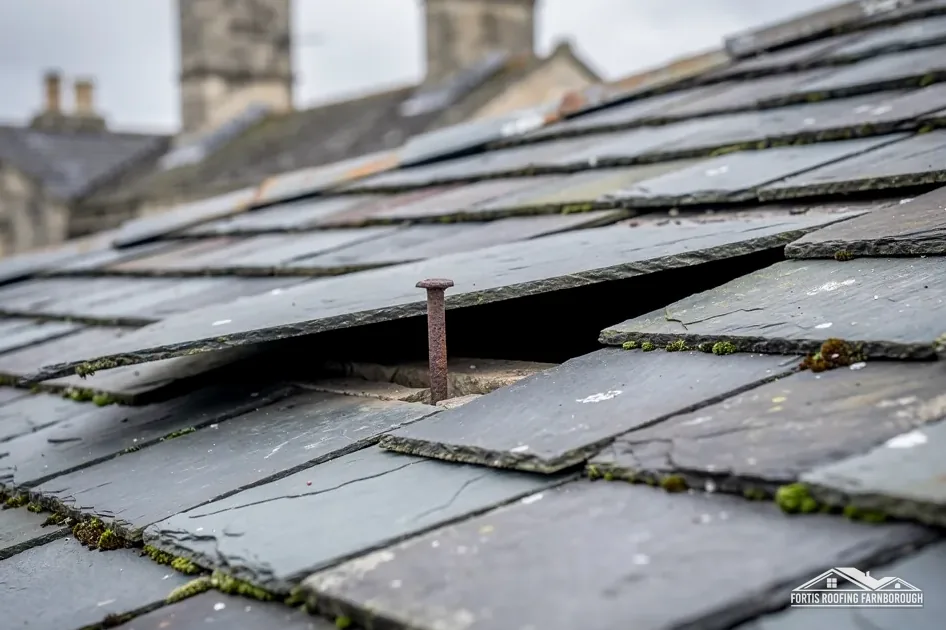
Where hung tiles meet the roof edge, a lead flashing takes the water over the covering, and the bottom hung courses are lifted there to see the battens and wall behind. Slate roofs are checked for slipped slates and rusting fixings, tile roofs for cracked tiles and failed bedding. Pitch matters on slate, and we measure it at the survey: Cupa, citing BS 5534, gives 20 degrees as the minimum, so on a low slope a tile cannot simply replace a slate.

The 1962 history adds that 94 council houses were built around Worple Avenue in the 1920s, and that many Staines houses are detached or semi-detached, with some 19th-century terraces. Where one builder put up a whole phase, the houses are alike and age together, so a fault on one is a prompt to ask the next owner to look. Every roof is still surveyed on its own, with separate photographs and a separate list of what is worn.
Where the tiles or slates have gone across a whole slope, our roof replacement page describes how a roof is renewed, and the photographs say if that step is needed at all.
Chapter 03 of 03
| Designation | In Staines | For roof work |
|---|---|---|
| Conservation areas | Staines; Egham Hythe | Changes to the look checked with the council |
| Grade II* listed church in use | Church of St Mary (NHLE 1187031) | Church of England faculty, not listed building consent |
| Grade II* listed | The Blue Anchor Public House (NHLE 1204918) | Listed building consent for works affecting its character |
| Grade II listed | 1 to 11, The Hythe (NHLE 1028940) | Listed building consent for works affecting its character |
| Grade II listed | 111 and 113, Church Street (NHLE 1298927) | Listed building consent for works affecting its character |
Two conservation areas appear for Staines in the planning dataset: the Staines Conservation Area and Egham Hythe. Spelthorne designated the Staines Conservation Area in 1975. Egham Hythe is on Runnymede's list, so a house near the river may come under one council's map or the other's, and finding out which applies is the first step. Spelthorne updated its Staines appraisal in 2023. Both councils' pages are read before a survey, and the file records which map applied, so it shows that the check was made. Where a house is let or part of a converted flat, the freeholder's consent may also be needed, and ownership of the roof structure is settled first, since that decides who signs the instruction.
Historic England counts 53 listed buildings within about 900 m of the town centre. St Mary's Church and The Blue Anchor Public House both carry a Grade II* listing from 11 August 1952, and 1 to 11, The Hythe and 111 and 113, Church Street are Grade II. For any listed building, consent has to be in place ahead of any work that affects its character, and we see it ourselves before booking the scaffold, so nothing goes up on a promise.
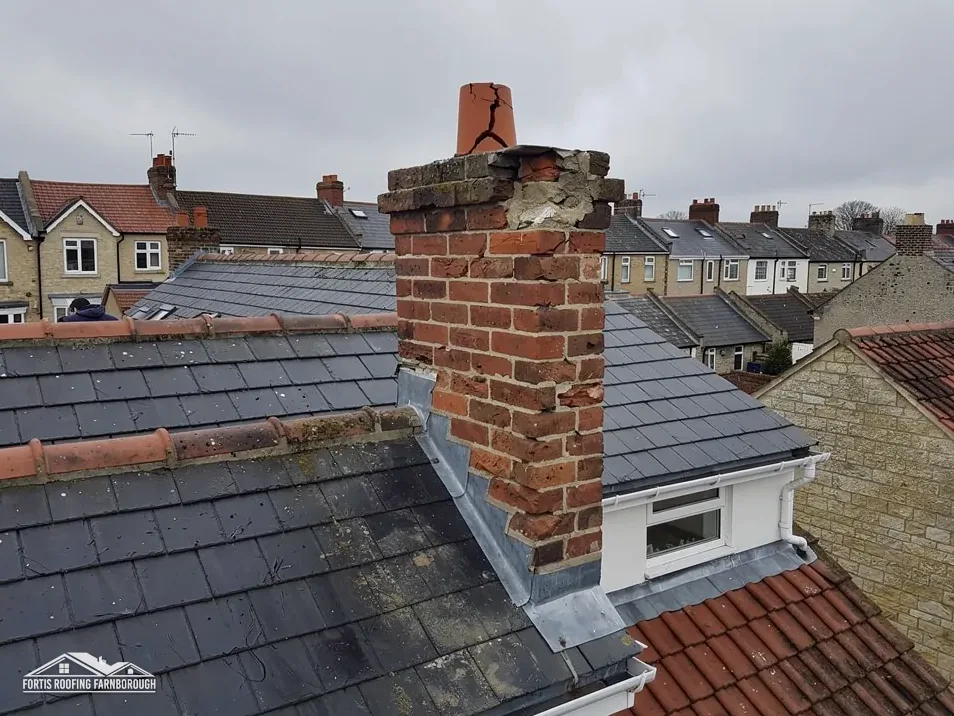
In planning law, restoring what was there is not development, which is the effect of section 55 of the Town and Country Planning Act 1990, so a small mend in matching slate or tile is the easy case. A different covering or ridge changes how the building looks, so Spelthorne's planners are consulted first. The council is also asked whether an Article 4 direction covers the address, and the reply goes into the survey notes.
The Environment Agency's planning flood map shows Flood Zone 3 within about 250 m of the centre, which is a statement about land. For a roof, the survey follows the path rainwater takes: gutters, downpipes, outlets and their joints, and whether a discharge sits against a wall.
St Mary's is a live Church of England church, so its roof is a faculty matter. For any Staines house the first visit produces dated photographs of the roof's tiles or slates, ridge, verges, stacks and hung tile; the repair then follows the original, and the file stays with you.
Each shared ridge and party-wall junction is photographed at both ends of the house, and our comments on the neighbouring slope stop at what is visible from ours. Houses built in one phase can be alike, so we suggest what a neighbour could check from the ground. The report is yours to hand on if you both want to act together.
A domestic client is a person having building work done on their own home. The heavier duties fall on contractors and depend on their number: with several, the roles of principal designer and principal contractor are named, and with one, that contractor prepares a construction phase plan. The roles are written down for you before work starts.
The planning dataset names the Staines Conservation Area and Egham Hythe, and Spelthorne updated its Staines appraisal in 2023. Which council's map applies depends on the address, so that is checked first. Restoring what was there is not development, while a different covering or ridge goes to the council, and its reply reaches you before any price is set.
St Mary's carries a Grade II* listing, yet it is a live Church of England church, so its roof falls under the faculty system. The Blue Anchor and the houses on The Hythe and Church Street are different, because listed building consent from the council for the address, Spelthorne on the town side or Runnymede at The Hythe, applies before work that changes their character.
Get your free roof quote
Send your Staines street with a note of any leaks or loose tiles, and a visit gets booked.
10-year workmanship guarantee, in writing.