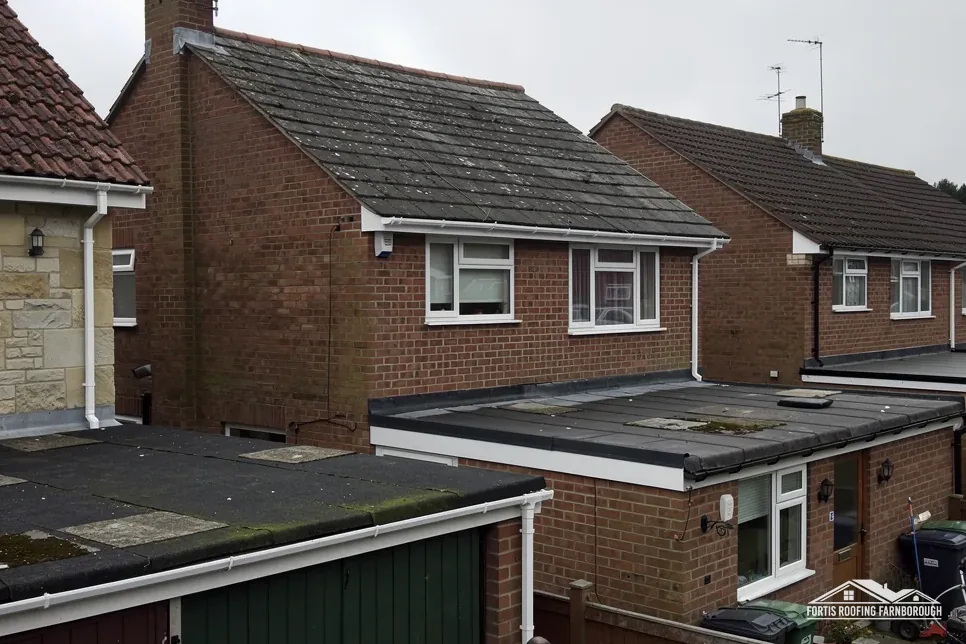
Shops on the old street
In 1911 the old village street was being rebuilt with modern shops, the county history says.
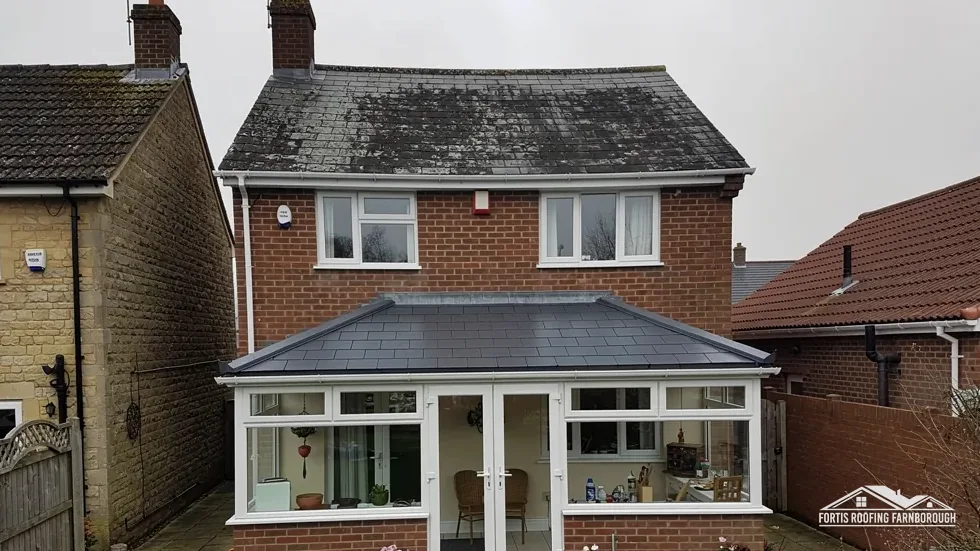
Roofs on Ashford's station-town streets, shop rows and workmen's terraces
In 1911 Ashford was rebuilding its old street with modern shops, and a new town had grown round the station. We survey those roofs and flats and price in writing.
In 1911 the old village street was being rebuilt with modern shops, the county history says.

An entirely new town had grown up around Ashford station by 1911, according to the same history.
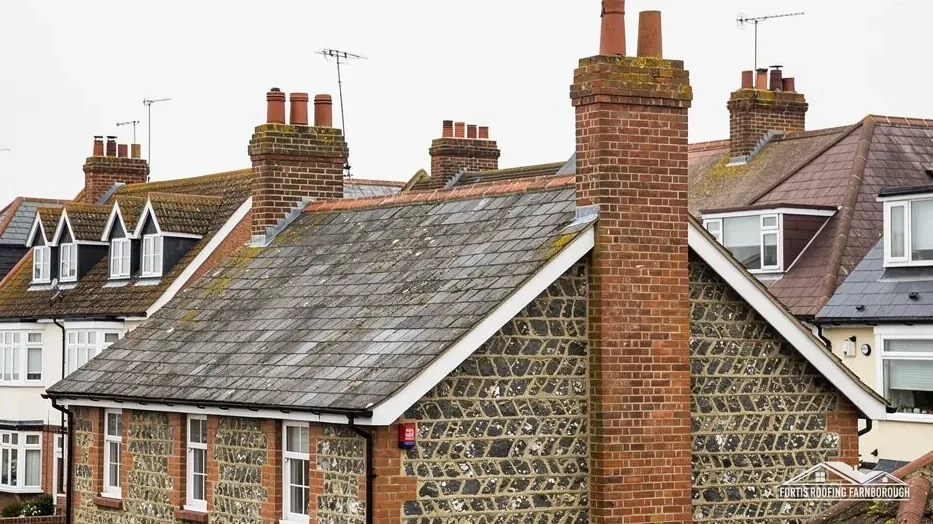
Several streets were laid out for workmen's houses a few hundred yards west of the cross-roads.
Map of Ashford with Stanwell, Laleham, Staines-upon-Thames, Feltham marked around it.
Map data © OpenStreetMap contributors. Loads only when you ask for it.
Stanwell lies to the north-west, Laleham to the south-west, Staines-upon-Thames to the west, Feltham to the east, Upper Halliford to the south-east and Stanwell Moor beyond Stanwell.
About 20.1 road miles north-east of Farnborough · Spelthorne Borough Council and Surrey County Council.
Ashford, flats, shops and streets
What it means to repair a roof above a shop or in a flat, how Spelthorne's two Article 4 directions fit, what the 1911 county history records of Ashford, and which consent route each listed building follows.

| No. | Chapter | The figure it turns on |
|---|---|---|
| 01 | Flats, shops and two Article 4 directions | Flats have no permitted development rights |
| 02 | A station town, a bridge and a level parish | Parish 45 to 50 ft above Ordnance datum |
| 03 | A Welsh school, two churches and three routes | Three consent routes in one town |
Chapter 01 of 03
| Subject | Position for Ashford addresses |
|---|---|
| Flats | The permitted development order's dwellinghouse excludes buildings with flats |
| Planning and building control | Spelthorne Borough Council, its own team |
| Article 4, three wards | Staines, Stanwell North, Ashford North and Stanwell South; in effect 29 August 2025 |
| Article 4, remaining wards | Includes Ashford Common, East and Town; in effect 13 March 2026 |
| What both directions cover | Houses becoming small shared houses, not roof repairs |
Ashford is a town on level gravel ground east of Staines, between the London road and the Staines to Kingston road, and the 2021 Census counted 22,808 people in its built-up area. Spelthorne Borough Council decides planning questions and runs its own building control team, and Surrey County Council holds the highway until 31 March 2027, when West Surrey Council replaces both.
The 1911 county history describes Ashford's old village street being rebuilt with modern shops. Many such buildings have flats above, and a roof over a flat is a different thing in law from a roof over a house. The permitted development order's definition of a dwellinghouse does not include a building containing flats, so the rights a house enjoys do not apply. So planning permission is needed for anything that is not a straight replacement in kind, or that alters how the building looks. A repair that matches stays inside the line, and a change of material or profile does not.
That has a practical edge for a leaseholder. The roof usually belongs to the freeholder or a management company, and a repair may need their agreement and, in some cases, a consultation process of their own. We survey, photograph and describe the roof so that whoever holds the responsibility has the evidence to decide.
Spelthorne has two Article 4 directions that take away permitted development rights for a house becoming a small house in multiple occupation. One covers the Staines, Stanwell North, and Ashford North and Stanwell South wards, in effect from 29 August 2025. The other covers the remaining wards, including Ashford Common, Ashford East and Ashford Town, in effect from 13 March 2026. They concern change of use and have no bearing on a roof repair.
For a flat roof on a shop or extension, Building Regulations may apply to a new membrane, since replacing a flat roof's waterproof membrane counts as renovation under Approved Document L. Our flat roofing page explains falls and coverings.
Scaffold on an Ashford road needs a Surrey County Council licence at £208 for each 28-day period, and busy shop frontages need a plan for pedestrians and deliveries. A scaffold over a shop entrance has to keep the door usable, so trading hours are discussed first.
Chapter 02 of 03
Ashford: people, bridge and ground
The 1911 county history said Ashford's aspect was rapidly changing: the old village street was being rebuilt with modern shops, and an entirely new town had grown up around the station. Ford Bridge, a stone bridge over the River Ash, had been built in 1789 by the Hampton and Staines Turnpike Trust. The parish, it adds, is low, only 45 to 50 feet above Ordnance datum, and nearly level, with gravelly soil. At Ashford Common several streets had been laid out for workmen's houses, a few hundred yards west of the cross-roads.
The same history records St Matthew's church, built in 1858, of stone with red-tiled roofs. What the account tells us of the houses is that much of Ashford changed quickly, around the railway. Rows of terraced houses put up together share an age, a builder and often their faults.
A terrace built around 1910 is now over a century old. Its roofs have had repairs and some have been re-covered. The details that fail are those of any terrace: ridge bedding, verges, chimney flashings, valleys where a rear projection meets the main roof, and gutters that have sagged or leaked at joints.
Chimney stacks on a terrace are often shared, with one stack serving two or three houses. A stack that leaks into one house may be a joint responsibility, so we photograph its condition from our own roof and describe what we see, leaving the conversation between neighbours to them.
The level ground matters in a small way. Flat sites mean long, shallow drains and gutters that discharge into drains with little fall, and a blocked gully can back water up. We trace every downpipe on a survey and note where it discharges. A downpipe that spills onto a path or against a wall is reported as a separate fault, since the damp it causes will not be cured by any repair to the roof.

A shop with a flat above can have a flat rear roof, a pitched front roof and a chimney, so one survey may cover three roof types. The pitched roofing page describes the tiled parts.
Chapter 03 of 03
| Building | Listing | Route for roof work |
|---|---|---|
| Welsh School | Grade II (NHLE 1204676) | Listed building consent |
| Chapel at Welsh School | Grade II (NHLE 1187027) | Listed building consent |
| Roman Catholic Church of St Michael | Grade II (NHLE 1428691) | The Catholic Church's own system, while in Catholic use |
| Church of St Hilda | Grade II (NHLE 1187067) | Faculty, as a Church of England church in use |
| Nearby conservation areas | Bedfont Green; Laleham | Check your address with Spelthorne |
Ashford has listed buildings that follow three different consent routes, and the route depends on who owns and uses the building. The Welsh School and the chapel at the Welsh School are each listed Grade II, and seven listed buildings stand within about 900 metres of the centre. Both need listed building consent from Spelthorne for work that affects their character.
The Roman Catholic Church of St Michael, with its boundary wall and entrance screen, is also listed Grade II. While it remains in Catholic use, its roof work is approved through the Catholic Church's own procedure rather than the council's listed building controls, and if that use ever ended, listed building consent would apply instead.
St Hilda's church is listed Grade II and is still an Anglican place of worship, so the faculty system covers it. Each of the three routes has its own paperwork and its own decision-makers.
The route decides who we talk to, what we send and when. For a council consent, we provide the survey, photographs and a written method. For a church system, the building's own architect or committee asks for the same evidence in a different form. Either way the survey record is the foundation.
Roofs on schools and chapels tend to be large, with high eaves and limited access, and they sit on sites with their own rules. A scaffold may be needed even for a repair, and scaffold on school grounds is planned around the school day. A chapel roof may carry a bell-cote or a ventilator, each a junction with its own flashing.
Bedfont Green and the Laleham Conservation Area are the closest conservation areas on the national map. Whether either reaches an Ashford street is a question for Spelthorne, and we put it to the council for any house near the edge of an area.
Surveys of such roofs happen in dry daylight, from a tower or scaffold, and nothing is touched until the route is known and the evidence is gathered, so the work follows the right procedure from the first day.
Our roof replacement page explains a whole re-roof when a survey shows one is justified.
Not usually. Standing water means the fall is too slight, the deck has dipped or an outlet is blocked, and a new coating over it will pond again. We level across the roof, photograph the water and trace the cause, then price the repair the evidence supports, rather than a patch that will not hold.
The roof usually belongs to the freeholder or management company, so its agreement is needed. Flats also have no permitted development rights, so planning permission may be required for anything beyond like-for-like repair. We survey and photograph the roof, giving whoever holds the responsibility the evidence to decide.
No. Spelthorne's directions take away permitted development for a house becoming a small shared house, and they came into effect on 29 August 2025 and 13 March 2026 for different wards. A repair is not a change of use, though a conversion that includes roof work is a planning matter first.
The Catholic Church's own approval system while St Michael's remains in Catholic use, and not listed building consent from Spelthorne, because a Roman Catholic church in use sits outside the council's listed building controls. The building is listed Grade II, so the work still needs careful evidence and a written method, and the owner applies.
Get your free roof quote
Name your Ashford address, whether house, shop or flat, and what is wrong, and we will visit and photograph the roof.
10-year workmanship guarantee, in writing.