The short answer
No. Three things decide it: what your mortgage lender will accept, the type and condition of the foam, and the state of the roof timbers under it. Some owners keep their foam without trouble, others remove it to sell, remortgage or settle a worry about damp. A survey in the loft gives the facts first.
The lender is often the deciding voice
For many owners the question is not about the foam at all but about a mortgage. In March 2023 RICS reported worry among some lenders, equity release first, spreading further. Its owner guide points you to your own mortgage provider to learn whether lending policy covers this insulation.
That is the practical starting point, and policies differ. One lender may be content, another may want a survey, and another may ask for the foam to be taken out. We cannot say what a particular lender will decide, and nobody should tell you that all lenders refuse such homes, because that overstates the position.
The moments that matter are a sale, a purchase and a remortgage. If any of these is coming, ask early and keep the reply in writing. A written answer, with the lender's name and date, is worth more than a verbal one if a dispute arises later.
If you are selling or buying, our answers on buying a house with spray foam and on selling cover the points a buyer or seller should raise. If you plan to stay and have no change of mortgage in view, the lender question may never arise.
Foam type and condition
Foams are not all alike. Open-cell foam is softer and lets some moisture through, while closed-cell foam is denser and resists it. Each behaves differently on a roof, and the type matters to any assessment of risk. Our guide to open and closed cell spray foam explains the differences.
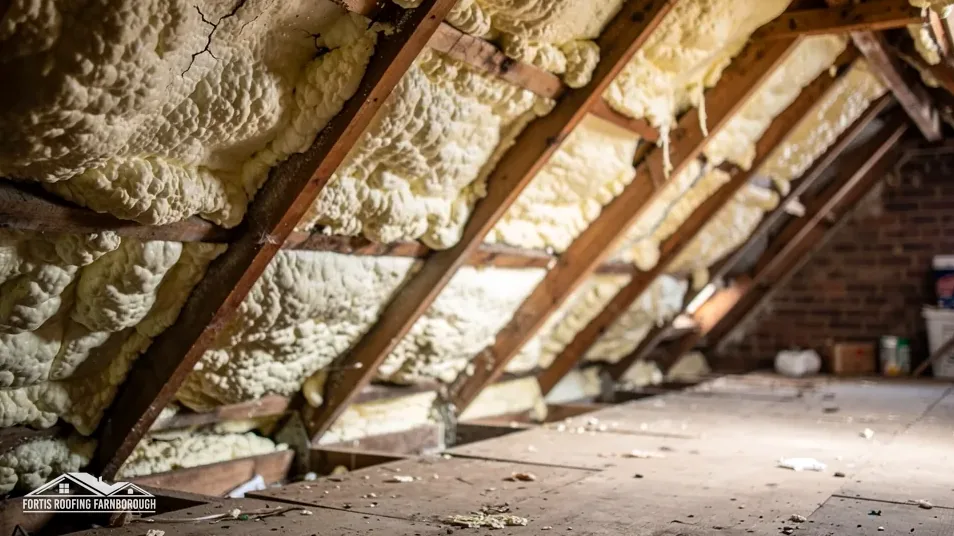
Condition counts as much as type. Foam that is well bonded, dry and unmarked is a different case from foam that is stained, crumbling, wet or sprayed over an old leak. Signs worth noting in the loft include discolouration on the foam, a musty smell, damp at the ends of the timber, and daylight or water marks where the foam meets the covering.
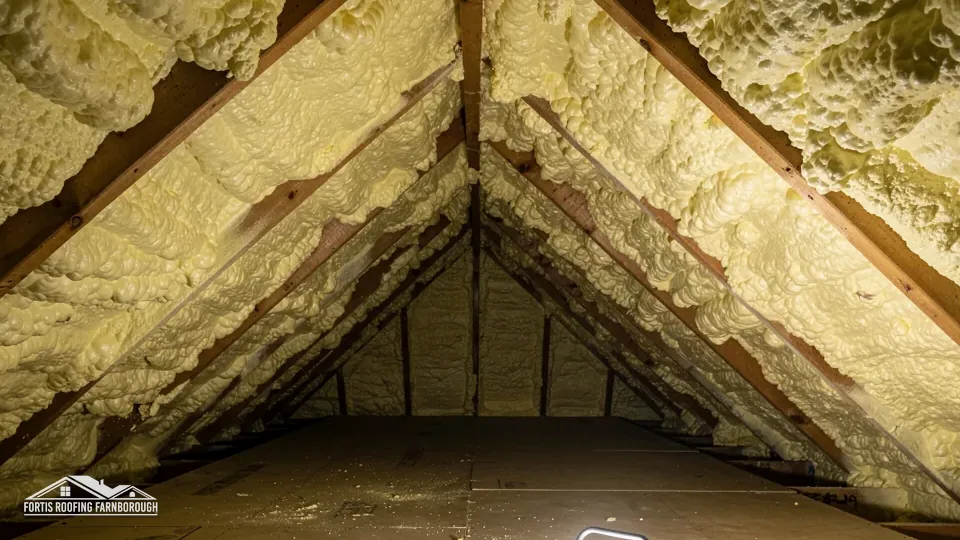
How it was applied matters too. A neat, even layer between rafters is one thing, and foam sprayed over the whole structure, burying the timbers, is another. RICS observes that foam-covered timber cannot be fully inspected, which makes the second case harder to judge.
Foam on a roof that is leaking is a particular worry. The Energy Saving Trust (updated May 2026) advises against foam over a leaking roof, since water can be trapped against the timber.
None of this means a loft is in trouble. It means the facts should be looked at.
The timbers and the survey
The deciding facts sit under the foam. Roof timbers that are dry and sound need nothing. Those that are damp, stained or softened raise a real question. Because foam hides them, the survey has two jobs: to see what can be seen, and to say plainly what cannot.
A loft survey looks at the foam's surface, the roof covering from inside, the ends of the rafters where they meet the wall, the wall plate, and any signs of moisture. A moisture meter may be used where access allows, and photographs record everything. Where timber is hidden, the survey may recommend opening a small area to check, or removing foam in a section to inspect.
The outcome might be a clean bill of health, a recommendation to monitor, a plan for partial removal or full removal. Our answer on partial spray foam removal covers the middle course.
Fear plays no part in this. Removal is a sensible option for some roofs and an unnecessary expense for others, and an honest survey says which. Findings come with photographs, so the decision rests on evidence, and the pictures go with the house papers for any later buyer, lender or surveyor who asks how the roof was checked.
Deciding what to do
Put the three factors together. If your lender requires removal, the question is settled whatever the timbers show. If your lender is content and the timbers are sound, many owners leave the foam and keep the records. If the timbers show damp, removal and repair make sense whatever the lender says.
Plans change the answer. Selling in the near future, remortgaging, converting the loft or re-roofing all bring the foam into view. A re-roof, for example, means the covering and underlay come off, and foam stuck to the underside of tiles may have to be dealt with as part of the job.
Cost enters the decision, and it is not guessed. Removal is priced from the area, the foam, the access and what the survey finds, so the one written total follows the survey.
If you have doubts about a contract signed with a foam installer, cancellation rights may exist, and Citizens Advice's consumer helpline on 0808 223 1133 can explain how they apply to the paperwork you signed. Keep the contract, any quotation and the installer's literature together, since an adviser will want to read them.
See spray foam insulation removal for the full service. The survey is the first step, and the evidence it produces is yours.