The short answer
Both copper and aluminium are used for fixing slates, and both avoid the rust that wrecks iron nails. The choice rests on the roof, the setting and the slater's judgement, and the nail should be named in the written scope. What matters most is that it is not plain iron, because rusting nails are what let slates slip.
Why the nail metal matters
Each slate hangs on one or two nails passed through punched holes into a batten, the timber strip that carries the covering. The slate itself may outlast the building, but the nails are thin and sit in a damp, changeable place under the covering, where moisture and air reach them.
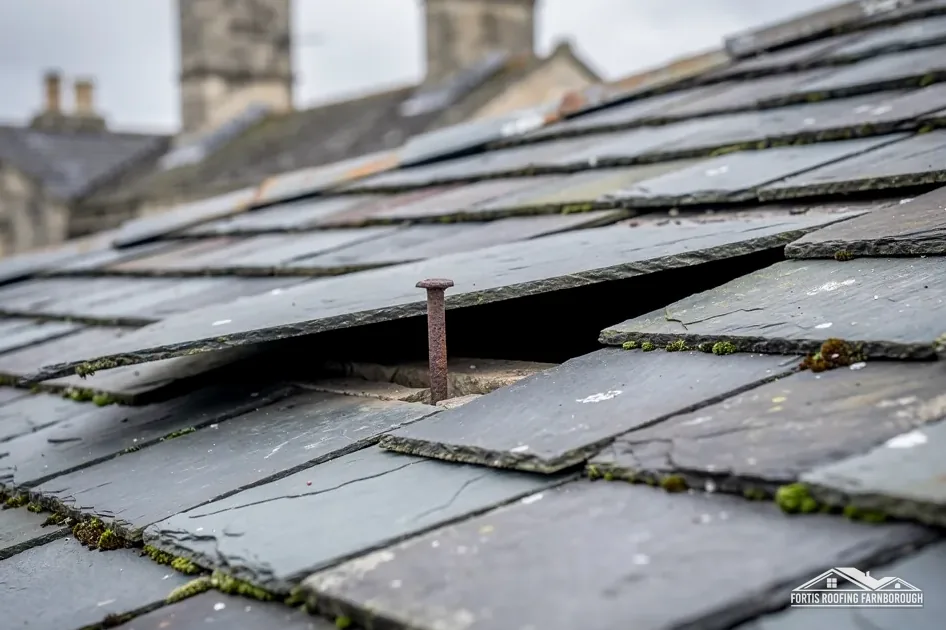
Iron nails rust. Rust swells, flakes and eats the nail down to a thin stub, and once the metal has gone the slate has nothing to hold it. This failure is called nail sickness. The slate slides down, a gap opens, and the next slate above loses some of its support, so the problem spreads from one slope to the next. Our guide to nail sickness describes the signs.
For that reason a new slate roof, or one being re-laid, is fixed with a metal that does not rust. Copper and aluminium alloy are the usual choices, and stainless steel is another. The aim is a fixing that will last as long as the slate it holds, and the nail is a small part of the cost and a large part of the result.
The slating code is BS 5534:2014+A2:2018. Marley points out that it is not a legal requirement, yet a careful roofer works to it, fixings included.
Comparing copper and aluminium
Copper is a traditional choice. It is soft, easy to drive without splitting a slate, and it forms a stable surface on the outside rather than rotting through. It is more costly than aluminium, and its use needs thought where copper might stain or react with other metals nearby.
Aluminium alloy nails are lighter and cheaper. They are strong enough for most slates, though a driven aluminium nail can bend if the batten is hard, and the alloy needs to be of a type made for roofing. Contact with certain materials can corrode aluminium, such as wet cement or some treated timber, so the setting and the batten treatment count.
Neither is right for every job. For an old slate roof where copper has been used before, matching it avoids mixing metals. For a new roof on treated battens, a roofing-grade alloy or stainless fixing may be specified. The data sheet and the supplier's guidance for the slate and the batten decide it.
What we do insist on is that the metal is named. A quote that says only "nails" leaves the choice open, and the scope should say which type goes in. The nail length also matters: it must be long enough to grip the batten properly through the thickness of the slate.
Nails, hooks and tingles
Nails are not the only fixing. A slate can also hang from a hook, a stainless clip that catches the batten and supports the slate's lower edge. Hooks look tidy and leave the slate without a nail hole to weaken it. Cupa rules hooks out on pitches under 25 degrees, so a shallow roof is nailed. Our answer on the minimum pitch for slate gives the pitch limits.
A third method is the tingle, a narrow copper or lead strip that holds a replacement slate where the course above hides the nail position. It is common in repairs and when a single slate is replaced. Our answer on the slate tingle explains how it works.
Each fixing has its place. Nails suit the main field of the roof, hooks suit steeper slopes where the look matters, and tingles suit repairs. Mixed fixings on one roof show where repairs were made, and a patchwork of tingles across a slope often points to nails failing around them.
BS 5534 sets out how slates should be fixed for the exposure and pitch, and a slater who knows the code will choose the method to suit the roof rather than the reverse.
What we check and put in the scope
Our survey starts with the nails in view. Slipped slates, rust stains below a slate and a scatter of old tingles all suggest iron nails are failing. A few slates are lifted so the nail itself can be photographed. A nail that crumbles or is eaten to a stub tells its own story.
If the roof is to be re-slated, the specification names the nail metal, the length, the number per slate and the batten treatment. If only a section is being repaired, the new fixings should not be mixed carelessly with old iron, which can still fail beside them.
The condition of the slate matters as well. Re-using slate on new battens with copper or alloy nails is a sound way to give a roof a second life, as long as the slates themselves are sound. HomeBuilding (Sep 2025) gives reclaimed Welsh slate "50-80 years" as a typical range, so the fixings should match the life you expect from the slate.
You see the photographs of the old nails and the findings explained simply, and a single written total follows. Our slate roofing page covers the wider service.