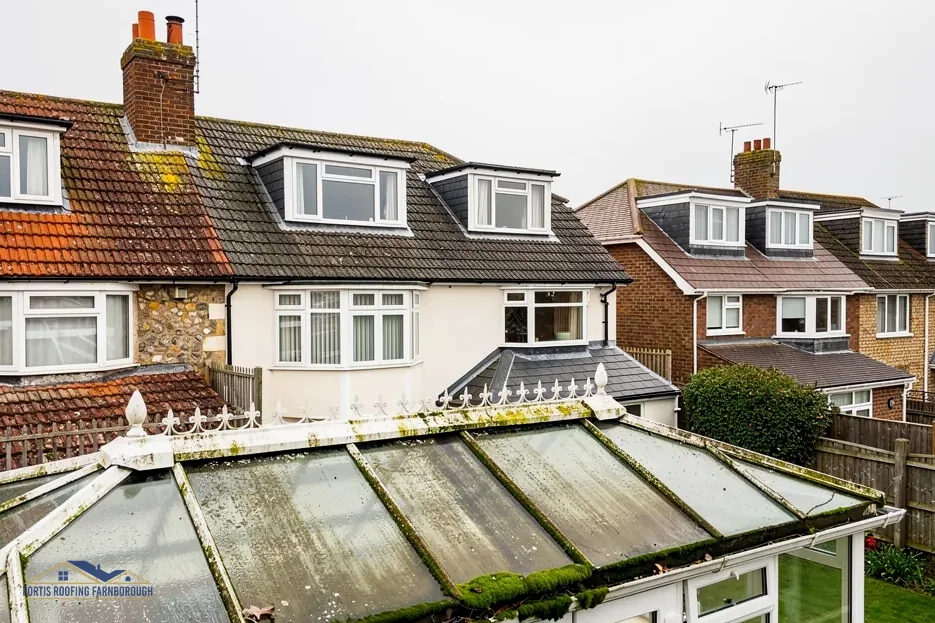
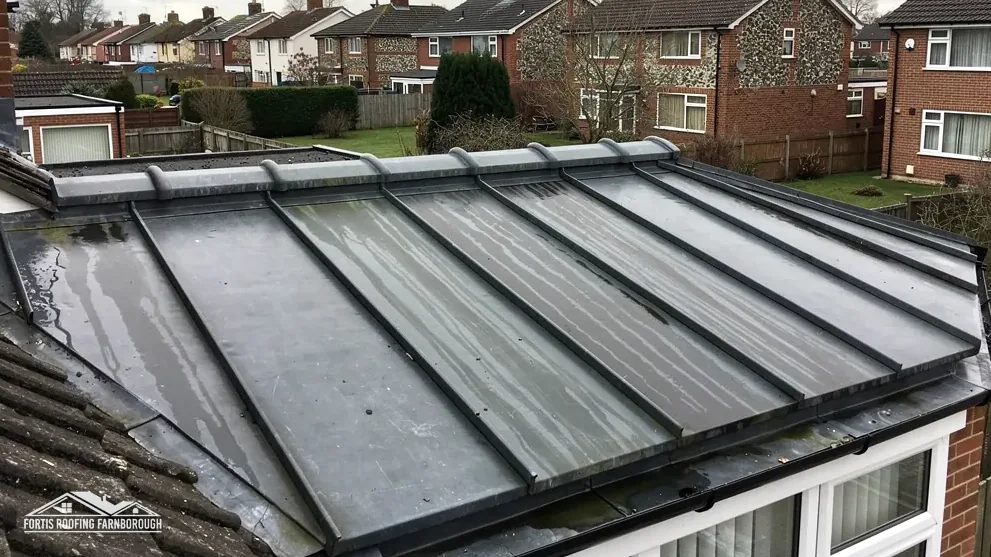
Water coming through a conservatory roof is easy to notice and hard to trace. It drips on the furniture, stains the frame and leaves tide marks on the wall, but the place where it lands is rarely the place where it gets in. A conservatory roof is a collection of parts: glazing or panels, bars that hold them, seals, a ridge, gutters and a junction with the house. Any of them can fail.
The temptation is to squirt sealant at the nearest joint and hope. Sometimes it works, and more often it hides the real fault for a season. A better approach is to look at each part in turn, from outside and inside, in the order in which water gets in, and to repair what has failed before thinking about replacing the roof.
This guide describes the main leak points, how to diagnose them, what a repair involves for each and how to judge when a repair is no longer sensible. It builds on our guide to the flashing at the house wall, and it sits beside our answers on glazing bar repair and box gutters. We survey the roof, photograph the findings and tell you plainly whether a repair will hold.
Finding where the water comes in
Water follows a path, and the stain inside is the end of it. Work backwards from the drip.
Note the pattern
When does it leak? Only in heavy rain, in driving rain from one direction, after a thaw or in a downpour with no wind? A leak that appears with wind-driven rain on one side points to a seal or a joint on that side. A leak in any heavy rain suggests a gutter that cannot cope or a fault at the top of the roof.
Look inside first
Look for where the drip starts. Run a torch along the glazing bars and the underside of the ridge on a wet day. Water often tracks along a bar before it falls, so the drip can be some distance from the entry.
Then look outside
Check the glazing bar caps, the seals along the bars, the ridge and cresting, the box gutters, the junction with the wall, the eaves and the ends of the roof. Look for lifted caps, gaps, cracked sealant, stained or green areas where water has been lying and missing screws.
Do not climb
A conservatory roof is not designed to be walked on. Glass can break and plastic can crack. Use a ladder to look from the side or a platform with boards that spread the load, and ask a roofer to do it where there is any doubt.
Test with water
Where the source is not obvious, water testing, working from the lowest point up with someone watching inside, can find it. We do this in stages, so each result belongs to one area of the roof. Our guide to conservatory roof flashing covers the wall junction.
Glazing bars and their seals
On many conservatories, the roof panels are held between aluminium or uPVC bars, and the joints are sealed with gaskets and caps. These are a common source of leaks.
How the bars work
Each bar has a channel that carries water down to the eaves. A rubber or plastic gasket sits on each side of the panel and seals the joint, and a cap on top clamps it down. If the gasket or cap fails, water gets into the channel faster than it can drain, or past the panel edge.
What goes wrong
- Gaskets shrink, harden or slip out of their grooves with age and sunlight.
- Caps crack, lift or lose their screws, especially at the ends.
- Bars flex in the wind, which opens the joint.
- Sealant that was added later has cracked and let water behind it.
- Screws have loosened, or their seals have perished.
Repairs
A failed gasket can often be replaced. A lifted cap can be re-fixed or swapped, and fresh fixings and seals fitted. Resealing a joint properly means cleaning it and using a product suited to the material. Our answer on conservatory glazing bar repair goes through it in more detail.
Condensation in the bar
Moisture in the bars can mimic a leak. Water that runs along the inside of a bar in cold weather comes from condensation, and it is worth checking before blaming the seal.
Limits
If bars are bowed, corroded or broken, a repair may not hold, and replacement of the bars or the roof may be more sensible.
Box gutters and valleys
On many conservatory roofs, water is collected in a box gutter or a valley between roof sections, particularly on Victorian and Edwardian styles with a ridge and gable. These gutters carry the most water, and they are where leaks hurt.
Why they fail
A box gutter is narrow and sits within the roof, often behind a parapet or between sections. Leaves, moss and debris block it. Once water has nowhere to go, it rises above the gutter lining and spills into the structure. Gutters can also be undersized, laid with too little fall or have failed joints and linings.
Signs
Water stains below the gutter line, overflow marks on the outside, standing water after rain, plants growing in the debris and drips that appear in heavy rain only.
Repair
Cleaning is the first step. A blocked gutter is a common cause, and clearing it may cure the leak. Where the lining has split or a joint has opened, a liner, a patch or new lead or membrane can put it right. Falls may need adjusting. Our answer on a conservatory box gutter covers what is involved.
Where lead is used
Gutters lined in lead should be in a suitable code, and the Royston brochure lists the heavier codes, 5 and upward, among those used for gutters. Lead is durable, though it can split if poorly supported.
Access
Box gutters can be hard to reach safely, and a tower or platform is often needed. We plan that before pricing.
Maintenance
Check and clear the gutter at least twice a year. A few minutes with a brush saves a roof.
Ridge, cresting and end caps
The highest point of the roof is exposed to the wind, and water can be driven in under a ridge as easily as it can fall onto it.
Ridge and cresting
The ridge is the line along the top where two slopes meet. On many conservatories, it carries a decorative cresting, a row of ornament along the top. The ridge section is sealed to the roof panels and the glazing bars beneath, and the cresting is usually screwed on. Gaps, loose fixings and perished seals let water in.
Ridge end caps
At the ends of the ridge, a cap closes the opening. These caps often crack, and their seals can fail. A leak at the gable end often begins there.
Finials and cresting fixings
Screws that pass through the roof for decoration are potential leaks. Each hole needs a sealing washer, and where the washer has failed, water follows the screw.
Our answer on a leaking ridge cap
Our short answer on a conservatory ridge cap leaking sets out the usual cure.
Repair
A ridge repair involves removing the cresting, checking the seals and fixings, replacing perished parts and refitting with new sealant and washers where needed, then testing with water before the access comes down. It is a job that needs careful access, since working on top of a conservatory risks damage to the roof.
Wind and movement
A ridge that rattles in the wind has loose fixings, and one that has moved has opened a gap. Both need attention before the next storm.
When it is more than the ridge
If the ridge beam is sagging or the roof is bowing, the cause is structural and a repair of the cap will not hold.
Panels, glass and polycarbonate
Sometimes the roof covering itself is the problem. Panels crack, slip or degrade, and the way they do so depends on the material, the age and the amount of sun the roof gets.
Glass units
Sealed double-glazed units can fail when the edge seal breaks, which lets in damp and leaves mist between the panes. That is not a roof leak, but the unit has failed. A cracked pane lets in rain. Glass can also slip in its bars if the retaining seals have failed.
Polycarbonate sheets
Polycarbonate is lightweight, and it becomes brittle in sunlight. Sheets can crack, split along their flutes or lose their end seals, which lets water into the channels. HomeBuilding gives polycarbonate roofs a typical life of 10 years, and The Eco Experts gives about 10 to 15 years. Those are typical ranges, not promises.
Solid roofs
A tiled or composite roof has its own leak points: flashings, tiles, ridge and valleys. Our conservatory roofs page lists the systems.
Wear and tear
A panel that is cracked, discoloured or failing throughout is reaching the end of its life, and patching it is only a stop-gap.
Condensation again
Water inside a sealed unit, or running down the underside of a sheet, may be condensation. A survey can tell, and so can a look at whether the dampness follows the weather or the heating.
Replacing panels
Single panels can often be replaced, provided a matching product is available. Where the whole roof has aged, replacing every panel with a different system may be better value than replacing one at a time.
Repair before replace
A new roof is a large expense, and many leaks can be cured without one. The aim of a survey is to decide how far to go, and to say so with evidence in hand.
When a repair is right
If the structure is sound, the panels are in good condition and the leaks come from identifiable points, such as a gasket, a ridge cap, a gutter or a flashing, repairing them is good value. The repair keeps the existing roof in service for years.
When replacement is right
If bars are corroded or bowed, panels are failing throughout, the frame has moved, repeated repairs have not lasted or the roof is too cold or hot to use, replacement is the more sensible choice. A new roof also lets you change the system, for instance to a solid or insulated one. Our guide to conservatory roof options compares them.
Typical replacement costs
MyJobQuote puts conservatory roof replacement at between £3,200 and £6,000 (Oct 2026), and The Eco Experts at between £2,300 and £6,000, both as typical UK ranges. A repair will be a small fraction of that.
Our approach
The aim is the right fix, not the biggest job. The survey checks every leak point, and the photographs show what is repairable, with one written price to follow.
Before you decide
Ask for the survey photographs, ask what a repair is expected to achieve and for how long, and compare that with replacement. If someone proposes replacement without showing why a repair will not do, ask them to explain.