The short answer
A conservatory ridge cap leaks when its seal has perished, an end cap has loosened or the junction with the house wall has opened. Water then runs down the ridge and into the roof. A roofer finds the entry point with a hose test, then renews the seal, refits or replaces the cap and reseals the wall joint. A cap that is warped or corroded is replaced.
How a conservatory ridge is built
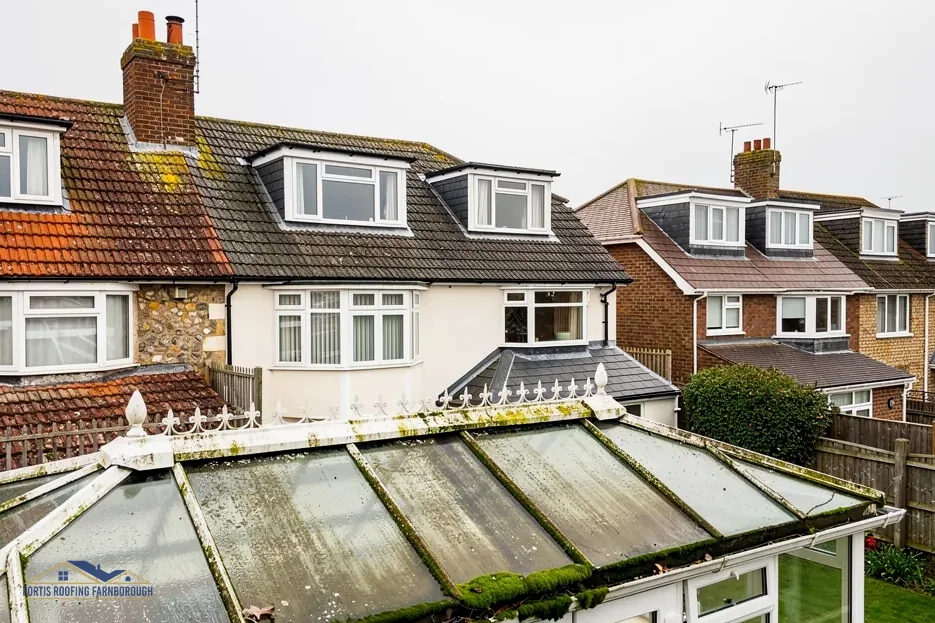
The ridge caps the top of a conservatory roof, at the point where the two slopes join. A lean-to has no ridge in the middle, but it does have an upper edge against the house wall. On a gabled, Victorian or Edwardian style conservatory, the ridge runs along the apex and a decorative cap often covers it.
The ridge assembly has several parts. A ridge bar or spine, in aluminium or uPVC, runs the length of the roof and receives the top edges of the glazing bars. A ridge cap, sometimes with a decorative profile, covers the joint between the two slopes. End caps close the ends, and on period styles a finial or cresting is added. Gaskets and sealant fill the gaps between the cap and the panels.
It is a part that has to cope with movement. The sheets or panels on both slopes expand and contract with temperature, and the ridge sits at the top where wind pressure and sun are strongest. Seals take the strain, and over the years they dry out.
Because a ridge leak enters at the top, the water has the whole length of the slope to travel before it drops. A stain or drip lower down may come from the apex. Our guide to conservatory roof leaking explains how leaks are traced.
Why the ridge cap leaks
Four causes account for most ridge leaks, and the pattern gives a clue to which.
A perished seal is first. The gasket or sealant under the cap hardens, shrinks and cracks with age and UV, leaving a gap along the joint. Water then enters in rain, especially when it is driven by wind towards that side.
The second is a loose or lifted cap. The fixings that hold the cap may have worked free, or the clips that grip it may have lost their spring. A cap that rattles in wind or sits unevenly is no longer sealing.
Third come the end caps and junctions. Where the ridge meets the gable end, the finial or the house wall, the joint is a place where several parts meet and rain can get in. Flashing against the wall may have lifted or its sealant failed. Our guide to conservatory roof flashing covers that junction.
Fourth is distortion. A ridge bar that has bowed, or a frame that has moved, opens the joint along its length. Sealant cannot cure a gap that changes with the weather.
Sometimes the leak is not the ridge at all. Condensation running down the underside of a cold ridge can look like a drip, and a hose test tells the two apart.
Tracing the leak safely
The ridge is the hardest part of the roof to reach, and a conservatory roof is not made to be walked on. Glass, polycarbonate and thin cladding can break under a person's weight, and a fall through one causes serious injury.
The trade method avoids the roof surface. The roofer works from a tower or mobile platform beside the conservatory, from a roof ladder or crawling boards that spread the load over the bars, or from inside on a platform.
Tracing is done with water, in stages. A hose is run over the lower sections first, then moved up, while an observer inside watches for drips. When the leak appears, the fault lies in whichever section was wetted last. The ridge is tested last, with water on the cap only, then on each end.
The observer notes where and when the first drop appears. A drip that appears within seconds suggests an open gap, while one that takes minutes points to water creeping along a joint.
Check the inside too: stained timber, algae on the glass and white salt deposits where water has dried tell their own story. Photograph them, with the date, and share them with the roofer. The images, together with the hose test, show whether the problem is the ridge, a bar or the wall junction.
The repair, and when to replace
Repair follows the cause. A cap with a failed seal is lifted, cleaned, fitted with new gasket and refixed, with sealant used as a supplement at the ends. A cap with lost clips or screws is refixed or replaced. An end cap that has gone is replaced with one that matches the profile.
Where the junction with the wall has opened, the flashing is renewed or resealed, and where the ridge bar has moved, the fixings are checked and the bar re-set. A product-specific cap is sometimes unavailable for older conservatories, and a roofer may fabricate or source a close match.
Replacement of the ridge assembly is the answer when the cap is warped, cracked or corroded, or the bar has bent. If the surrounding panels are brittle or the roof has reached the age at which it is failing generally, a wider repair or a new roof is more sensible, as our answer on conservatory roof repair explains.
Silicone smeared along a cap is a stopgap that traps dirt and hides the fault, so it is not the lasting repair.
We survey the ridge and junctions from safe access, photograph what we find and set out the options with a written price. The conservatory roofs hub lists the other repairs and replacements we carry out.