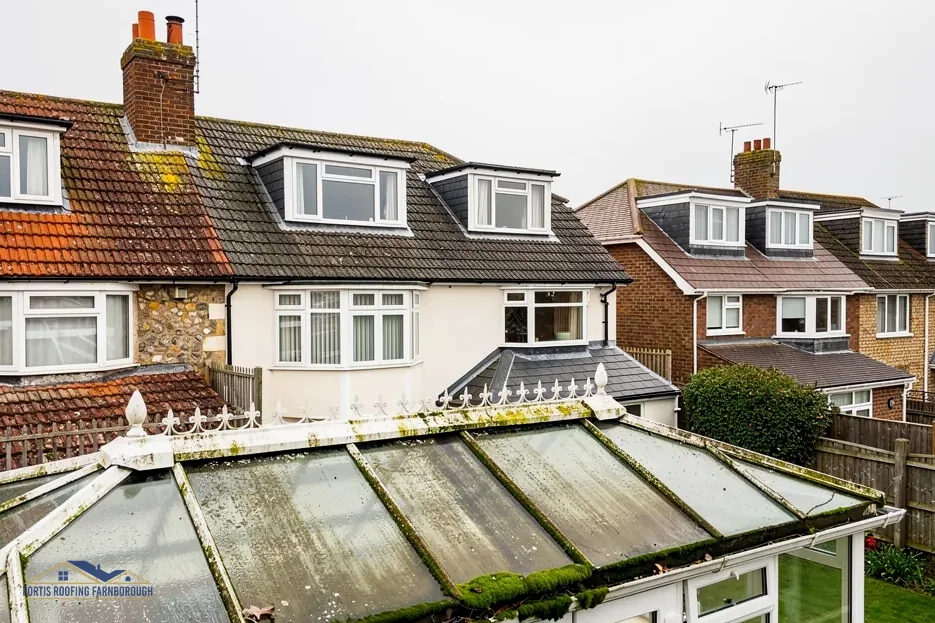
The short answer
A sagging conservatory roof means something that holds it up has moved, bent or been overloaded. The usual suspects are glazing bars that are too weak for the span, a covering heavier than the frame was built for, or movement in the base the roof sits on. A sag is a structural sign, so look at the cause before choosing a repair.
Glazing bars and the frame
A conservatory roof is held up by glazing bars, the long thin members that run from the ridge or house wall down to the eaves beam. They carry the covering and the loads on it, and they span the room without any intermediate support. Over a wide conservatory that is a long unsupported run.
Older bars were often made of thin aluminium or of timber with limited depth. Metal sections can bend slowly under a constant load, and timber can twist or soften if it has been damp. Where the bars bend, the covering follows, and a visible dip appears between the ridge and the eaves.
The ridge itself can sag if it is not supported along its length. So can a long eaves beam, the horizontal member at the low edge, if its ends are poorly held or the walls beneath have shifted.
A gap opening at the junction with the house, bars dropping away from their end brackets, or panels that no longer sit square in their frames all point the same way. Cracked sealant at the glazing edges and panels that rattle are early clues.
Our page on conservatory glazing bar repair covers what can be done to a bar that has lost its stiffness.
When the covering is too heavy
Weight is the cause that homeowners rarely suspect. A frame designed for lightweight polycarbonate may be asked to carry glass, and glass is far heavier. The same applies to a tiled replacement, which weighs more again. Approved Document A treats an increase of more than 15 per cent as a significant change in loading, and the Planning Portal sets its approval trigger at 15 per cent or more. The two wordings differ slightly, so ask your building control body which it applies.
Some older conservatory roofs have also had extra weight added over the years: a second layer of film, solar-control panels, roof blinds hung from the bars, or a satellite dish fixed to the ridge. Each is small, and together they add up.
Snow or standing water can load a shallow roof beyond its design. A roof that sags only after a hard winter, then partly recovers, has probably met a load it was never meant to carry.
If the covering was changed at some point, ask what it was made of and whether anyone checked the frame. That history often explains the dip. Our page on whether a conservatory can take a tiled roof covers the weight question for solid coverings.
Movement below the roof
Sometimes the roof is sound and the base has moved. A conservatory sits on its own foundations, which are usually lighter than a house's, and on dwarf walls or a frame. If a corner drops, the eaves beam drops with it and the roof appears to sag.
Look for diagonal cracks in the dwarf wall brickwork, doors or windows that stick, and gaps opening between the floor and the walls. A crack that runs up the junction between conservatory and house can be a sign of differential movement, where the two parts settle by different amounts.
A sag from the base is not mended by changing the roof. The cause has to be found by someone competent to judge foundations, and the roof is dealt with afterwards. A new covering on a base that is still moving would crack again.
Drainage can play a part. A blocked or leaking gutter, or a downpipe discharging next to the base, can soften the ground over time. Our page on a conservatory box gutter shows how roof water is collected and where it goes.
The distinction matters for the repair. A bent bar is a roof job, while a dropped corner is a structural one.
Getting structural advice
Before the weight of a covering is changed, the advice is to consult an engineer or surveyor, and the same step suits a roof that is already sagging. A structural engineer can say whether the frame, the base or the loading is at fault and set out what the repair should be.
A roofer can supply the information the engineer needs. At the survey we measure the span, photograph each bar and the eaves beam and record any gaps or cracks, so you hold a clear record to hand on. We also tell you what we see from the roof side, and where it points beyond our trade.
Where the answer is a new roof, building control is involved. At Farnborough and Fleet addresses that means the Hart and Rushmoor Building Control Partnership (01252 398715). A replacement that changes the weight carries a structural check as part of the application.
A sag is best looked at promptly. Bowed bars can crack seals and let water in, and water in the frame speeds up further damage. Our conservatory roofs hub covers both repair and replacement. We give one written price after measuring.