The short answer
A conservatory box gutter is a hidden channel, usually lined with lead, EPDM or GRP, that collects water where the conservatory roof meets the house or runs between two roof sections. It fails when leaves block the outlet, the lining splits or the falls have been lost, and the water backs up under the roof. Clearing, relining and correcting the falls are the usual repairs.
Where a box gutter sits and what it does
A gutter, for many householders, is a half-round channel on the fascia. A box gutter is different. It is a rectangular trough built into the structure of the roof, and it carries rainwater to an outlet and a downpipe without showing from outside.
On a conservatory, box gutters occur in two main places. One is the edge where the conservatory roof meets the house wall, where a lean-to roof drains along the foot of the wall. The other is between two roof sections, such as where a gable-fronted or hipped conservatory has valleys, or where it joins an extension.
The gutter is formed in a waterproof lining over a timber or aluminium base, with a slope towards the outlet. Lead is traditional, EPDM rubber is common on newer builds, and GRP, a glass-reinforced plastic, is used where a rigid shell is wanted. Glazing bars and roof sheets sit on either side, with a cover flashing that keeps water from running behind.
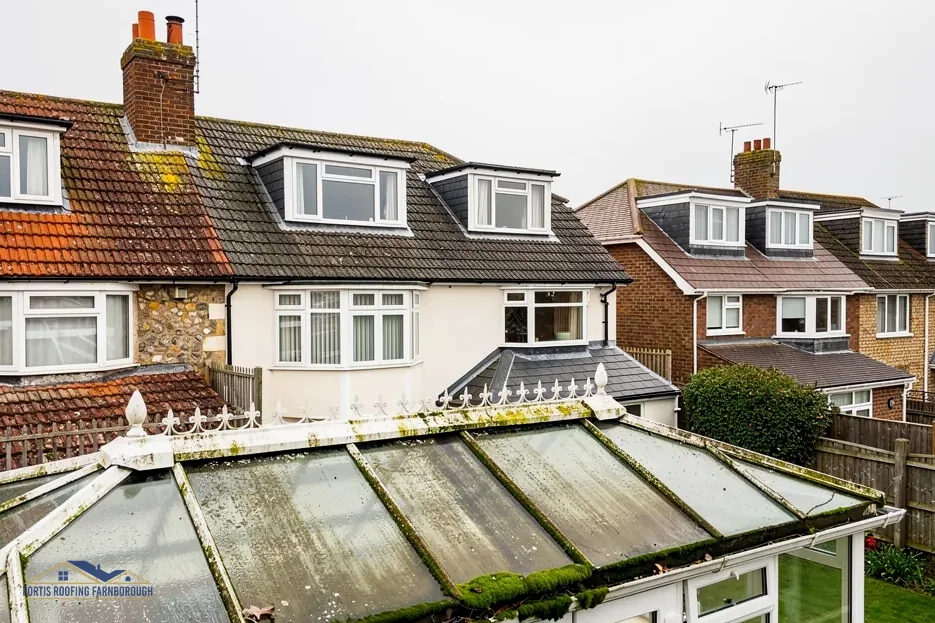
Because the gutter is hidden, it gets little attention until something goes wrong. Leaves, moss and silt collect in it, and a small leak can run behind the wall or down inside the frame before a stain shows.
Tracing a leak across the rest of the roof is covered in our guide to conservatory roof leaking.
Why box gutters fail
Four causes account for most failures, and a survey checks each.
Blockage comes first. A gutter with no leaf guard and a small outlet fills with debris, water backs up, and in heavy rain it overflows into the conservatory or over the wall. A clogged outlet is simple to clear, but the water may already have done harm.
The second is a split lining. Lead cracks at folds and joints when it has aged or when the support beneath it moves. EPDM can be punctured, and its seams can open. GRP can crack where the structure flexes. A hairline split lets water through every time it rains.
The third is poor falls. A channel has to fall towards the outlet. Rainwater guidance from Brett Martin works to 1 mm in every 600 mm, and BS EN 12056-3 is the standard that covers layout and calculation for roof drainage. Where the frame has settled, the fall can reverse in places, leaving a pool that never drains. Standing water ages any lining faster.
The fourth is undersized outlets or no overflow. A gutter that drains a large roof through a single small pipe will overflow in a storm. An overflow provision gives a safe path for the excess.
Moss, algae and tree debris from overhanging branches add to the load.
Checking and clearing
Regular care prevents most gutter trouble, and homeowners can do some of it safely from the ground or from inside.
From inside the conservatory, look along the roof's junction with the house wall for staining, drips, algae on the glazing or damp patches on the plaster above. Note when the marks appear, and whether they follow heavy rain, which points to an overflow or blocked outlet.
From outside, a view along the downpipe will show whether it runs freely during rain. Water spilling at the wall head instead of in the pipe tells you the outlet is blocked or too small.
Clearing the channel is a roofer's task whenever it needs a ladder or reach over the glazing. Glass and polycarbonate roofs cannot support a person, and sheets can break underfoot, so the roofer spreads the load with boards, uses a roof ladder or works from a tower.
Clearing is followed by a check of the lining, the outlet and the fall. A quick flood test with a hose, watched from inside, shows whether water drains and whether it leaks.
Keep the area clear of overhanging branches where you can. The habit of an annual check, in autumn after leaf fall, is worth more than any repair.
Repairs and relining
The repair follows the finding. A blocked gutter is cleared and, if the outlet is small, fitted with a larger one or a leaf guard. A small split in the lining can sometimes be patched, though a patch on aged material often fails again.
Where the lining is worn or the gutter leaks in several places, relining is the sound answer. The old lining is stripped, the base checked and repaired, the fall corrected with tapered battens or fillets, and a new lining laid. Lead is dressed to the profile with welted joints, EPDM goes down in a single sheet where possible, and GRP is laid in resin with matting. Approved Document C points to BS 6915 for lead work.
The gutter and the cover flashings are renewed together, because a new lining under a tired flashing still leaks. The glazing bars and roof sheets on either side may need lifting to reach it, which is where a conservatory roof differs from a house roof.
A survey comes first, with photographs of the gutter and a test of the fall, and the findings come with a written price for the repair.
Our conservatory roofs hub lists the related work, and the guide to conservatory roof flashing covers the wall junction.