Houses built on farmland
The 1911 county history said West Molesey had been agricultural until the recent building of suburban houses.

Suburban houses built where Molesey Hurst once raced
West Molesey was farmland until suburban and country houses arrived in the Thames valley, and Hurst Park races ran from 1892. We study each roof, ridge to verge.
The 1911 county history said West Molesey had been agricultural until the recent building of suburban houses.
West Molesey church was rebuilt in yellow brick, apart from its 16th-century tower of flint and stone.

Molesey Hurst, by the Thames, held cricket matches and prize-fights; Hurst Park Racing Club began there in 1892.
Map of West Molesey with East Molesey, Hampton, Thames Ditton, Teddington marked around it.
Map data © OpenStreetMap contributors. Loads only when you ask for it.
Esher lies to the south and Hampton to the north, while Thames Ditton is east and Sunbury-on-Thames west, with East Molesey adjoining it, all within a few miles.
About 24.4 road miles north-east of Farnborough · Elmbridge Borough Council and Surrey County Council.
West Molesey, ridges and the Hurst
What published guides give for ridges and verges and which code governs them, how a farming parish became suburb and racecourse, and how the conservation areas and a lone listing bear on the work.
| No. | Chapter | The figure it turns on |
|---|---|---|
| 01 | Elmbridge, the 2027 change and ridge costs | Ridge tile repairs: guides disagree |
| 02 | Farmland, suburbs and racing on the Hurst | Hurst Park Racing Club set up in 1892 |
| 03 | Five conservation areas and one war memorial | West Molesey War Memorial, Grade II, 2015 |
Chapter 01 of 03
| Matter | Position at West Molesey |
|---|---|
| Planning authority | Elmbridge Borough Council |
| Building control | Elmbridge Building Control Services (EBCS) |
| From 1 April 2027 | East Surrey Council replaces Elmbridge and Surrey County Council |
| Slating and tiling code | BS 5534:2014+A2:2018, current |
| Dry-fix ridge, hip and verge specification | BS 8612:2018, current |
West Molesey is a Thames-side village next door to East Molesey, in Elmbridge Borough Council's area, and its inspections come through EBCS. Elmbridge and Surrey County Council are due to give way to East Surrey Council on 1 April 2027, so a long job may straddle the change, and any letter names the council in charge on the date it is sent. The mapped centre sits in Flood Zone 2, which concerns flooding from the river and nothing about the roof above it. From Farnborough it is 24.4 road miles, so a visit is booked for a set day.
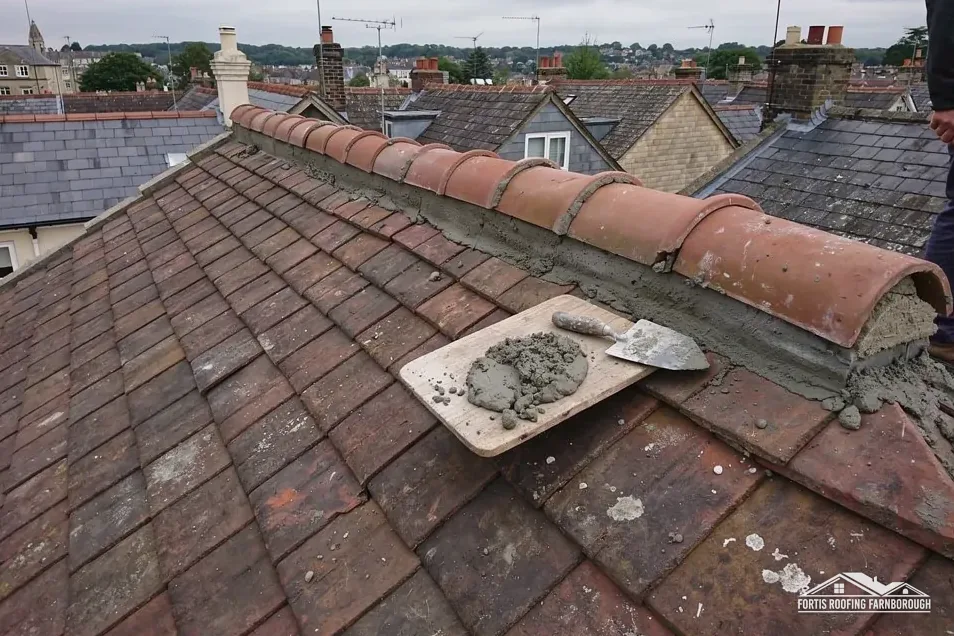
The ridge is the top edge of a pitched roof, and the hips are the sloping edges where two planes meet at an outward corner. Both are capped with special tiles, and both take the full force of weather. They are also the places where a suburban roof most often shows its age: a tile has shifted, the joint beneath has cracked, or a fixing has rusted through. A ridge that looks straight from the road can be loose underneath, so we check by hand along its length.
BS 5534 is the code for slating and tiling, and BS 8612 is the test specification for ridge, hip and verge systems that are clipped or screwed down rather than bedded. Marley points out that installing to BS 5534 is not required by law, which is worth knowing when a quote cites it. What matters is that the job is done to a standard you can name, and that the written findings tell you which one.
A November 2025 Which? survey puts a new ridge tile at a typical UK range of £80-£300, excluding VAT. MyJobQuote gives a ridge as between £225 and £550 and a dry verge system as between £500 and £2,000. The spread has a simple cause: a ridge of four tiles and a ridge of forty are different jobs, and a verge on a gable end is not a hip. National guides cannot see your roof, so a figure for your own roof has to wait for the survey. Our pitched roofing page explains the choices.
Chapter 02 of 03
West Molesey in dates from the county history
The Victoria County History of 1911 said West Molesey had been agricultural until the recent building of suburban or country houses in the Thames valley. Molesey Hurst, by the Thames, was famous for cricket matches, prize-fights and occasionally duels, and the Hurst Park Racing Club was set up on it in 1892. West Molesey church was rebuilt in modern times of yellow brick, apart from its 16th-century tower of flint and stone.
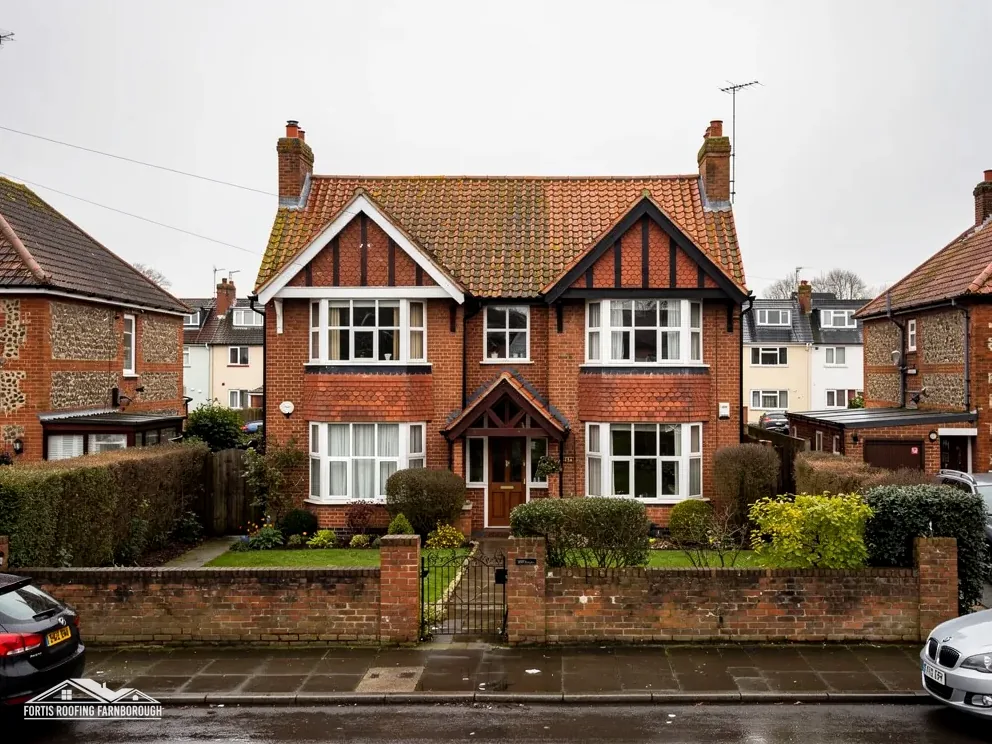
Suburban streets built at one time have houses that share details, so the same faults tend to reappear along a street: a gutter fixing that corrodes, a valley lining that wears, a hip that creeps. That is a reason to look for the common failure points, and a reason not to assume. Each roof is surveyed on its own, because owners have repaired, extended and re-covered in different ways since the houses were built.
Extensions are the usual cause of differences. A rear addition, a loft room or a porch adds a roof with its own junction to the old one, and that join is where we start when a leak is hard to trace. If a ceiling shows a stain, we follow the water through the loft, checking for daylight at the laps, damp at the rafter feet and staining on the timbers, and mark each finding on a roof plan. The outcome is one of three, a spot repair, a partial re-cover or a new roof, and the written findings say which and why, with a photograph beside each reason and a note of what happens if the work waits.
If a loft room is being formed, other rules join in. In Table 4.3 of Approved Document L the retained roof counts as an existing element, triggered at 0.35 W/(m²·K) and improved to 0.16, and any roof window has to achieve 1.4 or Band B. Approved Document B usually calls for a protected stair when a loft room is added to a two-storey house, though it allows alternatives. The roofer's part is to measure and record what is there, so the designer starts from facts.
Racing and rebuilding
Our gutters, soffits and fascias page covers the roofline, where suburban houses suffer from blocked outlets and sagging falls. The fall that gutter makers advise is 1 mm per 600 mm of run, so a sagging section leaves water standing at the fascia while the wall below stays wet. A level gives the reading we report, in place of an opinion.
Chapter 03 of 03
| Designation | Near West Molesey | For roof work |
|---|---|---|
| Conservation area | Bushy Park, within about 0.75 km of the centre | Confirm your address with the council |
| Conservation areas also named | East Molesey Kent Town, East Molesey Old Village, Hampton Village, Platt's Eyot | Confirm your address |
| Grade II listed | West Molesey War Memorial (NHLE 1427656) | Listed building consent |
| Flood map | Flood Zone 2 at the centre point | Concerns river flooding, not roofs |
In the national dataset the Bushy Park conservation area, across the Thames, lies within about 0.75 km of West Molesey's centre, and the same query touches East Molesey Kent Town, East Molesey Old Village, Hampton Village and Platt's Eyot. Elmbridge says it has 26 designated conservation areas, covering more than 2,000 properties. Whether your house is within one can be read from the council's plan alone, and any change to a roof's street view is a matter for the planners first. Our planning permission for roof work guide names the people to ask and what to give them.
Scaffolding on the road here, until 31 March 2027, is a matter for Surrey County Council: licence applications go in at least 10 working days ahead, the fee is £208 for each 28 day period, and the application fee is not refunded. East Surrey Council takes over on 1 April 2027, so a job running beyond that date is planned with the change noted, and the licence is sorted with our scaffolding contractor from the start.
West Molesey War Memorial is listed at Grade II, with Historic England dating the listing to 4 August 2015, and it is the one listed building within 500 m of the centre. That is a small number, so most houses here are not listed, but we still read the National Heritage List against each address before a price is set. For a listed building, altering its character calls for the council's consent.
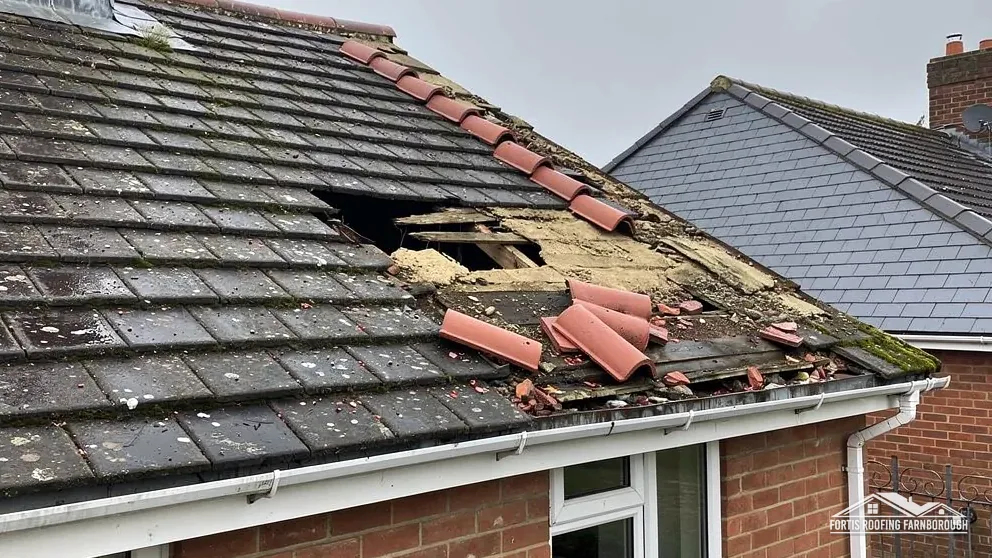
Most West Molesey roof work is therefore ordinary roof work done well: ridges re-fixed, hips re-bedded or dry-fixed, valleys re-lined, flashings renewed and gutters put back to their fall. Each step is photographed, allowing a later comparison with the roof as found, and the written findings say plainly what was done and why.
Flood Zone 2 at the centre point is worth a word. It concerns water on the ground, and so it matters to ground floors, garages and insurance. Buying near the river? Have the roof looked at before exchange, since the report can go to your solicitor, and a published guide puts a stand-alone roof survey at around £300. Our chimney repairs page covers the stacks.
A hip is held by the ridge at its top and the eaves at its foot, and the bedding or fixing in between can fail. We examine the top, the foot and everything between, as a single failed fixing is seldom the only one, and then say whether a re-bed or a dry-fix suits.
A November 2025 Which? survey gives £80-£300, excluding VAT, for a new ridge tile as a typical UK range. MyJobQuote gives a ridge between £225 and £550 and a dry verge system between £500 and £2,000. Those are national guides, not a quote. Ours arrives as one total once the survey is done.
Only to the memorial itself. West Molesey War Memorial is listed Grade II, so changing its character needs the council's listed building consent. A neighbouring house without a listing follows the usual planning and building control routes, and the survey checks which of them applies to yours, in writing.
No. The Environment Agency's zone concerns water on the ground and not water through a roof. It bears on ground floors and on insurance cover. Rain getting through a roof reflects a worn covering, and no flood zone alters that, so the trace starts in the loft and on the slopes, not at the ground-floor walls.
Get your free roof quote
Tell us where in West Molesey the roof is and what it is doing; a survey and one price follow.
10-year workmanship guarantee, in writing.