Thatch on the oldest buildings
East Hampshire's conservation area appraisal says thatch is the main roofing on Ropley's oldest buildings.
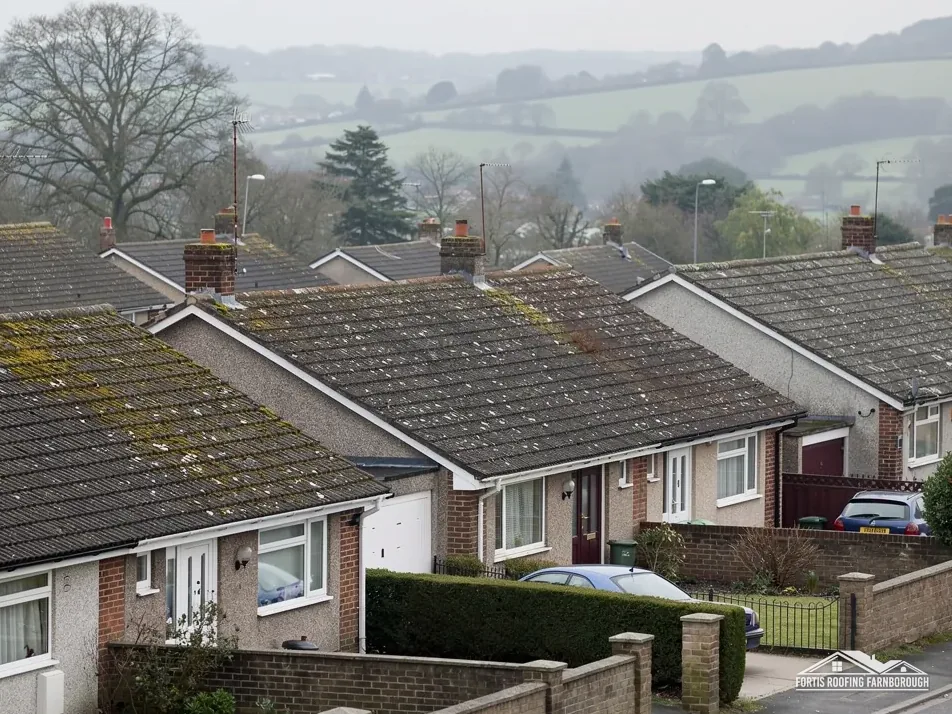
Roofs on a ridge village, from thatch to slate
Ropley's conservation area appraisal records thatch, handmade clay tile and slate across its buildings. We check each slope before deciding how to repair it, and explain what we find.
East Hampshire's conservation area appraisal says thatch is the main roofing on Ropley's oldest buildings.

Handmade clay tiles are used widely in Ropley, often on half-hipped roofs, according to the same appraisal.
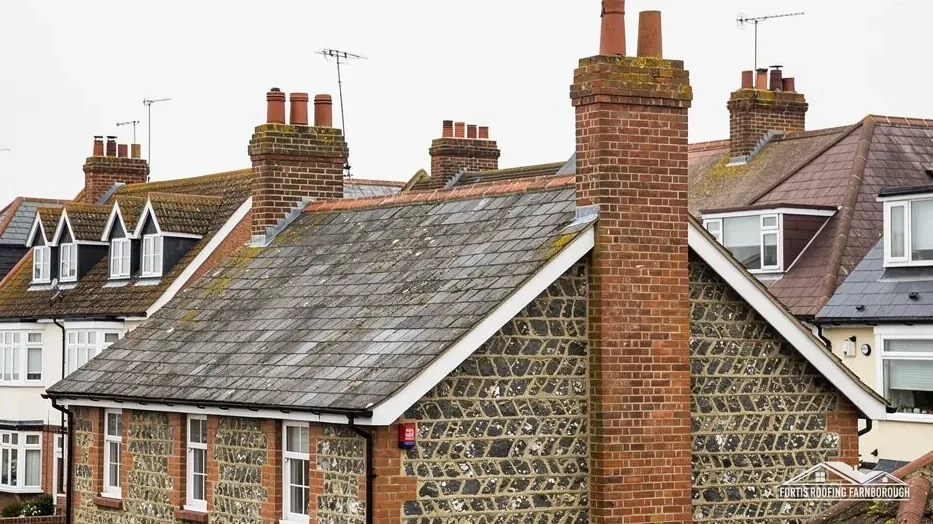
Slate appears on later 19th and early 20th-century houses, while concrete tiles are listed among changes that harm the area.
Map of Ropley with Four Marks, Medstead, New Alresford, Selborne marked around it.
Map data © OpenStreetMap contributors. Loads only when you ask for it.
Ropley stands on a ridge east of New Alresford, between the A31 and the Petersfield road, with Farnborough 27 road miles to the north-east.
About 27 road miles south-west of Farnborough · East Hampshire District Council and Hampshire County Council.
Ropley, tile, slate and thatch
East Hampshire's rules and Hampshire's scaffold fees, what the conservation area appraisal says Ropley's roofs are made of, and how listed cottages and St Peter's church change the route, with sources.

| No. | Chapter | The figure it turns on |
|---|---|---|
| 01 | East Hampshire and the scaffold on the lane | East Hampshire plans, Hampshire licenses scaffold |
| 02 | Thatch, handmade tile and slate in Ropley | Thatch on the oldest buildings |
| 03 | A 1976 conservation area and Grade II cottages | Ropley conservation area, 1976 |
Chapter 01 of 03
| Role | Body for Ropley addresses |
|---|---|
| District council and planning authority | East Hampshire District Council |
| County council and highway authority | Hampshire County Council |
| Building control | East Hampshire District Council's own team |
| Scaffold licence on the highway | Hampshire County Council, applied for by the scaffolding company |
Ropley sits in East Hampshire, so a roof job here answers to East Hampshire District Council for planning and to Hampshire County Council for the road outside. East Hampshire runs its own building control team, and that team is the one that looks at a re-roof once the work goes beyond a repair. Knowing which desk handles which question saves a good deal of waiting later, and it means the right person is asked first time.
Ropley's roads fall to Hampshire County Council as highway authority, so scaffold on a verge or footway needs its licence. The application comes from the scaffolding company, not the householder, and the card alongside sets out the council's notice period and fees. A job that overruns its licence needs a new application, because the council offers no extensions. Scaffold on a private road needs none.
None of that paperwork falls on you. We settle with the scaffolding firm where the frame will stand, so the licence goes in before any start is promised and the start you hear about already respects the notice period. A job on a low Ropley roof that needs only a short ladder never meets the question.
The Planning Portal draws the line. An application is not usually required for a Ropley job touching under 25 per cent of the building envelope and under 50 per cent of the roof, though a new covering that weighs 15 per cent or more beyond the existing covering does need approval, whatever its area. Cracked tiles replaced one by one, or a ridge bedded again, come in far below it. A full re-cover of a Ropley house does not.
Should a job cross the line, you are told first, and the single written price that follows the survey already covers the extra step. East Hampshire's pages also explain that if a private registered approver can no longer act, the job can revert to the council by application. If you hold a completion certificate from earlier roof work, bring it, for it records the last sign-off, and tell us of past repairs, however small, which help us read the roof.
Chapter 02 of 03
Ropley's roofs and parish in four published figures
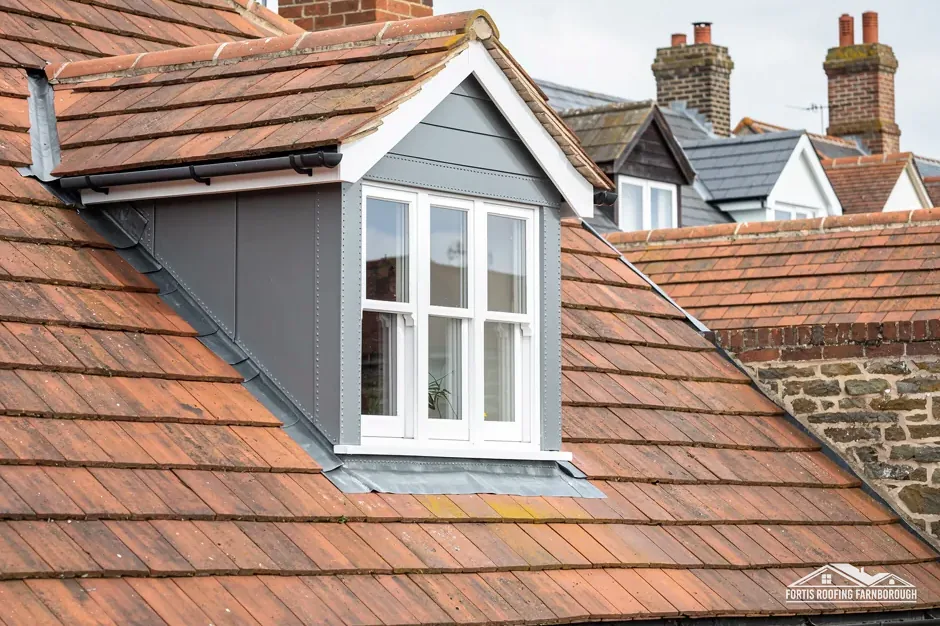
East Hampshire's conservation area appraisal for Ropley is unusually specific about roofs, and we work from its wording. Thatch, it says, is the main roofing on the village's oldest buildings. Handmade clay tiles are used widely, often on half-hipped roofs, where the gable end is cut back by a short sloping hip instead of rising to a point. Slate appears on later 19th and early 20th-century houses. The same appraisal lists concrete roof tiles among the modern changes that harm the conservation area.
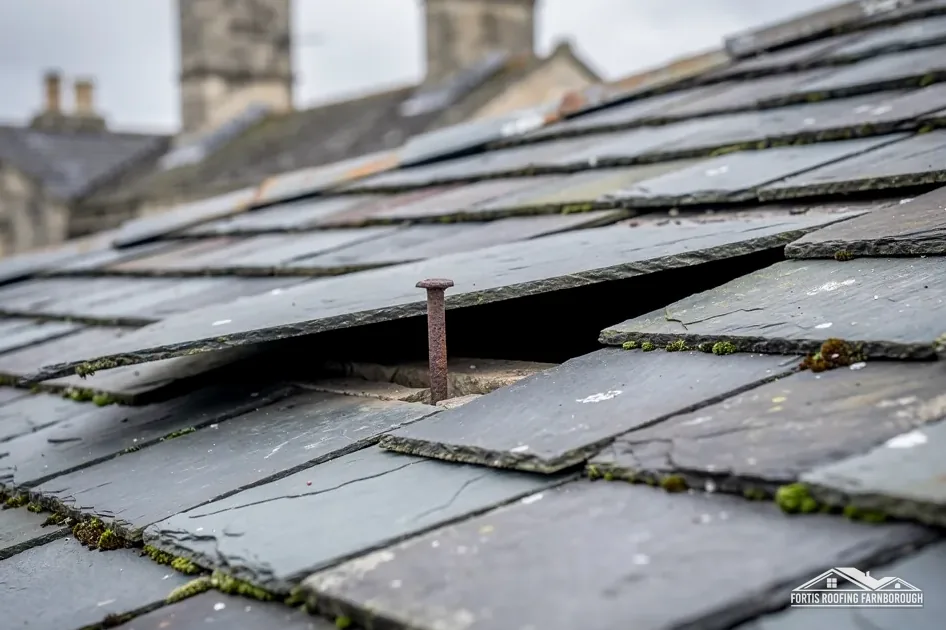
Clay tile and slate are fixed and repaired in different ways. A handmade tile varies in colour and thickness from its neighbours, and replacing one with a smooth modern tile shows from the lane. Slate is nailed or hooked, and a cracked slate on a Victorian house is lifted and replaced with one of the same size and thickness. Each slope therefore gets a separate note in our survey papers, since a Ropley roof can alter from one slope to the next.
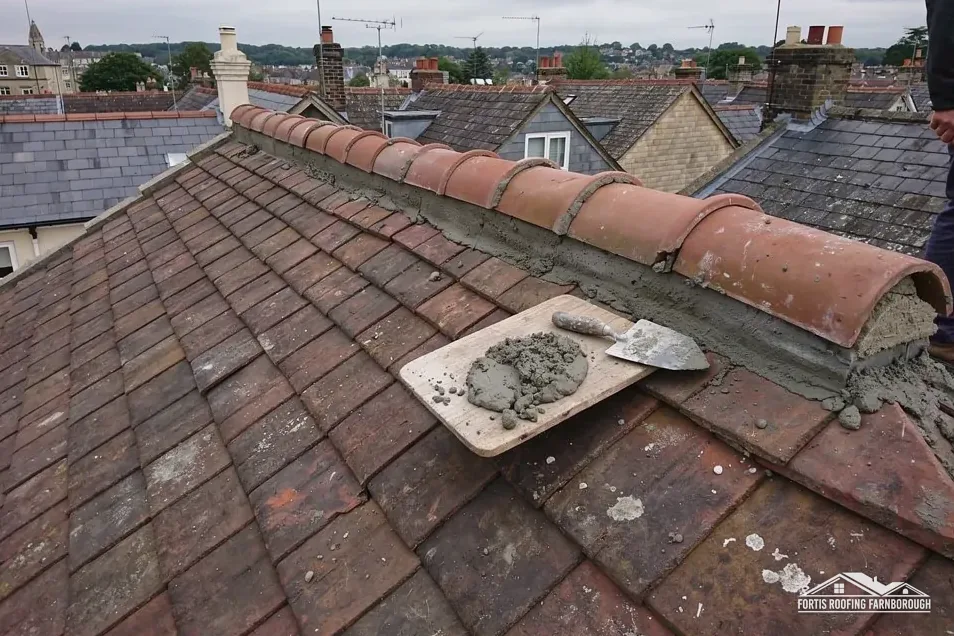
Half-hipped roofs carry an extra joint as well. The short hip meets the main slope along a line that needs its own tiles or a cap, and it is a place where mortar can fail. We check the loft side too, looking at battens, underlay and rafter ends, since tiles can look sound from outside while the timber beneath them has not fared as well.
The appraisal's point about concrete tiles matters if a re-cover is on your mind. Swapping materials alters the roof's look, so East Hampshire's planners should weigh in before work begins and never part-way through it.
Because the three coverings age differently, a Ropley survey also looks at how they meet: slate against tile at a change of house, lead at a chimney, and gutters that must keep water off an old wall face.
St Peter's church
St Peter's church was badly damaged by fire in 2014, rebuilt with money raised largely by local people and reopened in 2022. A 1908 account in the Victoria County History describes its tower as a good example of timber framing, weather-tiled in its upper part and finished with a low-pitched pointed roof. Weather-tiling is tile hung on the face of a wall, and where wall tiles meet roof tiles, rain can get in. The village's 1,723 residents live around that story.
Chapter 03 of 03
| Record | In Ropley | For roof work |
|---|---|---|
| Conservation area | Ropley, designated 1976 | Matching repairs; ask East Hampshire about changes |
| Grade II listed church in use | Church of St Peter (NHLE 1339053) | Church of England faculty system |
| Grade II listed | Archbishop's Cottage (NHLE 1179845) | Listed building consent for work affecting character |
| Grade II listed | Cromwell Cottage (NHLE 1093930), Dover Cottage (NHLE 1339055) | The same consent route |
| Article 4 direction | Mapped by East Hampshire, address by address | Ask East Hampshire if one covers your address |
Ropley's conservation area was designated in 1976. Inside one, repairs are held to a plain test: they should match the original materials and details. A roof re-covered in the same clay tile, or patched in the same slate, keeps the look the designation protects. Under section 55 of the 1990 Town and Country Planning Act, work with no material effect on outward appearance is not development, so matching repairs are usually simple and a change of material is not.
A change of material is therefore the trigger for asking East Hampshire District Council's planning team first. An Article 4 direction strips certain permitted development rights from a mapped area. East Hampshire can tell you whether one reaches your address. We put that question to the council ahead of any Ropley price and keep the reply in your file, so nothing about the designation rests on memory.
Archbishop's Cottage, Cromwell Cottage and Dover Cottage carry Grade II listings, among twenty-four listed buildings within 500 metres of Ropley's centre. Permitted development is not lost on a listed house, but anything that touches its character needs listed building consent as well. Our planning permission and roof work guide draws the line between repair and alteration.

The Church of St Peter is also Grade II, first listed on 31 July 1963. Its congregation is Anglican, which sends roof work through the faculty system and leaves the council's consent process out of it. That route belongs to the church itself, not to the houses around it.
Each East Hampshire conservation area has an appraisal and a boundary map, and the planning team can confirm by phone whether your roof lies inside Ropley's. We make that call as part of the survey and pass on what we learn, so the answer is in front of you before the price is.
For a Ropley cottage with an old tile or slate roof, the useful habit is a record. We photograph ridges, hips, verges and chimney junctions before a repair and again afterwards, so a like-for-like job can be shown to match. Our slate roofing and pitched roofing pages describe how those repairs are carried out.
Yes, one at a time, if a matching tile can be found. Handmade tiles vary in colour and thickness, so we compare candidates against the slope before choosing replacements. On a half-hipped roof we also check the hip junction, where the short slope meets the main slopes, because joints let rain in long before open tiles do.
East Hampshire's appraisal lists concrete roof tiles among the modern changes that harm the conservation area, so a change of covering material belongs in a conversation with its planning team before work starts. A like-for-like repair, with matching tile and ridge, is the safer route. We note what is on the roof and ask first, before pricing any change.
Not for the church itself. St Peter's has a Grade II listing, but as an Anglican church it is exempt from the council's route, and its roof is a faculty matter. Listed building consent from East Hampshire District Council applies to listed cottages nearby, and we raise that with the council before pricing.
Hampshire County Council expects 10 clear working days between applying and starting, and says plainly that it offers no extensions. Scaffolding companies apply to Hampshire County Council for their customers. So a roadside job cannot be given a firm start until the licence is secured, and the plan we agree at the survey tells you the likely date before booking.
Get your free roof quote
Tell us your Ropley address and the covering you can see, and we will survey the whole roof.
10-year workmanship guarantee, in writing.