Low slated cottages
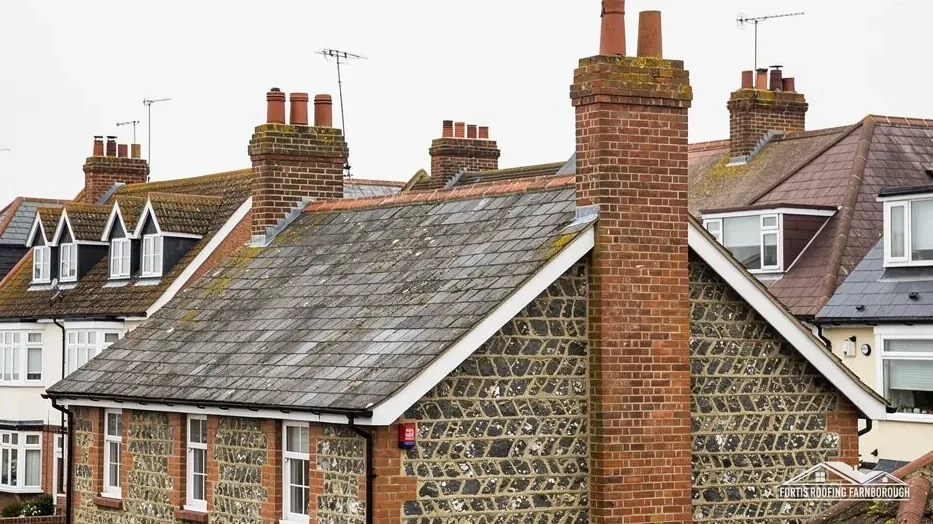
In 1908 the county history described the main village street as lined with low slated cottages.

Low slated cottages on high chalk ground above Alton
The 1908 county history found Medstead's main street lined with low slated cottages, small shops and the post office. We look closely at slate roofs like these.
In 1908 the county history described the main village street as lined with low slated cottages.
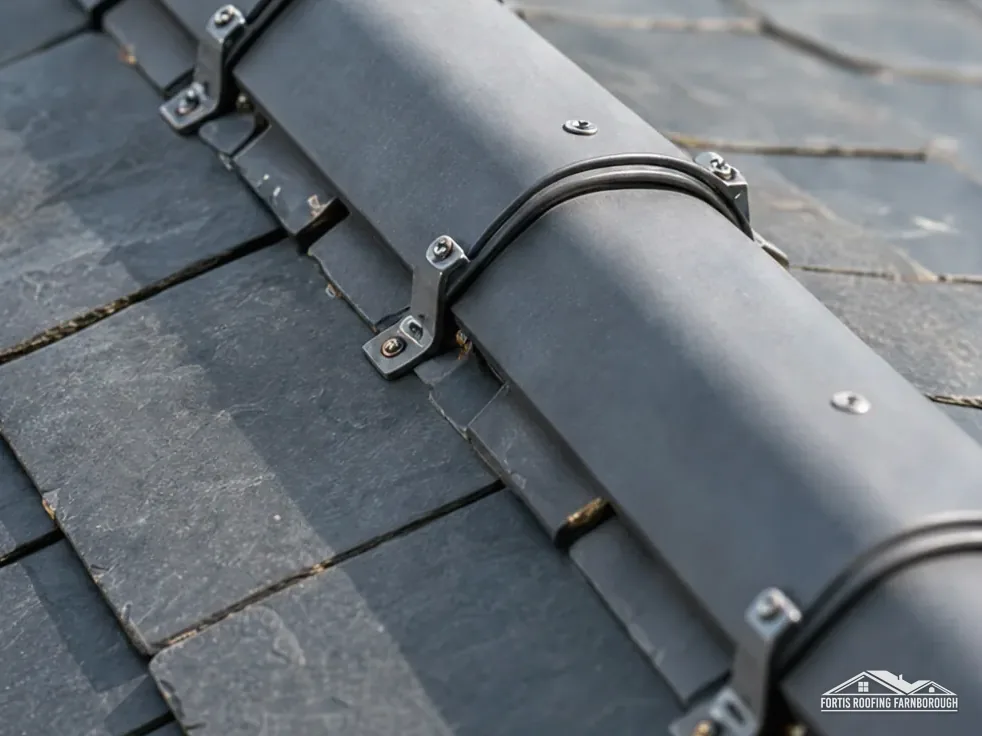
The same account records small shops and the post office along the street, beside the cottage rows.
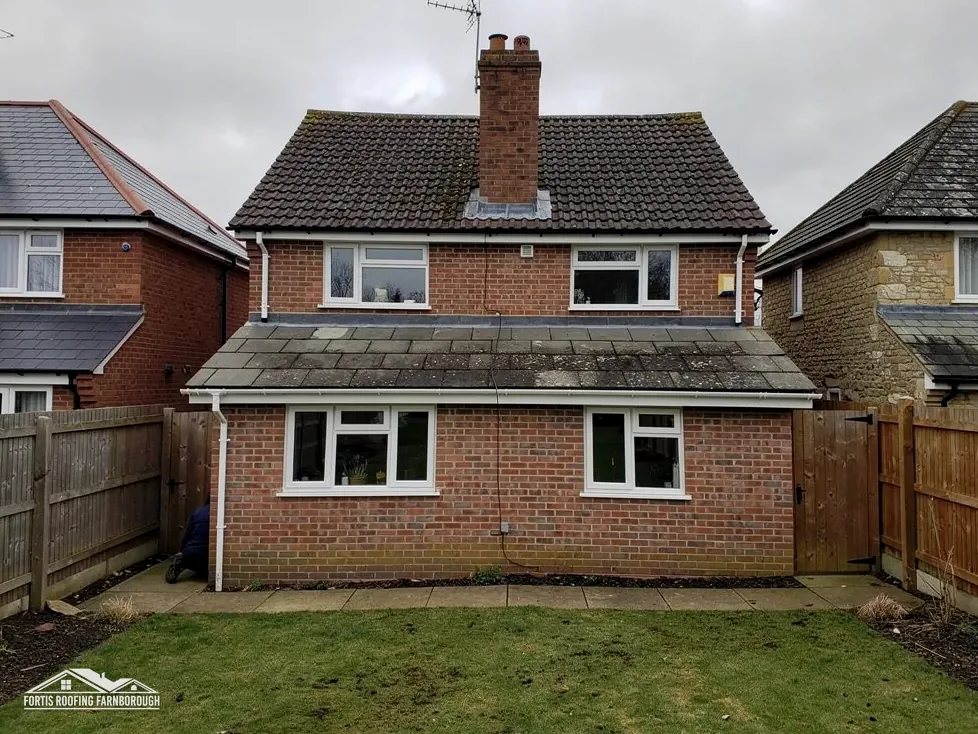
The highest point of the parish, 697 ft, is near the village on high chalk ground.
Map of Medstead with Four Marks, Ropley, Alton, New Alresford marked around it.
Map data © OpenStreetMap contributors. Loads only when you ask for it.
Four Marks lies to the south-east, Ropley to the south, Alton to the east, New Alresford to the south-west and Dummer further off to the north-west.
About 24.1 road miles south-west of Farnborough · East Hampshire District Council and Hampshire County Council.
Medstead, slate and low pitches
What pitch natural slate needs and why low cottage roofs call for care, how the 1908 county history describes Medstead's street and high ground, and what the church listing and nearby conservation area mean for a repair.

| No. | Chapter | The figure it turns on |
|---|---|---|
| 01 | East Hampshire, Hampshire and the slate pitch rule | Natural slate needs 20 degrees at least |
| 02 | Low cottages on high ground | Parish high point, 697 ft, near the village |
| 03 | St Andrew's Church and the nearest conservation area | Upper Wield is the nearest conservation area |
Chapter 01 of 03
| Matter | Position at Medstead |
|---|---|
| District council and planning authority | East Hampshire District Council |
| County council and highway authority | Hampshire County Council |
| Building control | East Hampshire District Council, its own team |
| Minimum pitch for natural slate | 20 degrees, BS 5534 as cited by Cupa |
| Hook fixings | Not used below 25 degrees, Cupa |
Medstead is a village on high ground north-west of Alton, where the 1908 county history found a soil of chalk and clay over chalk, in a two-tier part of Hampshire. Planning and building control are East Hampshire District Council's, and scaffold on the highway is licensed by Hampshire County Council, which names the scaffolding firm as the applicant. Farnborough is 24.1 road miles away, so a visit is arranged in advance, in good light, with the findings written up from photographs and measurements.
The 1908 county history describes low slated cottages along the street, and low roofs are where slate calls for the closest attention. Natural slate sheds water by overlapping, and the lower the slope, the slower water runs off it and the more readily wind or a blocked joint can push it under a slate. According to Cupa, BS 5534 indicates a minimum roof pitch of 20 degrees for natural slate, and Cupa's advice is to keep hook fixings off any slope under 25 degrees.
So on a low roof we measure the pitch with a level before anything is said about the slates. A pitch below the minimum is no mere slipped-slate fault but a design shortfall, and a repair that ignores it will fail again. Between 20 and 25 degrees the fixing method is the question: nails, not hooks. We give you the pitch in degrees, say which side of those thresholds it falls, and set out what each option would involve.
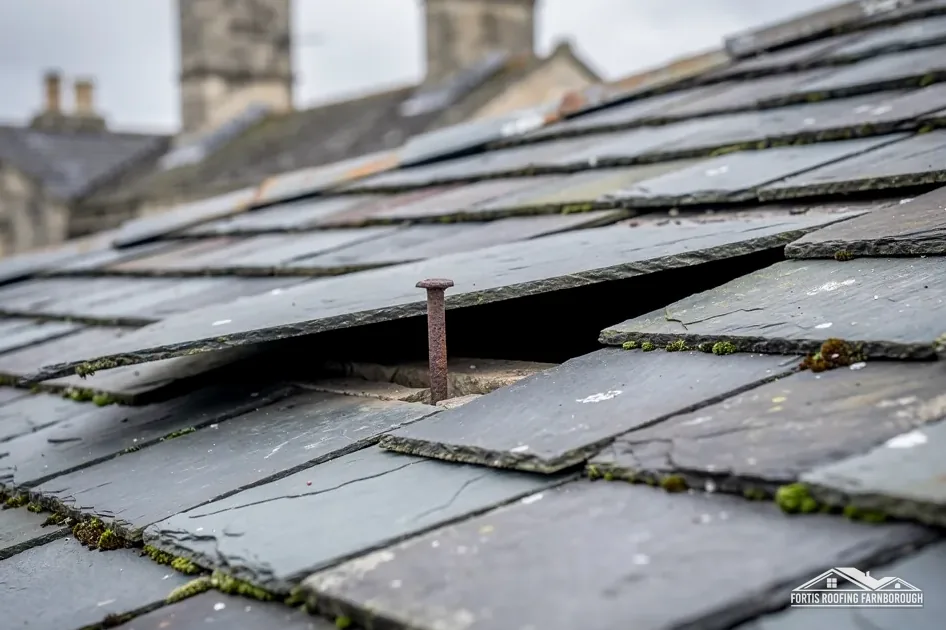
Most slate faults begin with fixings. A nail rusts through, a slate drops, and its neighbours loosen in turn. Where the slates themselves are sound, they can be lifted and re-hung on new battens and nails, which gives the roof further years at a fraction of the cost of new slate, and a torn underlay can be replaced cheaply while the slates are off. Where they have gone soft or laminated, replacement is the straight answer. At each survey we note the headlap, the batten spacing, the size of the slates and the nails, then test sample slates by tapping for a clear ring. Our slate roofing page explains how each option is judged. The result is a short list in the written findings: which slates stay, which go, and why.
Chapter 02 of 03
Medstead in figures from the record
The Victoria County History's 1908 account says Medstead stands on high ground: the highest point of the parish, 697 ft, is near the village. It describes the main village street as lined with low slated cottages, with small shops and the post office. The 2021 Census counted 3,013 usual residents in the parish, so Medstead is a good deal larger than the cottage street of 1908.
Low cottage eaves put much of the roof within reach, which helps a survey. The lower courses can be inspected from a ladder, the gutters and fascias checked at close range, and slates photographed one at a time. It also means a fault shows from the street: a dropped slate or a sagging ridge is visible to everyone who passes. The higher parts, the ridge, the chimney and the verge, still need a roof ladder or scaffold, and we plan for them from the start.
HomeBuilding's published lives for slate run from 50-80 years for reclaimed Welsh slate through 75-100 years for Spanish natural slate to 100+ years for Welsh. They are typical ranges and not promises, and a roof's own condition and fixings decide where it falls. The slate that has stayed on the longest is not always the best one to keep, so we judge sound slates by their ring and faces, not by their age.
Low roofs also have low gutters, and gutters under slate take a great deal of water, because a slate slope sheds its rain in a sheet. An undersized or sagging gutter overflows against the wall. Our gutters, soffits and fascias page covers the roofline, and each fall is checked with a level, not by eye.
Place and people
The county history names small shops and the post office along the street, so some buildings had commercial fronts as well as homes. Roofs on such buildings often join one another, with shared walls and valleys between them, and a leak at a valley can start next door. We record each junction from our side and note what is visible beyond it, so an owner can show a neighbour the same pictures. Our chimney repairs page explains how the stacks through these low roofs are assessed, each face checked in turn.
Chapter 03 of 03
| Designation | At Medstead | For roof work |
|---|---|---|
| Nearest conservation area | Upper Wield, within about 2.5 km | Confirm your address with East Hampshire |
| Grade II listed church in use | Church of St Andrew (NHLE 1338947) | Faculty system |
| Listed buildings | Two within 500 m of the centre | Check the National Heritage List |
In the national dataset, the conservation area closest to Medstead is Upper Wield, within about 2.5 km, and none reaches the 1.5 km area round the village centre. Even so, a street map cannot settle a particular house, so East Hampshire District Council's own plan is checked and the answer is given to you before pricing. Our planning permission for roof work guide covers the questions to put to the council.
The Church of St Andrew is listed at Grade II, a listing that Historic England dates to 31 July 1963. With an Anglican congregation, its roof is a matter for the faculty system and not for the district council. Two listed buildings fall inside 500 m of the centre on Historic England's record, and we look up your address before pricing; if your house is listed, altering its character calls for the council's consent.
Where a repair has to match, slate is a forgiving material, because old slate can be reclaimed. HomeBuilding's supply-only prices per square metre are £72 for Spanish natural slate, £90 for reclaimed Welsh slate and £185 for new Welsh slate. Those are national figures, so we tell you which slate suits your roof and why, and the one written total follows from the survey.

Before any is ordered, the existing slate is measured for its size, colour and thickness, and the sample goes in the file. A later owner can then set the finished roof beside what was there.
For scale, MyJobQuote's guide gives the average roof repair at around £650 in 2026, an emergency call-out at typically £150 to £300, and extensive storm repairs at £1,200 or more. Those are national figures and no quotation. What a Medstead repair costs depends on the number of slates, the height of the eaves and the condition of the battens, and the one total we give comes after the survey.
A short note on weather: for a few hours after rain, slate shows where water sits, and a good survey makes use of that. Damp lines mark slates that lie flat or lap too little, and a line that runs the length of a course points to a failed batten. We look for those lines and record them, because they show faults that a dry day hides.
Often, though not always. Most slate faults come from failed fixings, not failed slates, so sound slates can be lifted and re-hung on new battens and nails. We count the dropped slates, check the pitch and the ring of the slates, then say whether re-hanging or replacement is the better buy, and why. Where slates have laminated, replacement is the straight answer.
Cupa, citing BS 5534, names 20 degrees as the floor for natural slate, and it advises against hook fixings on any slope under 25 degrees. A roof below the minimum has a design shortfall and not only a slipped-slate fault, so we measure the pitch before we suggest any repair at all.
Not in the ordinary sense. St Andrew's is listed Grade II, but with an Anglican congregation its roof is a matter for the faculty system and not for East Hampshire District Council. A listed house nearby is a separate case: altering its character calls for the council's consent, which we raise with you before work is booked, and again if the plan changes.
East Hampshire District Council runs its own building control team, and a registered building control approver is the private option. A handful of replaced slates stays inside the Planning Portal's limits and needs neither route. The survey settles whether your job goes further, along with the timetable and cost of each route, and we put it in writing for you.
Get your free roof quote
Give us your Medstead road and the fault; a survey follows, then one price in writing, in plain words.
10-year workmanship guarantee, in writing.