Huge hipped peg-tile roof
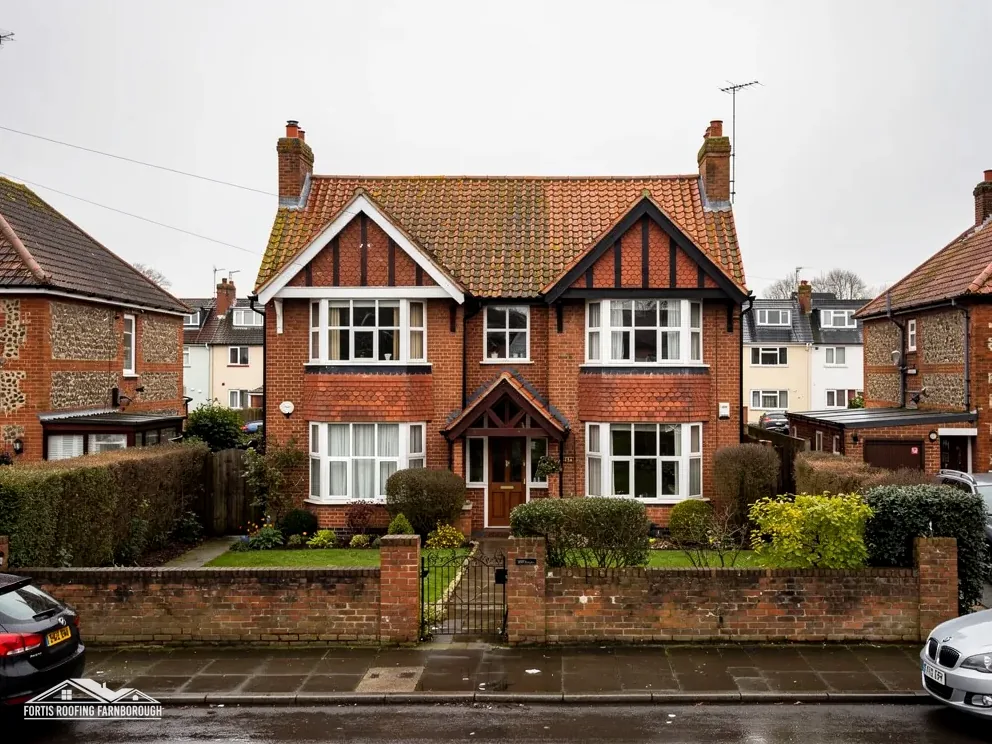
Andrews Endowed School's red-brick house has a huge hipped roof of clay peg tiles, built early in the 18th century.
Roofs of peg tile, slate and thatch on the old London Road
East Hampshire's guidance describes steep clay-tile roofs with full hips, slate roofs with decorative bargeboards and thatch in Holybourne. We survey each roof slope.
Andrews Endowed School's red-brick house has a huge hipped roof of clay peg tiles, built early in the 18th century.
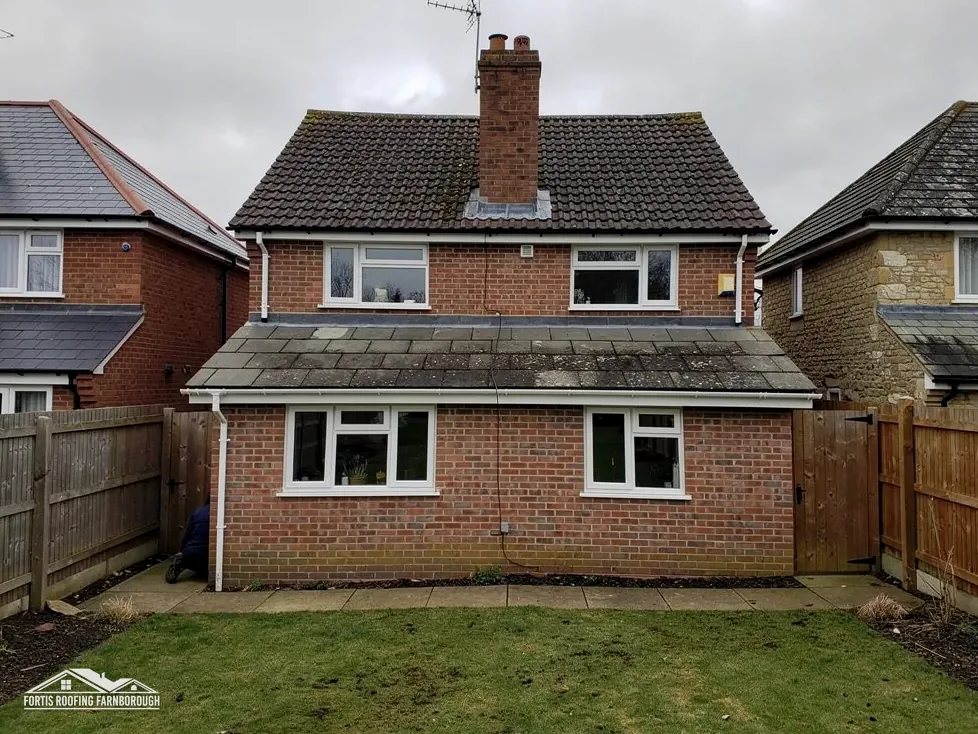
Nos 147 to 153 London Road are 16th-century timber-framed buildings with hipped and gabled peg tile roofs.
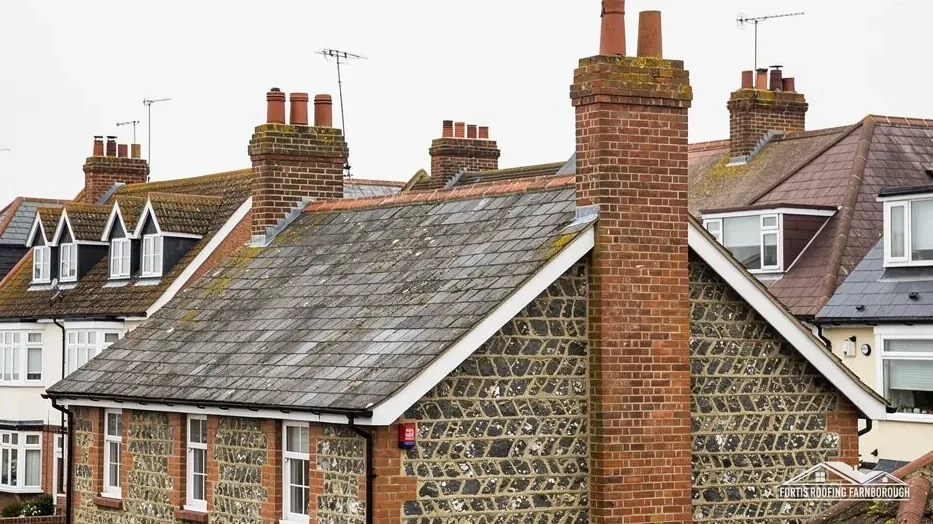
East Hampshire also records slate roofs with wide verges and decorative bargeboards in the village.
Map of Holybourne with Alton, Binsted, Bentley, Selborne marked around it.
Map data © OpenStreetMap contributors. Loads only when you ask for it.
Alton is the neighbouring town, to the south-west, with Binsted to the east, Bentley to the north-east and Selborne to the south; Farnborough lies beyond Bentley.
About 17.4 road miles south-west of Farnborough · East Hampshire District Council and Hampshire County Council.
Holybourne, East Hampshire record
How East Hampshire and Hampshire County Council split the paperwork for a Holybourne roof, what the conservation-area guidance says about peg tile, slate and thatch, and how two Grade II* buildings and a high count of listings shape repairs.

| No. | Chapter | The figure it turns on |
|---|---|---|
| 01 | East Hampshire, Hampshire and a one-fee licence | 2 weeks covered by the first fee |
| 02 | Peg tile, slate and thatch in one village | 1,303 residents in Holybourne |
| 03 | Two Grade II* buildings and 33 listed neighbours | 33 listed buildings within 500 m |
Chapter 01 of 03
| Question | Office for Holybourne addresses |
|---|---|
| Planning | East Hampshire District Council |
| Building control | East Hampshire District Council's own team |
| Highway authority | Hampshire County Council |
| Scaffold licence on the highway | Hampshire County Council; the scaffold firm applies |
| Council reorganisation | Hampshire decision to replace its councils withdrawn, September 2026 |
Holybourne is a village on the north-east edge of Alton, 17.4 road miles south-west of Farnborough on the measurement taken from the A325 Farnborough Road. Hampshire still runs on two tiers of local government. Planning decisions rest with East Hampshire District Council, which has building control of its own, and Hampshire County Council owns the roads. The government has withdrawn its decision to replace Hampshire's councils, so nothing changes under the present arrangements. A job booked this winter goes through the same offices that answer today.
Under Hampshire County Council rules the scaffold firm files the licence for its customer, so no form lands on your doormat. Hampshire County Council also requires ten clear working days between filing and the intended start, charges £211.90 for the first 2 weeks and £72 for every further 2-week period, and grants no extensions, so a job that overruns needs a fresh filing. We add a day or two of slack when we plan the licence period, so that bad weather does not force a second application. That turns the length of the licence into a planning decision, and we settle the period with the scaffolder after the survey.
Private roads fall outside Hampshire's licence. London Road is a public highway, so a scaffold on the front is likely to need one, while a scaffold in a rear garden does not. A short job of a few days can fit inside the first fortnight, whereas a re-cover with chimney work may need a second period, and the plan we give you says which.
East Hampshire gives no percentage for roof work, so the Planning Portal's two limits are the guide: 25 per cent of the building envelope and 50 per cent of the roof. A repair inside both is not an application. Re-covering the whole of the roof exceeds them, as does a covering adding 15 per cent or more in weight, which matters on an old frame already carrying clay peg tiles. Our pitched roofing page describes how peg tile roofs are refixed, and the survey weighs what is there before a price is written.
Chapter 02 of 03
Four facts about Holybourne
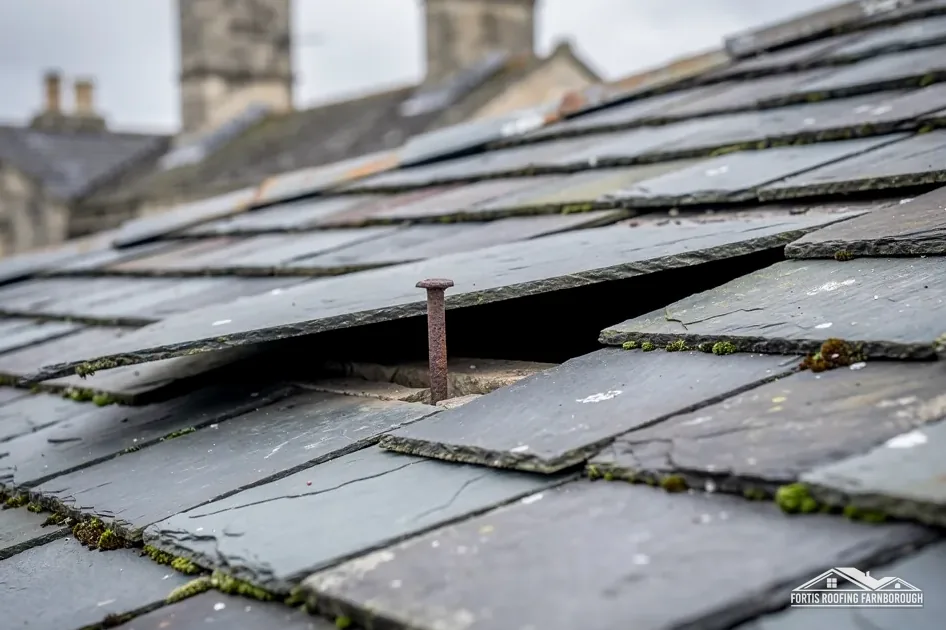
East Hampshire's Holybourne conservation-area guidance gives a rare list of roof types for one village. It records steep clay-tile roofs with full hips and plain gables, slate roofs with wide verges and decorative bargeboards, and long straw and combed wheat reed thatch. A hip is the sloping edge where two roof slopes meet at an outside corner, and a gable is the triangular end wall under a roof. A bargeboard is the board that runs along the edge of a gable, often shaped for decoration.
The guidance describes Andrews Endowed School, on London Road, as a symmetrical house of the first quarter of the 18th century in fine red brick, with a huge hipped roof of clay peg tiles. It describes Nos 147 to 153 as a terrace of 16th-century timber-framed buildings with hipped and gabled clay peg tile roofs. A peg tile is a small clay plain tile, and on a hipped roof each hip carries its own run of special tiles that has to be laid and bedded with care.
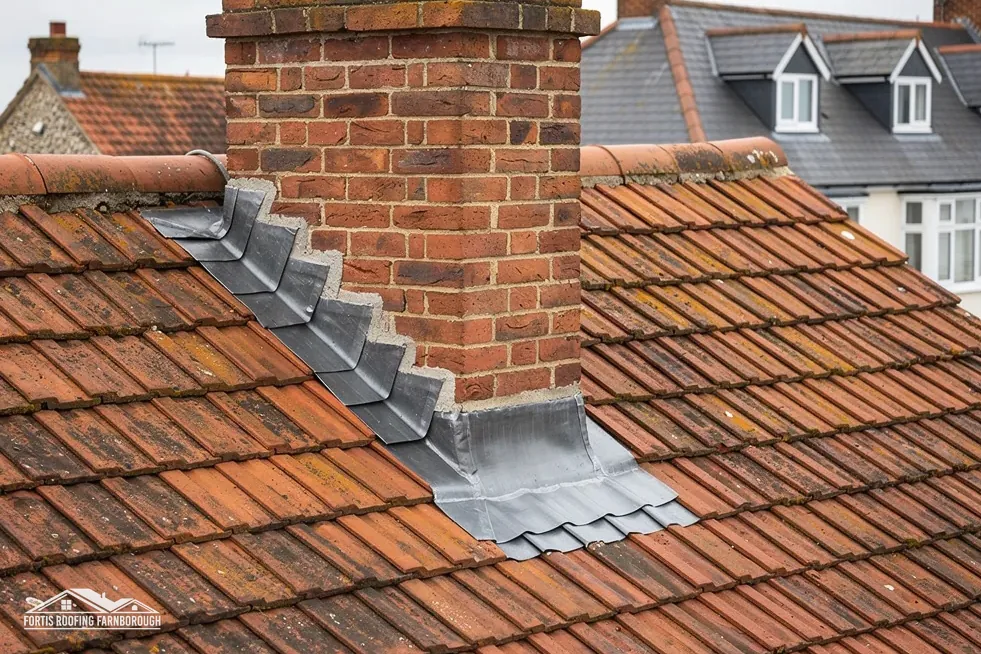
Hips are places where an old tiled roof can show its age, because the ridge and hip tiles are mortared and mortar weathers. We photograph each hip and ridge along its whole length, look for gaps and slipped tiles, and say whether re-bedding or a mechanical dry-fix (the clip system covered by BS 8612) suits the repair.
A slate roof with wide verges and decorative bargeboards carries its decoration at the gable. The board is fixed to the rafter ends, and when it rots water reaches the roof edge. We check the board, its fixings and the verge beneath, and match any renewal to the pattern. Thatch is a specialist covering with its own trades, and the survey on a thatched property records the lead, flashings, gutters and chimneys that sit beside it, as well as any tiled or slated outbuildings.

Holy Rood Church has a Norman west tower with a 19th-century oak-shingled broach spire. That is a church and not a house, but it shows the range in one parish. For a worn bargeboard or gutter line on a house, our gutters, soffits and fascias page covers the boards, brackets and joints. A rotten board is a small job when it is caught early, but a gable edge that has been wet for years can take the rafter ends with it, and the survey says which case yours is.
Chapter 03 of 03
| Designation | In Holybourne | For roof work |
|---|---|---|
| Conservation area | Holybourne; Anstey (Alton) | Changes to the look checked with East Hampshire |
| Grade II* listed church in use | Holy Rood Church (NHLE 1179586) | Church of England faculty, not listed building consent |
| Grade II* listed school | Andrews Endowed C of E Primary School (NHLE 1338937) | Listed building consent for works affecting its character |
| Grade II listed | 107, 109 and 111, London Road (NHLE 1094165) | Listed building consent for works affecting its character |
| Article 4 direction | Check with East Hampshire | Ask East Hampshire whether one applies to your address |
Historic England's list counts 33 listed buildings within about 500 m of the village point. Holy Rood Church and Andrews Endowed C of E Primary School are both listed Grade II*, each first listed on 13 March 1951. Another group is on London Road: 107, 109 and 111, listed Grade II. A listed building owner needs listed building consent before changing the building's character, and the consent has to exist before work starts.
Holy Rood is still a place of Church of England worship, so a faculty covers its roof work, and East Hampshire does not. The school building is a different case, and its owner would apply for consent. We ask who owns a building and how it is used before saying which approval applies, because the answer decides where an application goes.
East Hampshire's conservation-area list names Holybourne, and its guidance describes the roofs that give the area its character, which is why a changed covering, ridge or chimney is a change of look. By section 55 of the Town and Country Planning Act 1990, restoring the original is not development. We read the guidance for each job in the conservation area and ask East Hampshire's planners where a change of look is proposed.

The conservation area was designated in 1977, and before a job that alters how the roof looks is priced, East Hampshire is asked whether an Article 4 direction applies to the address. The reply is entered in the survey notes beside the relevant photographs, with its date. The council's building control team, or a registered building control approver, is told in advance where a re-cover goes beyond the Planning Portal's limits.
Wherever the house stands, the file is the same: photographs of the covering, hips, ridge, verges and chimneys before work, a repair matched to the original, and a record that is yours to keep. Because so many neighbours are listed, we also look at the scaffold route before a plan is drawn, so that poles never rest on a listed wall or a protected boundary. Where there is any doubt about a neighbouring building, we tell you and photograph the line.
Yes, if the new board follows the old pattern. East Hampshire records decorative bargeboards on slate roofs with wide verges in the village, and in the conservation area a change of look is a planning question. We photograph the existing board, its profile and fixings, and match the renewal to them.
Hampshire County Council has the scaffold firm file for the customer, and ten clear working days must pass first. Hampshire County Council charges £211.90 for the first 2 weeks and £72 for each additional 2 weeks, and gives no extensions. Private roads need no licence, so a scaffold in a rear garden is a different case again.
East Hampshire's list names Holybourne, together with Anstey in Alton. Its guidance describes the village's clay-tile, slate and thatched roofs. A repair matching the original is outside planning control under section 55 of the Town and Country Planning Act 1990; a different covering or ridge changes the look, and East Hampshire hears of it first.
No. Holy Rood is listed Grade II* but is a Church of England building in use, so roof work goes through the faculty system. Andrews Endowed C of E Primary School, also Grade II*, and the Grade II buildings at 107, 109 and 111 London Road follow listed building consent through East Hampshire instead.
Get your free roof quote
Tell us your Holybourne address and any hips or gables that worry you, and we will arrange a visit.
10-year workmanship guarantee, in writing.