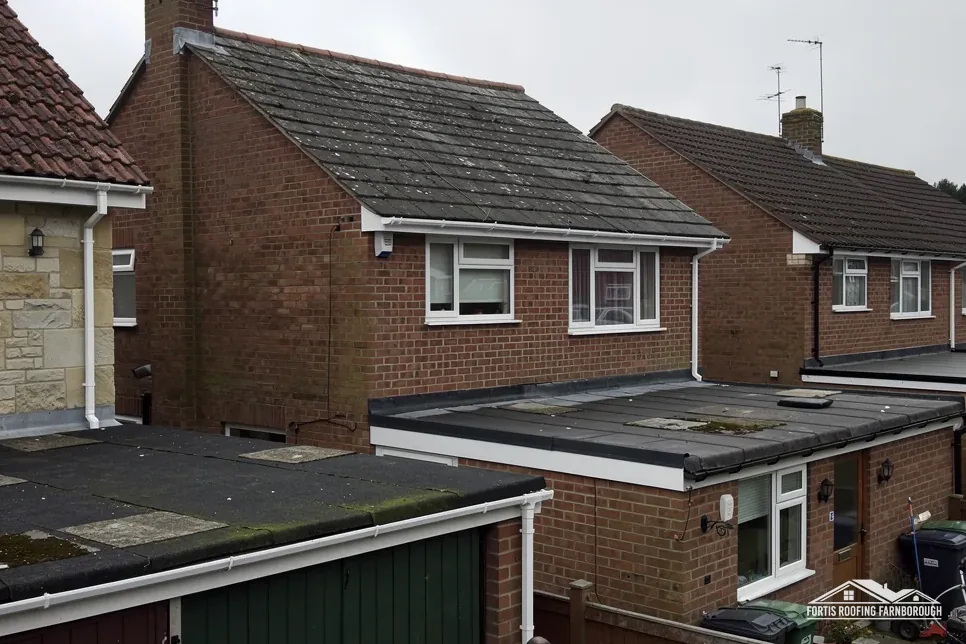
Late Victorian expansion streets
The council's Routh Lane appraisal says large numbers of houses went up in Reading's late 19th-century expansion.

Railway-boom terraces, Georgian slate on Castle Hill and Grade I churches
Reading grew quickly once the Great Western Railway arrived in 1840, building large numbers of houses in its late Victorian expansion. Every roof gets its own survey.
The council's Routh Lane appraisal says large numbers of houses went up in Reading's late 19th-century expansion.
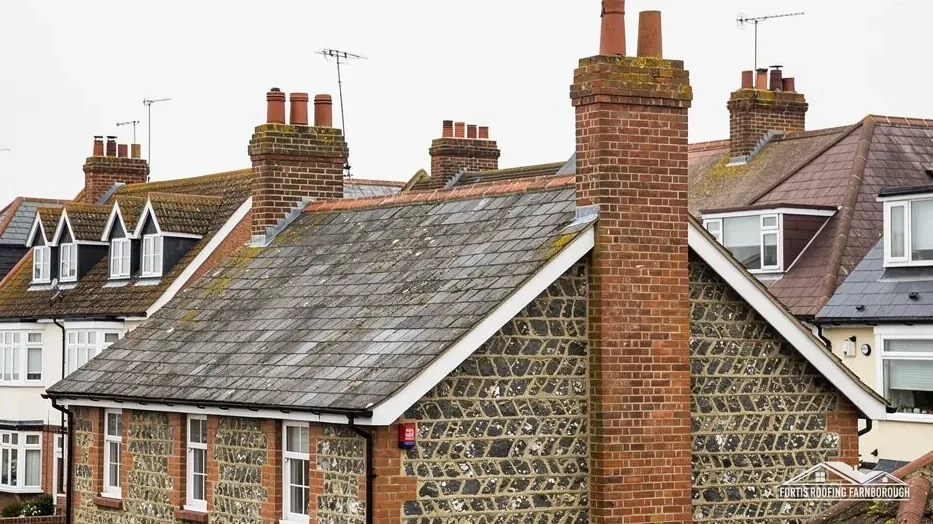
Reading's Russell Street and Castle Hill appraisal describes slate roofs on the Georgian houses of Castle Hill.

The same appraisal describes slate roofs along Oxford Road, set among brick, stucco and stone dressings.
Map of Reading with Caversham, Earley, Lower Earley, Woodley marked around it.
Map data © OpenStreetMap contributors. Loads only when you ask for it.
Caversham lies just to the north, Earley and Lower Earley to the south-east, Woodley to the east, Sonning to the north-east, and Shinfield south of the centre, with Tilehurst on the western edge.
About 20.6 road miles north-west of Farnborough · Reading Borough Council (unitary).
Reading, railway, slate and church towers
How one unitary council covers planning, building control and the roads in Reading, what the council's own appraisals say about its railway-era houses and Georgian slate, and how conservation areas and listings shape a repair.
| No. | Chapter | The figure it turns on |
|---|---|---|
| 01 | One unitary council behind every Reading roof job | Reading Borough Council, unitary |
| 02 | The 1840 railway and a town built for workers | Railway reached Reading in 1840 |
| 03 | Five conservation areas and three Grade I churches | Five areas, three Grade I churches |
Chapter 01 of 03
| Role | Body for Reading addresses |
|---|---|
| Council and planning authority | Reading Borough Council (unitary) |
| Building control | Reading Borough Council's own building control service |
| County council | None: Reading is a unitary authority |
| Highway and scaffold licence | Reading Borough Council, as highway authority |
| Article 4 directions | Council list and interactive map |
Local government in Reading has a single tier. The borough council handles planning, building control and the roads outside the house, with no county council above it. For a roof job that is convenient: the questions we put before a planning team, a building control surveyor or a highways officer all go to the same organisation, and the survey photographs travel with them. Measured from the A325, Reading is 20.6 road miles away, lying north-west of Farnborough, so a survey here is planned as a proper day on the road, with the access questions settled in advance and the paperwork ready.
We start from the Planning Portal. Its test leaves a re-roof outside the application route while the work involves under 25 per cent of the building envelope and under 50 per cent of the roof, while a new covering that is 15 per cent or more heavier than the existing one needs Building Regulations approval together with structural advice, however small the area. A few slipped tiles on a terrace sit comfortably inside the first test. A full strip and re-cover on a large house sits outside it. Flats are the exception to keep in mind: a building containing flats is outside the permitted development rights that houses enjoy, so planning questions on a block are asked early.
On a survey we measure the slope areas and total them against the roof, so the figure the building control team asks for is already on file. Where a job is close, we ask the council's team directly, and we do it before dates are fixed, not afterwards.
Putting a scaffold over the pavement or into the road calls for a licence from the highway authority, and in Reading that authority is the borough council itself. The notice period and fee for your road are for its highways team to confirm, and we ask them while planning the job, since the answer sets the earliest start date. Scaffold within your own boundary is another matter and involves no highway licence. Terraced houses whose doors open straight onto the footway are the likelier case, so the survey notes how far each house sits from the pavement, and the report carries a line saying which situation applies.
Chapter 02 of 03
Reading in published figures
Reading Borough Council's Routh Lane appraisal sets out how the town grew. The Great Western Railway reached Reading in 1840, and rapid growth followed in industries such as Huntley and Palmers and Suttons Seeds. Large numbers of houses were built in the town's late 19th-century expansion. The 2021 Census counted 203,808 usual residents in the Reading built-up area.
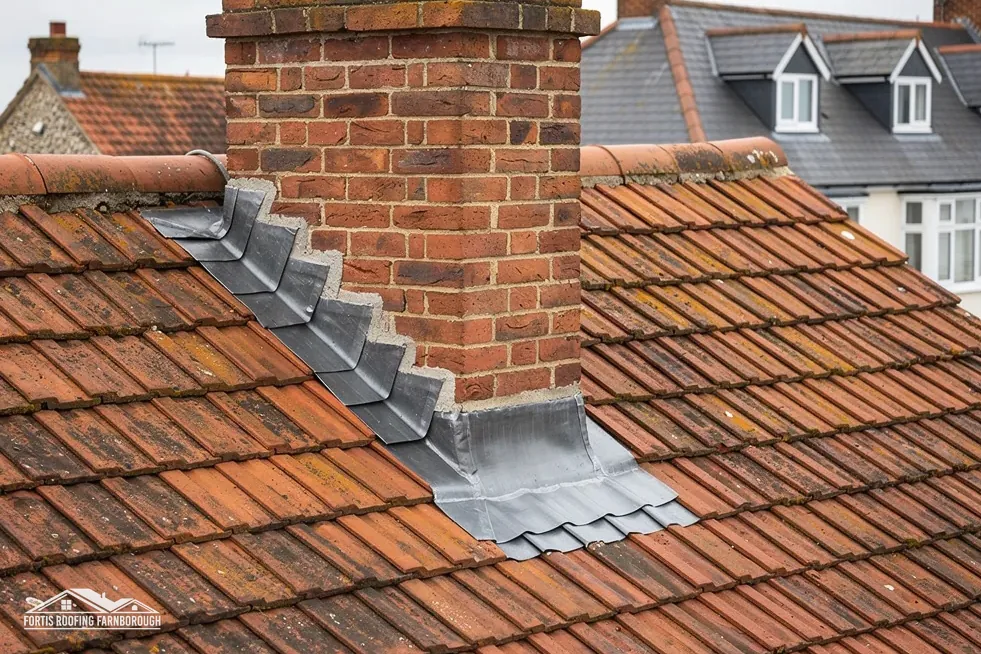
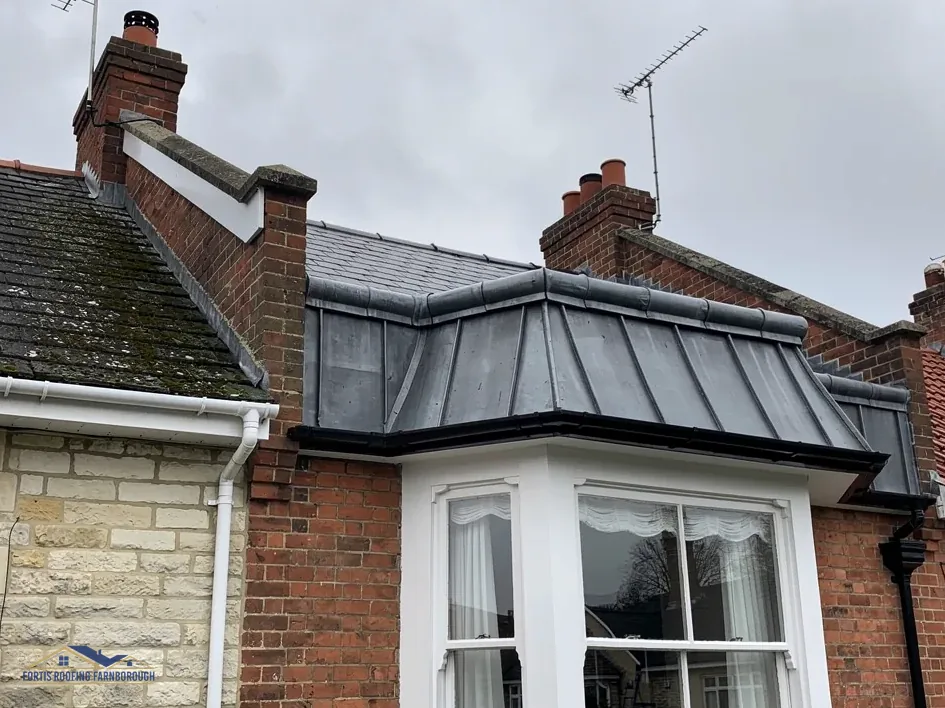
Rows of houses built in the same decades tend to share details. Chimney stacks serve two houses, party walls separate the roof slopes, and valley gutters run between the main roof and the rear additions that later owners built. Those are the places we look first on a Reading survey. Where a rear extension joins the main roof there is a valley or an abutment flashing, and water finds that joint before it finds any fault in the covering itself. Lead flashings can last for over 80 years by MyJobQuote's lower bound, so one that has split is worth a closer look at the fixings and the movement behind it, not just a patch. We photograph each junction, and where the lead has split or lifted, say so plainly.
The same council's Russell Street and Castle Hill appraisal describes the area's common thread as red brick and tile, set beside stucco, Welsh slate, red tile and stone dressings. It says the Georgian houses on Castle Hill have slate roofs and that the roofs along Oxford Road are slate too. Those are descriptions of named streets, not of the whole town. Beyond them, the roof on any one house is whatever its owners over the years have put there, which is why the survey records it slope by slope.
Flat-roofed extensions and garages added behind these houses age differently from the pitched roof beside them. Our flat roofing page explains how the falls, the upstands and the outlets are inspected, and what a membrane repair can and cannot fix.
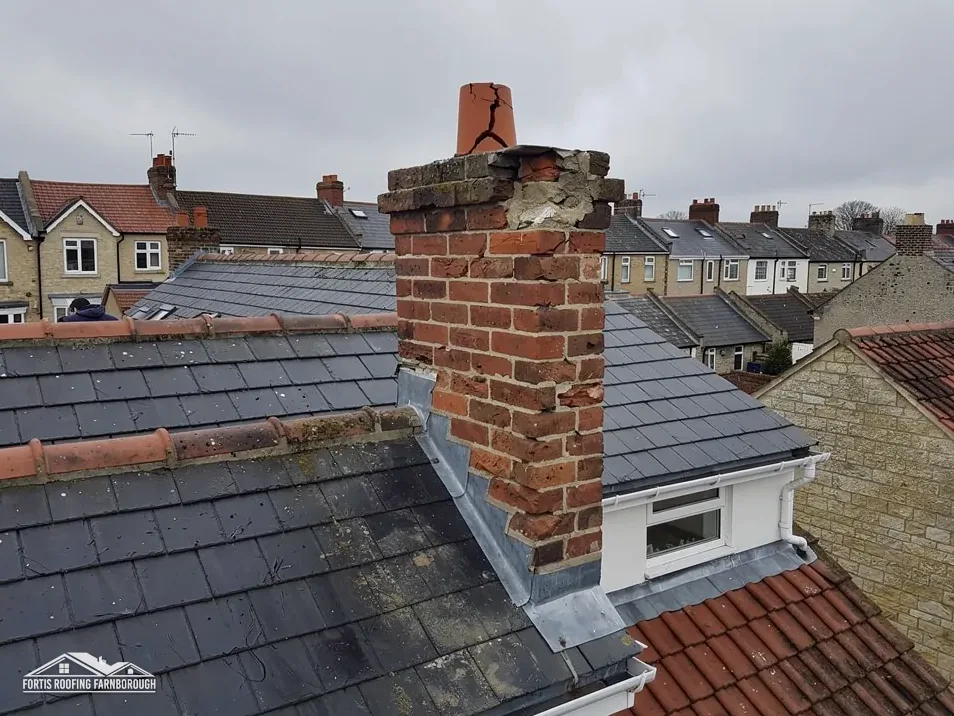
A stack serving two houses means a shared decision. We photograph it from each side, and report on the neighbour's half only where your own roof or our ladder gives a clear view of it. If the next house needs work too, the two households can work from one set of pictures. Our chimney repairs page covers flaunching, pots and flashings.
Chapter 03 of 03
| Designation | In Reading | For roof work |
|---|---|---|
| Conservation area | Russell Street and Castle Hill | Changes to the look checked with the council |
| Conservation area | Market Place and London Street | Changes to the look checked with the council |
| Conservation area | St Mary's Butts and Castle Street | Changes to the look checked with the council |
| Grade I listed church | St Laurence (list entry 1113532) | Route depends on denomination and use |
| Grade I listed church | St Mary (list entry 1113573) and Greyfriars (list entry 1321952) | Route depends on denomination and use |
The national planning dataset lists five conservation areas in central Reading: Eldon Square, Kendrick Road, Market Place and London Street, Russell Street and Castle Hill, and St Mary's Butts and Castle Street. What matters for a roof is the same in all of them. The Town and Country Planning Act 1990 (section 55(2)(a)) excludes works that do not materially affect external appearance from what counts as development, whereas a different covering, a moved chimney or a new roof window can change that appearance. Those go to the planning team before we price them.
Historic England lists the churches of St Laurence, St Mary and Greyfriars at Grade I, and there are listed tracery fragments in St Laurence's churchyard at Grade II. The denomination and present use of each are the first questions we would ask before any survey. A parish church in regular Church of England use takes the faculty route, other traditions run their own systems, and a closed church needs listed building consent. Roof work on a Grade I church is a specialist job, and the first step is knowing which route applies.
Reading Borough Council keeps an Article 4 directions list and an interactive map. For a house in any conservation area we check whether an Article 4 direction applies with Reading Borough Council before pricing, and we ask the council to confirm in writing what that means for the roof, the chimneys and the front of the house wherever the answer is not plain from the map. The map is searched by address, so the check takes minutes, and the result is filed with your survey photographs.
On a listed house the position is firmer. Listing does not remove a house's permitted development rights, but listed building consent is still required for works that affect its character. Our planning permission guide explains how the routes fit together.
In a conservation area, a repair is also a record. We keep the survey photographs, the measurements and our notes of the covering on each slope, so if the council later asks what was there before, the answer is on file and you hold a copy.
The flashing at the junction of an extension and the main roof is a joint, and joints fail before plain covering does. Houses from Reading's late 19th-century expansion may have gained rear additions since. We photograph each junction, check the lead and the fixings, and say whether the flashing alone needs renewing.
Matching is the sensible approach. The council's appraisal describes slate roofs on Castle Hill's Georgian houses, so keeping the same slate, pitch and ridge details leaves the roof as it was. A change of covering is a different matter, and we put it to the planning team before any price is written.
Reading Borough Council, as the highway authority for a unitary area. The notice period and fee for a particular road are for its highways team to confirm. We ask them while planning the job, and the start date is set once that answer is known, so the programme reflects the real wait.
Not always. St Laurence, St Mary and Greyfriars are Grade I listed, but a parish church in regular Church of England use is handled by the faculty system rather than the council. Other traditions and closed churches follow different routes. We would establish which applies before any survey, and keep every photograph for the approving body.
Get your free roof quote
Send your Reading postcode with a line about the fault, and we will propose a survey slot.
10-year workmanship guarantee, in writing.