

A half-timbered barn of 1775
The county history records a half-timber and brick barn at Sonning Farm with 1775 cut on a roof principal.

Timber-framed barns, Georgian red brick and a Thames-side bridge village
Sonning's older buildings include a 16th-century inn, a Georgian red brick house and a barn dated 1775. We survey each roof on what it actually carries.
The county history records a half-timber and brick barn at Sonning Farm with 1775 cut on a roof principal.
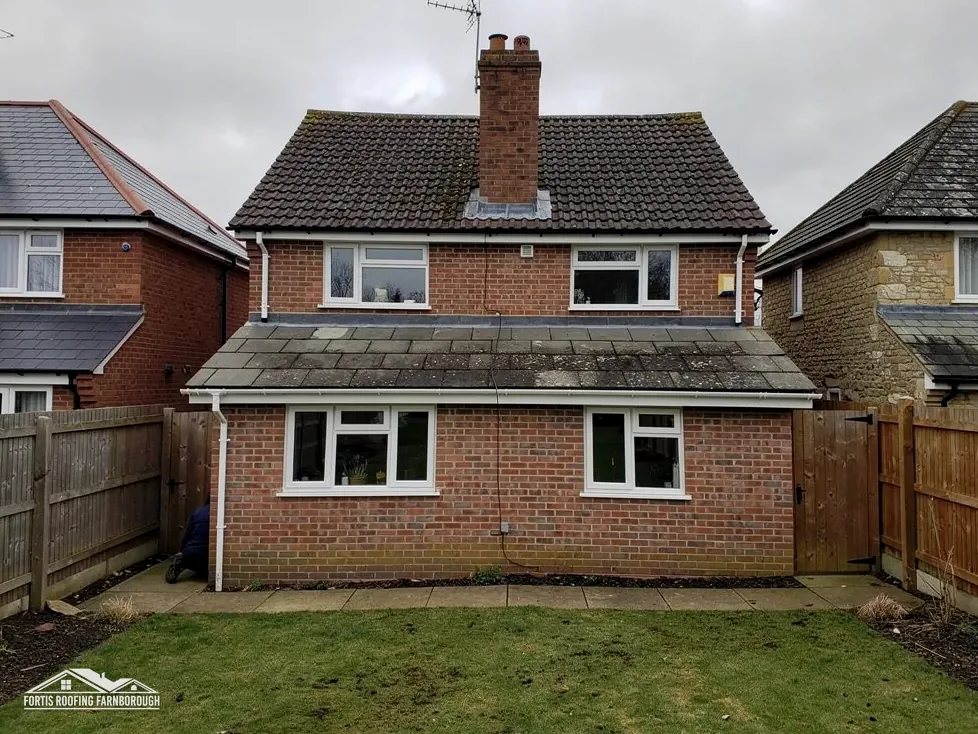
In 1923 the history described the Red House as a handsome Georgian red brick house.

The Bull Inn was recorded in 1923 as a fine 16th-century building, and the Bull Hotel is listed Grade II*.
Map of Sonning with Woodley, Shiplake, Twyford, Binfield Heath marked around it.
Map data © OpenStreetMap contributors. Loads only when you ask for it.
Hurst lies to the south-east, Woodley and Earley to the south, Twyford and Ruscombe to the east, and Shiplake and Binfield Heath to the north.
About 20.7 road miles north-west of Farnborough · Wokingham Borough Council (unitary).
Sonning, bridge, barn and bishop
Which council arrangements and which scaffold rules apply in Sonning, what the 1923 county history records of its bridge, inn and barn, and what its conservation area and Grade I Deanery mean when a roof needs work.
| No. | Chapter | The figure it turns on |
|---|---|---|
| 01 | Wokingham's rules for scaffold and building control | Wokingham: 10 working days' notice |
| 02 | A bridge, an inn and a barn dated 1775 | 1775 cut on a roof principal |
| 03 | Sonning's conservation area, the Deanery and St Andrew's | The Deanery, Grade I |
Chapter 01 of 03
| Role | Body or rule for Sonning addresses |
|---|---|
| Council, planning authority and highway authority | Wokingham Borough Council (unitary) |
| Building control | Building Control Solutions, a West Berkshire and Wokingham partnership |
| Who lodges the scaffold application | The scaffold firm (Wokingham Borough Council's rule) |
| Notice before a licence starts | At least 10 working days |
| Licence charging period | 4 weeks, then each further 4 weeks |
Sonning sits inside Wokingham borough, a unitary area, so a single council handles its planning and its highways. Building control is delivered through Building Control Solutions, or BCS, which Wokingham runs jointly with West Berkshire. Those arrangements sit behind every roof job in the village, from a handful of slipped tiles to a complete re-cover. Sonning is 20.7 road miles from our Farnborough base, on a north-westerly bearing, and the survey day is planned round that drive and round where the scaffold would stand.
According to Wokingham Borough Council's own licensing page, the application is lodged by the scaffolder on the customer's behalf, never by the householder directly. The first 4 weeks cost £263, and each 4-week period after that costs £163. The council wants an application at least 10 working days ahead of the planned start, and it expects the footway to stay at least 1.2 metres wide, so we measure the pavement at the survey, not on the day. No licence is needed on a private road.
Those terms shape the programme. A re-cover that overruns its first 4 weeks incurs a further licence period, so the likely duration is agreed with the scaffold firm before a start date is offered to you, along with an honest note of how weather could stretch it.
Our first reference is the Planning Portal. Work that stays under 25 per cent of the building envelope and under 50 per cent of the roof will not normally need an application. A covering that adds 15 per cent or more to what the roof carries is the other trigger, and that sends the job to building control and a structural engineer's eye however small the area. Wokingham's own pages set no percentage, so those national figures stay the yardstick. For a borderline job we put the question to the BCS team before dates are agreed, and you may use a registered building control approver instead if you prefer. The survey report gives the measured area of every slope, so either body starts from the same numbers.
If a job turns out to need approval, the extra time is built into the plan before the scaffold is booked, not discovered when the neighbours are already looking at poles.
Chapter 02 of 03
Sonning in published figures
The 1923 Berkshire volume of the Victoria County History describes Sonning's older buildings with unusual precision. It records the brick bridge over the Thames, probably of the late 18th century, with eleven arches that grow in size towards the widest central one. It calls the Bull Inn a fine 16th-century building and the Red House a handsome Georgian red brick house. At Sonning Farm it notes a half-timber and brick barn with 1775 cut on a roof principal. The 2021 Census counted 1,612 usual residents in the civil parish.
A roof principal is one of the main trusses that carry a roof's weight, and a date cut into one is a rare piece of evidence. It tells us the timbers have stood for two and a half centuries, and it reminds us that on a building like that the covering is only the visible layer. The frame beneath has to be sound, dry and free to ventilate. When we survey an old timber-framed or brick-and-timber outbuilding in Sonning, we inspect the roof space from within as well as the covering outside, photograph any staining, movement or daylight at the joints, and say what is a covering problem and what is a timber problem.
The same history says the palace of the Bishops of Salisbury stood just south of St Andrew's Church and was demolished in the 16th century, and that excavations reported in 1923 found its foundations and many medieval tiles. The history does not say what kind of tiles they were, and the find tells us nothing about current roofs. Every house is judged on what its own slopes show.
Old outbuildings are often re-roofed in a different material when they are converted or repaired. Where a new covering would change the weight a roof carries, we would involve an engineer or surveyor early, as the Planning Portal advises, and on a historic frame we would raise that question before any covering is chosen.

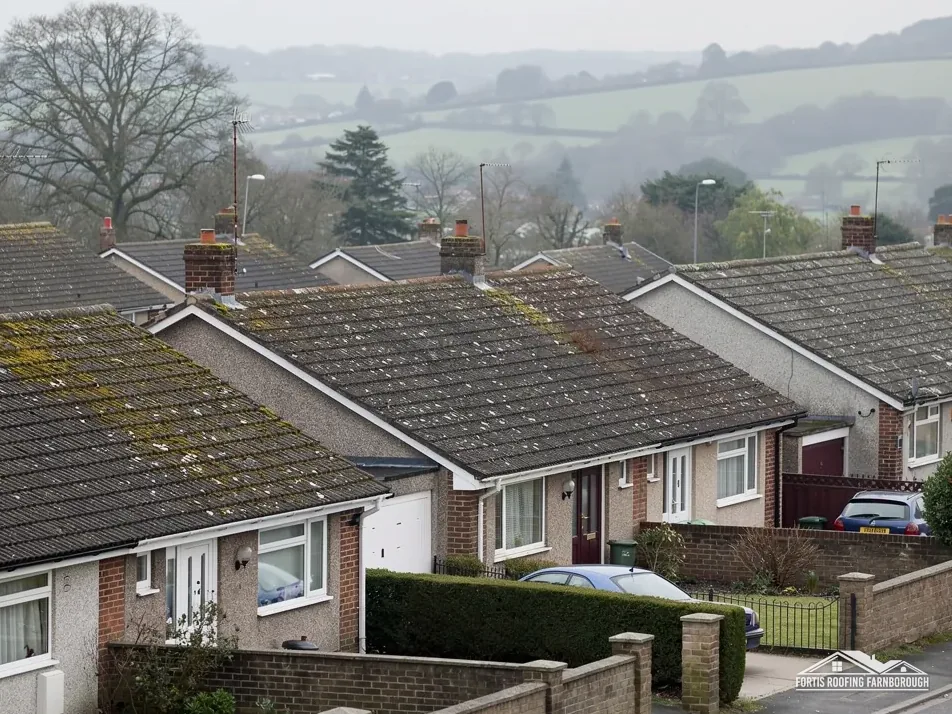
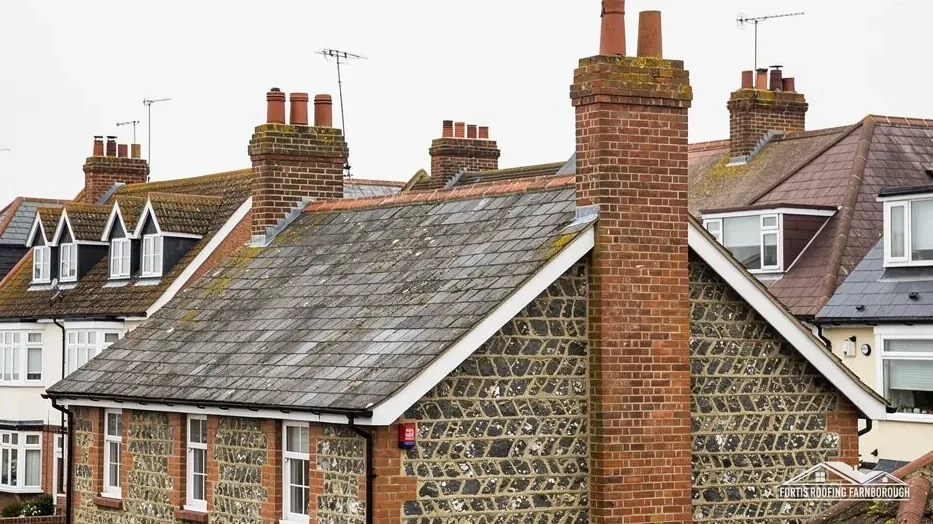
A Georgian red brick house of the Red House kind has its own weak points: chimney stacks that have weathered for two centuries, lead flashings at their bases, and valleys between roof slopes. Our chimney repairs page covers pots, flaunching and flashings, and our pitched roofing page sets out how the choice between patching and re-covering is made.
Chapter 03 of 03
| Designation | In or near Sonning | For roof work |
|---|---|---|
| Conservation area | Sonning, one of Wokingham's 16 | Changes to the look checked with Wokingham |
| Conservation area nearby | Sonning Eye, within about 0.75 km | Confirm which boundary covers your address |
| Grade I listed | The Deanery (list entry 1319459) | Listed building consent for works affecting character |
| Grade II* listed church | Church of St Andrew (list entry 1135979) | Route depends on denomination and use |
| Grade II* listed | The Bull Hotel (list entry 1117462) | Listed building consent for works affecting character |
Wokingham Borough Council lists 16 conservation areas, and Sonning is one of them. The national planning dataset also shows a Sonning Eye conservation area about 0.75 km from the village centre, which means a home on the village's fringe should have its boundary checked with the council before any roof change is planned. Within a conservation area a repair stays possible, and the test is the look of the roof. Under the Town and Country Planning Act 1990 (section 55(2)(a)), works with no material effect on external appearance are not development. Re-covering in a different material, moving a chimney stack or cutting in a roof light alters that look, so each of those goes to Wokingham's planning team before it is priced.
Historic England lists the Deanery at Grade I, and both the Church of St Andrew and the Bull Hotel at Grade II*. For the Deanery and the Bull, works affecting character need listed building consent, and the listing leaves permitted development rights in place beside that requirement. Our planning permission guide explains how the two interact.
St Andrew's is a different case. A church's own tradition and current use decide the approvals route for its roof: a church worshipping in the Church of England today takes the faculty route, churches of other traditions follow their own approval systems, and a closed church falls to listed building consent. We would establish which applies before surveying, and the parish would lead on approvals.
Whether an Article 4 direction applies to your address is something we ask Wokingham before pricing, and we put its answer into your survey file.
A normal house within the conservation area is best repaired like for like: the same covering, the same pitch, the same ridge and the same chimney pots. Our survey records each of those details first, so a proposal can be shown to match them, and the council can see at once what is staying and what is changing. A modest repair inside the conservation area still gets the full photographic record, since that record is what lets the planning team see that nothing about the roof's look has changed.
The county history records a half-timber and brick barn at Sonning Farm with 1775 cut on a roof principal. On a building like that we inspect the covering, battens and timbers from outside and inside, photograph any staining, movement or daylight, and say whether the roof needs patching, refixing or a fuller re-cover.
Building Control Solutions, or BCS, is the council service, run by Wokingham with West Berkshire. You can instead choose a registered building control approver, an approver on the register set up from 6 April 2024. Whether an application is needed turns on the share of the roof a job touches, which our survey measures slope by slope.
Wokingham Borough Council charges £263 for the first 4 weeks and £163 for each further 4 weeks, and the scaffold firm lodges the application for its customer. The charge is rolled into the one price you receive in writing, so nothing is added later, while a private road is exempt from the licence.
It depends on the church's tradition and use. St Andrew's is listed Grade II*. A church worshipping within the Church of England follows the faculty system instead of consent from the council, while a closed church or one of another tradition may follow a different route. The parish would lead, and we would ask first.
Get your free roof quote
Tell us where in Sonning you live and what has gone wrong up top, and a survey visit gets scheduled.
10-year workmanship guarantee, in writing.





