Over 6,000 new houses
Earley Town Council says over 6,000 houses were built on the development, which had not begun by 1974.
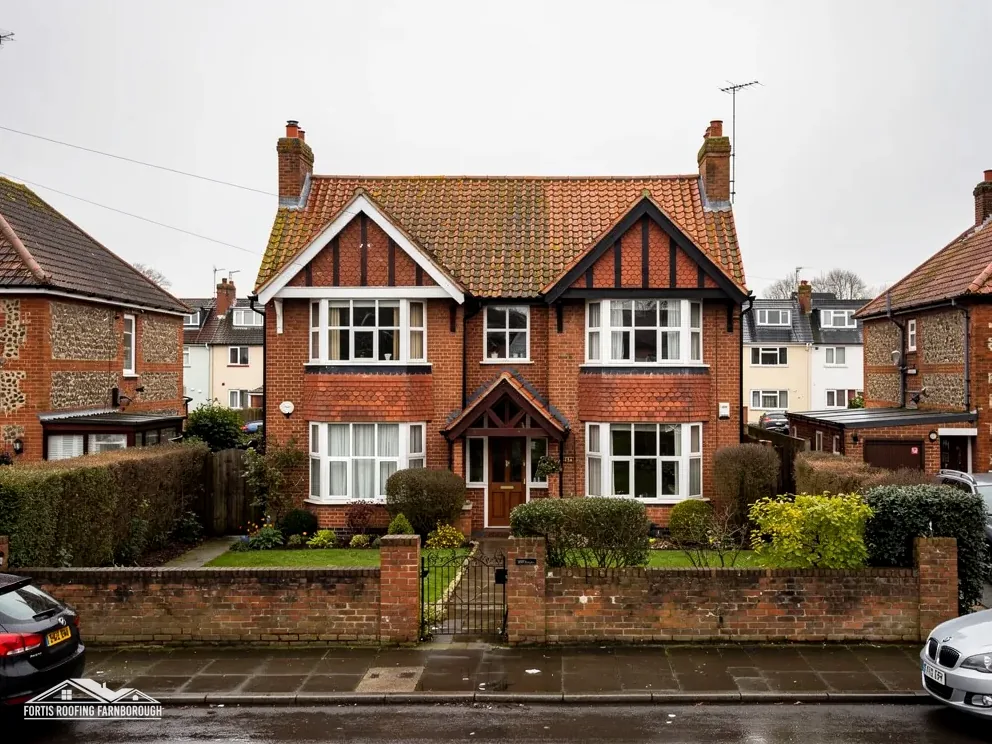
Roofs on the 6,000-house Lower Earley estate built after 1974
Earley Town Council counts over 6,000 houses on the Lower Earley development. We survey those roofs, extensions and garages slope by slope, and price each job once in writing.
Earley Town Council says over 6,000 houses were built on the development, which had not begun by 1974.
Radstock Lane Community Centre opened in 1983 and Maiden Place Community Centre was built in 1986 as the estate grew.

Radstock Cottage is listed Grade II, entry 1136320 on the National Heritage List, and first listed on 12 January 1989.
Map of Lower Earley with Earley, Shinfield, Woodley, Sindlesham marked around it.
Map data © OpenStreetMap contributors. Loads only when you ask for it.
Earley lies immediately to the north, Shinfield to the south-west, Woodley to the north-east, Sindlesham and Winnersh to the east, with Three Mile Cross to the south-west and Arborfield some distance on.
About 18.4 road miles north-west of Farnborough · Wokingham Borough Council (unitary).
Lower Earley, roof by roof
How Wokingham and Building Control Solutions regulate roof work in Lower Earley, how the estate came to be built, and how long the flat roofs on its extensions and garages last, each figure with its published source.
| No. | Chapter | The figure it turns on |
|---|---|---|
| 01 | Wokingham, Building Control Solutions and the footway | Footway at least 1.2 metres |
| 02 | How 6,000 houses went up after 1974 | Over 6,000 houses on the development |
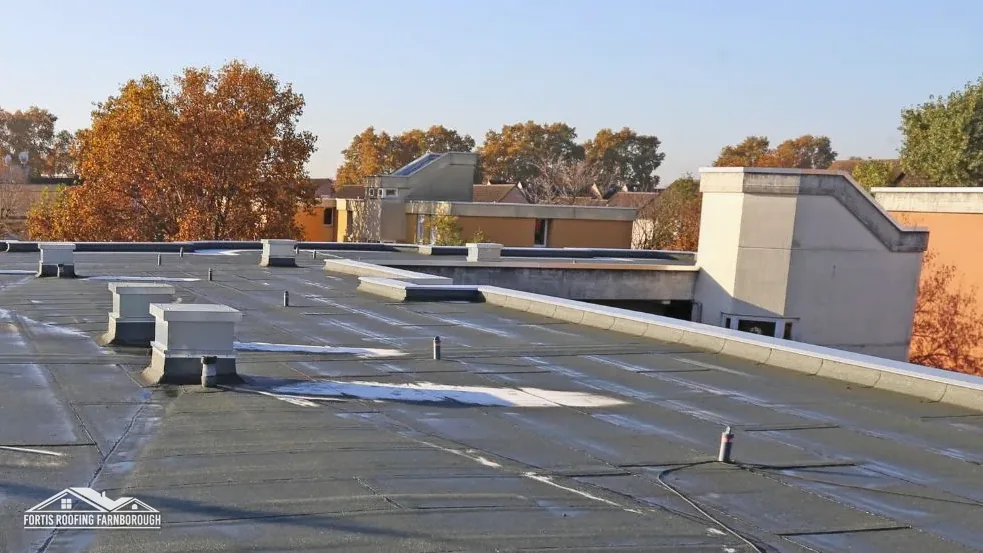
| 03 | Flat roofs on extensions and garages | Felt 10-20 years, EPDM 25-50 |
Chapter 01 of 03
| Role | Body for Lower Earley addresses |
|---|---|
| Unitary council, planning authority | Wokingham Borough Council |
| Highway authority | Wokingham Borough Council |
| Building control | Building Control Solutions (BCS) |
| BCS partners | Wokingham and West Berkshire councils |
| Scaffold licence on the highway | Wokingham Borough Council licenses it |
Lower Earley is 18.4 road miles north-west of Farnborough, reached from the A325 Farnborough Road. It lies in Earley parish and in the unitary borough of Wokingham, so Wokingham Borough Council decides planning questions and looks after the roads as well. There is no county council to consult, and the borough's building control service is not run by the council alone.
Wokingham's service is Building Control Solutions, which calls itself the local authority building control service in Berkshire and is run jointly by West Berkshire and Wokingham. Wokingham has no re-roofing figure of its own, so the Planning Portal's yardstick is used: building control seldom becomes involved while under 25 per cent of the building envelope and under 50 per cent of the roof is touched.
A few loose ridge tiles, or a stained bedroom ceiling traced to one slipped slate, sit on the repair side of that line. A full re-roof of a semi on the estate sits on the other side of it. We measure the area at survey and say plainly which route your job takes. Where a registered building control approver is the better fit for the programme, we explain that alternative too, since approvers are registered under a national regime that began on 6 April 2024.
Under Wokingham Borough Council's rules the scaffolding firm, not the householder, makes the application, and at least 10 working days must pass between applying and starting. The licence costs £263 for the first four weeks, then £163 for each further four-week period, so a job that runs long costs more. The footway left beside the scaffold must be at least 1.2 metres wide, and a licence is not needed to place scaffolding on private roads.
On a modern estate, pavements are often narrow and driveways short, so that 1.2 metres decides where the scaffold can go. Our survey measures the footway outside your house and tells you whether the scaffold will fit the front, or whether we must work from the side or rear instead.
Wokingham Borough Council expects the scaffolders to file the form themselves, so the firm and its dates are agreed with you before the licence goes in. Scaffold also needs somewhere to stand: a drive, a side passage or a rear garden gives an alternative to the pavement, and we look at all three at the survey. The one-price quote we give you covers the scaffold access we plan.
Chapter 02 of 03
What the council history records about the estate
Earley Town Council's own history says that over 6,000 houses were built on the Lower Earley development, and that the development had yet to begin when the town council was formed in 1974. The Radstock Lane Community Centre opened in 1983 and the Maiden Place Community Centre was built in 1986 as the estate grew. A district of that size went up across more than a decade, so its roofs are now around 40 years old, give or take a few years either way.
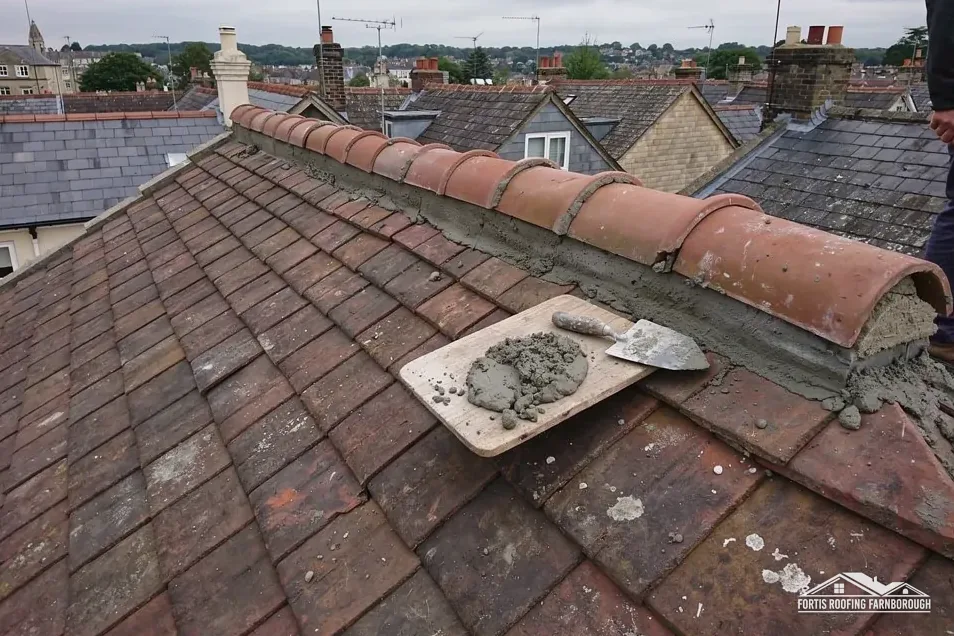
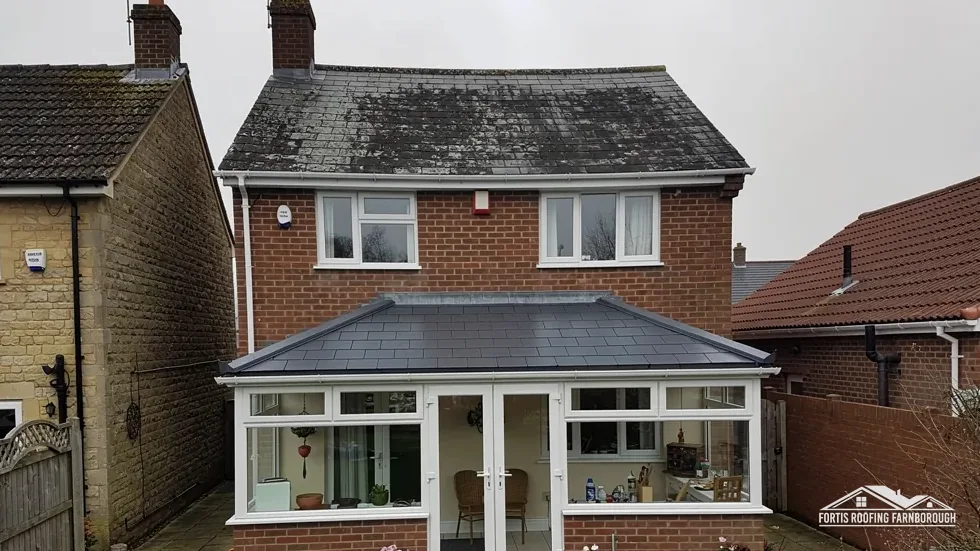
Age does not tell us the material, and the council history does not tell us which coverings were used, so we never assume. A roof of that age is at the point where small faults begin to add up. Ridge bedding, the cement or mortar that holds ridge tiles, loosens with frost and sun. Flashings, the strips of metal that seal joints against walls and chimneys, lift or split. Valley linings and underlay fatigue. Rain, frost and sun work on every roof year after year, and four decades of that is a long time for a joint to hold.
On the survey we work from the ridge to the eaves. At the ridge we check the bedding and the fixings of the ridge tiles. At the verges we check that the end tiles are held. In the valleys and at the abutments we check the flashings, and we lift a sample of tiles to see the underlay and battens. Each point gets a photograph, and the set goes into your notes.
What you get is a plain account: which faults are cosmetic, which will leak within a winter or two, and which are signs that a whole slope is nearing the end. Where a repair is enough, the price is for the repair. If the photographs show a re-roof is the better buy, they go in your notes beside the reason.
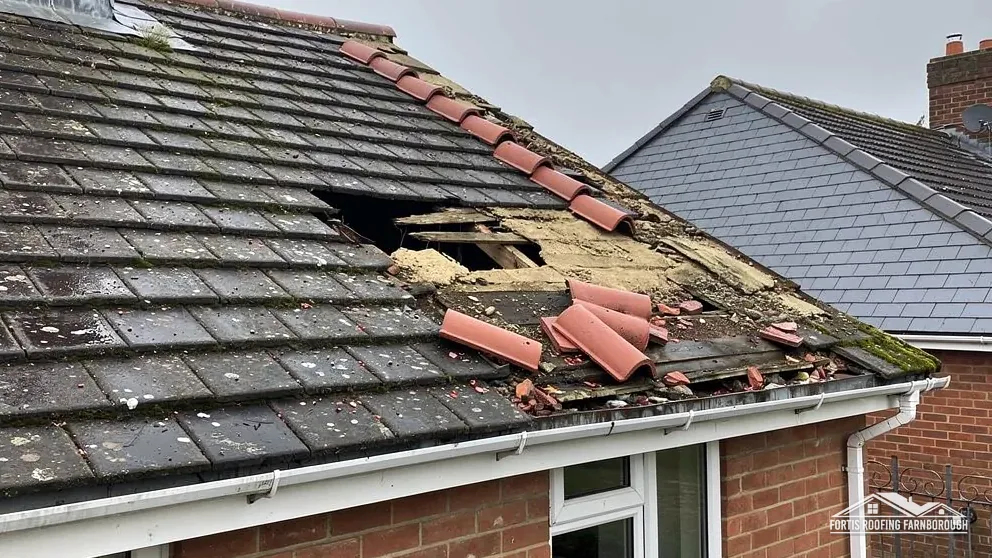
Houses on an estate sit in rows, and what we find on your roof may be worth a look next door. We note the faults we find, so you and your neighbours can compare. Our pitched roofing page lists the repairs we carry out.
Not necessarily, but age is a reason to look closely. Ridge bedding, flashings and underlay are the parts that tire first, and we photograph each of them during a survey. You receive the photographs and a clear summary of what is sound, what needs repair and what is nearing the end of its life, so the next decision is yours to make with the facts in front of you.
It can be. Wokingham's page says the footway beside scaffolding must stay at least 1.2 metres wide. Estate pavements are sometimes narrow, so we measure outside your house at survey and plan the scaffold on the front, the side or the rear accordingly, and show you the plan in writing.
Building Control Solutions, the service Wokingham shares with West Berkshire. For a patch repair there is normally nothing to apply for. For a full re-roof, a registered building control approver is the private alternative, and at survey we tell you which route fits your job and why. The building control contact details are in the notes we leave with you.
According to Wokingham, scaffolding on private roads needs no licence, and scaffolding wholly on your own drive does not obstruct the highway. Where it stands on the footway or road, the scaffolding firm applies to Wokingham Borough Council for you, and we agree the dates with you first, so nobody is left guessing about the day the poles go up. The licence fee is part of the one written price.
Get your free roof quote
Send your Lower Earley road and describe the fault, and a visit will be booked to photograph every slope, ridge and gutter.
10-year workmanship guarantee, in writing.