High roofs above shop fronts
In 1911 the history described Thames Street houses whose high-pitched roofs showed above the stucco of their walls.

Roofs above Thames Street's shop fronts and the market
Kingston upon Thames is a historic market town at Kingston Bridge, where high-pitched roofs rise above shop fronts. We check each older roof, and what it may hold, first.
In 1911 the history described Thames Street houses whose high-pitched roofs showed above the stucco of their walls.
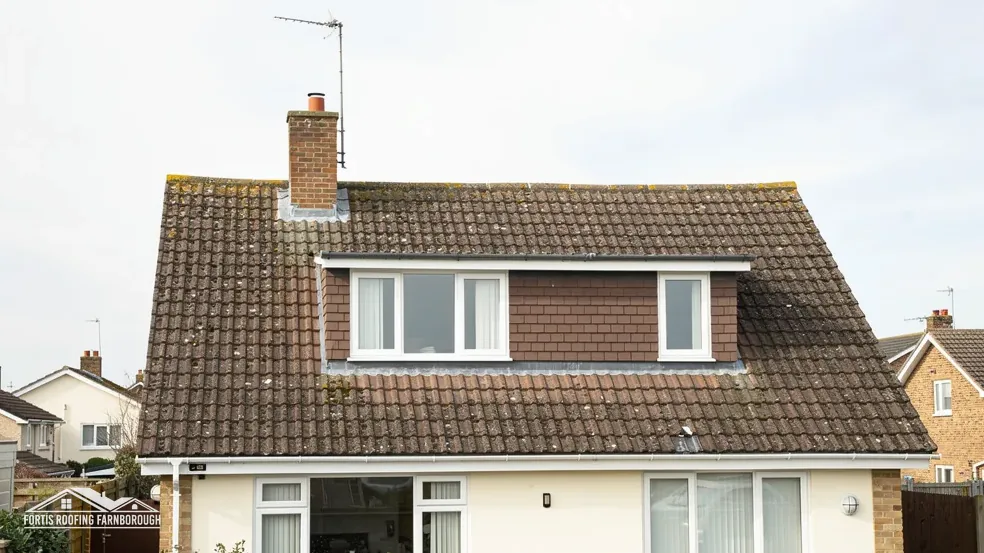
Three old timber houses behind the church had overhanging second floors and four gabled heads, converted to shops.

The old town hall was red brick and gabled, probably 16th-century; its replacement was built in 1838 to 1840.
Map of Kingston upon Thames with Surbiton, Thames Ditton, Teddington, East Molesey marked around it.
Map data © OpenStreetMap contributors. Loads only when you ask for it.
Surbiton lies south of Kingston upon Thames, Thames Ditton south-west, Teddington north-west, East Molesey and West Molesey west, Hampton west, with Twickenham beyond Teddington.
About 26.1 road miles east of Farnborough · Royal Borough of Kingston upon Thames (unitary).
Kingston, shops and older roofs
What to check before any older Kingston roof is disturbed, including asbestos, what the 1911 history records about Thames Street's high roofs and the cleared Horse Fair, and how listings and conservation areas shape work.

| No. | Chapter | The figure it turns on |
|---|---|---|
| 01 | Before an older Kingston roof is disturbed | Before 2000: assume asbestos is present |
| 02 | High roofs above shops, and a cleared Horse Fair | Clearance of 1905, new town hall 1838 |
| 03 | Grade I neighbours and Kingston's conservation areas | 90 listed buildings within 900 m |
Chapter 01 of 03
Asbestos and older roofs in four published points
Kingston is an old market town with buildings of every age, and a roof, flat roof or soffit on any of them needs a question asked before it is touched: could this contain asbestos? The Health and Safety Executive's guidance gives a simple rule of thumb. A building put up or refurbished before the year 2000 should be treated as a place where asbestos may be present. That does not mean every roof contains it. It means nobody should break, drill or strip a covering, a soffit or a gutter on an older building until they have found out.
HSE warns that a roof of asbestos cement sheets cannot be trusted to bear a person's weight, so walking on one without proper boards risks a fall through it. Asbestos insulating board, a different material, turns up in external soffits, and HSE adds that it is hard to tell such boards from non-asbestos equivalents by eye. Taking asbestos cement sheets or gutters away carefully, without breaking them up, needs no licence. Breaking them up substantially makes the work notifiable, with health records to be kept for 40 years, and work on insulating board that is not of short duration requires a licence.
Where the rules call for a licence, a specialist contractor takes the work. What we do at the survey is note whether the soffits, rainwater goods, flat roof coverings and any sheeting look as though they could contain asbestos, say so in the report and recommend testing before anything is disturbed. If tests confirm asbestos, the debris travels double-wrapped, labelled and under a consignment note, never in an open skip.
Kingston belongs to the Royal Borough of Kingston upon Thames, which is a unitary council: one body for planning, and a building control service of its own. For a re-roof, the Planning Portal's limits show whether an application is likely: under 25 per cent of the building envelope and under 50 per cent of the roof normally means none. Section 169 of the Highways Act 1980 puts a scaffold on a Kingston street under the highway authority's licence, and the applicant and turnaround are established before we book.
Chapter 02 of 03
| Subject | What the history records |
|---|---|
| Thames Street houses | Of the 17th and 18th centuries, with high-pitched roofs showing above the stucco of their walls behind modern shop fronts |
| Three old houses | Behind the church, converted to shops; timber plastered over, with overhanging second floors and four gabled heads |
| 1905 clearance | The north end of Thames Street, the Horse Fair and the Back Laines were cleared; present houses built |
| The old town hall | Red brick, gabled, probably 16th-century; the replacement was built in 1838 to 1840 |
In its 1911 volume, the Surrey county history described the 17th- and 18th-century houses of Thames Street, whose high-pitched roofs showed above the stucco of their walls behind a few modern shop fronts. It also described a row of three old houses backing on the south-east of the church, converted to shops, of timber plastered over, with overhanging second floors and four gabled heads.
A building with a modern shop front, a plastered upper floor and a high-pitched roof is really several buildings in one. The ground floor is one phase, the walls above another and the roof a third, and the junctions between them are where water gets in. Behind the pitched part there may be a flat section, where an extension was added to the rear. Our commercial roofing page explains how shop and mixed-use roofs are surveyed, and our flat roofing page covers membranes, outlets and falls.
The north end of Thames Street, the open Horse Fair and the surrounding Back Laines were cleared of their ancient buildings in 1905, and the present houses built. A street rebuilt in one period may have roofs of a similar age, which can reach the end of their lives together. The old town hall, red brick and gabled, probably of the 16th century, was replaced in 1838 to 1840. Neither fact says how any roof is covered, so the survey identifies each covering for itself.
For a shop, or a flat above one, access matters as much as the roof itself. Pavements are busy, deliveries restricted and neighbours close. We plan where a scaffold can stand, how long it will stay and how customers and residents can still get in, and we agree the programme with you, so that a Kingston business is disturbed as little as the job allows.
Kingston dates on record
Ask also whether the shop's lease makes the freeholder responsible for the roof. Some commercial leases do, and a tenant who finds a leak should tell the landlord in writing, with pictures, before any work is ordered. Our survey report is written so that it can be handed to a landlord or a managing agent as it stands.
Chapter 03 of 03
Kingston's heritage in four published figures
Five conservation areas bearing Kingston names meet the 1.5 km area round the centre: Kingston Old Town, Riverside North, Riverside South, Grove Crescent and Fairfield/Knights Park. The dataset also names Hampton Wick, Hampton Court Green and others across the river. In a conservation area the usual allowance for dormers is withdrawn, so a roof extension needs an application, and the planners at the Royal Borough can say whether a given street lies inside and whether an Article 4 direction applies to it.
On the national list, 90 listed buildings stand within 900 m of the town's centre. The Church of All Saints, Clattern Bridge and the Coronation Stone are each listed Grade I. St John's church has a Grade II listing and Church of England worship, which sends its roof repairs through the faculty route of the ecclesiastical exemption. For All Saints, the approval route depends on how the church is used today: an Anglican church still holding services takes the faculty route, and its custodians will know which applies.
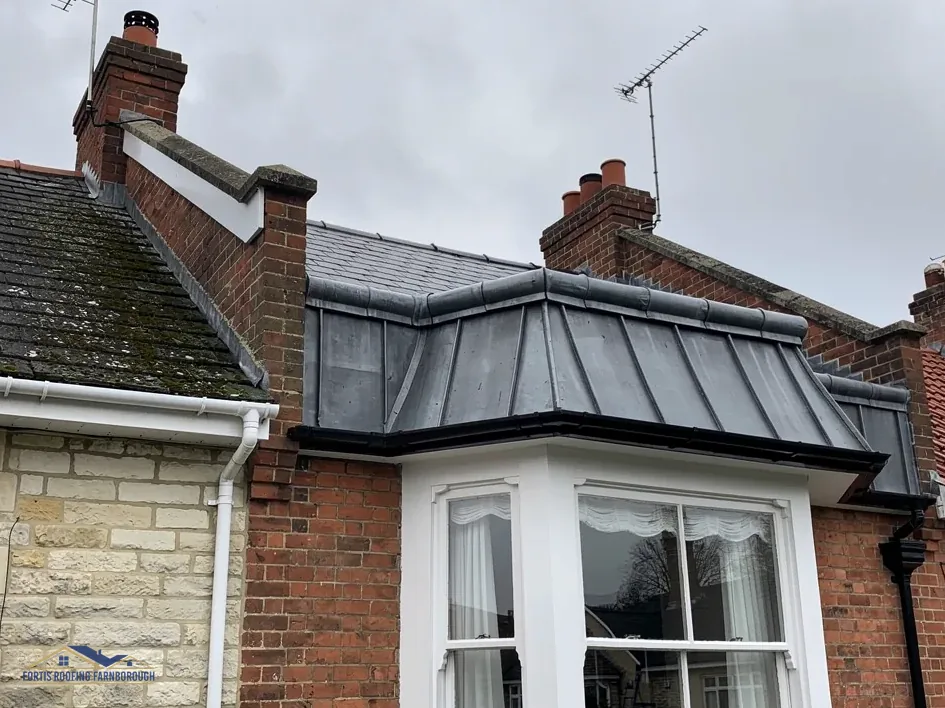
On a listed building, any work touching its character calls for listed building consent from the Royal Borough. We ask before pricing, and the survey supplies pictures and measurements of the ridge, verges, chimneys, lead and rainwater goods to go with the application.
Where a house or shop is not listed, section 55 of the Town and Country Planning Act 1990 leaves outside development works that leave how a building appears from outside materially unchanged, which makes a straight repair the plain case. A new covering, a raised parapet or a bigger opening deserves a word with the council first. Our lead roofing and lead work page explains how parapet gutters and flashings are renewed, which matters on a town-centre building with a parapet.
Our planning permission for roof work guide sets out the national rules. If your building is both old and in use, say so at the first call, so that the survey covers access, asbestos and designation together, and the report can answer all three questions at once.
A town centre has traffic, trees and tall neighbours, and each affects where water goes and how a scaffold stands. We look along the street as well as at the roof, and note any neighbouring building that overhangs or discharges onto yours, so that the report is complete and a later dispute starts from facts.
They might. HSE advises treating a building put up or refurbished before 2000 as a possible source, and warns that asbestos cement sheets cannot safely carry a person, so nobody should step on them without proper boards. We note suspect sheets at the survey and recommend testing before anything is touched; any waste travels on a consignment note.
Five areas with Kingston names meet the area round the centre: Kingston Old Town, Riverside North, Riverside South, Grove Crescent and Fairfield/Knights Park. A name does not prove your own street is inside, so the Royal Borough's planning team confirms it. Inside one, a dormer calls for planning permission, and any change in the roof's appearance is raised with the council first.
Not for consent. St John's is a Grade II church in Anglican use, so the ecclesiastical exemption applies and roof repairs follow the faculty system. For listed houses and shops outside that exemption, the Royal Borough's listed building consent is the route, and we raise it before pricing any such work.
Often yes, if the plan is made with that aim. We look at where a scaffold can stand, how entrances are kept clear, how deliveries and waste are handled, and which days the noisiest work falls on. The survey sets this out beside the price, and the highway licence, where one is needed, is timed to match.
Get your free roof quote
Send us your Kingston address, the building's age and the fault, and we will book a visit.
10-year workmanship guarantee, in writing.