The short answer
An orangery roof has a flat or low-pitched perimeter, usually with a glazed roof lantern rising from the centre, set on brick piers or solid walls. A conservatory has glass walls and a glazed roof, while an orangery has masonry walls and a smaller glazed section on top. The difference matters for repairs, because the flat edge is a flat roof and the lantern is a separate unit.
A flat perimeter with a lantern above
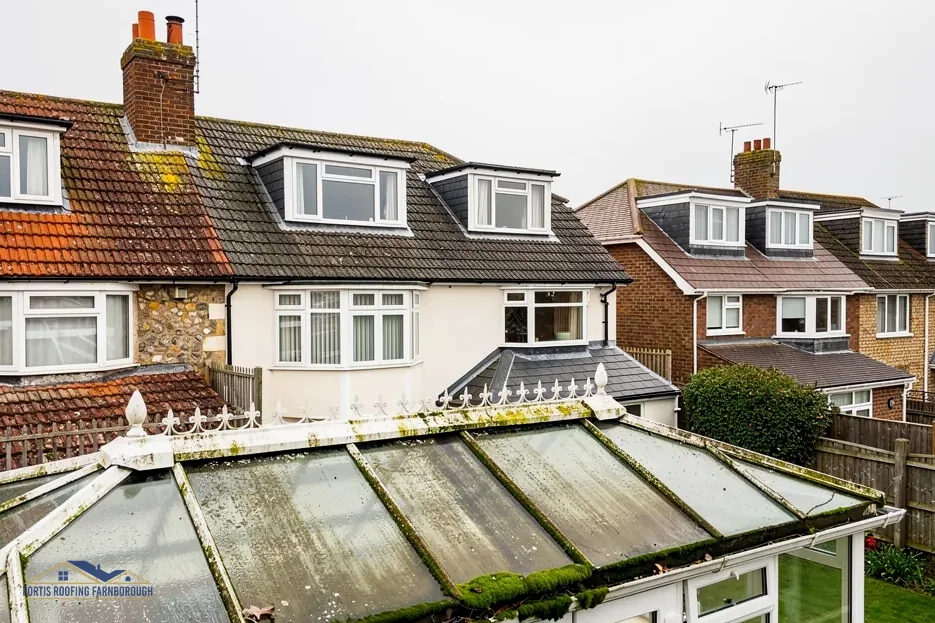
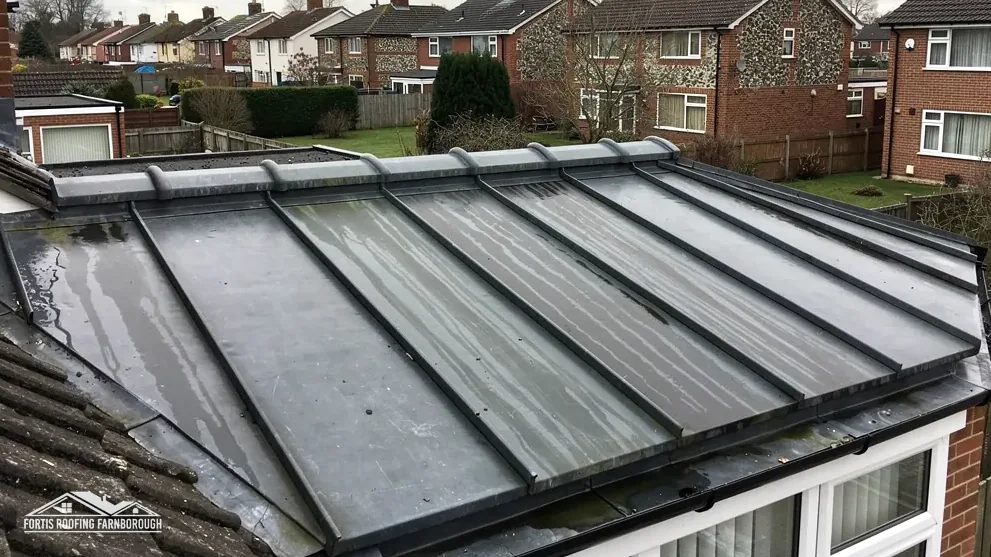
A conservatory roof slopes from one or more ridge lines to the eaves, and glass or polycarbonate makes up most of its area. An orangery roof is built differently. Around the outside runs a flat or very shallow roof, finished in a waterproof membrane or in lead, and in the middle sits a roof lantern: a glazed, often multi-sided unit raised above the flat area.
The flat roof around the lantern is hidden from the garden by a parapet or a fascia (the board along the roof edge) and often has a plastered ceiling beneath it with spotlights set in. That ceiling is why an orangery feels more like an extension of the house than a glazed room added to it.
The brick piers and walls beneath make the room warmer and sturdier, and they carry the roof weight. The lantern is the only glazed part, and it often has aluminium or timber bars with sealed glass units.
Those are the parts a roofer deals with: the flat perimeter, the lantern base where it meets the flat roof, the gutter or outlet system and the junction against the house wall. Each one fails in a different way, so the repair starts with finding which of them is leaking.
Building Regulations and orangery roofs
The Planning Portal treats a conservatory's new roof as work that must satisfy the Regulations on stability, heat loss and airflow. An orangery is the more substantial building, so a new or replacement roof is routed through your building control body. Around Farnborough and Fleet, that body is the Hart and Rushmoor Building Control Partnership, on 01252 398715.
Part L, the energy part of the Regulations, sets limits for a new roof. Approved Document L Table 4.2 gives 0.15 W/(m²·K) for a new roof and 2.2 for a rooflight. A flat perimeter roof has to reach the roof figure, so it needs a good thickness of insulation, while the glazed lantern is judged on its own figure.
The same document names renewal of a flat roof's waterproof layer as renovation, which uses Table 4.3 for the figure an existing element must reach. AD L 2026 takes effect on 24 March 2027, with renumbered tables.
Ask your building control body which edition applies on the date of your application.
Repairs to an orangery roof
Most orangery leaks start in one of three places. The first is the flat perimeter, where an old membrane has cracked, blistered or opened at a seam. The second is the lantern base, where the glazed unit sits on a kerb (the raised upstand that holds it) and the junction relies on flashing and sealant. The third is the gutter or outlet, where water can back up on a flat roof if the fall is poor.
The fall matters. BS 6229:2025 keeps a minimum 1:80 finished fall for general roof areas of flexible-membrane flat roofs, and the roof should be designed for 1:40, according to IKO. Ponding water that stays for a day or more after rain suggests a fall problem.
The lantern glass can also fail, with misted units where a seal has broken. A misted unit is a glazier's job, replaced as a sealed unit, while the roof around it is a roofer's.
Because the finishes differ, an orangery repair is a mix of flat roofing, glazing and sealing. Our conservatory roof repair page covers the general method, and the flat roofing hub sets out membrane choices.
What we look at when we survey one
The survey treats each part of the roof separately: we photograph: the flat area, the lantern, the upstand and the outlets. We measure the falls, note the membrane's condition and study where the roof joins the house wall, since that edge is a frequent source of damp.
We also look for signs that a repair is not enough. A flat roof with a membrane that is cracked all over, or a lantern whose frame has warped, is better replaced than patched. The opposite also applies, and a single failed seam or one misted unit does not justify a new roof. The right fix is the smaller one where it will hold.
If building control is involved, we tell you which stages the inspector will want to see, so the order of work suits those visits.
Where an orangery stands in a conservation area, check the planning route before changing how the roof looks, as our page on a conservatory roof in a conservation area explains. The conservatory roofs hub covers the other conservatory shapes. One written price follows the survey.