The short answer
Replacing industrial rooflights means removing old translucent panels, often brittle and discoloured, and fitting new ones matched to the profile of the roof. The panels are a serious fall hazard, because they can look like the sheets around them and give way underfoot. The job needs safe access, a check for asbestos in the surrounding sheets and a plan under the CDM Regulations.
Why old rooflights fail
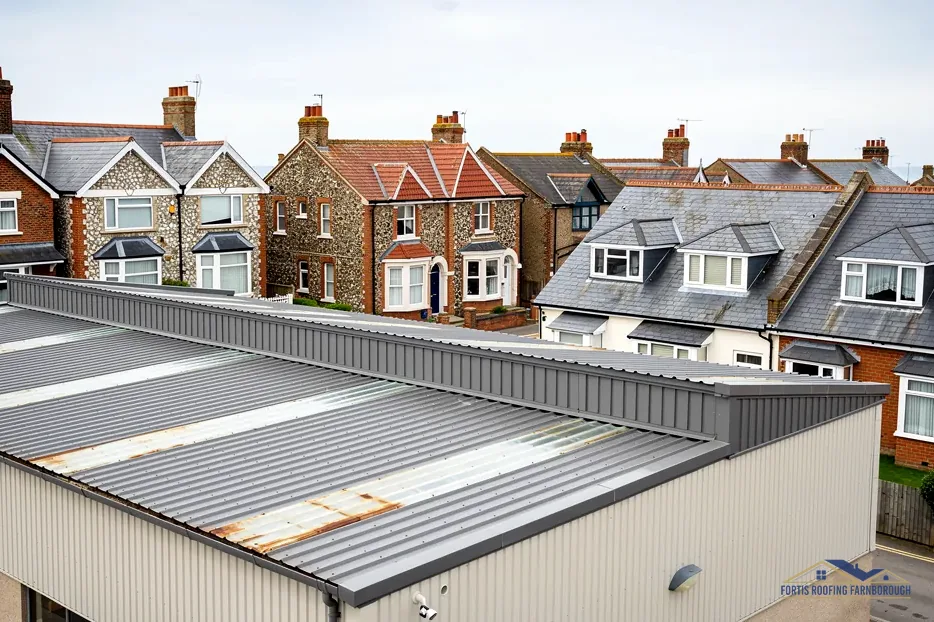
An industrial rooflight is a translucent panel set into a sheet roof so that daylight reaches the floor. Most are made of glass-reinforced plastic or polycarbonate, and they are formed to the same profile as the sheets, so that they lap into the roof without a break.
They are the shortest-lived part of many roofs. Sunlight attacks the plastic, which turns yellow and loses clarity, and over time it becomes brittle. HomeBuilding gives polycarbonate roofing a typical life of 10 years, and The Eco Experts say about 10 to 15 years. A roof of fibre cement or metal may last far longer, so lights are often renewed more than once in the life of the building.
Failure takes several forms. Panels crack or split, laps open, sealants age and fixings loosen, so water enters at the light. A light that has gone dull no longer does its job, and the floor below darkens, which brings electricity costs for artificial lighting.
There is a safety dimension as well. A brittle light is weak, and a panel that has been painted over, covered with moss or dust or hidden under a layer of dirt looks like part of the roof. It will not bear weight. Our guide to fragile roof safety explains why this causes so many accidents.
Safe access for the work
Replacing a rooflight means standing next to, and sometimes over, the very thing that can fail. The access plan comes before the first panel is touched.
The controls follow the usual order. Where possible, work is done from below or from outside the roof, using a mobile access platform that places the operator at the edge. Where people must go onto the roof, they use crawling boards or staging that spread the load across the sheets and purlins, with edge protection at the perimeter and a safe route from the access point.
Fragile panels are protected or covered. Guard rails, nets or covers go over the lights, so that nobody can step on one by mistake. Nets fitted beneath a roof are another layer of protection, where the structure allows.
Nobody is allowed to work alone, and the area below is closed to people while panels are lifted out, since a falling piece is a hazard of its own. Where the building is in use, the work is phased to protect staff and customers, so that staff and visitors are protected from falling material and noise.
A written method statement and the construction phase plan record all of this, and the principal contractor or sole contractor is responsible for it under CDM.
The sheets around the lights
A rooflight sits in a roof, and the sheets beside it count as much as the panel. On an older unit, the surrounding sheets may be asbestos cement, and removing a light disturbs the sheets at its edges: bolts are removed, laps are opened and sealant is cut. All of that can break fragile material.
That is why an asbestos check comes before the work. HSE advises treating any pre-2000 building, new or refurbished then, as asbestos-bearing until a survey shows otherwise. If the sheets contain it, the method must reflect that, and breaking material up changes the work from non-licensed to notifiable non-licensed.
Our answer on asbestos surveys before roof work explains the process.
If the survey shows the sheets are modern and free of asbestos, the job is simpler. The light is removed, the area around it is checked and any damaged sheet is replaced, and the new panel is fitted.
The state of the supports counts too. Purlins that have rusted or sagged under a failing panel need attention before a new light goes in. A new panel on a weak frame will not last.
The survey records all of this, so that nothing is discovered halfway through a job.
Replacement options
Daylight can be renewed in several ways, and the choice follows the roof and what the building is used for.
Like-for-like panels are the simplest. A new translucent sheet in the same profile is lapped into the roof and fixed through the same positions, which suits a sound roof with worn lights. Double-skin or insulated rooflights improve thermal performance and cut condensation compared with single-skin plastic.
Rooflight kits and framed units, set into a kerb, are an alternative where the roof is being re-covered. They give a tidier and more watertight installation, and they can include integral fall protection.
Some owners remove lights and sheet over the opening, which saves on repair but reduces daylight and may raise lighting bills. The decision should weigh energy use and the working environment.
Fixings, laps and sealants deserve as much attention as the panel. The best light leaks if its side laps are badly made, and a well-fitted one lasts. Our guide on warehouse roof repair shows how lights fit into wider roof maintenance.
The commercial roofing hub lists related services. A survey opens every job, and the written price that follows covers access and the new panels.