The short answer
Warehouse roofs usually leak at laps, fixings, rooflights, gutters and flashings, not across the middle of a sheet. A survey from safe access finds the entry points, and local repairs deal with them. When corrosion, failed fixings or wet insulation are widespread, repair stops paying and overcladding or replacement is the better route. Older sheeting is checked for asbestos first.
Where warehouse roofs fail
A warehouse roof covers a large area with few interruptions, and it fails at the points where something changes. Knowing the usual places saves time in tracing a leak.
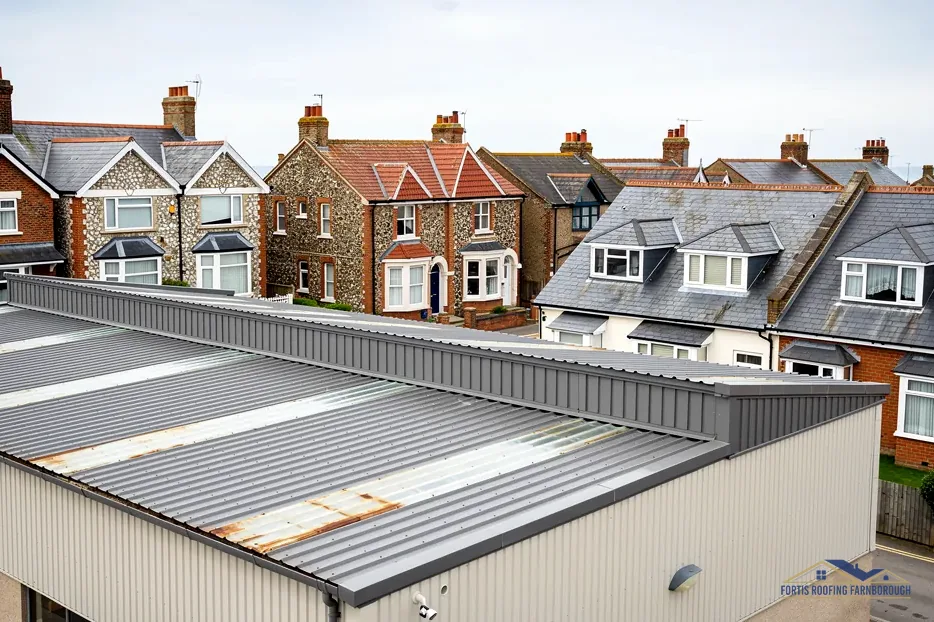
On a profiled metal roof, the common failures are at laps, where sheets overlap and sealant ages, and at fixings, where screws loosen, washers perish or holes enlarge as sheets move in the wind. Sheet ends at the eaves collect dirt and water and corrode, which our answer on cut-edge corrosion explains.
Rooflights are the next group. Lights are lapped into the sheets and often outlast their sealing, and cracked or brittle panels let water in. Gutters are another weak point. Box and valley gutters blocked by leaves overflow into the building, and old linings split.
Flashings at walls, ridges, vents and plant fail where metal has moved or sealant has dried.
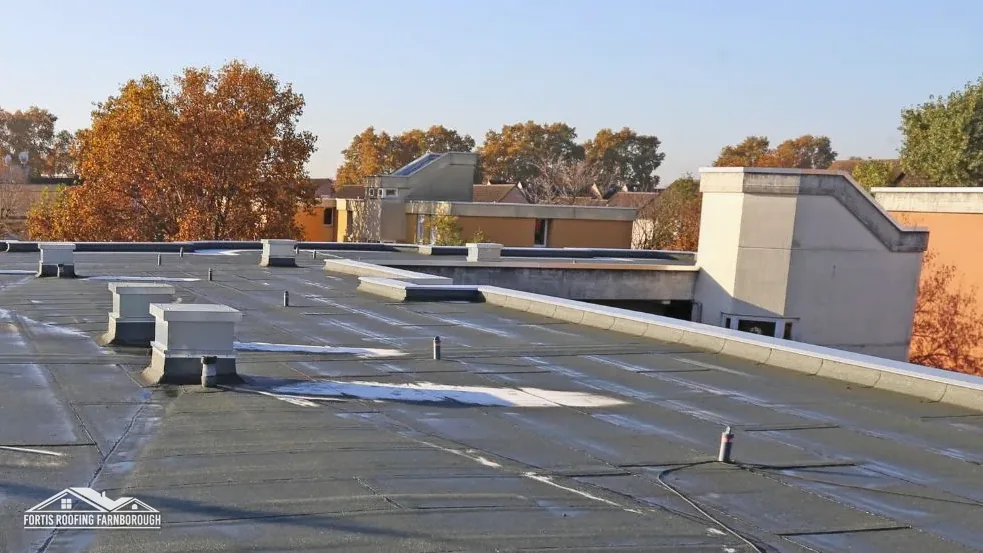
On a flat or membrane warehouse roof, the pattern is similar but different in detail: splits at seams, blisters, damaged upstands, blocked outlets and ponding where falls have been lost.
Leaks rarely appear where the water enters. It runs along the underside of the sheet, along a purlin or down a wall before it drops, so the stain on the floor can be some distance from the fault.
Tracing from the roof, with the inside in view, is the reliable method.
Working safely at height
Roofs on industrial units present specific hazards, and the repair plan starts with them. A person who steps onto the wrong surface can fall many metres to a concrete floor.
Fragile surfaces are the main one. Plastic rooflights, old fibre cement and corroded metal sheets can give way, and they are often hidden by moss, dirt or paint. HSE treats asbestos cement roofs as fragile in every case. The plan covers staging or crawling boards over fragile areas, covers or guard rails on rooflights and a marked walking route from the access point.
The roof edge needs protection too, with guard rails, a scaffold or a harness line tied to a secure anchor. People reach the roof by a fixed ladder, a tower or a mobile platform, and nobody should climb a ladder that is not secured at the top.
Inside, the work area is protected. Stock below a repair is covered or moved, aisles under the work are closed and forklift routes diverted, because tools and debris can drop.
Weather limits the work. Wind makes sheets dangerous to handle, and rain or ice makes a roof slippery, so repairs are planned for suitable conditions, with a temporary cover for urgent leaks in between.
All of this goes into the construction phase plan under CDM.
Old sheets and the asbestos question
Many warehouses and industrial units are old enough to have asbestos cement roofing. HSE's advice on older buildings, meaning anything put up or refurbished before 2000, is to presume asbestos until surveyed, and it applies to a repair as much as to a replacement.
A small repair can disturb sheets: drilling for new fixings, cutting out a damaged section, removing a rooflight, replacing a gutter bolted through the sheet. Each of these can break fragile material and release fibres.
For that reason, the asbestos survey comes first. If the sheets are asbestos cement, repair work is planned around the rules. Careful handling that keeps the material unbroken is non-licensed work, while work likely to damage it substantially becomes notifiable. A repair that avoids disturbing the sheets, such as sealing from above, may be chosen where it works.
Our answer on asbestos surveys before roof work sets out the process, and the guide to fibre cement roof sheets explains the material.
The person managing the building should hold the asbestos register, and any contractor should read it before starting. If there is no register, a survey creates one.
When to stop patching
Repair is the right answer when the roof is basically sound and the faults are local. Resealing laps, replacing fixings, renewing a few sheets, fitting new rooflights and clearing and relining gutters can bring a roof back to watertight for much less than a new one.
The signs that repair is no longer enough are familiar. Corrosion across many sheets, fixings that no longer hold, leaks in several places that return after repair, wet insulation and a roof that is flexing or sagging all point to a roof that has had its day. A string of repairs on a failing roof costs more in total than one proper job, and stock is at risk meanwhile.
The options then are overcladding with a new roof over the old, or stripping and replacing. Our answer on metal roof sheet replacement sets out the choice.
The survey provides the evidence for the decision. We photograph the roof, measure the defects, mark the leaks and say what is repairable and what is not. You receive the findings, the options and a written price for each.
A roofer who recommends replacement without showing why, or who patches a clearly failed roof, is not serving you. The pictures and measurements let you judge. The commercial roofing hub lists the other options.