The short answer
Lining a commercial gutter means fitting a new waterproof layer inside the existing channel, usually in a liquid-applied coating, a bonded membrane or a sheet such as GRP or EPDM, instead of removing the gutter. It suits a sound structure that leaks at the surface. It cannot fix poor falls, rotten supports or undersized outlets, which are checked first.
What lining is and where it is used
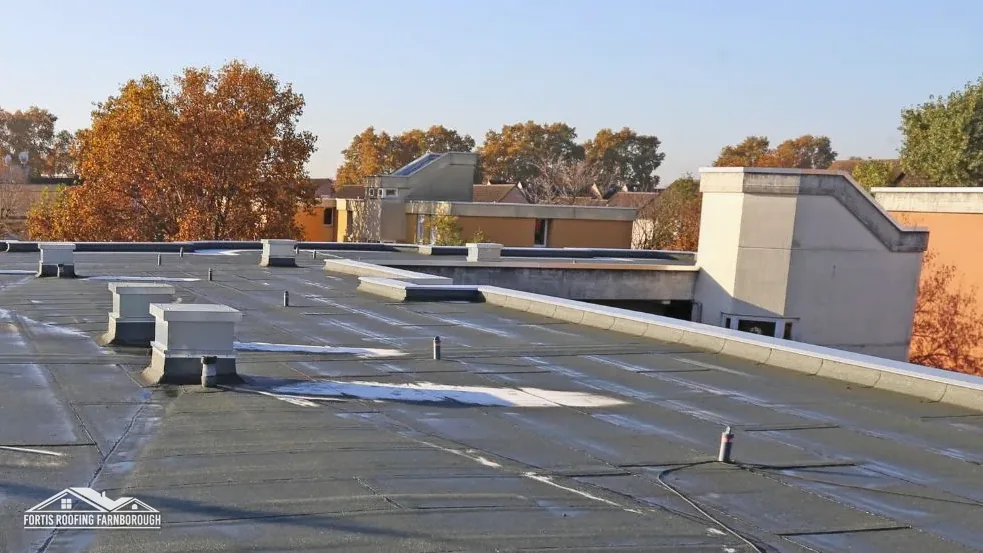
Many commercial and older buildings drain through gutters that sit inside the roof line: box gutters between two slopes, parapet gutters behind a low wall and valley gutters where roofs meet. They are hidden from the ground, carry water from large roof areas and are costly to replace, because they are built into the structure.
Lining is a way of renewing the waterproof surface without tearing out the gutter. The old channel is cleaned and prepared, then a new layer is formed inside it. Several systems are used. A liquid-applied coating is rolled or sprayed on and cures to a continuous skin without joints. A bonded membrane, such as EPDM rubber, is cut to fit and glued down. A glass-reinforced plastic lining, known as GRP, is laid in resin and matting to form a rigid shell.
The choice depends on the shape of the gutter, how it is reached and the condition of the surface. Complex junctions, outlets and corners are formed with extra care, since those are the places that leak.
The attraction is speed and disruption. A gutter can often be lined in a day or two, without lifting the roof covering around it, and the building stays in use. For an owner with a leak and a tight budget, it may be the best first step.
When lining works, and when it does not
Lining only works when the gutter beneath it is sound. The new layer is thin, and it bonds to what is there. It restores a waterproof surface, and it does not restore structure.
The signs that favour lining are straightforward:
- the gutter leaks because the surface has cracked, split or worn, but the supports and boards are firm;
- the channel is accessible and can be cleaned back to a sound, dry surface;
- the falls are adequate and the outlets are the right size and in the right places;
- the existing lining, if any, is not wet underneath and can be removed or bonded over.
Replacement is the better answer when the deck beneath is rotten, when the supports have sagged, or when the gutter is too small for the roof it serves. A new lining on a sagging gutter simply follows the sag and holds water. Moisture trapped under a lining damages the deck from below, so a gutter that has been leaking for a long time needs its timbers checked.
It is also the wrong choice if the gutter has to be changed anyway, for example to increase capacity or to alter the layout. Our guide on commercial flat roof refurbishment covers the wider decisions.
Falls, outlets and capacity
A gutter that does not drain is a failing gutter, however new its lining. Falls and outlets decide how well a lined gutter works.
Falls are the slope along the channel towards the outlet. Brett Martin's guidance for rainwater systems gives a fall of 1 mm for every 600 mm, and the British Standard for roof drainage inside buildings, BS EN 12056-3, covers the layout and calculation of such systems. Where a box gutter has lost its fall through settlement, the lining can be built up to restore it, using tapered fillets or screed, but the correction has to be designed.
Outlets are the openings through which water leaves the gutter. They need to be large enough for the roof area, clear of debris and fitted with guards where leaves are a problem. An outlet that is too small causes overflow in heavy rain, and the water then runs into the building instead of away.
Overflow provision matters on parapet and box gutters, because a blocked outlet can fill the channel quickly. A weir or overflow pipe gives the water somewhere safe to go.
When we survey, we look at the falls, the outlets and the capacity as well as the surface. A lining that ignores those will leak again, and the survey is where that is caught.
What we check and what you receive
On a commercial gutter, the survey covers access, condition and cause. We photograph the length of the channel, the joints, the outlets and any upstands. We look inside the building for stains below the gutter, and we check the timbers or the concrete beneath where we can.
From that we say whether lining will work, what system suits the gutter and what has to be corrected first. If the gutter needs more than lining, we explain why, and what the alternative involves, whether that is partial rebuild, new falls or replacement.
You receive photographs, a plain account of the findings and a written price for the proposed works. The price covers the whole scope, including access equipment and any temporary protection for the building. If the gutter is above an occupied area, we plan the work to limit disturbance. Our answer on roof work on an occupied building sets out how that is done.
A lined gutter is not a maintenance-free gutter. Outlets need clearing, and the surface should be checked twice a year, which our commercial roof maintenance plan guide describes. The wider range of commercial work is on the commercial roofing hub.