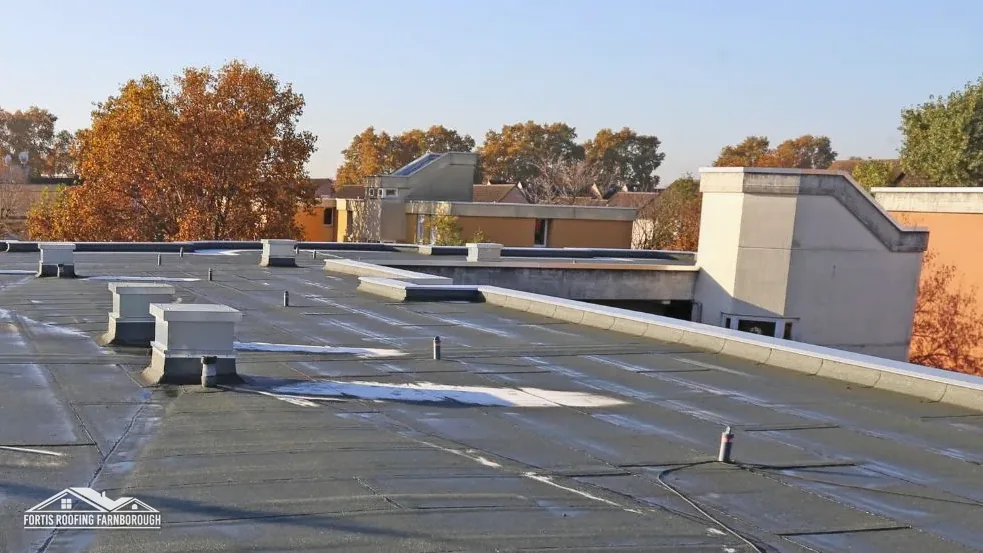
A question that sounds simple, how long does an asbestos roof last, does not have a tidy answer, and anyone who offers you a single number is guessing. Asbestos cement sheeting, the corrugated grey roofing found on industrial units, workshops, farm buildings and garages, was used on many buildings. Two roofs of the same age can be in quite different states, depending on the sheets, the fixings, the weather they have taken and what has been done to them since.
So this post does not give a service life. It does something more useful: it explains what to look at, what the Health and Safety Executive (HSE) says about handling the material, and what the realistic choices are for an owner or landlord. Those choices are to leave the roof alone and manage it, to cover it over with a new roof, or to take it off and replace it.
The safety rules shape everything. In HSE's position, every asbestos cement roof counts as fragile, so nobody walks on one. HSE also puts careful lifting of weathered sheets, with no breakage, in the non-licensed category, and breaking them up changes the category. Ask any contractor which category their work falls into, and what backs that up.
Why no honest lifespan exists
Roofing materials usually come with a typical working life, quoted as a range. Slate, clay and concrete tiles all have published ranges, and so do flat-roof membranes. That habit of quoting ranges is useful for a new roof, because you can plan renewal years ahead. Asbestos cement is a different case. You are dealing with an existing roof whose remaining life depends on condition rather than on a manufacturer's table.
Age tells you little
HSE's guidance for buildings is to presume asbestos wherever construction or refurbishment predates 2000, until testing shows otherwise. That sets a date for caution, not a date of expiry. A roof laid decades ago can still be sound, and a younger one can be damaged by a blow, a failed fixing or years of neglect.
What does move the answer
- Cracks, holes and broken corners in the sheets.
- Heavy moss and lichen that hold water against the surface.
- Rusted or missing fixings and lifted sheets at the ridge.
- Sheets that have been drilled, cut or hit by a vehicle or branch.
- Leaks through the sheets or at the laps.
So what do you do
Treat the roof as something to be assessed by a person who can inspect it safely, not as something with a countdown. A survey describes the condition and recommends one of the three routes below. Our guide to overcladding an asbestos roof covers the middle option in more detail.
What condition tells you
A competent survey reads the roof the way a doctor reads a patient: the history, the symptoms and the tests. Because the sheets cannot be walked on, much of the work is done from a safe position, from inside the building, from the edge or from a platform that spreads the load.
On the outside
The surveyor looks at the sheet surface for surface wear and cracking, at the laps where sheets overlap, at the ridge pieces and at the flashings and gutters. Weathered sheeting is not automatically a problem. HSE keeps weathered asbestos cement that is otherwise undamaged inside the non-licensed category, so long as it is handled with care and left unbroken.
On the inside
From beneath, the surveyor looks for light showing through, for stains, drips and condensation, and for sagging purlins or rusted bolts. This view shows how the sheets are held to the frame, and whether the framework could take the weight of a new covering, should you choose that route.
Testing and records
It is wise to have the material identified, and the survey can flag anything that wants a laboratory test. An asbestos survey is a separate job: MyJobQuote gives a typical UK figure of around £325 (updated 9 September 2026). The result goes in the building's records so that any contractor who works there later is told what is on the roof.
Condition is the whole story, and it is a story that is told in photographs and measurements: sheet counts, laps, fixings and what lies below. The photographs are what you use to decide between leaving, covering over and replacing.
Fragile: nobody walks on the sheets
HSE is blunt about this: a roof of asbestos cement is fragile, without exception. That fact should shape every decision about access.
In practice
A fragile roof will not carry a person's weight. Sheets that look sound can crack and fail without warning, and a fall through a roof of this kind is a serious injury. Age, weathering and moss make the problem worse. Nobody should walk across the sheets to look at a leak, clear a gutter or fit a satellite dish, whatever the building owner or a visitor says.
Why it matters to owners
Industrial units and farm buildings often have several people with reasons to be on the roof: a tenant's engineer, a signwriter, a maintenance contractor. A clear rule helps: nobody goes on the roof without a plan and the right access equipment. Once there is more than one contractor, CDM 2015 wants a principal designer and a principal contractor appointed, while every project needs a construction phase plan.
Signs to put up
Mark the building, and tell anyone who may need access, that the roof is fragile. Keep a note in the building's records. If a roof has already suffered damage, keep people out from underneath it as well as off the top, because broken sheets can release fibres.
Our guide to fragile roof safety sets out the access rules for commercial buildings, and the survey we carry out on commercial roofs begins from a safe position, never from the sheets themselves.
Three routes: manage, overclad or replace
Once the condition is known, the owner has three realistic choices. None is right for every building, and a survey is the way to find which fits.
Manage in place
When the sheets are in good order and nothing leaks, leaving the roof alone and checking it regularly can be reasonable. The advantage is that nothing is disturbed. The drawbacks are that the roof stays fragile, that sheets will go on weathering, and that every future job on the building has to take account of the material. Keep records and review them.
Overclad
Overcladding means fitting a new weatherproof covering over the existing sheets, leaving the asbestos in place under it. It avoids breaking the sheets up and avoids waste, but it depends on the structure being able to carry the extra weight and on the sheets being a sound base. The new roof adds load, so a structural check comes first, and it will need fixings that go through the old sheets. Because that fixing can disturb the material, it is a decision to take on proper advice.
Remove and replace
Removal takes the asbestos off the building, and a new roof follows. This route ends the fragility problem and the need to manage the material, but it is the one with the most rules attached, covered in the next section. MyJobQuote gives a typical UK figure of around £2,750 for removing asbestos from a roof (updated 9 September 2026), and a commercial building will need pricing after a survey.
The cost question is covered in our commercial roof cost guide.
What the rules say about taking it off
Taking asbestos cement off a roof is regulated work, but HSE does not treat all of it the same way.
Non-licensed work
HSE's non-licensed list includes asbestos cement items, roof sheets and rainwater goods among them, so long as the material is lifted with care and not broken up. That includes weathered sheets that are not otherwise substantially damaged. Unbroken sheets removed carefully fall into this category.
Notifiable work
Where the sheets will end up smashed or heavily damaged, the job moves into the notifiable non-licensed category. Short removal jobs on insulating board during a refurbishment are also notifiable in HSE's scheme. A register of such work, the health records, has to be kept for 40 years.
Licensable work
Work on asbestos insulating board that does not count as short duration, according to the risk assessment, is licensable. That is a different job from a cement roof, but it is worth knowing when a roof has board soffits as well.
Waste
Under HSE's guidance the waste goes in two layers of wrapping with a label on it, and it moves under a hazardous waste consignment note. The carrier needs an upper-tier waste carrier registration. The household exemption for hazardous waste does not extend to asbestos waste. So asbestos never goes in an ordinary skip, and you should ask who takes it and where it goes.
Ask any contractor which category the work falls into and why, and ask what they will do if sheets break.
For owners and landlords of commercial buildings
If you own or manage an industrial unit, a shop with a rear shed or a farm building, a few practical steps keep you in control.
Start with identification
Assume a pre-2000 building contains asbestos until you know otherwise, and get the roof and any soffits or boards identified. Get the result on paper and file it with the building's records, since every roofer, electrician and engineer who comes after you needs to be told.
Decide on the route with evidence
Ask for photographs and measurements of the sheets, the laps and the fixings, and a clear recommendation between managing, overcladding and replacing. A recommendation without evidence is not worth acting on.
Plan the work properly
For a re-roof on an occupied building, think about access, how the work is phased and how people will be kept clear. On a business park, scaffold on a private estate road needs no licence, while scaffold on a public highway needs one from the highway authority. For Hampshire addresses that is the county council, whose licences are applied for by the scaffold firm.
One price, in writing
The survey records the roof's condition, and the price comes as one written total for whichever route you choose. If a repair will do, the price covers a repair, and where managing the roof is the better buy, that is the recommendation. Start with the commercial roofing page.