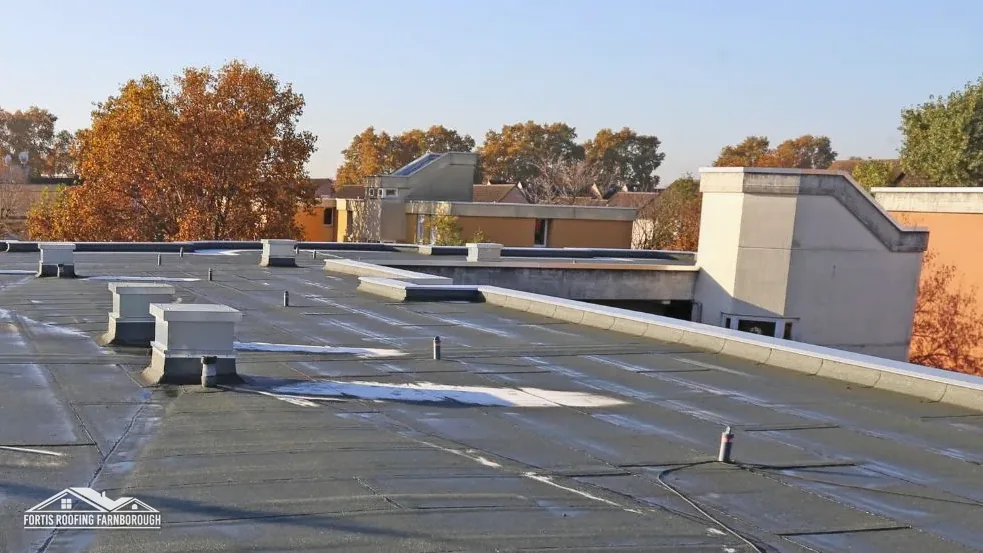
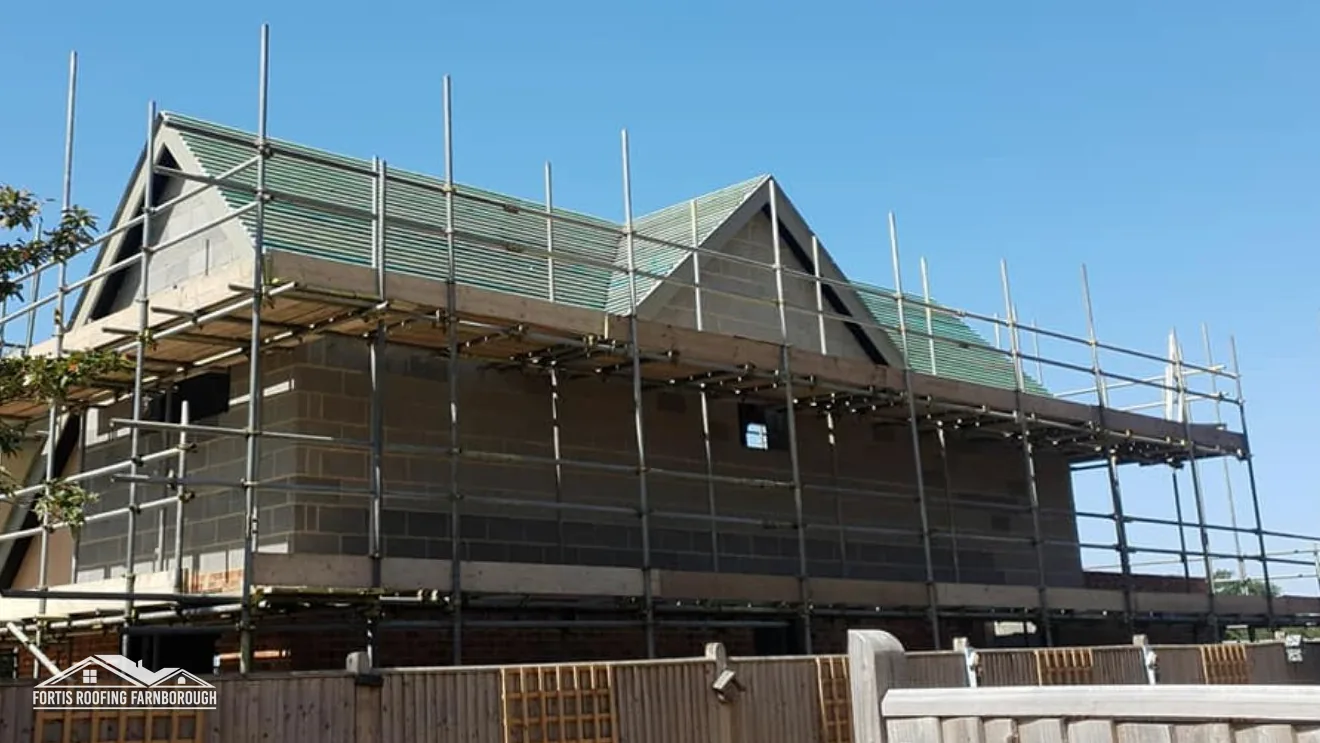
Owners of shops, industrial units and blocks often ask for a rate per square metre. It is a natural question, and it is hard to answer honestly, because two roofs of exactly the same area can differ in price by a wide margin. One has a straight, clear surface and easy access. The other has a dozen roof lights, a failing deck, an asbestos-cement covering and a tenant who cannot be disturbed before six in the evening.
For that reason, this page does not offer a headline figure. Instead, it explains the main things that decide the cost of a commercial roof, gives the typical UK ranges that are published for asbestos survey and removal, and shows how to compare quotes so that you are looking at the same work. It also covers the costs that sit around the roofing itself: access, safety arrangements, phasing and the paperwork.
Everything here describes how prices are built, and none of it is a Fortis price. A firm that quotes a firm figure before surveying your roof is guessing.
Why no standard rate fits a commercial roof
Domestic roofs fall into fairly familiar types. Commercial roofs are more varied, and that variety is the heart of the pricing problem, since each type brings its own materials, methods, risks and lifespans.
A wider range of roofs
One building might carry profiled metal sheets over a warehouse, another fibre-cement sheets on an old industrial unit, a third built-up felt on a block of flats, a fourth pitched slate on a historic office. Each has its own materials, methods and risks.
Much larger areas
The area of a commercial roof can be many times that of a house. Because costs do not scale evenly, a bigger roof is not simply a multiple of a smaller one, and the cost of the lift, the hoist or the crane can matter more than the extra metres of membrane. Set-up costs spread over more area, but the logistics of materials, labour and safety grow.
Use of the building
A vacant unit and a working food factory are different jobs. Where the building is occupied, work may be restricted to certain hours, areas may have to be protected and noise and dust controlled. All of that adds cost, and a contractor who ignores it will find out on the first day, when the tenant asks them to stop.
Condition and history
An old roof with several layers, wet insulation and a failing deck costs more than one with a sound base. The survey has to reveal what is underneath, and not just on the surface.
The sensible approach
Because of all this, a reliable commercial price comes from a survey. Our guide to commercial flat roof refurbishment shows what the survey looks at on a flat roof.
System, area and complexity
The roof system and its details come first in any commercial estimate. They set the baseline for materials and labour.
The system
Built-up felt, single-ply membranes such as PVC, TPO or EPDM, liquid-applied coatings, profiled metal sheeting, fibre-cement sheeting and pitched coverings all differ in material cost, speed of installation and expected life. The choice depends on the roof's use, its structure and how long the owner wants it to last.
New roof, overlay or repair
A new roof is the most expensive option and the longest-lasting, which is why the survey has to justify it with evidence of failing layers, wet insulation or a deck that cannot be saved. An overlay over a sound existing covering costs less, and a targeted repair costs less again. The survey decides which is justified, and a repair is better value when a repair will do.
Area and shape
The total area drives the quantity of materials and labour. The shape matters as much: a simple rectangle is quicker than a roof with many changes of level, valleys and junctions.
Details
Outlets, gutters, upstands, parapets, roof lights, vents, plant bases and edges are where time goes. A roof with many penetrations costs more per unit of area than a clear one, even if the area is the same.
Insulation and Building Regulations
Under Approved Document L, a flat roof given a fresh membrane is treated as renovated, so the insulation rules enter the specification. Ask your building control body early, since it can change the specification.
Materials market
Material prices move over time, and quotes carry a validity period, so ask how long yours holds and what happens to the price if the start date slips. That is another reason a figure from a general guide cannot replace a written price.
Access, edge protection and phasing
Working safely at height has a cost that grows with the size and difficulty of the roof. On many commercial jobs, access and safety are a large part of the total.
Getting onto the roof
Options include scaffold, mobile elevated platforms, hoists, cranes and permanent ladders or stairs. A tall building, a narrow yard or a roof over a busy street each calls for a different solution.
Edge protection and fall prevention
Guard rails, nets and fall-arrest systems are needed wherever people work near an edge or on fragile material. Our guide to fragile roof safety explains why some roofs need extra protection.
The highway
Where a scaffold reaches onto the road or pavement, the highway authority issues the licence, for a fee and with notice. On private land there is no such requirement.
Welfare and site set-up
Toilets, washing facilities, material storage and waste skips are part of running a site, and space for them may have to come from the client's land.
Phasing
If the building has to stay open, the work may be done in stages, one section of roof at a time, or at weekends and in the evenings. Phasing lengthens the programme and adds labour and set-up costs, but it can be the only practical option for an operating business.
Weather
Work on membranes depends on dry conditions, and a programme should leave room for delay. A contractor who has not allowed for this has either priced a gamble or left it out.
Making it visible
These costs sit inside the total we give you, and the survey spells out the access the job needs, so nothing arrives as a surprise halfway through.
Asbestos: survey and removal
Asbestos can transform the cost of a commercial roof job, because it brings extra safety measures, specialist work and disposal.
Why it matters
The HSE's advice is to treat a building from before 2000, or one refurbished before then, as suspect until a survey says otherwise. Fibre-cement roofing sheets, rainwater goods and some soffits can contain it, and the HSE's A14 guidance calls asbestos-cement roofs always fragile.
The survey comes first
MyJobQuote gives the average cost of an asbestos survey at around £325 (Sep 2026, typical UK range). A survey identifies what is present, and its result decides the method, the safety measures and the price.
Removal
MyJobQuote gives asbestos roof removal at around £2,750 (Sep 2026, typical UK range). That figure is for a typical roof, and a commercial building can be far larger. HSE guidance classes careful removal of asbestos cement as non-licensed. Heavy breakage turns it into notifiable non-licensed work, and insulating board work lasting more than a short while is licensable, so the method has to be fixed before the price. Waste travels on a consignment note, double-wrapped and labelled.
Overcladding as an alternative
Covering an asbestos-cement roof with a new sheet system, instead of removing it, can avoid disturbing the material. Our guide to overclad or replace an asbestos-cement roof sets out the choice.
Cost effect
Removal and disposal, specialist labour, air monitoring where needed and extra protection for occupants all add to the price. Our answer on asbestos roof removal cost goes into more detail.
VAT, CDM and the paperwork that costs money
Some costs sit outside the roofing itself. A commercial client should know about them before comparing quotes.
VAT
The standard VAT rate is 20%. Where both businesses are VAT-registered and report under the Construction Industry Scheme, the domestic reverse charge can apply and changes who accounts for the VAT. A homeowner is never charged this way. Ask any contractor whether the quote includes VAT and how it will be treated. Our short answer on VAT on commercial roofing goes through it.
CDM 2015
CDM 2015 applies to commercial roof work. Once two or more contractors are on site, a principal contractor and principal designer are expected, and a construction phase plan is needed regardless. The duties take time and sometimes a fee, so ask who is covering them, and whether the quote includes the plan. Our guide to CDM on commercial roofing jobs explains the roles.
Building Regulations
Some work needs approval from building control, which charges a fee and may require inspections. Where a flat roof's covering is renewed, the insulation standard can change the specification, and ordering the wrong one wastes money.
Planning and consents
A roof in a conservation area, or on a listed building, may need consent that takes time and drawings. Ask the council before anything is ordered, because a refusal after the work is priced throws the programme out.
Surveys and reports
Asbestos surveys, structural reports, moisture surveys and condition surveys are sometimes needed before a firm price can be given, and a good contractor tells you early which of them your roof calls for. They may be separate costs, and the client may commission them directly.
Getting a comparable written price
With so many variables, comparing commercial quotes takes care. The aim is to see the same job priced twice, not two different jobs.
Agree the scope first
Before asking for quotes, decide what is wanted: repair, overlay, strip and replace, or something else. A contractor's survey photographs should support whichever recommendation they make.
Ask each contractor
- What system do you propose, and why?
- Is it an overlay or a strip, and what happens to the old covering?
- How will falls and drainage be dealt with?
- What access and edge protection are included, and who arranges any highway licence?
- How will the work be phased around the use of the building?
- Has asbestos been considered, and what survey will you rely on?
- Are VAT, waste and welfare included?
- When will the price expire, and what happens if the programme slips?
Ask for the evidence
Survey photographs and measurements allow a second contractor, or your own adviser, to check the findings. If a quote has none, ask for some.
Be wary of a figure given by phone
A price without a survey is an estimate at best. For a commercial roof, the saving from a cheap guess can vanish the first time the deck proves worse than assumed.
Our price
A single written total comes after the survey, backed by the photographs. Our commercial roofing page lists the work we survey.