Anyone planning a commercial re-roof wants a number of weeks, and a contractor who names one before surveying the building is guessing. A roof over an industrial unit on a business park, a parade of shops or a block of flats is a different job from the next one along, and the programme follows from the particulars: the amount of roof, its construction, the route to it and whether the building stays in use.
This post sets out the factors that decide the duration, so that you can ask sharper questions and read a programme when one arrives. It quotes no durations, since none could be fair for a building we have not seen. What it gives you is a way to tell a realistic programme from an optimistic one.
It is one of two commercial posts that split the subject. This one covers time. The other covers responsibility, meaning who owns the duty to keep a roof in repair, in our post on who is responsible for the roof on a commercial property. Read both if you are a landlord, a managing agent or a tenant with a repairing lease.
For the full picture of what we do for businesses, start with the commercial roofing page.
Area, covering and the shape of the roof
The first factor is the simplest: how much roof there is. A large roof takes longer to strip, prepare and cover than a small one, in rough proportion, and a roof with many levels, rooflights, plant, parapets and upstands takes longer than a simple expanse.
The covering sets the method
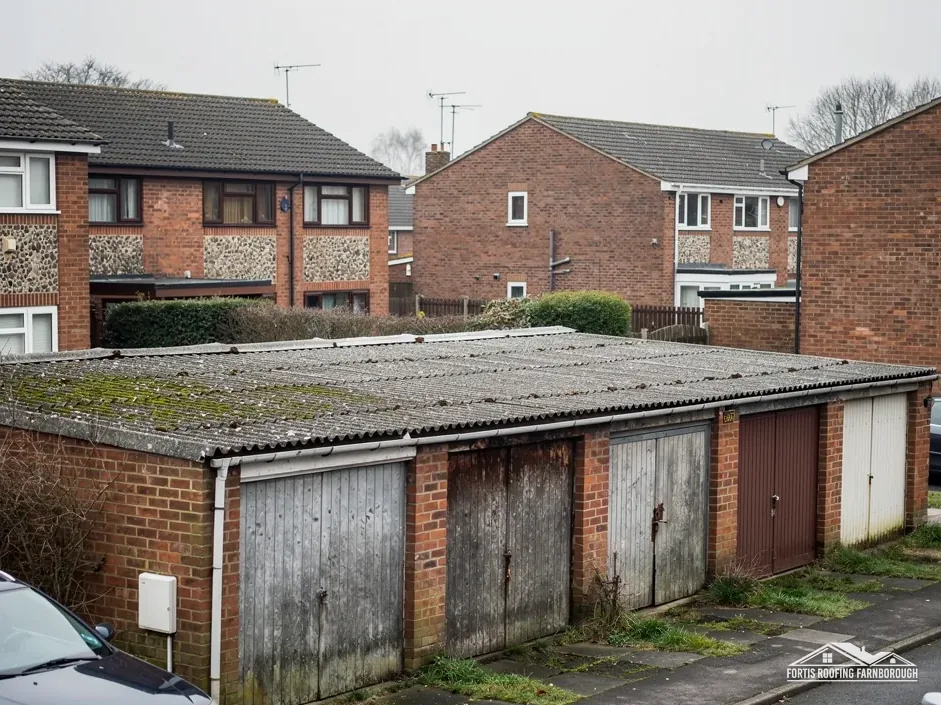
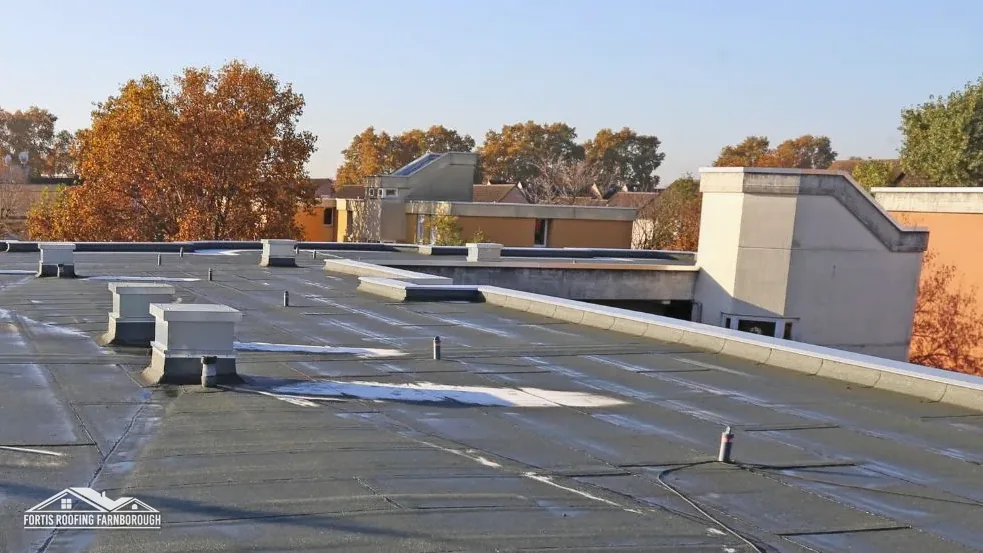
Different coverings are laid in different ways, so the same area can take different time. A single-ply membrane, a factory-made waterproof sheet laid in large pieces and joined at the seams, goes down in a different sequence from a built-up system laid in layers, and both differ from profiled metal sheeting fixed to purlins. Single-ply is the main type used on flat commercial roofs, and the choice of system is part of the survey.
Strip-out and preparation
Removing the old covering is not instant either. What is underneath decides how fast the new one can go on: whether the deck is sound, whether the insulation is wet and needs replacing, and whether the old covering is a type that must be handled with special care. A deck that turns out to be damaged adds time, and so does a discovery of old materials needing testing.
Details take longer than fields
Upstands, outlets, flashings, penetrations for pipes and extract fans, and the junctions with walls are slow to do properly. A roof with many of them takes longer than its area suggests, and these are also the places where water gets in if the work is rushed. A parapet wall with a lead or membrane cover, a valley gutter between two spans, or a bank of rooflights each add their own sequence of tasks.
A survey measures all of this, so that the programme is built on the real roof rather than on a guess.
Phasing work on an occupied building
If the building must keep working, the roof cannot simply be removed in one go. Work is phased, which means the roof is dealt with in sections, each stripped and made watertight before the next one is opened.
Why phasing adds time
A building must never sit under an open roof overnight, so each section is sealed before the crew leaves, and that takes planning and some extra labour. The total time is longer than a single sweep would take, but the building stays dry and in use. Where a tenant runs a process or stores goods that cannot get wet, the phasing may follow what happens inside, and the order of sections can be set by the most sensitive area. Ask for the sequence on a plan, with dates.
Questions to settle early
- Which areas must stay in use, and which can close for a time?
- Are there noise-sensitive hours, deliveries or shift patterns to avoid?
- Where can materials be stored, and where is the hoist or crane to stand?
- Who will be the day-to-day contact on site, and who tells the occupants?
Several occupiers, one roof
On a multi-let building or a block with several tenants, the programme has to work for every occupier. Agree it in writing before the start, and agree how changes will be communicated.
A flat commercial roof that is being refurbished rather than renewed has a different scope, and the time differs with it, so say which you are asking about when you request a programme.
Weather and access, and what the airport adds
Roofing is outdoor work, and weather decides which days are workable. Rain stops membrane laying and wet decks cannot be covered, so a programme should allow for lost days. Cold, damp mornings can delay adhesives and bonding too, and wind makes handling large sheets or panels unsafe, so allowance has to be made for more than rain alone. A good programme says how many days have been allowed for weather and what follows if they run out.
Getting to the roof
How the materials and people reach the roof also affects time. A single-storey unit with a hoist and a lorry parked alongside is easy to supply. A tall building, a roof hemmed in by neighbours or a site with narrow access is slower, because every sheet, roll and bucket has to be carried or lifted further. If a crane is needed for lifting materials, its booking and set-up become part of the timetable.
Near the aerodrome
Farnborough Airport says the area around its aerodrome is safeguarded so that temporary obstacles such as mobile or tower cranes and tall constructions do not affect safe operation. If a job near the airport needs a crane, the airport's safeguarding team is the body to contact early, using the details on the airport's own website. Our post on roof work near Farnborough Airport covers this.
Scaffold on a public road
A licence is the legal route whenever scaffold takes up part of the footway or carriageway: Highways Act s169 puts that licence with the highway authority. Scaffold wholly inside private land sits outside the rule. On a business park, the first question is therefore who owns the estate road. Where the answer is a management company, ask it what its own rules are for deliveries and skips.
Licences and the waiting time before you start
Some of the time sits before the first tile or sheet is touched, because permissions have lead times. A realistic programme lists them.
Highway scaffold licences
At Hampshire County Council, the scaffold firm is the applicant on its customers' behalf. Hampshire County Council asks for 10 clear working days between application and the planned start, and charges £211.90 for the first two weeks and £72 for each further two-week period. It gives no extensions, so a licence that runs out mid-job has to be replaced by a new application.
Wokingham Borough Council likewise puts the application with the scaffold firm. It wants at least 10 working days, and charges £263 for the first four weeks and £163 for each four-week period afterwards.
Surrey County Council, until the councils reorganise on 1 April 2027, charges £208 per 28-day period and asks for at least 10 working days. For addresses elsewhere, ask who applies; the licence is arranged between us and the scaffolder.
Why this matters to the timetable
The length of the licence has to match the length of the job. If the job overruns a licence period that cannot be extended, the scaffold may have to come down or be re-licensed, with a gap. A programme that treats licence and job length together avoids that.
Building control and consents
Some re-roofing needs building control approval, and some buildings need planning consent. Ask early, because each has its own queue.
Who runs the site: CDM roles and plans
The Construction (Design and Management) Regulations 2015, known as CDM, set out who is responsible for health and safety on a construction project. For a commercial roof, the programme and the roles are connected.
One contractor or several
Regulation 5(1) is what brings in a principal designer and a principal contractor, and it bites as soon as a second contractor is on the project. With a single contractor, regulation 15(5) puts the construction phase plan on that contractor. The count of contractors is what triggers the extra roles, whatever has been notified to HSE.
Why a roof job often has more than one
A re-roof can involve a roofing contractor, a scaffold firm that is separately engaged, an electrician disconnecting rooftop equipment, and a crane operator. If those are separate contractors under the client, the roles are needed. It is sensible to settle who takes which role before a start date, and to put the construction phase plan in front of everyone on site. A short briefing on the first morning, covering fragile areas, edge protection, hot work and emergency routes, costs little and shows who is in charge.
Building it into the programme
The plan takes time to prepare, and appointments take time to make. A programme that starts the day the quote is signed has probably left them out. Our guide to CDM on commercial roofing jobs goes through who does what.
The roles are the other half of this subject: time is covered here, and responsibility is covered in the companion post linked above.
Reading a programme when you get one
A written programme is the best evidence that a contractor has thought about your building. Here is what to look for.
A good programme shows
- The stages in order: survey, approvals and licences, mobilisation, strip, new covering, details, completion.
- How much time has been allowed for weather, and what happens if it is exceeded.
- How the work is split into phases, if the building stays in use.
- Who arranges scaffold, hoist or crane, and who applies for each licence.
- The construction phase plan, and the roles under CDM.
Questions that expose a thin one
Ask what the programme assumes about the deck. Ask what happens if damage is found under the covering, and who decides. Ask how the roof will be made watertight at the end of each day. Ask when the programme would be revised, and how you will be told. Ask what the contractor does if a delivery is late or an area cannot be reached on the planned day.
Duration is not the only measure
A quick programme that skips the details is not better than a longer one that does them properly. The aim is a roof that stays watertight, and that is settled at the survey stage. You receive photos and measurements of the roof, a programme in writing, and a single total price. The cost side follows from the survey, and the programme is attached to the written price.