The short answer
Often, yes. Roof work does not have a closed season, but individual days are lost to rain, high wind, ice and hard frost, and some materials are fussier than others. Mortar suffers in frost, a dry-fix system does not rely on it, and a roof is never left open overnight. The weather decides each day, and the plan allows for that.
The weather that stops a day's work
Three kinds of weather halt roof work, and they differ in how long they last.
Rain is the first. A roofer does not strip a slope in the wet, because an open roof lets water into the house. Light showers can be worked around with sheeting, and heavy rain is a reason to stop and cover up.
Wind is the second, and often the more serious. Sheets of ply, scaffold boards and loose tiles become hazards in a gust, and a crew handling long lengths of lead or membrane on a high roof cannot control them. Scaffold is built to be sound in wind, but the work on it is limited when conditions turn rough.
Ice and hard frost are the third. A frosted or icy slope is slippery underfoot, and a roofer does not walk on it until it has cleared. Frozen ladders and a wet scaffold deck add to the risk.
Local weather helps to set expectations. Met Office averages for South Farnborough (1991 to 2020) show annual rainfall near 715 mm over 118 wet days, with around 53 air-frost days. Those are averages, and they say nothing about any particular week, so a winter programme is planned with slack in it.
Mortar, frost and dry-fix systems
Materials react to cold in different ways, and this is where the choice of method matters.
Wet mortar and frost are a poor mix. Mortar that has not set can be disrupted if it freezes, and the bond it forms may be weaker as a result. Mortar is used for bedding ridge tiles and for pointing around chimneys, so those jobs are the first to be moved when a hard frost is forecast.
Dry-fix systems avoid the problem. A dry ridge, hip or verge holds its tiles with mechanical fixings, not by mortar, and the systems are tested to BS 8612. Marley notes that BS 5534, as revised in 2014, no longer lets mortar carry ridge and hip tiles alone, which makes dry-fix a sensible choice in any season. Our guide to dry ridge versus mortar compares the two.
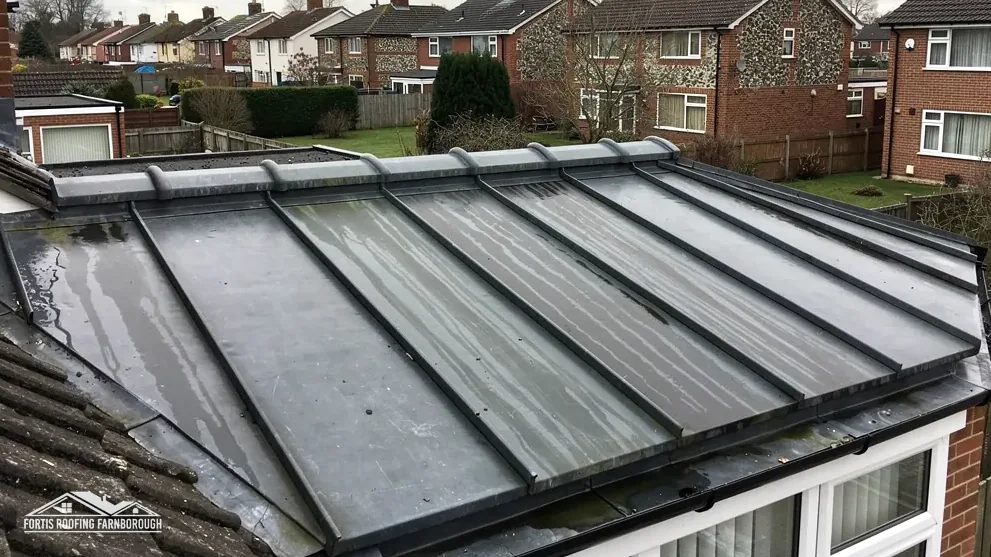
Flat roofing has its own limits. Membranes, adhesives and sealants each carry a minimum temperature in the maker's data sheet, and a good roofer reads it and waits if the day is too cold. Hot-work methods such as torch-on felt add their own cautions.
For any product, the data sheet is the authority, and it can be checked before the day is booked.
Keeping a roof watertight between visits
Winter work is planned in stages that can be closed up at the end of each day. A re-roof goes ahead in sections, so whatever is opened in the morning is covered again before the crew leaves. Underlay is laid, battened and held down, and temporary sheeting goes over anything still exposed.
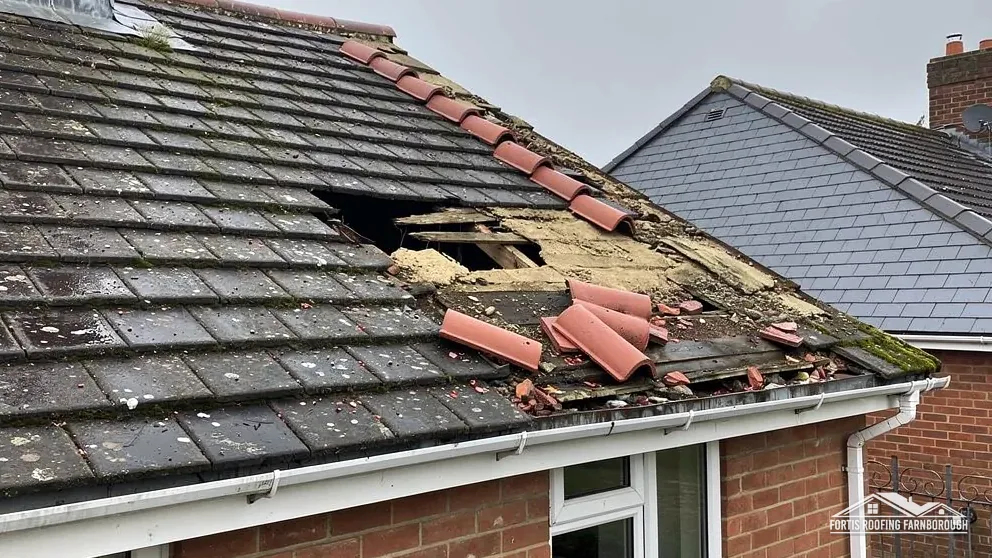
If a spell of bad weather arrives mid-job, the roof is left covered and safe, and the work resumes when conditions improve. Our guide to a temporary roof repair explains how a cover is held down and what it can and cannot do.
You will be told what to expect each day, including when the crew will be on site, what will be opened up and what could change with the weather. That is part of how we keep a site tidy and safe, and it means you are not left guessing why a roofer did not turn up.
A delay for weather is not the same as a delay for any other reason. A roofer who tells you the programme is fixed through the winter, whatever the forecast, is promising something the weather will not honour.
What is worth doing in winter, and what can wait
Some jobs are better done in cold months than left. A leaking roof should be made safe whatever the season, and a repair after a storm is often urgent. Gutters cleared before heavy rain protect the fascia and the wall below them.
Other jobs can wait for milder weather without harm. Repointing a chimney with mortar, a flat-roof overlay that needs warm adhesive or a cosmetic ridge re-bedding are all easier in spring. Our answer on chimney repairs in winter goes into the chimney case.
The best way to sort the two groups is a survey. The survey sorts urgent from not urgent, and the written price covers the whole job as one total. If a job can sensibly wait, you are told, and you can book it for a time when the conditions suit the materials.
If you are unsure whether a problem has to be dealt with now, photograph it and send the pictures with the address. If you are weighing up what to check this season, our roof maintenance checklist helps, and our other work is listed from the homepage.