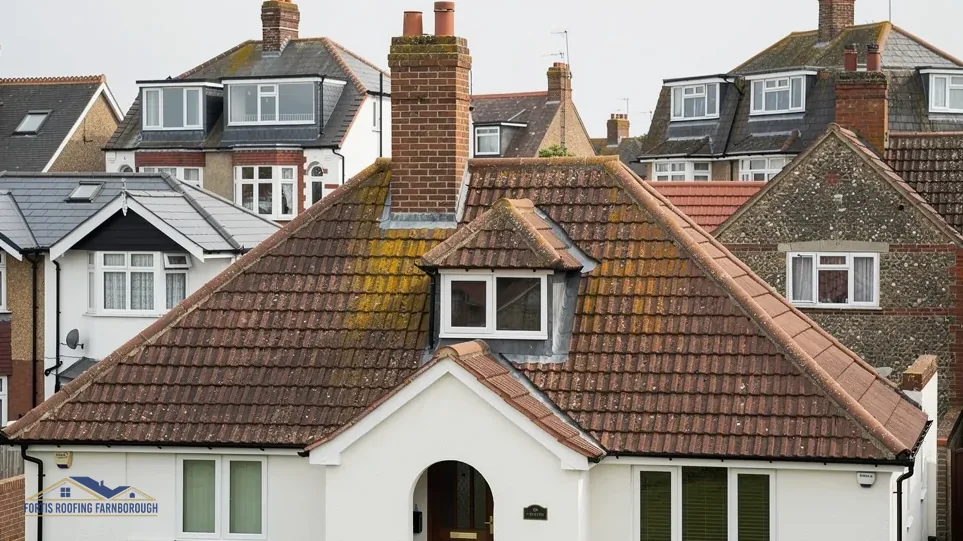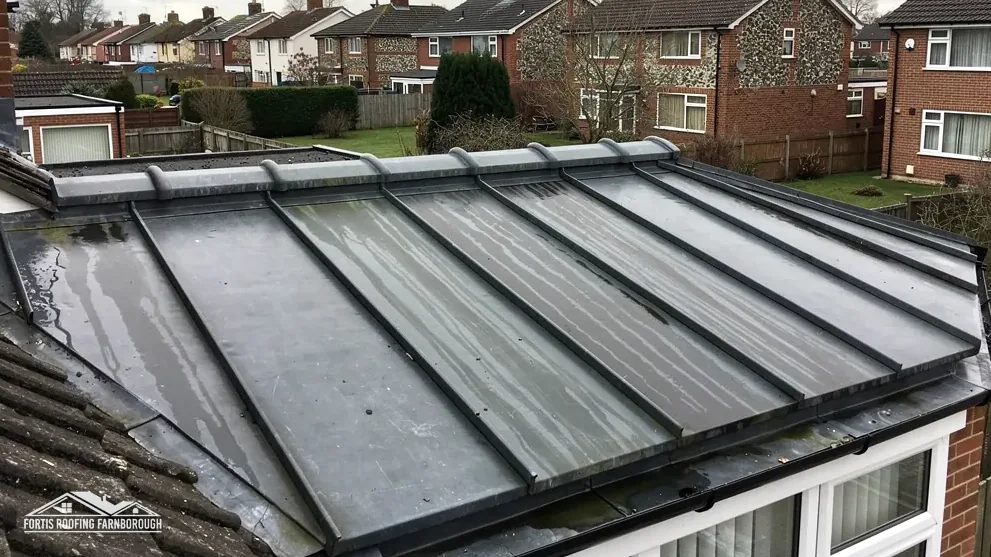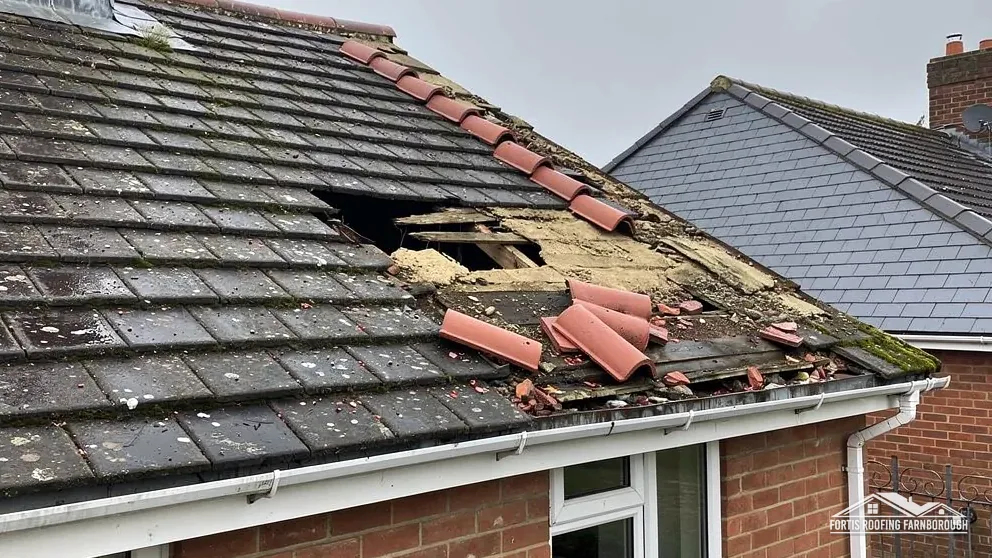
Most roof failures are not sudden. A tile slips a little more with each frost, a gutter joint weeps for a winter before it stains the wall, and a mat of moss keeps the covering wet until something gives. Regular, quick checks catch these while the repair is still small, and a dated record of what you saw is useful if you ever need to show an insurer or a buyer that the roof was sound.
Nobody needs to climb onto the roof for this, and you should not. A pair of binoculars, a torch and a notebook do most of the work, and the loft hatch is as important as the garden. Anything you find that needs a ladder is a job for a roofer, who will have the access and the training to do it safely.
This guide runs through the year and then through the parts of the roof that fail first: gutters, moss, flashings and ridge tiles. It finishes with the rule on nesting birds and bats, because a good maintenance job sometimes has to wait until the animals have finished with the roof.
What a Farnborough year does to a roof
The Met Office climate station at South Farnborough, using 1991 to 2020 averages, shows annual rainfall of about 715 mm, spread over 118 days of 1 mm or more, and around 53 days of air frost. Those are averages for one station, and they say nothing about any single winter. They do show what a roof here has to put up with: frequent wetting, and a good number of nights when water in a crack can freeze.
Why frost and rain matter
Water that gets into a hairline crack in a tile, a mortar joint or a flaunching can freeze and widen it. Moisture held in moss or in a blocked gutter stays on the roof longer than it should. Neither is dramatic, but over several seasons the effect adds up. A roof that was sound in October can have a new weak point by March, and the only way to know is to look. The point of a routine is not to fear the weather but to notice small changes before they become leaks, and to spread the looking across the year so that no single check feels like a chore.
A simple calendar
| Season | What to look at |
|---|---|
| Spring | Tiles and ridge after winter, moss regrowth, loft for damp patches |
| Summer | Flashings and chimney, gutter outlets, evidence of nesting |
| Autumn | Gutters and downpipes once leaves have fallen, loose slates before storms |
| Winter | From the ground after storms, loft for drips and daylight |
Our answer on how often a roof needs inspecting explains how this routine fits with a professional visit.
Checks from the garden and street
Pick a dry day with good light and walk right round the house. Binoculars let you read the roof without leaning over a ladder.
The covering
Look for tiles or slates that have slipped, cracked or gone missing, and for areas where the colour or texture changes. Sagging lines suggest movement underneath. A roof that looks wavy may be telling you something about the battens beneath it.
Edges and ends
Check the verge, the edge at a gable end, and the eaves, taking in the corners where two surfaces meet. Look for gaps, tiles that overhang less than they should, and any mortar that is crumbling or falling away. Daylight under a verge tile or a bird at the eaves is a sign that something has opened up.
Walls beneath the roof
Stains, green patches and damp marks on brickwork under the eaves or on an upstairs bedroom wall tell you that water is arriving somewhere it should not. Follow the stain upward to see where it starts.
What to write down
Note the date, what you saw, where, and take a photograph. A page of dated notes, even a few lines each season, becomes a history of the roof. If something changes between visits, you will know when.
What not to do
Do not climb on the roof, lean a ladder against the gutter or use a hose to test for leaks. Each of those puts you or the roof at risk. If a check turns up a problem, record it and arrange for a roofer to survey it with proper access.
Checks from the loft hatch
The loft shows what the garden cannot. Go up with a torch, stay on boards or joists, and keep your weight off the ceiling between them.
Daylight and damp
Switch the main light off if you can, let your eyes adjust, and study the underside of the slope. Pinpricks of daylight mean a gap. A dark, damp patch on a rafter or on the underlay means water is entering, and it is worth marking the place with a pencil on the timber so that you can see whether it grows.
Condensation
Black spotting on timber and underlay, or water beading on the underside of the covering, points to moisture from inside the house that has nowhere to go. Where the underlay is the non-breathable type, a cold roof needs air to pass through at the eaves. Marley's guidance gives 25 mm at the eaves where the pitch is 15 degrees or less and 10 mm for steeper pitches, and loft insulation pressed into the eaves may close that gap.
Insulation and hatch
Check that insulation is even and not squashed, and that the loft hatch closes with a seal. Warm air leaking through a gap in the ceiling is a common cause of condensation in the roof space.
Pipes and tanks
Stains under a tank or a pipe point to plumbing rather than the roof. It is worth knowing which, before a roofer is blamed or called.
Wildlife
Look for droppings, nests or scratching sounds. If you find them, do not disturb them. The last section explains why.
Gutters, moss and flashings
These three carry water off the roof and keep it out at the junctions. They are where the first signs of trouble usually appear.
Gutters and downpipes
Check twice a year, in late autumn and in spring, and after any heavy storm. Look for overflow marks, sagging runs, leaking joints and plants growing in the channel. Water spilling down a wall in heavy rain is the most reliable sign that a gutter is blocked or has dropped out of fall. Which? gives £75 to £350, ex VAT, to clear all the gutters, front and rear, of a house (Nov 2025, typical UK range).
Moss and lichen
Moss holds water against tiles and can lift edges and block gutters. Marley advises against jet washing a roof, since the jet can damage a tile or slate and shorten its life. The HSE adds that biocides sold only to professionals are not for householders to use. Brushing off loose moss from the ground, or having a roofer deal with it with the right products, is safer than either.
Flashings
Flashings are the strips, usually lead, that seal the point where the roof runs up against a chimney, a wall or a window. Look for lifted edges, gaps in the pointing that holds them in, and any staining below. A stained ceiling next to a chimney breast often begins with a flashing.
When to book a roofer
If gutters are out of fall, a flashing has lifted or moss is thick, book a survey. We photograph and measure what we find before any price is written.
Ridge tiles, verges and chimneys
The highest parts of a roof take the most weather, and a failure there lets water into the loft quickly.
Ridge and hip tiles
The ridge runs along the very top, where two slopes meet, and hips run down the corners of a hipped roof. They are bedded on mortar or held by a dry-fix system. Look from the ground for tiles that are out of line, gaps, cracked mortar or a section that has slipped sideways. A ridge that moves in the wind is not safe, and it can come down.
Verges
The verge is where the roof stops at a gable wall. It is held with mortar or with clips and a dry-fix verge system. Cracks or missing pieces show that the edge is loosening, and wind can lift tiles from a loose verge.
Chimney stacks
Look for leaning, cracked or spalling brickwork, missing mortar, and a cracked flaunching, the sloped mortar collar that keeps the pot in place. A stack with a tilt is a safety matter, so the area below stays clear until a roofer has seen it.
Pots and caps
A missing cap or cowl lets rain down the flue and into the room below. If a flue is unused, ask a roofer about capping it with ventilation in place, rather than sealing it tight.
After a storm
Walk the garden and look for tile fragments on the lawn. They tell you something has come off, even if the roof looks fine from the front. Take photographs before you clear them, in case of a claim.
Nesting birds and bats before any work
A maintenance job sometimes has to wait. Birds nest in eaves and gutters, and bats use some lofts and roof gaps, and both are protected.
Birds
Under section 1 of the Wildlife and Countryside Act 1981, the law makes it an offence intentionally to take, harm or destroy any nest that is occupied or being built. The word intentionally matters: clearing a nest you know about is what the law targets. GOV.UK confirms that no licence is available for building work as such. So if a nest is active, the job around it has to wait until the occupants have gone. We quote no nesting dates, because they vary with the species and the year, so we look at the actual nest instead of the calendar.
Bats
Every bat species is fully protected, along with the places where it breeds or rests, and GOV.UK lists re-roofing and roof repair as jobs that can disturb bats. Under the 1981 Act, deliberately or recklessly disturbing a bat in its roost, or blocking its entrance, is an offence. Under the Habitats Regulations 2017, harming a roost site is an offence even where no harm was intended.
What to do
If you see droppings, hear scratching or find a nest, stop, make a note and tell your roofer before work begins. See our answers on nesting birds and roof work and bats and roof work. Return to the Farnborough roofing homepage for the rest of our guides.