A damaged roof is stressful enough without the paperwork. Slates are on the lawn, a ceiling is stained, and the first question is usually whether the insurer will pay. That depends on your policy, on the cause of the damage and on how well you can show what happened, and nobody outside the insurer can promise the outcome.
What you can control is the order of events. Tell the insurer, make the roof safe, record the damage, and keep every receipt. Those four steps are the same whether the cause was a gale, a fallen branch or snow load, and they protect you if the claim is later disputed.
This guide sets out the sequence, explains what the Financial Ombudsman Service says about storms, shows why claims so often fail on wear and tear or gradual damage, and describes what to do if the insurer says no. Our part is the roof itself. Where water is getting in, stopping it comes before anything else; then comes a survey with photographs of the damage. The claim remains a matter between you and your insurer.
First call: tell your insurer
Ring the insurer before you spend money on anything beyond an emergency cover. The policy documents give the claims number, and many insurers run an out-of-hours line for emergencies, so check yours.
What to have ready
Have the policy number, the date and time you noticed the damage, a short description of what happened and where, and whether anyone was hurt. If a tree or a neighbour's fence caused it, say so, because that can affect who pays.
Ask these questions
- Does the policy cover the cause of the damage, and what is the excess?
- Do you need to approve a temporary repair, and what will they reimburse?
- Do you need to use an approved contractor, or can you obtain an estimate from your own roofer?
- What evidence do they want, and by when?
Do not agree to everything on the phone
An insurer may offer to send its own contractor. That is their right under many policies, and you can listen to the offer, but you are entitled to understand the terms first. Make a note of the time of the call, the name of the person, and anything they promise.
Do not start the full repair first
Pausing the permanent repair until the insurer has had a chance to look is usually wise. A temporary make-safe is different, and the next section covers it. The point is to avoid arguing later that you replaced something before anyone could see it. Our answer on how often to inspect a roof explains why a dated note of how the roof looked before any storm also helps.
Make it safe, then stop
Most policies expect the owner to act sensibly to stop the damage getting worse. That means covering the opening, stopping water getting in, and keeping people away from anything unstable.
What a make-safe looks like
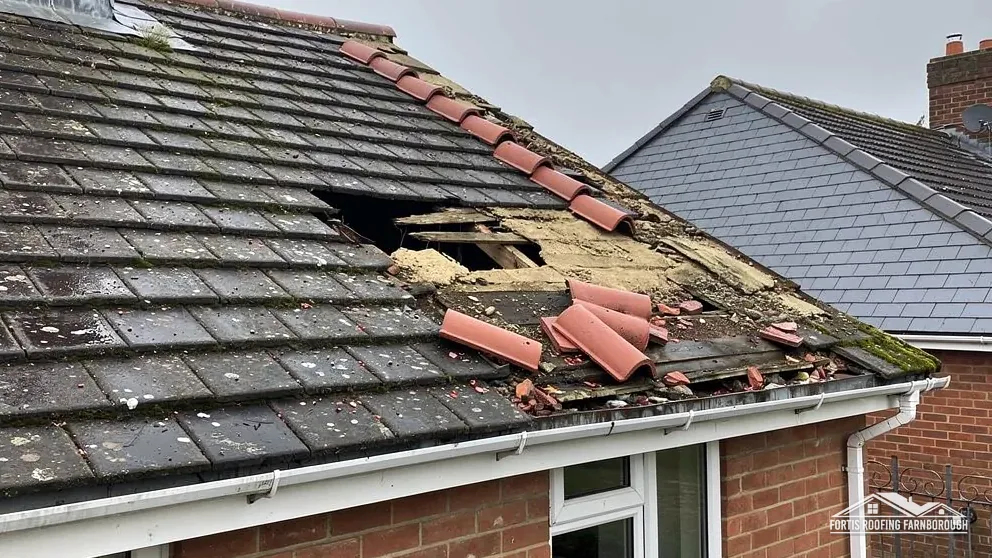
For a missing section of tiles, a roofer usually fixes a tarpaulin or temporary sheet over the gap, secured to the structure so it will not flap loose in the next gust. For a damaged chimney, it can mean removing loose masonry and covering the stack. In a leak, it can mean directing water into a bucket inside and cutting off the entry point from outside.
Why it is not the full repair
A make-safe holds the position. It gives the insurer time to inspect and gives you time to understand what the permanent repair involves. The permanent repair is agreed once the cause is clear, after a proper survey.
Safety comes first
Do not climb on a damaged roof yourself. Wet tiles, loose slates and unsupported timber are hazards, and a fall will cost more than any roof. If water is coming through a ceiling, move belongings, switch off the supply to any wet fitting where you can do that safely, and ring a roofer.
Keep what was removed
Ask the roofer to keep broken tiles, bent flashing or a damaged chimney pot for the insurer's visit. A pile of debris on the drive is evidence that the roof really was broken, and photographing it before it goes is sensible.
Photographs and receipts that carry weight
IStructE, the structural engineers' institution, advises that a claim is much stronger with photographs, because they show an assessor what you saw. We pass the same advice to every customer after a storm, and we remind them to include the whole house in at least one frame.
What to photograph
- The damage from the ground, showing the whole house for context, then closer shots.
- Debris on the ground, with something in the frame for scale.
- Interior damage such as stains, drips and affected furniture.
- The date, if your phone embeds it, and a note of what each picture shows.
Before-and-after records
If you have older photographs of the roof in good order, keep them. A picture from last summer showing sound tiles is a useful answer to a suggestion that the damage was there already. A dated survey from a roofer, with photographs of the roof's condition, plays the same part.
Receipts
Keep every invoice and receipt for temporary repairs, scaffold hire, drying and storage. Ask suppliers for dated receipts and note what each purchase was for. Insurers usually want to see what you spent, and cash payments with no receipt are hard to claim back.
Our survey record
When we survey a storm-damaged roof, we photograph and measure the affected area and describe what we found. You can pass the photographs to your insurer if they help your case. MyJobQuote puts extensive storm repairs at £1,200 or more (Oct 2026, typical UK range), and what you pay turns on your own roof, how it is reached and what is found.
What counts as a storm
Many home policies cover 'storm' damage, and the word is not as simple as it looks. The Financial Ombudsman Service, which settles complaints between consumers and insurers, explains how it approaches the question.
The Ombudsman's view
It says a storm usually involves violent winds, normally with rain, hail or snow, although there can be storms without high winds. Rain, hail or snowfall alone can amount to a storm. Wind force on the Beaufort Scale is one thing it weighs, and it points out that some insurers set their own threshold on that scale, below which they say no storm took place.
Rain, snow and hail
For these, it asks whether there were high volumes in a short period, or whether the snow, rain or hail was extreme.
Your policy's own definition
The definition that matters first is the one in your policy. Read the section headed 'storm' or 'weather', and note any wind speed or rainfall condition in the wording. We do not quote a single wind speed as a national test, because insurers differ.
What the Ombudsman asks about a refusal
Where an insurer has refused, its reviewers look at three things in turn: did a storm occur, does the pattern of damage fit one, and was the weather the main reason the roof failed. Evidence such as a Met Office report for the date, a neighbour's damaged fence or a news item can help show that a storm took place. A dated photo of the weather and the debris matters as much.
Why claims fail on wear and tear
Home insurance is designed to cover sudden events, not the ordinary ageing of a roof. This is the reason most disputes begin.
Common exclusions
Many policies leave out damage that builds up over time and ordinary ageing. Tiles that have slowly slipped over years, a ridge that has been crumbling, flashing that has corroded and underlay that has perished all look like wear when an insurer's assessor arrives.
The existing problem
The Ombudsman will probably not side with the owner where the roof was already failing before the weather came and the owner knew it, or where the storm merely exposed a fault that was there already. A storm can be the day a weak roof finally fails, and the insurer may then say the true cause was the weakness.
What helps
A record that the roof was sound before the storm is the best answer, which is why a dated survey and routine maintenance matter. Our roof maintenance checklist shows what to check each season and how to note it down.
Which? and payouts
Which? reported that only 32% of storm-related claims made in 2024 resulted in a payout. That is a reminder to read the policy carefully and keep a full record, not a prediction for your case.
Repair or replace
If an insurer accepts part of the damage, ask which items they will pay for. A cracked tile may be covered while a whole slope of old tiles is not. Our answer on guarantees and warranties explains how workmanship cover differs from insurance.
If the insurer says no
A refusal is not always the end. Start by asking for the reasons in writing and the policy wording they relied on.
Complain to the insurer first
Write to the insurer's complaints team, state what you disagree with and attach your evidence. Include photographs, the roofer's survey and any independent report. Keep a copy and note the date you sent it.
The Financial Ombudsman Service
Two time limits apply. If eight weeks pass and the insurer has still not issued a final response, you may go to the Financial Ombudsman Service. If a final response has arrived and you disagree with it, you have 6 months from its date. The Ombudsman's service is free and easy to use, according to its own site, and its helpline is 0800 023 4567.
Choosing a roofer in the meantime
Water will keep coming in while you argue, so the temporary cover must stay in place. Ask any roofer to put the permanent repair in writing, and decide whether to go ahead while the complaint continues. Keep every receipt, because they form part of what you are asking the insurer to repay. If the temporary cover starts to fail, say so to the insurer in writing, and photograph it again, because a delay that was not your choice looks very different on paper from one that was.
Help with the roof
The Citizens Advice consumer helpline, 0808 223 1133, can advise on dealing with traders if the repair itself goes wrong.
For the wider picture of how we survey and price a roof, start from our Farnborough roofing homepage.