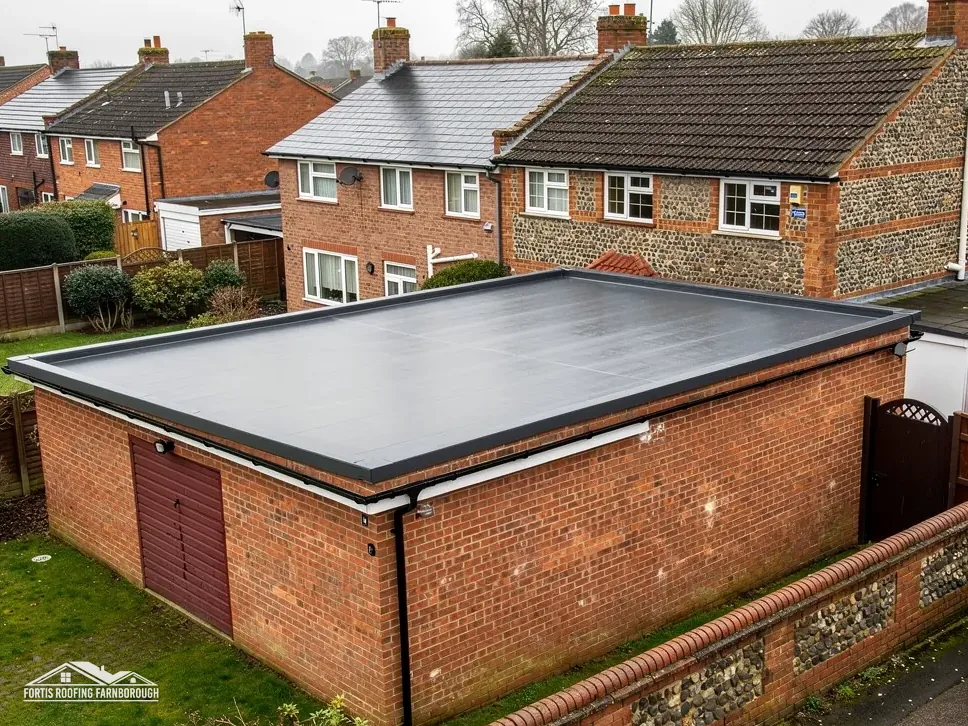
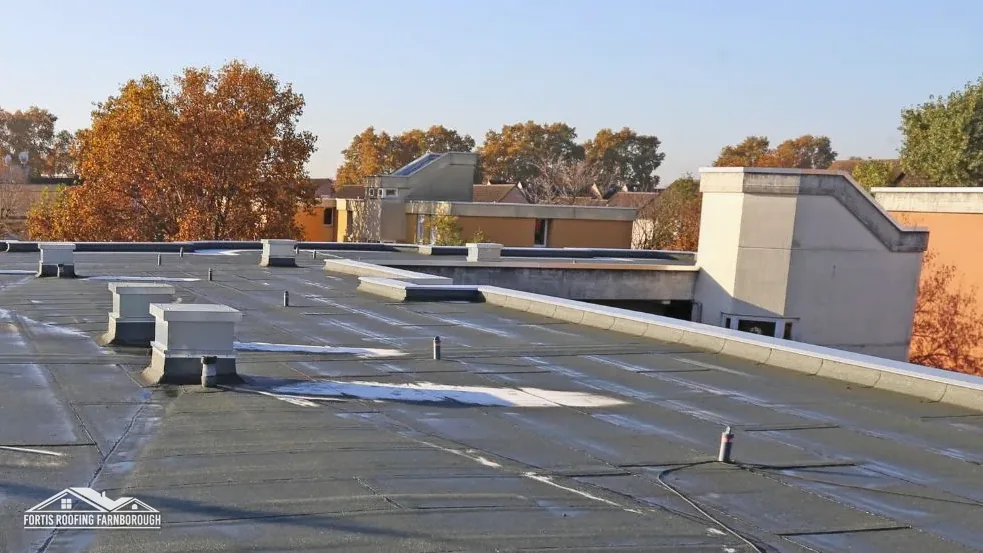
Most roof jobs in Farnborough never involve the airport at all. A semi in Cove or a terrace in North Camp is re-roofed from a scaffold with materials carried by hand or hoisted by a small machine. But some jobs, such as re-roofs on large industrial units and business-park buildings, need materials lifted onto the roof, and that can mean a crane. That is where the airport comes in.
Farnborough is a working business airport with a long aviation history. Its website describes the ground and air around the aerodrome as protected from temporary obstacles that could get in the way of safe flying, and it names mobile and tower cranes and tall constructions. For a roofer or building owner planning a lift, that is a prompt to ask, early, before a crane is booked.
This post explains in plain terms what the airport has said, what it has not said, and how to build the question into the planning of a commercial roof job. It also covers the part that is within our control: the lifting plan, the roles under the construction regulations, and the order of the preparation.
Nothing here is a ruling on any particular site. Only the airport can say whether a given crane is a problem, so the advice is to contact it before the lift is fixed.
What the airport says about safeguarding
Farnborough Airport publishes a page on its airfield specifications. On it, the airport describes itself and its surroundings as safeguarded, so that nothing temporary in or around the airfield, whether a mobile crane, a tower crane or a tall structure, interferes with safe operation of the aerodrome.
The idea behind it
An airfield needs clear approach and departure paths. A tall crane close to a flight path is the kind of temporary obstacle the airport has in mind, and safeguarding is how it keeps track of such things before they go up.
A working airport with a long record
The airport's own site dates its first civil aviation operations to 1989, and says the Farnborough International Airshow takes place every two years. Rushmoor's overview dates the airfield to 1905, when it began life making balloons for the Royal Engineers, and calls the town the birthplace of aviation. Safeguarding today sits on top of that long use of the ground and the air above it.
What the page does not give
The airport's wording sets out the principle. It does not set a trigger distance, a height, or a fee, so the rule cannot be reduced to a number. You cannot judge from the pavement whether your unit is in an area where a lift will need clearance.
That is why the practical step is a question to the airport rather than a calculation of your own. The airport knows its own approach paths and procedures, and the building owner does not, so the question belongs with the body that can answer it.
Which jobs this touches, and which it does not
The wording of the airport's page is about temporary obstacles: cranes, tall plant and tall constructions. It does not mention roofing, scaffolding or ordinary repair work.
Jobs unlikely to raise the question
A repair from a ladder, a re-roof of a house from a standard scaffold, a gutter replacement and a chimney repair do not involve a crane or plant that stands tall above the building. If the materials are lifted by hand or with a small machine, the safeguarding wording is not about you. The airport's page says nothing that ties them to scaffolding.
Jobs that may
A re-roof on a large unit may need pallets of insulation, rolls of membrane or bundles of sheeting lifted onto a high roof, and a mobile crane is a common way to do it. A tower crane on a larger development is a more obvious case. A long-reach machine that rises well above the roof line may also count as tall plant, so it is worth asking about whatever you plan to use.
Other airports are not a guide
You may find rules online quoting a distance or a height for crane notification. Those come from other airports and do not apply here. Farnborough's page does not give a figure, so a number copied from elsewhere is not a safe guide.
If you are unsure whether your method counts, describe it to the airport. A clear description of the machine, its height when working, the dates and the address is what its team will want.
Planning a lift on a business-park re-roof
Re-roofing a large unit is a project with a sequence, and the airport question belongs near the front of it.
A sensible order
- Survey the roof. Area, covering, deck condition, access and the loads that will go on it.
- Decide how materials will reach the roof. A hoist or telehandler, a crane, or a combination.
- Ask the airport early if a crane is involved. Describe the machine and the dates.
- Fix the programme once the answer is in. The crane booking and the roof start follow it.
- Write the lift into the construction phase plan.
Why early matters
If the answer comes late, a booked crane can sit idle or be cancelled. Cancelled bookings cost money and delay the start. It is a small email at the start of the project against a possible hold-up in the middle, and the reply may also change the plan: a different machine, a different date or a different route onto the roof.
Keep every message. A dated record of what you asked and what the airport said is worth more than a recollection when the crane company wants to know whether the lift can go ahead.
Lifting is a planned operation
Whatever machine is used, a lift on a commercial site is planned and supervised, with a clear zone beneath the load and agreed signals. The plan sets out the weights, the ground conditions for the crane and the routes people use. It is also where you record the airport's answer.
Our post on how long it takes to replace a commercial roof shows where these steps sit in a full programme, and the survey is where the whole sequence begins.
CDM roles when a crane arrives
The Construction (Design and Management) Regulations 2015 shape who does what on a commercial roof, and a crane makes the roles easy to see.
The trigger
Under regulation 5(1), once a project has a second contractor, two roles must be filled, and they are the principal designer and the principal contractor. A crane supplier is often separate from the roofer, so a lift can supply that second contractor. A lone contractor falls under regulation 15(5) and prepares the construction phase plan alone.
What this means for a roof job
- Someone is named as principal contractor and coordinates the site.
- A principal designer is appointed to coordinate the design stage.
- The construction phase plan covers the lift, the exclusion zone and the routes.
- Every contractor sees the plan before they start.
The client's part
On a commercial project, the owner or the managing agent is the client and is expected to make the appointments in good time. If you are a tenant on a lease with repairing obligations, see our post on who is responsible for the roof on a commercial property, because the lease decides who commissions the work.
Our guide to CDM on commercial roofing jobs goes through the roles in more detail. For work near the airport, the airport's answer on cranes goes into the same plan, so that everyone on site works from one document.
Heritage buildings and the old airfield site
Parts of the old aircraft research site are protected, and that is a separate question from safeguarding. Rushmoor's overview records seven listed buildings there, picked out for their architectural or historic interest, including a Grade II listed portable airship hangar, two Grade I listed wind tunnels and the Grade II* listed former battalion headquarters, which now houses the Farnborough Air Sciences Trust museum.
Listing changes the route
Listed building consent is the extra approval for a listed building where work would alter its character, and it comes on top of any other that applies. A roof on a listed building is therefore never treated as a routine job. It is worth knowing about because aviation heritage and a modern business park can sit close together in this area, and a unit may stand beside something protected.
Conservation areas near the airfield
Rushmoor has nine conservation areas, and dormers lose their permitted development on that land. Rushmoor's planning team can tell you whether an address falls inside one.
Keep the two questions apart
Safeguarding is about the air and tall objects. Heritage is about the building and its character. A job can raise one, both or neither. Ask each separately, and put the answers in the same file.
We describe the heritage context from Rushmoor's own overview, and we do not describe the roofs of the listed buildings. Any work on them is for their owners, with the right consents and the right specialists.
What to do first, and who to ask
If you own or manage a building near Farnborough Airport and you are planning a re-roof, a short list keeps you on the right path.
Before you book anything
- Get the roof surveyed so the scope is known.
- Ask the contractor how materials will be lifted.
- If a crane or tall plant is proposed, contact the airport's safeguarding team through the details on its website.
- Ask whether a scaffold will stand on a public highway, in which case the highway authority's licence applies; for these Hampshire addresses the authority is the county council.
- Appoint the CDM roles if more than one contractor will be on site.
What to tell the airport
Give the address, the type of machine, its working height, the dates and a contact. Ask for the reply in writing and file it alongside the construction phase plan.
What we do
A survey comes first. We record the roof in photographs and measurements, and set out the lifting method in the written programme, so the airport question is raised before a machine is hired. The survey is followed by a single written price for the chosen method, and where the roof needs only a repair, the repair is what is priced.
For more on what we do for businesses, see the commercial roofing page. The first practical step is a survey.