The short answer
A commercial roof condition survey records the covering, joints, penetrations, drainage and structure of each roof area, with photographs and measurements, and rates what needs doing and how soon. It gives an owner a basis for budgeting and for specifying repairs. MyJobQuote puts a typical roof survey at around £300, though a large commercial roof costs more to inspect.
What the survey looks at
A condition survey is a structured inspection of the whole roof, carried out on site and written up as a report. It starts with the form of the roof: the type of covering, the number of areas, the access routes and the way water leaves the building.
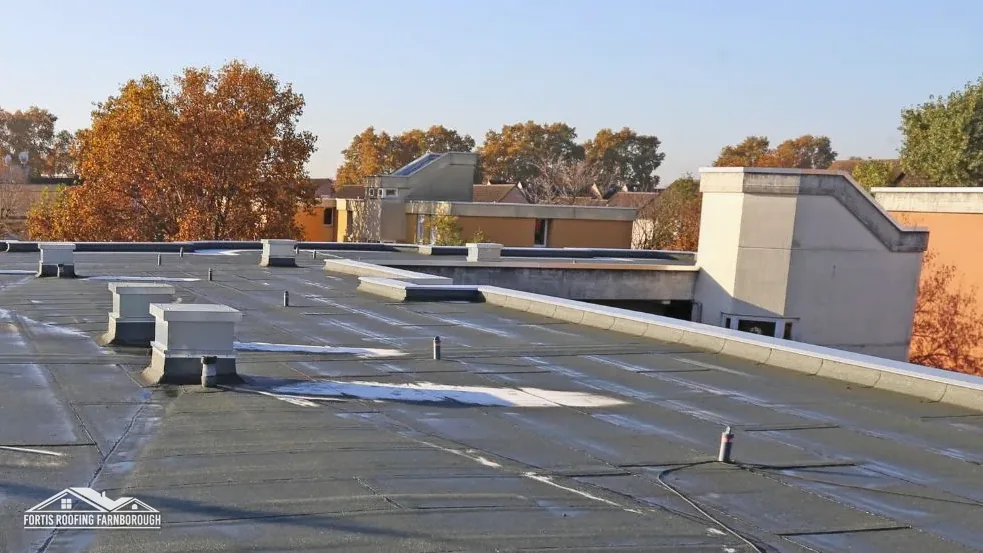
The inspector then works through each part. For a flat or shallow roof that means the membrane or sheet surface, the laps and seams, the upstands at walls and plant, the flashings, the rooflights and the edges. On a profiled metal roof it means sheet fixings, side and end laps, sealants, corrosion and any damaged or fragile sheets. Gutters, outlets and downpipes are checked for blockage and fall, and the roof void or soffit below is inspected where it can be reached.
Drainage gets particular attention. Ponding water, blocked outlets and failed gutters are common causes of premature roof failure, and a survey often finds them before a leak does.
Where the building is old, the inspector also notes any materials that may contain asbestos, and recommends a proper asbestos survey before any work that could disturb them. Our answer on asbestos surveys before roof work explains why.
The survey does not strip the roof or take it apart. It records what can be seen and measured without causing damage.
The photo report
The product of the survey is a report that an owner, a managing agent or a lender can read without visiting the roof. Photographs are the core of it.
A good report is organised by roof area. Each area has a plan or sketch showing where the photographs were taken, a set of images of the covering and details, and a short note on condition and cause. Defects are tied to locations, so that a repair can be priced and found again. Measurements go alongside: lengths of failed laps, areas of damaged sheet, number of blocked outlets.
Findings are ranked by urgency. Items that let water in or present a safety risk come first, followed by faults that will become leaks if left, and then maintenance points. The ranking turns a long list into a plan.
A report should also say what it could not see. Areas that were out of reach, covered by plant or hidden by snow or standing water are listed as limitations, so that nobody takes silence as approval.
You can read the report and check each point against the pictures, which means you are not relying on an opinion. We also record fall risks as part of the same visit, since our guide to fragile roof safety sets out what the access controls need to cover.
What the report is used for
Owners use a condition survey in several ways, and the report supports each.
The first is budgeting. A list of defects ranked by urgency, with a view of the remaining life of the covering, lets an owner plan spending over several years instead of reacting to leaks. Published lifespans give context: Less puts felt at 10 to 20 years and EPDM at 30 to 50, while HomeBuilding gives felt 10-15 years and EPDM 25-30, so the age of a roof tells you where it sits.
The second is specification. The report tells a contractor what to quote for, so that quotes compare like with like. Our guide to a commercial roof maintenance plan shows how a survey leads into regular care.
The third is transactions. Buyers, tenants, lenders and insurers often ask about the roof, and a dated report shows its state. Landlords and tenants use it to settle who is responsible for what.
The fourth is safety and compliance. Anyone commissioning construction work on a commercial building has duties under the CDM Regulations, including making sure the contractor has what it needs to plan the work safely, and a survey is a source of that information.
It is a snapshot, so it should be repeated at intervals and after severe weather.
Cost context and getting one done
On cost, MyJobQuote gives around £300 for a typical roof survey, and its table shows rows of £100 to £200 and £200 to £350. That is a typical UK range for a straightforward property. A larger commercial roof, with several areas, plant and difficult access, takes longer to inspect and costs more, and a firm will confirm a price after hearing about the building.
It helps to have a few things ready: a plan of the building, any earlier surveys or repair records, details of the roof covering if known, and the asbestos register if one exists. Tell the surveyor the purpose, be it a repair budget, a sale or a lease, because that shapes how the report is written.
Access has to be arranged in advance. Roof hatches, ladders and any need for a mobile platform or scaffold should be agreed, as should the times when the roof can be visited in an occupied building.
After the survey, you decide what to do. A report that finds the roof in good order is a useful outcome too, and one that finds faults gives you the evidence to act. Any repair work then follows with a single written price based on the findings. For the repairs that can follow, see the commercial roofing hub.