The short answer
Non-licensed work is work on asbestos materials that HSE permits without a licence, so long as set controls are followed. HSE lists asbestos cement, such as roof sheeting, when it is lifted gently and kept in one piece. Work likely to damage it badly moves up to notifiable non-licensed work, and longer jobs on insulating board need a licence. Health records are kept for 40 years.
Three groups, sorted by risk
HSE ranks asbestos work by how likely it is to release fibres. The rank decides who may do the job, what notice goes to the regulator and which controls apply.
At the top sits licensable work. It covers materials such as sprayed coatings and lagging, and also work on insulating board that will run beyond a short period. Only a contractor holding a licence from HSE can take it on.
The middle group is notifiable non-licensed work. No licence is required, but the enforcing authority must be told before work begins, and workers need medical surveillance. HSE places there asbestos cement that will be badly damaged or broken up, and quick removal of insulating board during a refurbishment.
At the bottom is plain non-licensed work. It still calls for training, a risk assessment and proper precautions, but it needs neither a licence nor a formal notice.
Do not read the bottom group as low-effort. Wetting the material, avoiding breakage, wearing suitable protective equipment and cleaning up carefully all apply. Identification comes before any of it, as our answer on asbestos surveys before roof work explains.
Where cement roof sheets sit
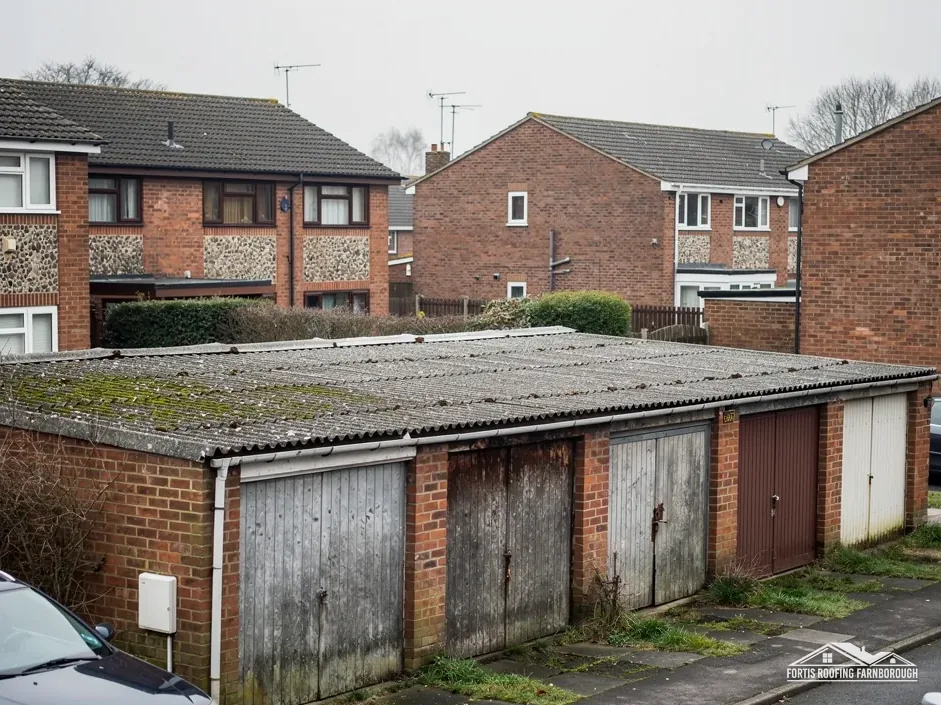
Asbestos cement is the usual roof material, so roof jobs often turn on one question: will the sheets stay whole?
HSE's page on non-licensed work names asbestos cement, with roof sheeting and rainwater goods as examples, and sets one condition. The material must be handled or removed with care, without being broken up. The page adds that weathered cement still counts, provided it is not otherwise substantially damaged.
Method therefore decides the group. Unbolt a sheet, lift it away whole, lower it, wrap it and take it off site, and the job stays at the bottom. Take a hammer to it, run a power tool through it or let it fall, and the same sheet drags the job into the middle group.
This is why a method statement is worth reading. A plan to smash old sheets has chosen the wrong route, whereas careful lifting keeps risk down and cost lower.
Condition plays its part. A crumbling sheet may not survive being lifted, and the survey establishes that before the plan is settled.
Every group shares one hazard, since HSE treats cement roofs as fragile without exception. Falls matter on every job, and our guide to fragile roof safety covers access.
Insulating board and the licence line
Insulating board, known as AIB, is lighter and softer than cement sheet and is treated more strictly. It was used in ceilings, partitions and fire protection, and on the outside it turns up in soffits.
The licence line is drawn by duration. On HSE's rules, a job on AIB needs a licence once the risk assessment says it will outlast a short spell. Brief removal during a refurbishment is notifiable non-licensed work, and only the briefest jobs sit lower.
For roofers the practical issue is the soffit. Fascia and soffit replacement can expose AIB on an older house or unit, and HSE warns that it looks much like board without asbestos. A soffit that might be AIB is therefore tested before it is touched.
Where the survey finds material that needs a licence, a firm holding one must do the work, and anyone else hands it on. Licensable jobs go to specialists.
Group, method and duration are set by the risk assessment, and nobody can tell from the outside which a job will be. The survey comes first, and the commercial roofing hub shows the work we carry out on commercial and industrial buildings.
Records, waste and what an owner should hold
Paperwork forms part of the regime. For notifiable non-licensed work, HSE requires a register of work, essentially a health record for each worker involved, and it must be kept for 40 years. The period reflects how long asbestos disease takes to show.
The person in charge of the building, the duty holder, keeps a different set: the survey, the register of materials and any record of work done. When a roofer finishes, ask for the method statement, the waste notes and a short account of what was done and where.
Waste has its own route. It is wrapped twice, labelled and carried on a hazardous waste consignment note by a registered carrier. Our answer on how asbestos roofing waste is disposed of covers it.
Five questions help when hiring for an asbestos job. How will the material be handled? Which group does the work fall in? Who notifies, where that is needed? Where does the waste go? What records will I receive? A firm working within the rules answers each without hesitation.
Where anything is unclear, take specialist advice before work begins. After a survey, our written price covers the whole scope.