
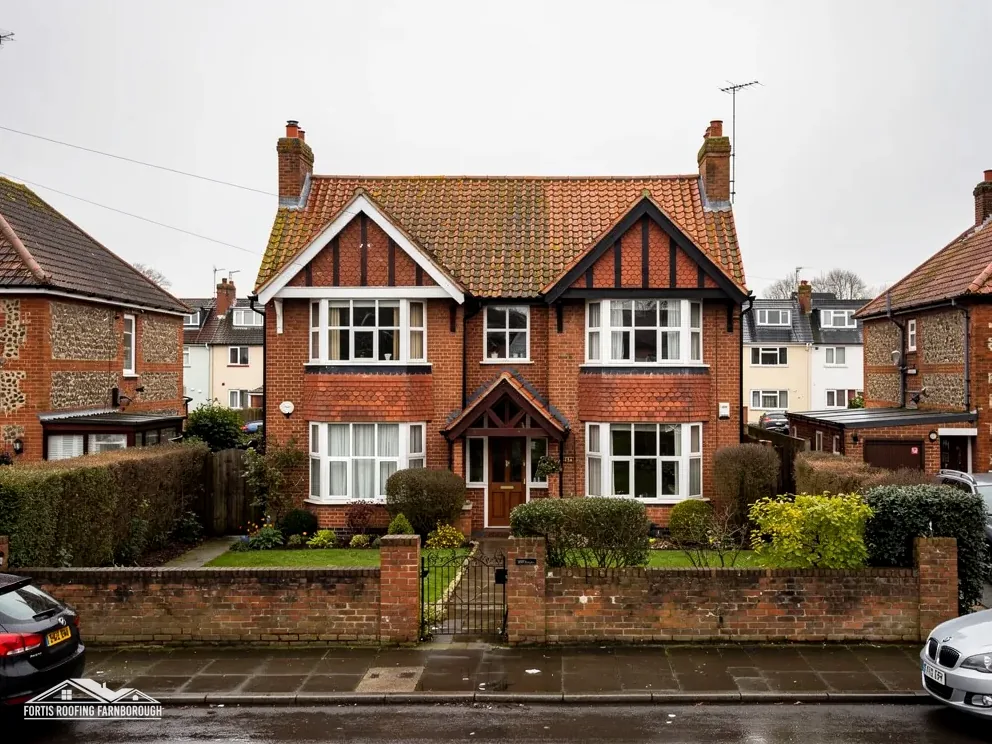
The Bell Inn, Grade II*
A two-storey brick and half-timber inn, apparently 16th-century, with a tiled roof and overhanging square upper bays.

Roofs on brick and half-timber houses around the Bell Inn
The 1923 county history found Waltham St Lawrence almost untouched by the modern builder, its brick and half-timber houses generally tiled. Every slope gets its own survey.
A two-storey brick and half-timber inn, apparently 16th-century, with a tiled roof and overhanging square upper bays.
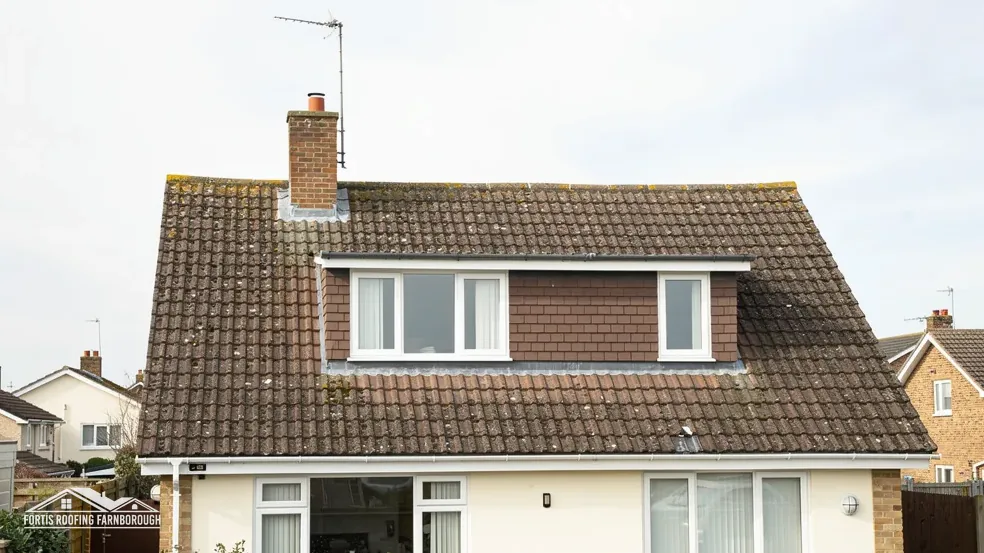
Two cottages at the north-east corner of the open space are brick and half-timber with tiled roofs.

A red brick Elizabethan mansion in the south of the parish, main part built by Sir Henry Neville.
Map of Waltham St Lawrence with White Waltham, Ruscombe, Twyford, Hurst marked around it.
Map data © OpenStreetMap contributors. Loads only when you ask for it.
White Waltham is the neighbour to the east, with Ruscombe and Twyford west, Hurst south-west, Wargrave north-west and Binfield south; Farnborough lies a long way beyond Binfield.
About 16.4 road miles north of Farnborough · Royal Borough of Windsor and Maidenhead (unitary).
Waltham St Lawrence, the record
How the Royal Borough of Windsor and Maidenhead handles building control and scaffold for a Waltham St Lawrence roof, what the 1923 county history records, and what dense listing means for a repair.
| No. | Chapter | The figure it turns on |
|---|---|---|
| 01 | The Royal Borough, re-tiling and scaffold permission | Re-tiling listed by RBWM, 15% weight test |
| 02 | Brick, half-timber and a Tudor mansion | About 1567: Billingbear Park built |
| 03 | A village with 23 listed buildings nearby | 23 listed buildings within 500 m |
Chapter 01 of 03
| Task | Body for Waltham St Lawrence addresses |
|---|---|
| Planning authority | Royal Borough of Windsor and Maidenhead (unitary) |
| Highway authority | Royal Borough of Windsor and Maidenhead |
| Building control | The Royal Borough's own service |
| Scaffold on the highway | Permission from the Royal Borough |
| County council tier | None: Berkshire councils are unitary |
Waltham St Lawrence is a Berkshire village, 16.4 miles by road to the north of Farnborough, counted from the A325 Farnborough Road. The Royal Borough of Windsor and Maidenhead, shortened to RBWM, is a unitary council: planning, the highways and building control all sit inside the one organisation, and no county council stands above it.
RBWM is one council whose own pages name roof work directly. Its guidance names two roof cases: under thermal elements, re-tiling or re-felting, and separately, re-tiling where the new tiles weigh more or less than the old ones. We attribute that to RBWM for its own addresses and no one else. No percentage appears there, so small jobs are judged by the Planning Portal's test of 25 per cent of the building envelope and 50 per cent of the roof, below which no application is normally needed.
So for a Waltham St Lawrence house the sensible course is to treat re-tiling as something building control may care about, and to ask. The national rules also call for approval where a new covering outweighs the old by 15 per cent or more. The survey weighs the roof as it stands and the covering proposed, and a written note of both goes with our price. Because RBWM names re-tiling by weight, we keep that comparison on file: the old covering, the new one, the area and the survey date, ready to show building control if a question comes later.
On the Royal Borough's scaffolding page, anyone placing scaffold or hoardings on the highway is told to obtain the council's permission first. No fee and no applicant are published, and the page cautions that fines of up to £5,000 can follow if a scaffolding licence is breached. We therefore ask who applies when we survey, and agree the dates with the scaffolder before booking.
For a house with a street frontage the scaffold plan is part of the quote. For a house set back behind its own drive, access is usually easier, and the plan says so. Our chimney repairs page sets out repointing, flaunching and flashing at the top of a stack, work the scaffold makes safe to reach.
Chapter 02 of 03
Waltham St Lawrence's record in four figures
The county history for Berkshire, written in 1923, found Waltham St Lawrence almost untouched by the modern builder. Most houses and cottages were old, of brick or half-timber, and the roofs were generally tiled. That is a statement about 1923, when the volume was written, and a century of repairs and replacements has intervened. The 2021 Census counted 1,244 residents in the parish.
The same history calls the Bell Inn a two-storey building of apparently 16th-century date, in brick and half-timber, part plastered outside, under a tiled roof, with square bays overhanging the upper floor. It also names two early 17th-century cottages at the north-east corner of the village open space, brick and half-timber with tiled roofs. An upper floor that overhangs, called a jetty, carries the roof edge beyond the wall below, so eaves and gutters end up higher and further out than they would on a plain brick wall.
That detail changes how the work is done. A ladder cannot reach the eaves comfortably, a scaffold has to stand clear of the projecting bays, and the gutter brackets are fixed into timber that may be soft or weathered. We record the eaves, the bays and the fixings before a price is written, because each affects how the job is carried out.
On a timber-framed house the roof and the frame below it need reading together. When the frame moves a little with the seasons, the tile laps and the flashings at the wall head take that movement, so those are the first places we check for cracks and daylight. Billingbear Park, in the south of the parish, is described as a red brick Elizabethan mansion, its main part built by Sir Henry Neville about 1567. We do not work from this record on the house itself. What it shows is a parish with buildings of several centuries, from a Tudor mansion to cottages built since, and a survey here must be ready for any of them.
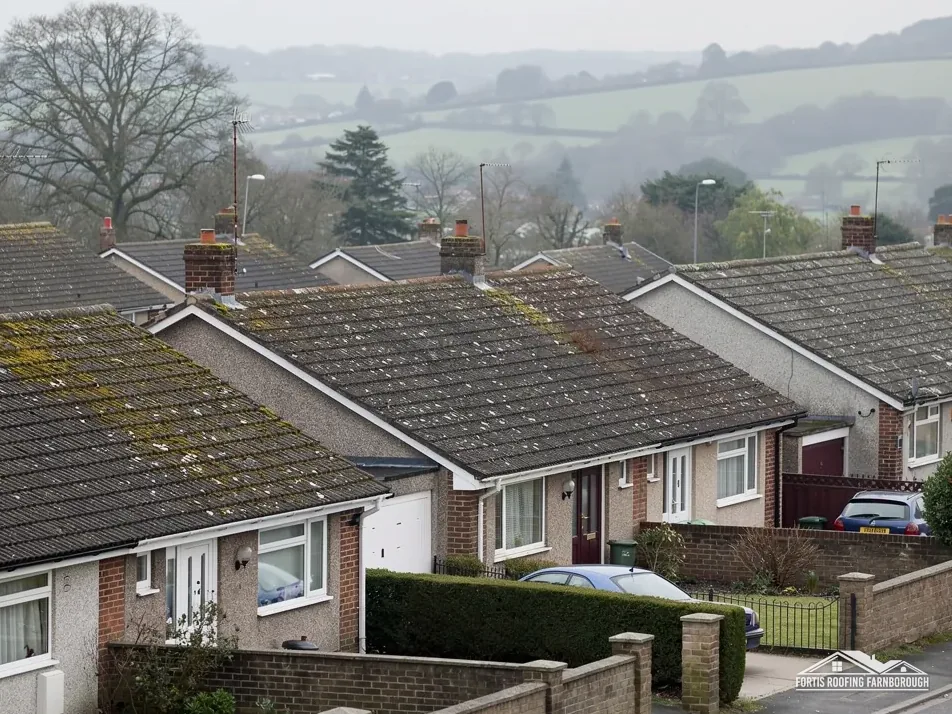
Where a whole slope has worn through, the sensible answer changes, and our roof replacement page sets out each stage of renewing a whole roof covering. Each price rests on the survey photographs, which keeps a small fault from being sold as a large job.
Chapter 03 of 03
| Designation | In Waltham St Lawrence | For roof work |
|---|---|---|
| Grade II* listed inn | Bell Inn (NHLE 1135882) | Listed building consent for works affecting its character |
| Grade II* listed | Church of St Lawrence (NHLE 1117515) | Consent route set by the church's denomination and use |
| Grade II* listed house | Kellinghams (NHLE 1135894) | Listed building consent for works affecting its character |
| Article 4 area on RBWM list | East of Shurlock Road | Covers gates, fences and walls, not roofs |
Historic England's list shows 23 listed buildings within about 500 m of the village point. The Bell Inn, the Church of St Lawrence and Kellinghams are each listed Grade II*. Anyone altering the character of a listed building applies for listed building consent first, with planning permission alongside where it applies, and a roofer who skips that step leaves the owner exposed. Because so many listed neighbours stand close together, a scaffold on one house can sit beside another listed building, so we look at what is next door before the scaffold plan is drawn.
A church follows another route. Should the Church of St Lawrence be in Church of England use, roof repairs need a faculty, while other denominations have their own systems, so who owns it and how it is used come first. If you look after the building, tell us who owns it and we approach the correct body before any price is set.
RBWM's own list of areas where permitted development rights have been withdrawn includes Waltham St Lawrence, East of Shurlock Road, described there as covering gates, fences, walls and other means of enclosure. That is about boundaries, not roofs, and we do not stretch it. For any other Article 4 question on a Waltham St Lawrence address, we ask RBWM.
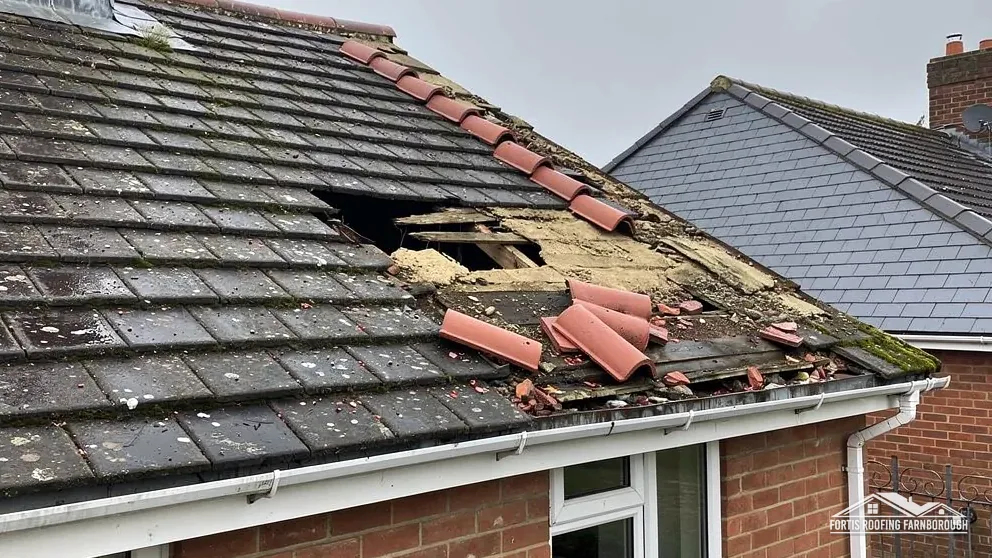
The borough says it has 27 designated conservation areas, and the council map is the check for your address. Within one, a repair that leaves the street view alone is outside planning control under section 55 of the Town and Country Planning Act 1990, whereas swapping the covering, reshaping the ridge or rebuilding a chimney alters the street view, so RBWM hears about it first.
On every house here, listed or not, covering, ridge, verges and stacks are photographed beforehand, the repair is matched and the record filed, and that file is what a conservation officer or buyer's surveyor will ask to see. The same pictures show which parts of an old roof are still sound, so those stay in place and only the failed parts are renewed, which keeps as much of the original fabric as the evidence allows. On a house this old the loft is part of the survey too: rafters, purlins and the underside of the tiles show past repairs, damp staining and daylight that cannot be seen from the lane.
Yes, with a scaffold planned around the overhang. The eaves sit further out than on a plain brick wall, and gutter brackets are fixed into timber that may be soft. We record the eaves and the timber before we price, so the scaffold, the fixings and the lap of the tiles are all in one written plan.
RBWM reports 27 designated conservation areas across the borough, and its conservation team can say whether your street lies in one. RBWM's mapping is consulted for your address before any job that would change the roofline is priced, and the result reaches you in writing.
No. RBWM's list describes it as covering gates, fences, walls and other means of enclosure, so it is about boundaries rather than roofs. The entry names Waltham St Lawrence, East of Shurlock Road, and nothing wider. For any roof question we ask RBWM's planning team whether another direction applies to your own address.
RBWM tells anyone putting scaffold or hoardings on the highway to obtain the council's permission first. Its page names no applicant and publishes no fee, so we ask who will apply when we survey. Scaffold standing wholly on your own drive is a different case from one on the road.
Get your free roof quote
Name the road and the fault you have seen, and a day for the survey will be set.
10-year workmanship guarantee, in writing.





