Ockwells Manor House
Sir John Norreys built it between 1446 and 1466 of half-timber with brick filling round a small courtyard.

Roofs on the Larchfield estate and round Lillibrooke Manor's farm buildings
Cox Green grew from a hamlet in Bray parish into a suburb that merged with Maidenhead after the war. We survey estate roofs and old farm buildings, and price in writing.
Sir John Norreys built it between 1446 and 1466 of half-timber with brick filling round a small courtyard.

The Larchfield estate began after the Second World War, when building across Cox Green exploded.
Lillibrooke Manor and its barn with horse engine threshing house are each listed Grade II.
Map of Cox Green with White Waltham, Maidenhead, Holyport, Bray marked around it.
Map data © OpenStreetMap contributors. Loads only when you ask for it.
White Waltham is the nearest neighbour south-west, Maidenhead runs on beyond Cox Green, Holyport and Bray lie south-east and east, with Waltham St Lawrence and Hurley further out.
About 19.8 road miles north of Farnborough · Royal Borough of Windsor and Maidenhead (unitary).
Cox Green, estates and manors
How to read a roofing quote and what your consumer rights are, what the records say about Ockwells Manor and the post-war estates, and how ridge tiles should be fixed on a roof of that age.

| No. | Chapter | The figure it turns on |
|---|---|---|
| 01 | Reading a quote, and what you can expect | Written quotes from at least 3 traders |
| 02 | Larchfield, mortar ridges and dry-fix | Estate begun after the Second World War |
| 03 | Lillibrooke Manor and the conservation question | Two Grade II listings at Lillibrooke |
Chapter 01 of 03
| Ask | Why it matters |
|---|---|
| How many quotes? | Citizens Advice suggests written quotes from at least 3 traders |
| Is VAT included? | The standard VAT rate is 20 per cent (GOV.UK) |
| Is scaffold included? | Scaffold can be a large part of a total price |
| One total price, in writing? | A single figure is easier to compare than a list of parts |
| What if the work is poor? | Services must be performed with reasonable care and skill |
Cox Green is a residential parish on the south-west edge of Maidenhead, once a hamlet in the west of Bray parish, with 7,606 residents at the 2021 Census. The Royal Borough of Windsor and Maidenhead looks after planning, roads and building control for it. This first chapter is about the document you will be handed, the quote, because a clear one is the best protection you have.
Citizens Advice recommends gathering at least 3 quotes in writing before choosing a trader. When they arrive, compare four points: whether VAT is in the figure, whether scaffold is, whether the price is a single total in writing, and what survey stands behind it. A number with no survey behind it is a guess.
GOV.UK sets the standard VAT rate at 20 per cent, while installing certain energy-saving materials is zero-rated from 1 May 2023 to 31 March 2027, reverting to the reduced 5 per cent rate from 1 April 2027. If a price excludes VAT, add a fifth of it to see the real cost.
Under the Consumer Rights Act 2015, anyone supplying a service owes reasonable care and skill, and a reasonable time where no time was agreed. The Act also bars a trader from contracting out of those duties and lists your remedies. Separately, section 308 of the Digital Markets, Competition and Consumers Act 2024 obliges a trader to tell you what dispute-resolution route exists if you are unhappy with the result. Ask for that information before you sign, not after a disagreement starts.
For advice, the Citizens Advice consumer helpline is 0808 223 1133. We are roofers and not solicitors, but the survey photographs, the written method and the written price are the papers that help in any disagreement, and you receive all three.
A firm that will not put its price in writing, or that presses you to decide on the day, is one to walk away from. A fair price will still be fair after a few days of thought.
Our own quote is one total price in writing, after a survey, with photographs of your roof beside it. If you want to compare it with two others, that is a sensible thing to do, and the photographs let anyone else see what we saw.
Chapter 02 of 03
Cox Green: manor, lanes and estates
Cox Green Parish Council's history says that by the mid-1700s buildings lined Lock Lane, Cox Green Lane, Cox Green Road, Ockwells Road and Kimbers Lane, and that by 1900 building had reached along Cox Green Lane, Curls Lane and Highfield Lane. The Larchfield estate was begun after the Second World War, and the later 20th century saw an explosion of building in which Cox Green, Woodlands Park and Altwood merged with one another and with Maidenhead.
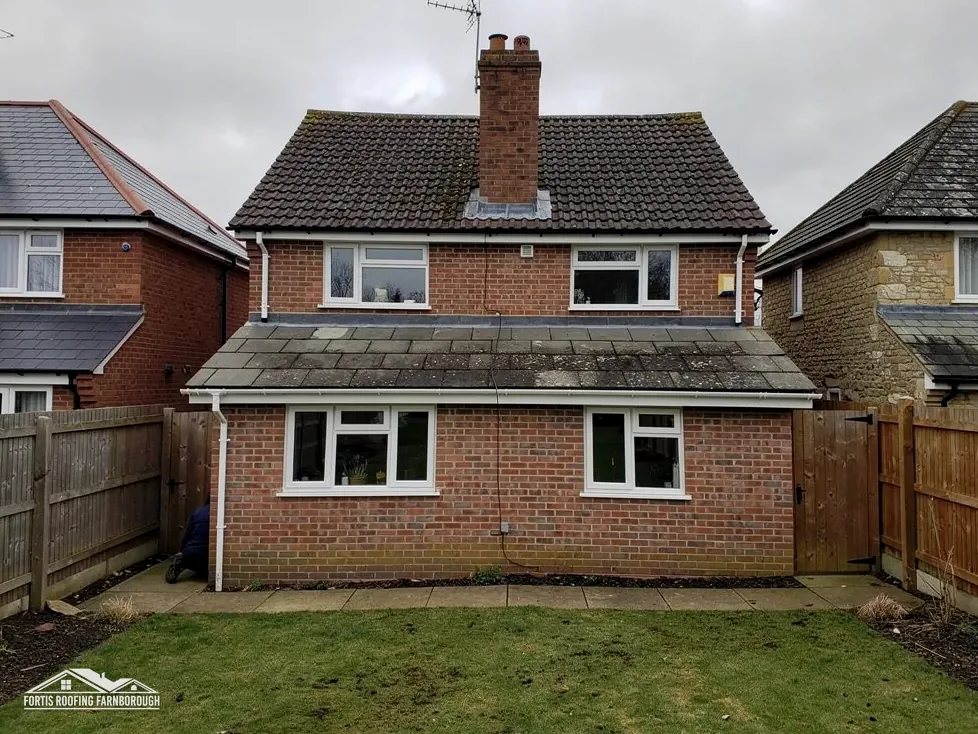
Houses put up after the war are now seven or eight decades old, and we survey every estate roof on what it shows. What we do know is how roofs of that age behave, and the ridge is usually the first thing to need attention.
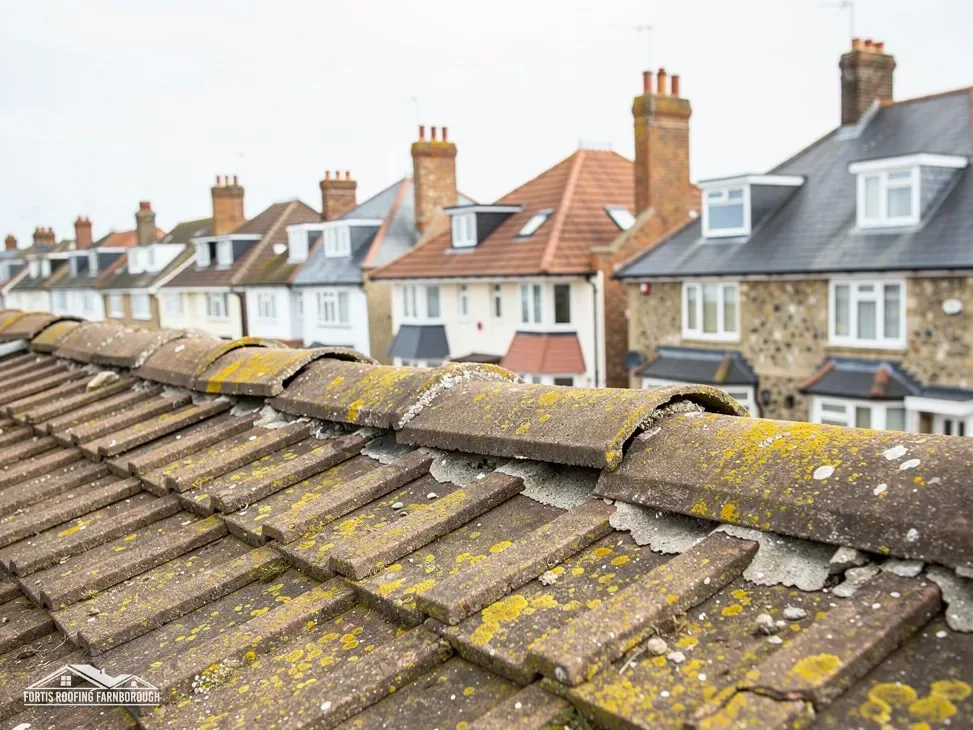
Older ridge tiles sit in mortar. Marley explains that the 2014 revision of BS 5534 recognised the limits of mortar as the only fixing for ridge and hip tiles, because its holding strength could not be counted on by itself. BS 8612 specifies the dry-fixed alternative, in which clips and fittings hold the tiles. Marley adds that meeting BS 5534 is not a legal requirement.
A post-war ridge that needs re-bedding is therefore a natural point to add mechanical fixing. Cracked, crumbling mortar admits water and lets tiles lift in a gale, and putting it right costs less than the damage it causes.
Every ridge and verge is photographed on a survey. We note where mortar has gone, where a tile rocks under pressure and where a verge tile has slipped. If the covering below is sound, the price covers the ridge and verge alone.
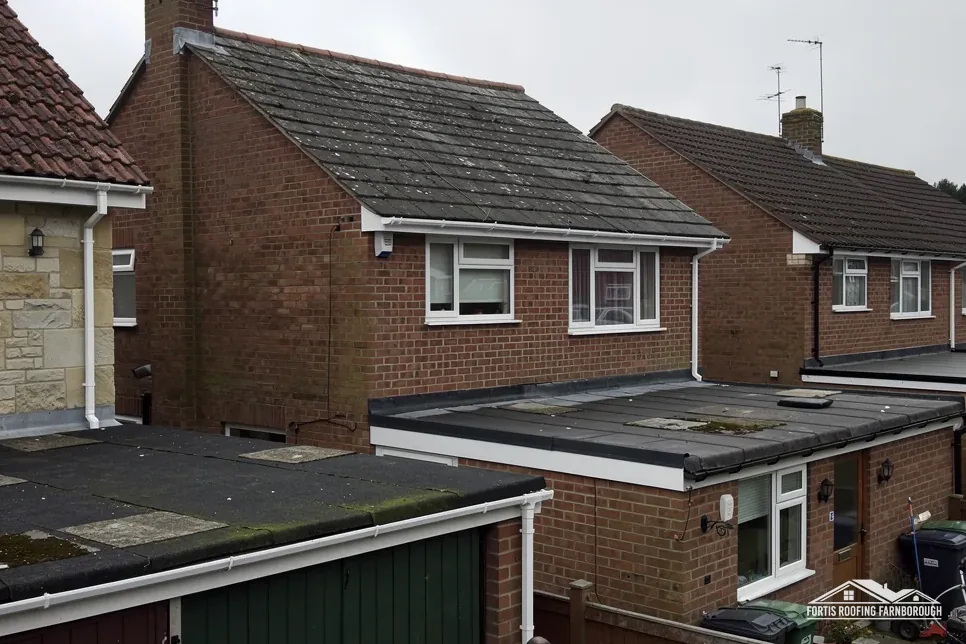
Many estate houses also carry a flat-roofed porch, garage or extension, and the flat roofing page covers those, while the pitched roofing page deals with the tiled slopes. One survey takes in both.
Gutters on a house of this age deserve a look as well. Plastic or cast, they sag with years of leaf weight, and a gutter that drips at a joint stains the wall below. The survey notes each fault so that one visit can put the whole roofline right, and a downpipe that empties onto a path is traced and its route reported, because water at a wall foot causes damp that no roof repair will cure.
Chapter 03 of 03
| Subject | Position |
|---|---|
| Lillibrooke Manor | Listed Grade II (NHLE 1136305) |
| Barn and Horse Engine Threshing House | Listed Grade II (NHLE 1136307), at Lillibrooke Manor |
| Listed buildings nearby | 3 within about 500 m of the centre |
| Conservation areas | Check your address with RBWM |
| RBWM conservation areas | 27 designated across the borough |
Lillibrooke Manor carries a Grade II listing, as does the barn with a horse engine threshing house at Lillibrooke Manor, and three listed buildings stand within about 500 metres of the centre of Cox Green. Listing leaves permitted development rights in place, but listed building consent is also needed for anything touching a building's character.
The 1923 county history adds Ockwells Manor House, built between 1446 and 1466 of half-timber with brick filling and grouped round a small central courtyard. We look up its listing on the National Heritage List before any work, and it shows how different Cox Green's oldest buildings are from a post-war estate, and how far the parish has travelled from a half-timbered courtyard house to a suburb of nearly eight thousand people.
Whether a Cox Green address lies in a conservation area is for the council to say. RBWM says it has 27 designated conservation areas across the borough, and its planning team can say in a short reply whether a particular house falls inside one.
For a listed building the sequence is set: survey, written method, consent, then scaffold. If you are unsure whether a house is listed, the National Heritage List can be searched by address, and we run that search when a survey begins.
A threshing barn has a long roof with few openings, and a horse engine house is an attached structure with its own roof and its own junction with the barn. Where two roofs meet, the valley or abutment flashing is a recurring weak point. Old farm buildings were also altered over time, with openings widened, lean-tos added and roofs patched, and each alteration leaves a joint that the survey has to read.
Our survey photographs those junctions, the verges, the ridge and the eaves, and measures the tiles and battens. If the evidence points to a full re-cover, the roof replacement page sets out what that involves.
Whatever the building, nothing is ordered until the consent position is clear. Materials bought early for work that is later refused are a waste, and the survey record avoids that. It also helps a conservation officer, who can see the same photographs, measurements and written method that we do.
It is a roofing job. Ridge tiles were often bedded in mortar, and Marley notes that mortar cannot be the sole fixing for them any longer, so a re-bed often adds mechanical fixing. We photograph the ridge, press the tiles and price only the ridge and any slipped verge.
No. Citizens Advice recommends collecting at least 3 written quotes first. Check each for VAT, scaffold, the survey behind it and one total price. The Consumer Rights Act 2015 also entitles you to reasonable care and skill from whoever you choose, whatever the quote says.
RBWM lists 27 designated conservation areas in the borough, and its planning team can confirm whether your house is inside one. Any visible alteration is put to the council before a price is set, and the reply is filed with your survey photographs.
If the barn is listed, as the one at Lillibrooke Manor is at Grade II, yes: work touching a listed building's character needs listed building consent from RBWM. We photograph the roof, describe the like-for-like repair and seek consent first, before scaffold or materials are ordered.
Get your free roof quote
Name your Cox Green road and what you noticed, and we will photograph the ridge, gutters and every slope.
10-year workmanship guarantee, in writing.