Gabled cottages in old clay
RBWM's appraisal records older gabled cottage roofs now all in old red clay tiles, though some were perhaps thatched.
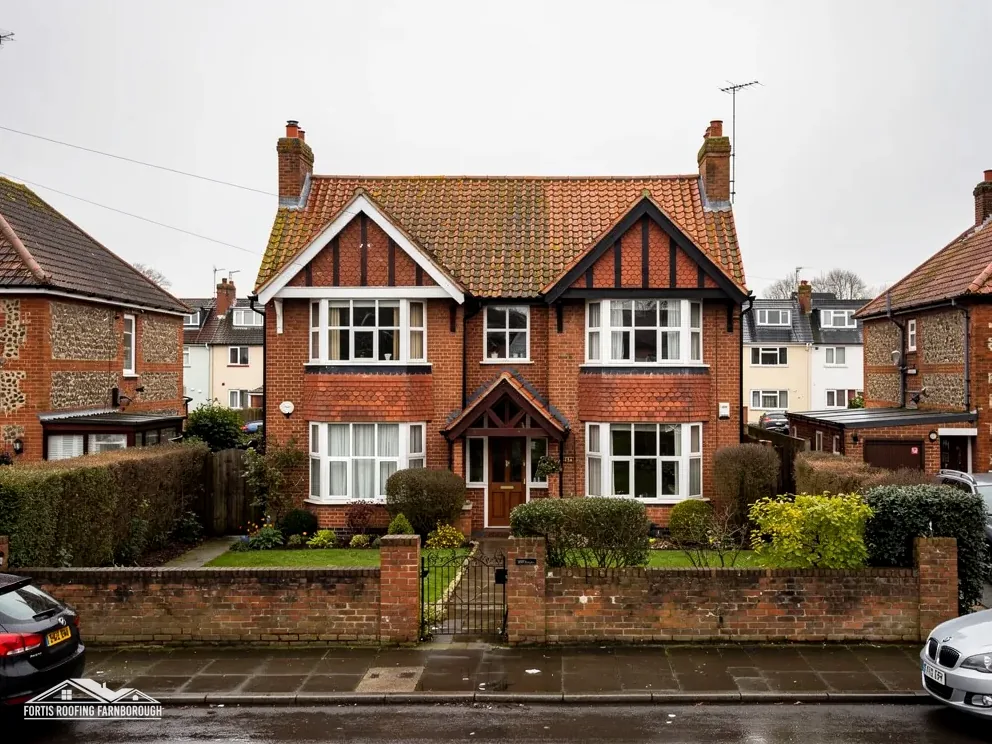
Roofs round Holyport's green, from old clay tile to lower-pitched slate
Holyport's cottages and hall houses around The Green carry clay tile and slate from several centuries. We survey each slope and tell you what it needs before any price.
RBWM's appraisal records older gabled cottage roofs now all in old red clay tiles, though some were perhaps thatched.

Former medieval hall houses have hipped or half-hipped roofs, and slate arrived by train in the 19th century.
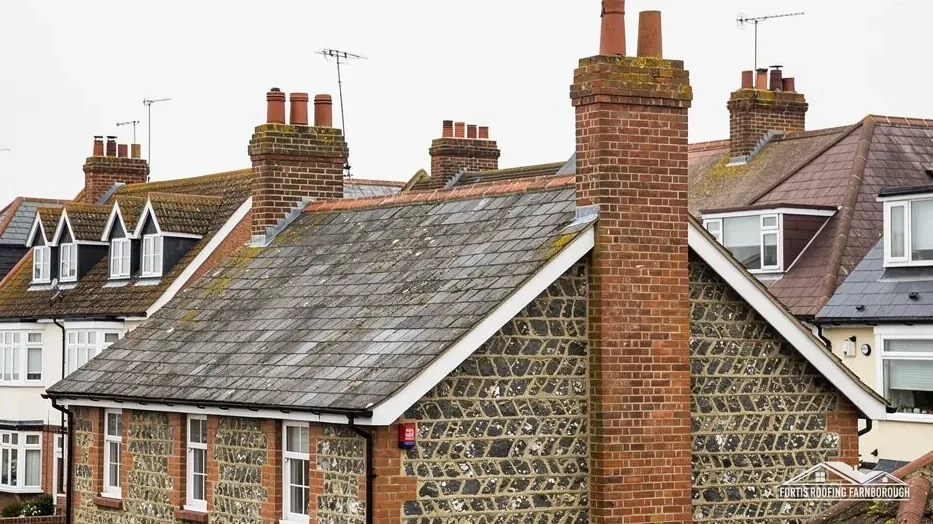
Some 18th and 19th century houses have rendered walls and lower-pitched slate roofs, says the council's conservation area statement.
Map of Holyport with Bray, Cox Green, Maidenhead, White Waltham marked around it.
Map data © OpenStreetMap contributors. Loads only when you ask for it.
Bray lies to the north-east, Cox Green to the north-west, Maidenhead to the north, White Waltham to the west, Dorney to the east and Taplow to the north.
About 18.3 road miles north of Farnborough · Royal Borough of Windsor and Maidenhead (unitary).
Holyport, tile and slate
Which council deals with a Holyport roof, what the conservation area statement records of its tile and slate, and the published life of each covering, with every figure tied to its source.

| No. | Chapter | The figure it turns on |
|---|---|---|
| 01 | One council for planning, highways and building | Royal Borough covers all three |
| 02 | A wet, low-lying green, and bricks from Paley Street | Conservation area since April 1968 |
| 03 | Clay and slate: how long each covering lasts | Clay 60-80 years, Welsh slate 100+ |
Chapter 01 of 03
Holyport's councils in four facts
Holyport is a Berkshire village, a drive of 18.3 miles from Farnborough when you start at the A325 Farnborough Road. No county council sits above Holyport. The Royal Borough of Windsor and Maidenhead, known as RBWM, is a unitary authority, so a single body handles planning, the roads and building control for a Holyport address. That makes a job simpler to plan, because there is a single place to ask.
RBWM's building control pages are specific about roofs. Under its heading on renovating or replacing thermal elements, the council lists re-tiling and re-felting, and adds the case of a roof re-tiled with tiles heavier or lighter than the ones removed. That wording is RBWM's own and applies to RBWM addresses. It is not a national rule, and the council publishes no percentage. The Planning Portal's national test remains the one to measure against: less than 25 per cent of the building envelope and less than 50 per cent of the roof.
In practice the question is settled ahead of a re-roof. A few refixed tiles are a repair, and the survey photographs show how many. A full re-tile, or a switch from clay to a heavier covering, is the kind of job RBWM's list points at, and we raise it at the survey with the weight of the old and new coverings written down. Because one council handles all three duties, the order is short: survey, written price, scaffold licence if the job needs one, then a building control notice if RBWM or a registered approver is involved. You get each date in writing, so the sequence is never a surprise, and the scaffold plan is agreed before the first tile is lifted.
Under section 169 of the Highways Act 1980, the highway authority licenses any scaffold set up on a pavement or road. RBWM states that scaffolding on the highway needs the council's permission, and it supplies separate residential and commercial forms. No fee or applicant is published, so the licence is arranged with the scaffolder before dates are agreed. RBWM also states maximum fines of £5,000 for not complying with a scaffolding licence, so it is worth having in writing.
Chapter 02 of 03
| Record | What it says |
|---|---|
| Conservation area | Holyport, designated April 1968, amended October 1994 |
| Listed Grade II | 1, 2 and 3 Ascot Road (NHLE 1117485) |
| Listed Grade II | 1 to 12 Pamela Row (NHLE 1312796) |
| Listed Grade II | Anne Duel's House (NHLE 1117465) |
| Nearby listed buildings | 14 within about 500 m of the village centre |
Holyport is a low-lying village on a large green on flat farmland. RBWM's conservation area appraisal says it stands on London Clay with permanently wet subsoil, that rapid run-off from The Bourne has led to winter flooding and wetness, and that the Bray Drainage Act of 1818 improved what had been marsh. A roof never sits in the ground, but a wet village does mean gutters and downpipes have work to do.
Clearing outlets matters here more than on a hillside, because the ground has few places to put water. A gutter that overflows at the corner of a gable pours onto a wall that already stays damp, and the staining and frost damage show up years later. So on a Holyport survey we trace every downpipe to its drain, photograph each outlet and run a hose to confirm the flow where the access allows.
The Victoria County History of Berkshire, written in 1923, recorded that plastic clay from Paley Street was used for brick-making in Holyport. That shows the village was making its own brick by then, which fits the appraisal's description of local brick and clay tiles around The Green. It cannot say what any particular house carries now. Only a survey does that, slope by slope. The brick-making history is simply a reason to expect old clay and brick, and a reason to match them with care when a repair is needed.
The listed buildings are the ones where the work is most careful. Numbers 1, 2 and 3 Ascot Road, the twelve houses of Pamela Row and Anne Duel's House are all listed Grade II, and the National Heritage List shows 14 listed buildings within about 500 metres of the village centre. For any of them, work to the covering, the ridge or the chimney that would affect the building's character needs listed building consent from RBWM as well as skill.
Listed Grade II
We record what is up there before touching it: the size and colour of the tiles, the bonding of the ridge, the lead round the stacks. That record is what makes a like-for-like repair a repair, and it goes in your file with the written price. If the house is listed, the same photographs go to the conservation officer with the application, so the council sees what we saw. A repair can then be agreed on the evidence, not on a description over the phone.
RBWM's appraisal says Holyport's older cottages have gabled roofs now all covered in old red clay tiles, though they may originally have been thatched. Former medieval hall houses have hipped or half-hipped roofs, and slate became more common in the 19th century when it arrived by train. The chart gives published lifespans for those coverings. They are typical figures for a material, never a promise for a roof.
HomeBuilding gives clay tile 60 to 80 years. Marley says the BRE's minimum life expectancy of 60 years applies to clay tiles only, and we never apply it to other coverings. HomeBuilding's supply-only table gives Welsh slate 100 years or more, Spanish natural slate 75 to 100 and reclaimed Welsh slate 50 to 80. A roof that has lasted longer than the low end of its range is not failing; it is simply worth a closer look.
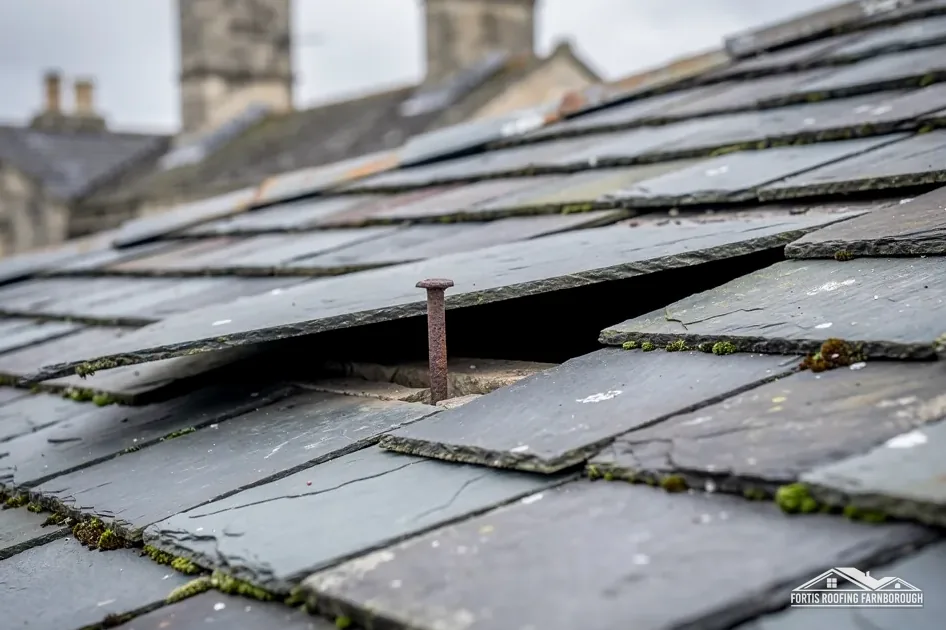
What a survey adds is the condition of each slope. A clay roof reaching 60 years may need only its ridge re-bedded and a few cracked tiles replaced. A slate roof is often limited by its fixings rather than the stone: nails rust through, and slates slip while the slate itself stays sound. A sample lifted from the slope, with its underside photographed, shows which it is. Where the stone is sound, re-fixing and replacing the slipped ones can give the roof more years, and a repair of that kind costs far less than stripping the slope. We say which of the two the evidence supports.
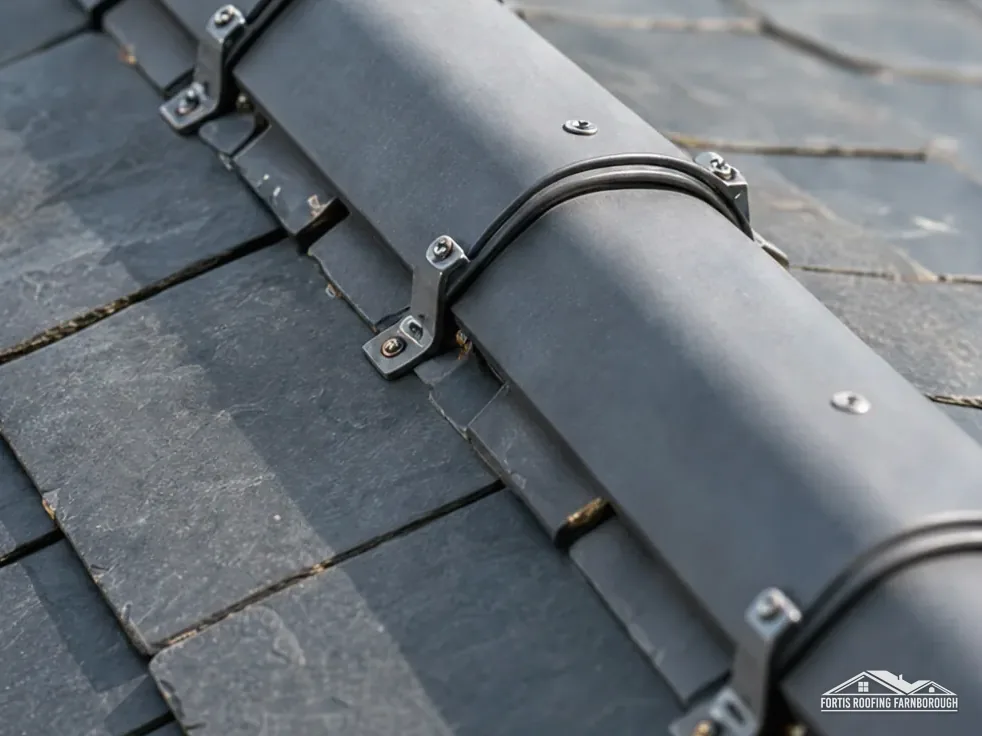
The appraisal also notes some 18th and 19th century houses with rendered walls and lower-pitched slate roofs. For natural slate BS 5534 points to a 20 degree minimum pitch, and Cupa warns against hook fixings on anything under 25 degrees. A shallow slate roof therefore leaves less margin in the way each slate is held, and the fixing method matters more. Our slate roofing work starts with measuring the pitch and the head-lap, the overlap between courses, and our pitched roofing page covers the clay roofs next door. We never guess either figure from the ground, and both go into the notes you receive with the written price. If a shallow pitch turns out to be below what the slate needs, we tell you straight away and explain the options, rather than patching it and hoping.
We repair when the evidence supports it. We lift a sample, mark cracked, slipped and sound tiles in the photographs and measure how much of each slope is affected. If a handful need replacing, that is the job. Where battens and tiles are failing across a whole slope, you see the photographs and are told so, and one written price follows.
Matching the existing roof keeps its look, but altering the covering, the ridge or a stack changes it and calls for a conversation. Holyport has been a conservation area since April 1968, so RBWM's planning team is asked about any alteration to the roof's appearance from The Green before it is priced, and its reply is filed beside your survey photographs and the written price.
The Royal Borough of Windsor and Maidenhead is the highway authority. Its page makes permission from the council a requirement, and it gives no fee. The scaffolder and we settle the licence, you agree the dates at survey, and nothing goes up without it, so the footway stays usable.
Rarely. Refixing or replacing a handful sits well inside the Planning Portal's test of less than 25 per cent of the building envelope and less than 50 per cent of the roof. RBWM does put re-tiling on its list of building control work, so we ask the council before any larger re-tile and give you the answer in writing.
Get your free roof quote
Give us your Holyport address and the fault you spotted, and a surveyor will come out to measure every slope.
10-year workmanship guarantee, in writing.