Slate and tile cottages
The 1923 county history described red brick houses and cottages with roofs of slate and tile, and a few thatched.
Roofs among 1664 almshouses and timber-framed Loddon cottages
In 1923 the county history found Hurst's red brick houses and cottages roofed in slate and tile, with a few thatched. We survey each slope for what it carries.
The 1923 county history described red brick houses and cottages with roofs of slate and tile, and a few thatched.
William Barker founded them in 1664: a low brick range, a wing at each end, tiled roofs and dormer windows.
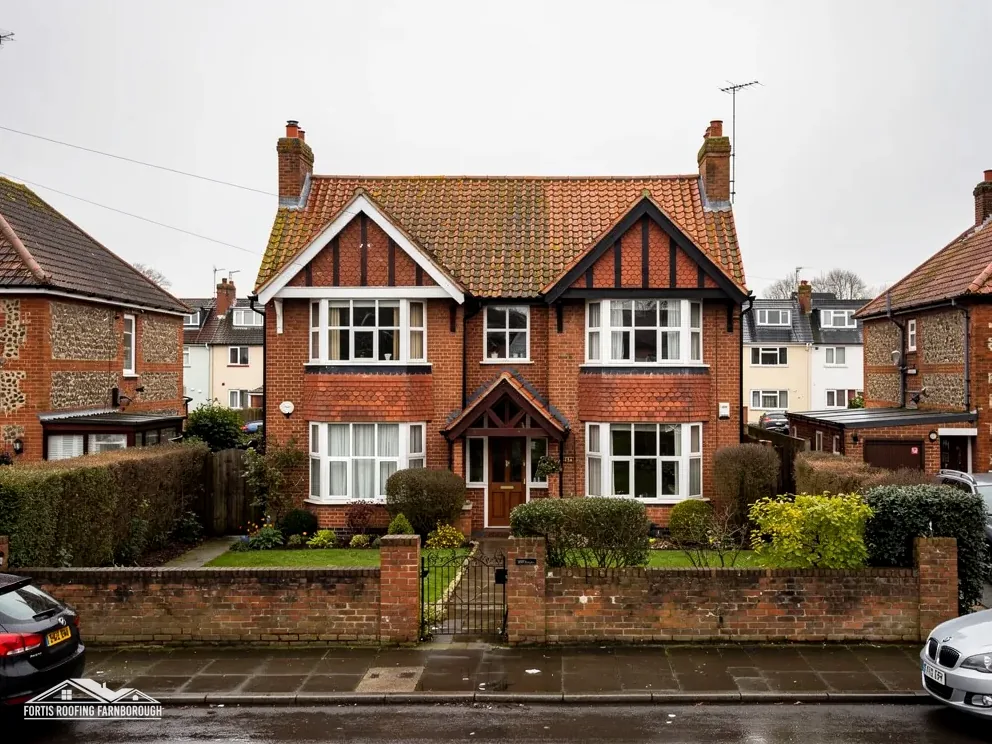
Several older cottages are timber-framed with brick filling, which means roof edges meeting framed walls.
Map of Hurst with Twyford, Ruscombe, Winnersh, Woodley marked around it.
Map data © OpenStreetMap contributors. Loads only when you ask for it.
Twyford and Ruscombe are the nearest villages north, then Waltham St Lawrence north-east, Woodley west, and Winnersh and Sindlesham south-west; Farnborough lies far to the south.
About 16.1 road miles north of Farnborough · Wokingham Borough Council (unitary).
Hurst, rules and records
Which authority decides what on a Hurst roof, what the 1923 county history records about its slate, tile and thatch, and how a conservation area and Hurst Lodge's listing bear on repairs.
| No. | Chapter | The figure it turns on |
|---|---|---|
| 01 | Wokingham, Building Control Solutions and the scaffold firm | 4 weeks per Wokingham scaffold period |
| 02 | Slate, tile and thatch in the 1923 record | 1,009 residents in Hurst |
| 03 | Hurst's conservation area and Hurst Lodge | Hurst Lodge, Grade II*, NHLE 1117439 |
Chapter 01 of 03
| Task | Body for Hurst addresses |
|---|---|
| Planning | Wokingham Borough Council (unitary) |
| Roads and pavements | Wokingham Borough Council |
| Building control | Building Control Solutions (BCS), a West Berkshire and Wokingham partnership |
| Scaffold licence | Wokingham Borough Council, applied for by the scaffold firm |
| County council | None: Berkshire councils are unitary |
Hurst is a Berkshire village 16.1 road miles north of Farnborough, with distance taken from the A325 Farnborough Road. In Berkshire the councils are unitary, which in Hurst means Wokingham Borough Council covers what a Hampshire or Surrey householder would split between a district and a county. One council decides planning questions, licenses scaffold on the roads, and sits behind the building control service.
That service is Building Control Solutions, or BCS, which the council's own pages describe as a partnership between West Berkshire and Wokingham. Few roof jobs reach it. On the Planning Portal's test, a job reaching under 25 per cent of the building envelope and under 50 per cent of the roof does not reach building control. Wokingham adds no percentage of its own. One exception matters on older houses: a covering heavier by 15 per cent or more brings in Building Regulations approval, because the roof timbers must carry the extra load, and the Planning Portal wants a structural engineer or surveyor consulted before work starts.
A slate roof re-covered in a heavier tile could cross that 15 per cent line, whereas a like-for-like swap would not. For that reason the roof as it stands is recorded, and any proposed covering is weighed against it, before a price is written. Weight is also why we ask what the rafters are made of and how far apart they sit: an older roof frame was built for the covering it first carried, and the loft inspection shows how much margin it has.
Wokingham Borough Council's licensing page says the scaffold firm makes the application on its customer's behalf, and the homeowner fills in no form. The council allows a minimum of 10 working days between application and start, charges £263 for the first 4 weeks and £163 for each further 4 weeks, and states that a licence is not needed for scaffolding on private roads. We find out at the survey which kind of ground the scaffold would stand on, so the plan names the licence only where one is needed.
Where a scaffold is needed against an old brick wall, we agree with the firm how it stands clear of the timber framing and the eaves. Our gutters, soffits and fascias page explains the eaves work that the scaffold allows.
Chapter 02 of 03
Figures from the Hurst record
The Victoria County History of Berkshire, in 1923, described the village of Hurst as red brick houses and cottages with roofs of slate and tile. It added that several older cottages were timber-framed with brick filling and that a few were thatched. The 2021 Census counted 1,009 usual residents in the Hurst built-up area, a small village where houses of very different ages stand close together, and each roof is surveyed as the one it is.
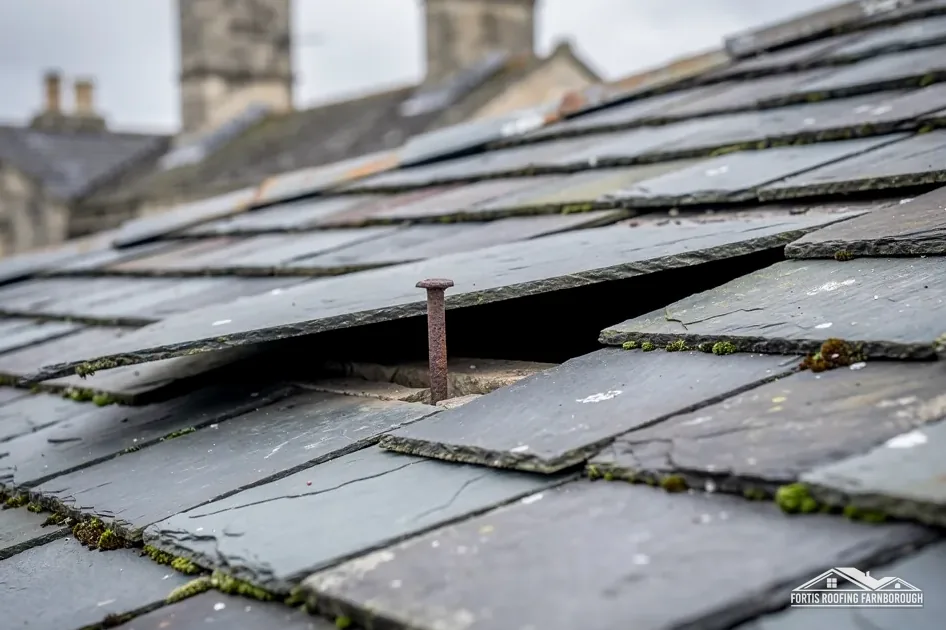
Slate and tile fail in different ways, so a roof that has both is surveyed as two roofs. Slates are held by nails or hooks, and the usual fault is a slipped or cracked slate where the fixing has rusted. Clay or concrete tiles hang from battens on nibs, and the usual faults are cracked tiles, failed nibs and mortar bedding that has let go. The first is dealt with on our slate roofing page and the second on our pitched roofing page, and a cottage with both can have both put right on one visit.
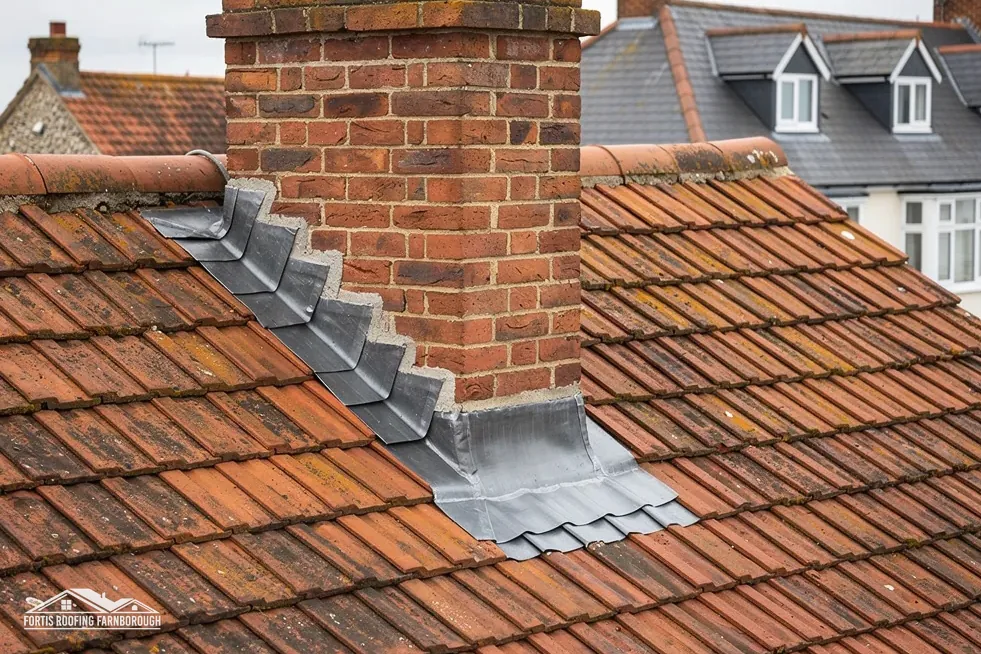
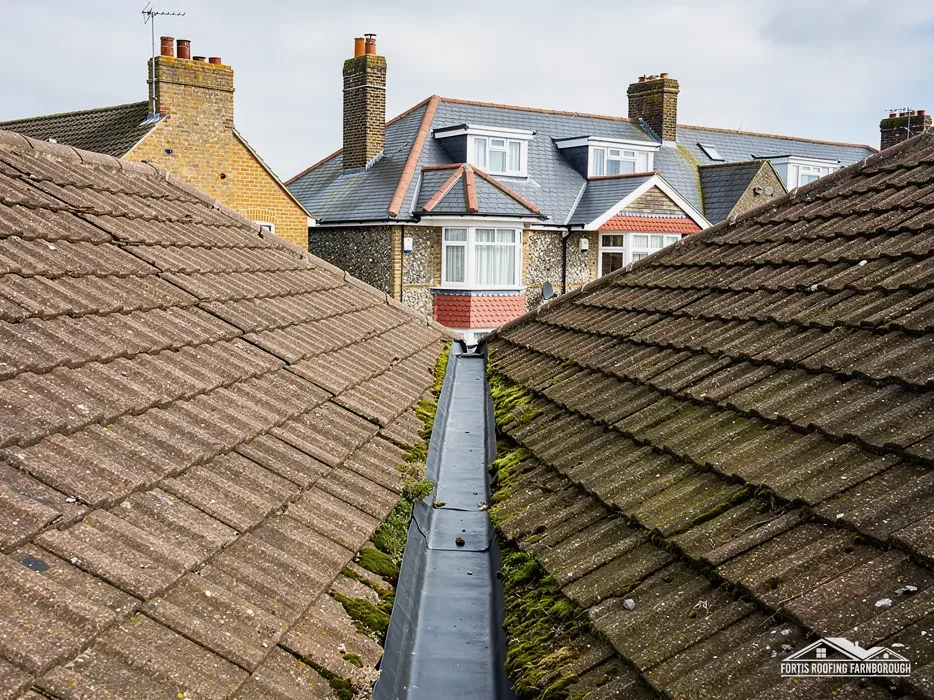
The 1923 history also records the almshouses opposite the church, founded in 1664 by William Barker: a low brick range with a wing at each end, tiled roofs and dormer windows. A range with wings has valleys where the roofs meet, and each valley is a line of lead or other flashing that carries a lot of water. A valley that has worn through is a repair, not a re-roof, and we say which it is from the photographs.
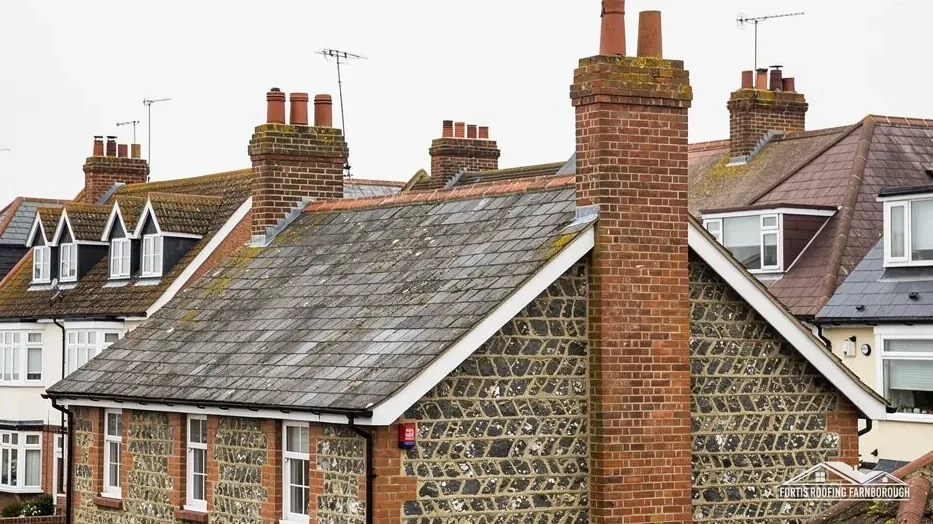
Where an older cottage is timber-framed with brick filling, the roof edge meets a wall that moves a little with the seasons. A rigid mortar fillet at that junction will crack, so the flashing is detailed to move. We photograph these edges and the verges closely, because water running down a cracked verge can reach the framing and cause rot that is invisible from outside.
The church adds another date: the 1923 text records twelfth-century work in the north arcade, fifteenth-century roof supports and a tower added in 1612. We do not work on the church from this page; we mention it because a village with that range of ages needs a survey that never assumes. For a house with a worn lead valley, our lead roofing and lead work page explains how lead is chosen by code and renewed.
Chapter 03 of 03
| Designation | In Hurst | For roof work |
|---|---|---|
| Conservation area | Hurst, on the Wokingham list | Changes to the look checked with Wokingham |
| Grade II* listed house | Hurst Lodge (NHLE 1117439) | Listed building consent for works affecting its character |
| Grade II listed | Bower Cottage (NHLE 1117398) | Listed building consent for works affecting its character |
| Grade II listed | Buttercups (NHLE 1117399) | Listed building consent for works affecting its character |
Wokingham's published list of sixteen conservation areas names Hurst. The council lists it alongside neighbours such as Ruscombe and Twyford Village, and a conservation area covers the land inside its boundary, so the opening check on a Hurst job is whether your house lies within it. The council's map is where to look. Under section 55 of the Town and Country Planning Act 1990, a repair that leaves the outward look materially as it was is not development, so work that matches the original is normally the simple case for Wokingham's planners.
A different covering, a reshaped ridge or a stack lowered by half alters the view from the road, and within a conservation area the planners at Wokingham are consulted at once. We ask before we price, and we tell you what the council says. An Article 4 direction on a given Hurst address is the same kind of question, and the council is asked and not guessed at. The answer is written into the survey notes, so that a later owner can see it was checked and what the reply was, and the photographs sit beside it.

Listing follows a separate route. Hurst Lodge was first listed Grade II* on 1 August 1952, and Bower Cottage and Buttercups are Grade II. Historic England's list shows 11 listed buildings within about 500 m of the middle of the village. For any of them, works that affect the character of the building need listed building consent as well as any planning permission, and the consent is applied for before the work, not after.
On a listed or conservation-area house we keep a full photographic record of the covering, ridge, verges and stacks, and we repair to match it. If an older roof is past sensible repair, our roof replacement page sets out the re-cover, and the survey photographs supply the evidence for it. The record can then be shown to the council or to a buyer's surveyor. Because Hurst Lodge and the other listed houses stand among ordinary homes, a repair next door to a listed building is looked at with extra care for the way it appears beside it, even where no consent is needed.
Yes. Each slope is surveyed on its own terms: slates for slipped or cracked pieces and rusted fixings, tiles for cracked pieces, failed nibs and loose bedding. Both can be put right in the same visit, and the photographs show which faults sit on which slope, so you can see what the price covers.
Wokingham's list of conservation areas names Hurst, and the council's map shows which side of the boundary your house sits. A repair that follows the original is normally the straightforward kind. Swapping the covering, reshaping the ridge or taking down a chimney alters the look from the road, so we ask Wokingham's planning team about it first and report back before any price is set.
Building Control Solutions, the West Berkshire and Wokingham partnership, handles building control for Wokingham addresses, while a registered building control approver offers the private route. Replacing a handful of tiles calls for neither. A whole-roof re-cover does, and so does a covering outweighing the old one by 15 per cent or more; measuring the slopes shows which case yours is.
Yes, where scaffold stands on the highway. Wokingham Borough Council asks for 10 working days' notice, charges £263 for the first 4 weeks and £163 for each further 4 weeks, and has the scaffold firm make the application. Scaffold on a private road falls outside that licence.
Get your free roof quote
Tell us your Hurst lane and which slopes worry you, and we will find a day to photograph them all.
10-year workmanship guarantee, in writing.