The barracks keep
The Keep and Attached Gateway of the former Stoughton Barracks is listed Grade II, first listed in July 1998.
A northern Guildford suburb around the old Stoughton Barracks
Stoughton is a northern suburb of Guildford on the Worplesdon Road, built up around the old barracks depot. We take each roof in turn, then price it once in writing.
The Keep and Attached Gateway of the former Stoughton Barracks is listed Grade II, first listed in July 1998.

The Mortuary Chapel in Stoke New Cemetery carries a Grade II listing too.
The history says Guildford grew north with business streets and small houses near the railway stations.
Map of Stoughton with Jacobs Well, Guildford, Fairlands, Worplesdon marked around it.
Map data © OpenStreetMap contributors. Loads only when you ask for it.
Jacobs Well lies north-east of Stoughton, Guildford south-east, Burpham east, Wood Street and Fairlands west, and Worplesdon north-west along the Worplesdon Road.
About 10.5 road miles east of Farnborough · Guildford Borough Council and Surrey County Council.
Stoughton, barracks and suburb
How Guildford and Surrey regulate a Stoughton roof, what the 1911 county history records of the parish, the barracks and the cemetery, and how the barracks conservation area and its listed keep bear on a repair.
| No. | Chapter | The figure it turns on |
|---|---|---|
| 01 | Guildford's inspectors and Surrey's licence | Guildford inspects; Surrey licenses scaffold |
| 02 | A depot, a school and a cemetery | Stoughton parish formed 1893 |
| 03 | Stoughton Barracks conservation area | Conservation area within about 0.75 km |
Chapter 01 of 03
| Role | Body for Stoughton addresses |
|---|---|
| Planning authority | Guildford Borough Council |
| County council and highway authority | Surrey County Council (until 31 March 2027) |
| Building control | Guildford Borough Council, its own service |
| Scaffold licence on the highway | Surrey County Council, 28 day periods |
East of Farnborough by 10.5 road miles, counting from the A325 Farnborough Road, lies Stoughton. Guildford Borough Council is both planning authority and building control body, and Surrey County Council keeps the highway in its charge, as the highway authority until 31 March 2027. For a suburb inside a town, one borough office covers the planning and inspection sides of a roof job.
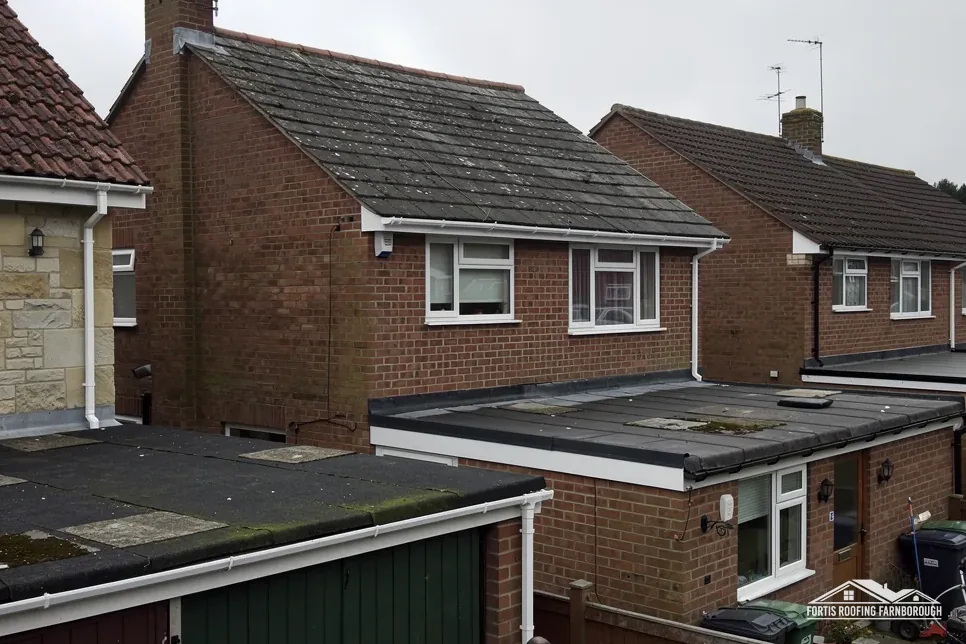
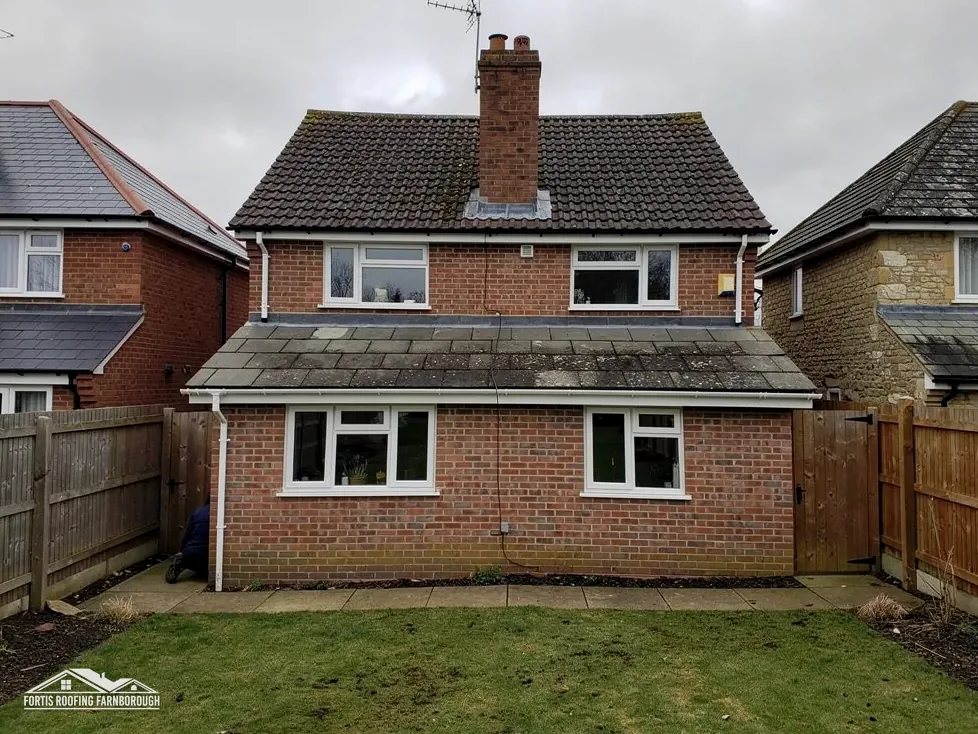
The county history of 1911 says Guildford grew north and north-west with business streets and small houses near the railway stations, much of it in Stoke parish. Where small houses stand in a run, roofs often share a line, and work on one can touch the next. The Planning Portal's yardstick, under 25 per cent of the building envelope and under 50 per cent of the roof, is measured per building, so in a row of houses your own roof is the one counted, and the party wall junction is checked as part of it.
A whole-house re-cover goes beyond the yardstick, and Guildford's service or a registered building control approver then inspects. Past a 15 per cent rise in weight, approval and a structural check follow. Our roof replacement page explains how that decision is made.
Surrey County Council's licence for scaffold over a road or pavement costs £208 for each 28 day period, and its page says applications are processed within 10 days. The form should be in 10 working days before the start. No applicant is named, so the scaffolder is asked, and what it says is passed on to you.
Where a house has no front garden, the scaffold stands on the pavement. The footway width left for pedestrians, the position of skips and ladders, and the dates told to neighbours are all settled before work begins.
When the choice is between repairing and re-covering a roof, the decision turns on evidence from the slope: how many tiles are cracked, whether the battens give under pressure, how the flashings look. The report sets that out photograph by photograph, so the recommendation can be checked by anyone who reads it, including a neighbour or a surveyor acting for a buyer.
A roof window or skylight is not a thermal element, so a replacement faces the window figure, not the roof's. Under the 2021 edition of Approved Document L, which applies until 24 March 2027, a figure of 2.2 applies to a rooflight, and 1.4 or Window Energy Rating Band B applies to a roof window.
Chapter 02 of 03
Stoughton in dates from the county history
The 1911 Victoria County History records that Stoughton became its own ecclesiastical parish, carved out of Stoke, in 1893, that its 8-acre cemetery was bought and laid out in 1880 to 1882, and that Stoughton School was built in 1885. Stoughton Barracks were the depot of the Royal West Surrey regiment, and the remains of the old moat survive on the site of Stoughton Manor House.
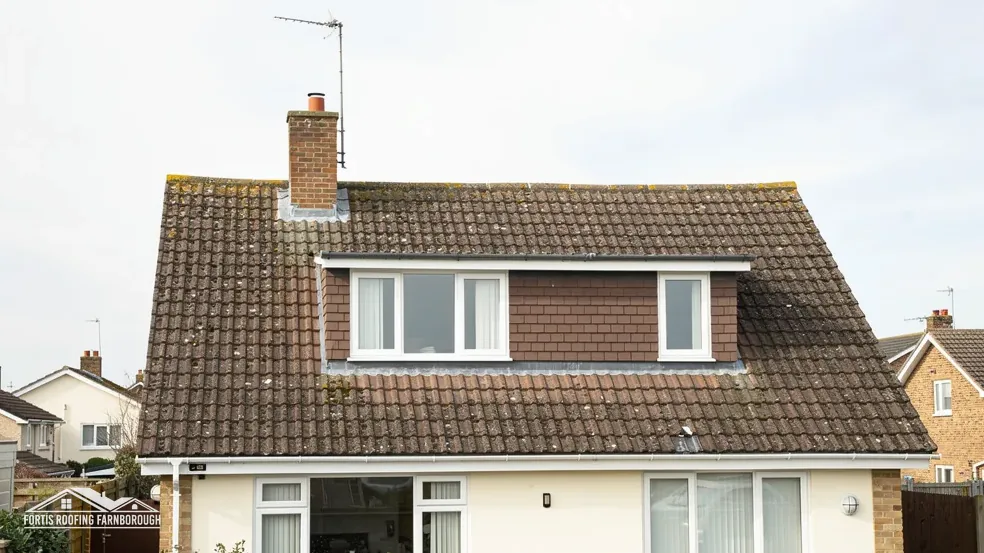
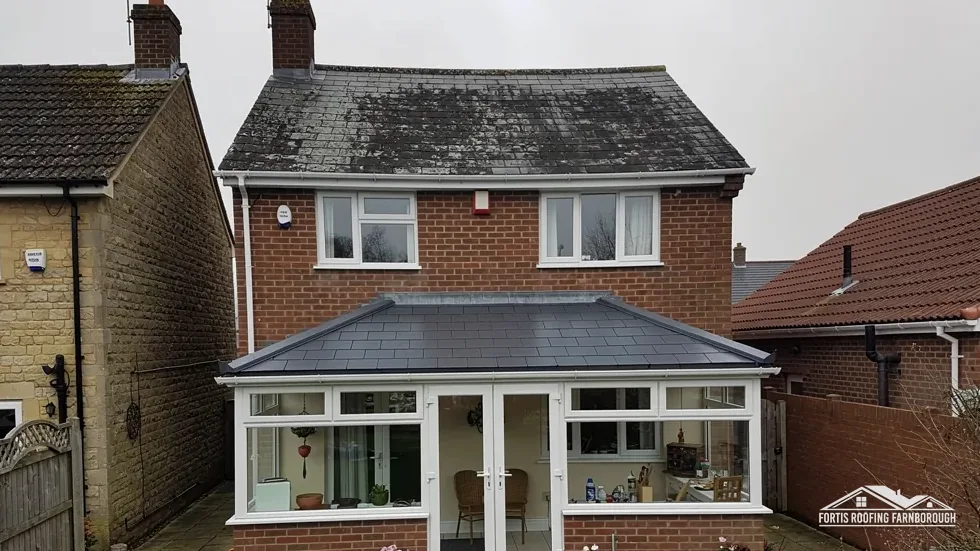
Those dates put the cemetery, the school and the new parish within thirteen years of each other in the late 19th century. Any house of that period has had a century and more of weather, and its covering may not be the first. We do not guess which, so each slope is opened up, recorded and named, with the findings set out in order.
A Victorian or Edwardian terrace roof has several points of failure: the ridge, the party wall flashings, the valley over a rear return, and the gutters at the eaves. Each is checked, and our gutters, soffits and fascias page describes how a gutter run is judged.
Two buildings in the area carry listings, and both show that institutional buildings have roofs of their own character. The Mortuary Chapel in Stoke New Cemetery and the Keep and Attached Gateway of the former barracks are each Grade II. Neither affects the houses around them, but each is a reminder that a roof on an old building is repaired by matching what was there.
On any roof the water has to be led away, so every outlet, fall and downpipe is followed from slope to gutter to ground, and a downpipe that empties against a wall is noted.
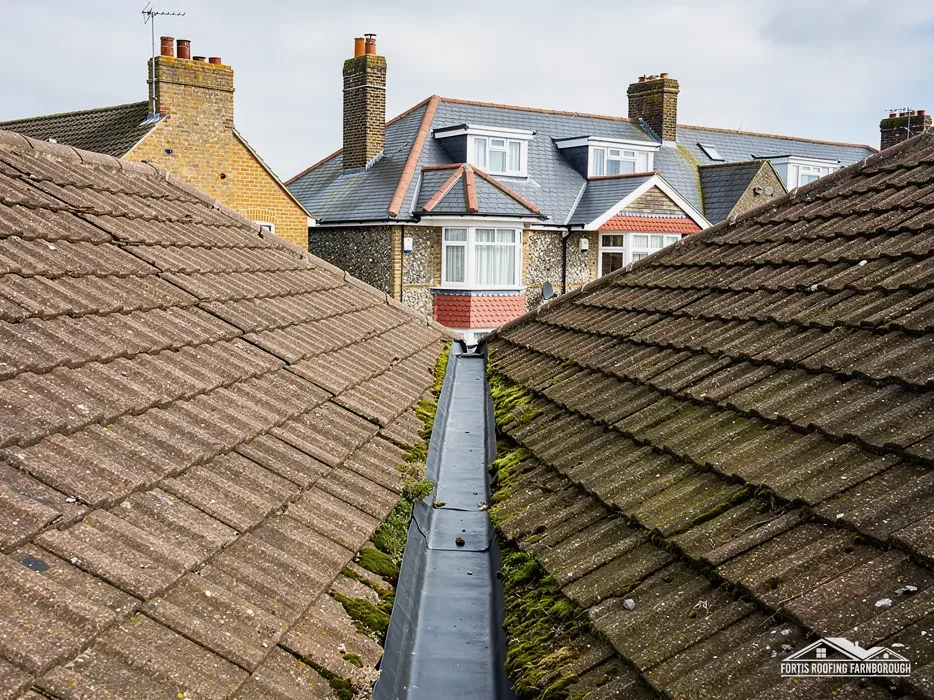
A gutter that sags between its brackets holds water. Brett Martin's guidance of 1 mm of fall for every 600 mm of run is the yardstick for a gutter, and the survey checks each run by eye and by level, noting the brackets that have loosened.
Any older house gets a full set of dated photographs, slope by slope, along with the ridge and the stacks, so the roof as found is on file.
Chapter 03 of 03
| Designation | In Stoughton | For roof work |
|---|---|---|
| Conservation area | Stoughton Barracks, within about 0.75 km | Ask Guildford before changing a roof's look |
| Conservation area | Wey and Godalming Navigations | Ask Guildford before changing a roof's look |
| Grade II listed | Keep and Attached Gateway (NHLE 1375583) | Listed building consent for work affecting character |
| Grade II listed | Mortuary Chapel, Stoke New Cemetery (NHLE 1293980) | Listed building consent for work affecting character |
| Article 4 direction | Chimneys, where a direction applies | Checked by address on Guildford's map |
The Stoughton Barracks conservation area lies within about 0.75 km of the centre of Stoughton, and the search that found it also took in the Wey and Godalming Navigations. Two listed buildings stand within 500 m of the village point: the Keep and Attached Gateway, first listed on 8 July 1998 (NHLE 1375583), and the Mortuary Chapel in Stoke New Cemetery (NHLE 1293980), both Grade II.
Guildford's conservation areas can carry Article 4 directions, and under one, removing or reshaping a chimney requires permission. The council's map answers that question address by address. In a suburb of older houses the stack often gives the roofline its character, so before any stack is touched we read the map and put the question to the council.
Being inside a conservation area does not forbid upkeep. What counts is whether the view of the roof changes: refixing the same tiles and re-bedding the same ridge leave it intact, while a different covering, a lowered ridge or a vanished stack alter it, and those are for the council to consider first. The front slope, the chimneys and the ridge line are recorded before anything else happens, so a later comparison starts from fact.
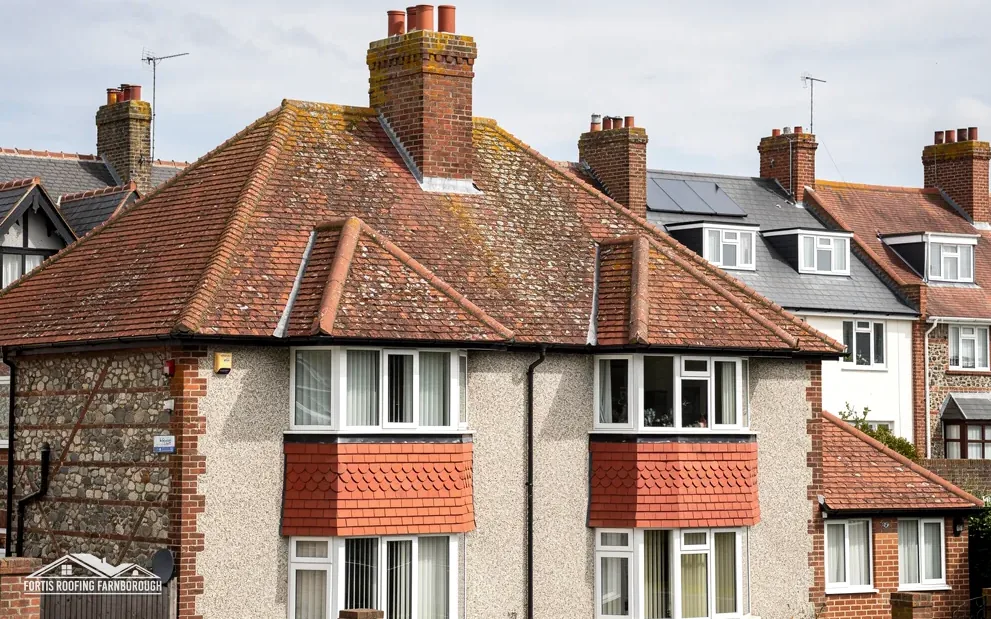
A listing on the keep means work affecting the keep's character needs listed building consent. Houses near the old barracks sit close to the conservation area's edge, so the map is read for each address, because the boundary decides whether a changed covering is a question for the council. The outcome for your address goes in the report, dated. Where a roof adjoins the next, the junction is checked on both sides as far as we can see from your property, and the findings are recorded without stepping onto a neighbour's roof, which keeps the visit within what you have asked us to do.
Every Stoughton report follows the same order: the roof as found, slope by slope, with photographs; the checks made on the address and what each showed; and the recommendation, with one total price. You can read it at your own pace, and share it with a neighbour whose roof adjoins yours.
Our chimney repairs page sets out the stack checks, and every stack is photographed from each side.
We reach the junction from a safe position, lift enough of the covering to see the lead or mortar flashing, and photograph it along the wall line. A failed flashing lets water into the neighbour's loft first, so the photographs go in your report and give both households the same picture of the problem.
Not if the repair restores the covering, ridge and chimney as they stood, because the view of the roof is unchanged. A new covering or a taken-down stack changes it, and then Guildford is asked first. Whether an Article 4 direction reaches your address is checked on Guildford's map before pricing.
No. The keep carries its own Grade II listing, so listed building consent applies to work affecting the keep's character, not to the houses around it. Houses nearby have records of their own, which the heritage list and Guildford's map reveal before we quote, with each finding set down in your report and dated.
Surrey County Council's page is silent on who fills in the form, so before booking we find out from the scaffolder and tell you. The fee is £208 for each 28 day period, the same on renewal, with the form wanted 10 working days ahead. Poles that stay off the highway need no licence at all.
Get your free roof quote
Send the road name and what you can see from the pavement, and a visit is set up.
10-year workmanship guarantee, in writing.