Lilac Cottage farmhouse
Listed Grade II in 1953, this farmhouse is one of the older buildings recorded in the Burpham area.

Roofs on London Road streets and older Wey valley cottages
Burpham is a suburb on the London Road beside the Wey valley, with Grade II cottages among its newer streets. Each Burpham roof is judged from its own evidence, nothing assumed.
Listed Grade II in 1953, this farmhouse is one of the older buildings recorded in the Burpham area.

Pimms Row is a Grade II listed row, so work on its roof is a listed building matter.
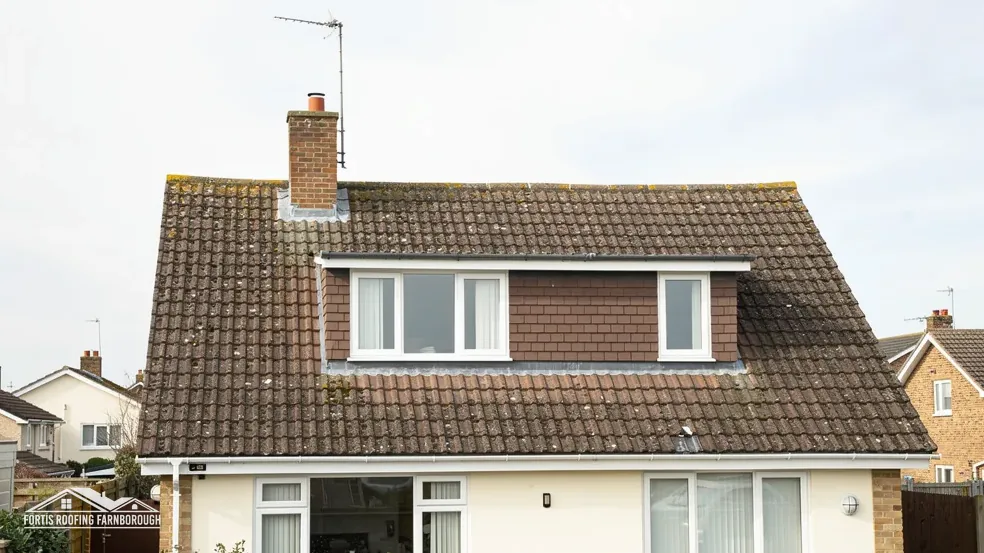
Burpham's later suburban houses stand near the London Road, and their roofs need steady upkeep.
Map of Burpham with Merrow, Jacobs Well, West Clandon, Stoughton marked around it.
Map data © OpenStreetMap contributors. Loads only when you ask for it.
Burpham sits north-east of Guildford town centre on the A3100, with Send to the north-east and Farnborough 12.3 road miles to the west.
About 12.3 road miles east of Farnborough · Guildford Borough Council and Surrey County Council.
Burpham, the rules and the record
How Surrey's licensing rules and Guildford's own building control apply to a Burpham roof, what is recorded about the area's past, and where the Wey and Godalming Navigations conservation area comes in.

| No. | Chapter | The figure it turns on |
|---|---|---|
| 01 | Guildford's rules, Surrey's scaffold licence | £208 licence, 28 days, 10 working days |
| 02 | A tithing of Worplesdon, a suburb now | One of four Worplesdon tithings |
| 03 | The navigation conservation area and Guildford's listed cottages | Conservation area within 0.75 km |
Chapter 01 of 03
The Surrey scaffold licence in published figures
Burpham belongs to Guildford Borough Council for planning and building control, and Surrey County Council looks after the roads around it as highway authority. Guildford staffs its own building control team, a service the council describes as not for profit, and the private choice is a registered building control approver. Either of them can inspect a re-roof that needs it. On 1 April 2027 twelve Surrey councils give way to two, and Guildford falls under West Surrey Council. Until then nothing changes in how you deal with them.
Section 169 of the Highways Act 1980 makes scaffold on a pavement or road a matter for the highway authority's licence. Surrey County Council (until April 2027) charges £208 for each 28-day period, and the renewal fee is the same. Its page asks for the paperwork at least 10 working days before the start date, says it processes licences within 10 days, and treats the fee as non-refundable. It does not say who must submit the form, so on every job we ask who applies and fix that with the scaffolder before booking.
Scaffold on private land needs no licence. A Burpham house set back from the London Road may be able to have its scaffold on its own drive and garden, which saves the notice period altogether. The survey is where we find out, because we look at the frontage, the width of the footway and where a scaffolder could safely stand.
Guildford publishes no re-roofing percentage, so the working test is the Planning Portal's. A re-roof normally falls outside building control while under 25 per cent of the building envelope and under 50 per cent of the roof are touched. A heavier covering, one that adds 15 per cent or more to the weight, brings a need for approval whatever the area. We identify the existing tiles at the survey and tell you what we found before you decide anything.
Because a scaffold licence takes weeks and not days, we raise it in the first conversation, well ahead of the booking, and tell you what start dates are realistic.
All our travel is measured from the A325 in Farnborough, where we work out to about 30 road miles. Burpham is 12.3 of them.
Chapter 02 of 03
| Record | What it says |
|---|---|
| Parish history | One of four tithings of Worplesdon, on its east side |
| Early finds | Romano-British burials with pottery |
| 1911 | A Primitive Methodist chapel at Burpham |
| Listed 1953 | Lilac Cottage New Inn Farmhouse, Grade II (NHLE 1377865) |
| Setting | London Road (A3100), north-east of Guildford town centre |
The Victoria County History of Surrey, volume 3, published in 1911, places Burpham as one of the four tithings of Worplesdon parish, on its eastern side. Romano-British burials with pottery turned up in Burpham, and a Primitive Methodist chapel stood there in 1911. Today Burpham is a suburb, and unlike Send to the north-east it has no parish of its own, since it falls in Guildford's unparished area.
That history means no single date or style can be assumed for a Burpham roof. Lilac Cottage New Inn Farmhouse and Pimms Row are both listed Grade II, so they sit among later houses that were built when the suburb grew along the London Road. A farmhouse roof and a suburban semi share a postcode and almost nothing else. We therefore never assume a covering from the street name. The survey names the covering on every slope after we lift a few tiles to look beneath, and the repair is matched to what we find.
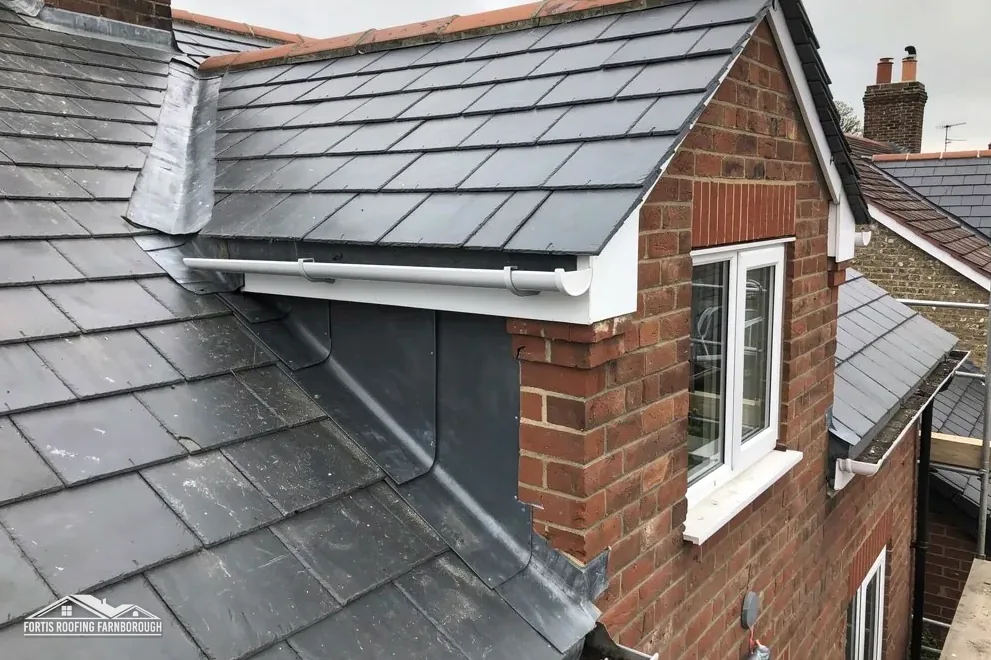
For the suburban houses the usual jobs are the plain ones: slipped or cracked tiles, ridge and hip mortar that has weathered, valleys that collect leaves and gutters that overflow behind a fascia. Those are also the least costly faults to put right when caught early, which is why we climb to look rather than judge from the pavement.
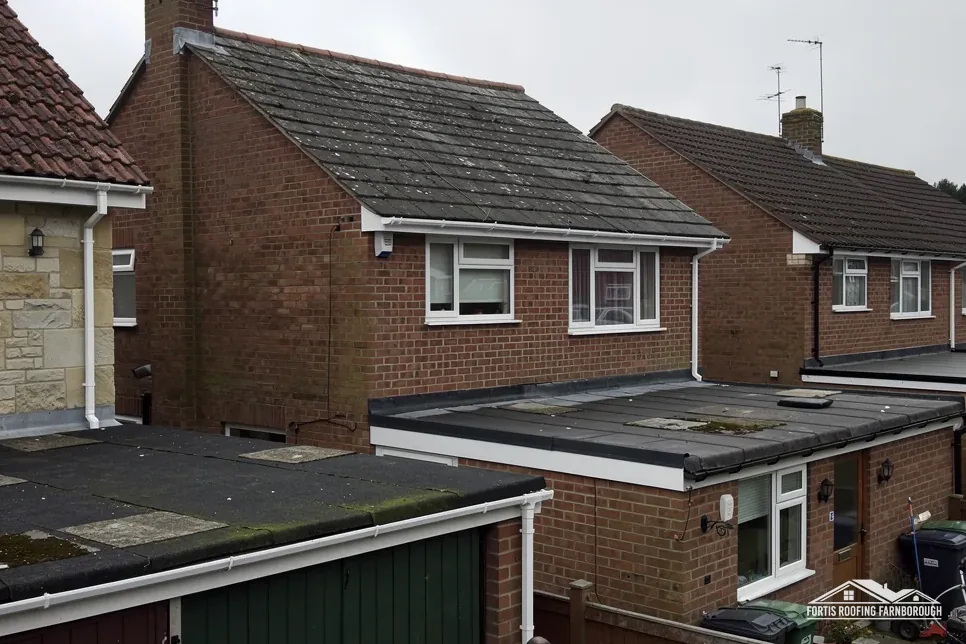
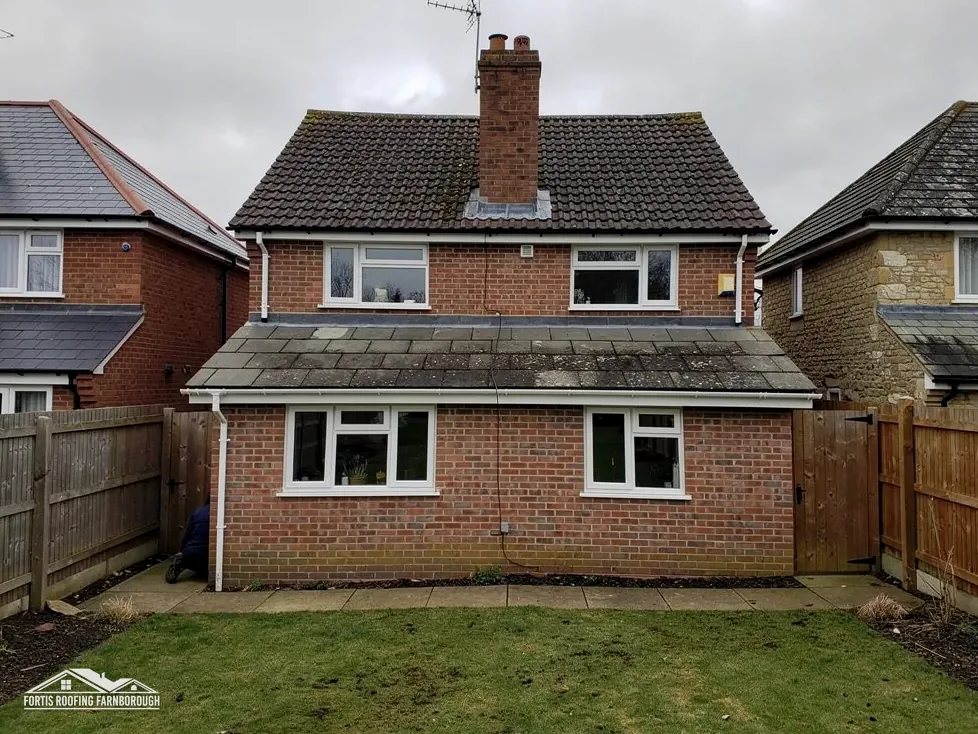
A loft that has been converted, or a flat-roofed rear extension added to a semi, changes what the survey has to cover. The flat section, its upstands and its outlet need a separate look, and the roof window or dormer cheek, if there is one, a third. Our flat roofing page lists what we check on those sections and the usual coverings.
Age is not the only variable. A south-facing slope that dries fast and a shaded north slope under trees age at different rates, and the wet slope may be the one that holds moss, loose tiles and blocked valleys. We record each slope separately for that reason, and the report you receive names every one of them.
Two dated entries
If your roof is listed, as Pimms Row is, the first conversation is with Guildford's heritage officers, before any roofer's price. We can photograph and measure the existing roof so that the application describes what is really there.
Chapter 03 of 03
Burpham's heritage record near the Wey
The Wey and Godalming Navigations conservation area lies within about 0.75 km of the centre of Burpham. A house within it, or near its edge, may be treated differently from one on the other side of the boundary, so the first job is to check the address on Guildford Borough Council's own map. Guildford says it uses Article 4 directions to control changes in conservation areas, and where one applies, taking a stack down or altering it needs the council's permission. The council asks owners to check their address on its map, selecting the Article 4 layer.
Chimneys are the roof feature Guildford's Article 4 wording names, because a stack can be seen from the road and its outline is part of a street's look.
On a Burpham house the chimney is the part most likely to meet that rule. A stack that leans, loses its pointing or lets rain in at the flashing is a repair, and repairs are normal work. Taking a stack down, or altering its height or outline, is the step that needs permission where a direction applies. We tell you which is which before you commit, and we ask the planning team about anything on the borderline.
Pimms Row and Lilac Cottage New Inn Farmhouse are listed Grade II. Any listed house needs Guildford Borough Council's consent whenever work would change its character, in addition to any other approval. A repair that copies the original is unlikely to change character, and the best evidence is a clear record of the existing tiles, ridge and verge before work starts.
Guildford's wording is also a reminder that a conservation area is a matter of fine boundaries. Two neighbours on the same road can be on opposite sides of a line, and the map is the only reliable answer. We read it before we write the report, and we say in the report which side of the line your roof is on, so the answer is on paper.
For unlisted houses outside any conservation area the practical risks are ordinary ones: weather, age and a previous repair that did not last. Our gutters, soffits and fascias page explains how the roofline is repaired once the roof above it is sound, and our pitched roofing page covers the covering itself.
Yes, because a flat section behaves differently from the pitched roof above it. We check the covering, the upstands where it meets the wall, the outlet and the fall, and we photograph each. A small defect there can let water in for months before a stain appears on the ceiling inside.
Repairing a stack, such as repointing or renewing flashings, is normal work. Guildford says that wherever an Article 4 direction applies, taking down or altering a stack needs the council's permission, so we check your address on its map first. Where a direction reaches your address, any change is put to the planners before it is priced.
Scaffold on private land needs none. Where it has to stand on a pavement or road, Surrey County Council (until April 2027) issues the licence at £208 per 28 days and asks for 10 working days of notice. Ask who applies, because the council's page does not say, and we fix that with the scaffolder.
No. A listed house needs listed building consent from Guildford Borough Council whenever character is at stake, which an unlisted house never does. A repair that copies the original tile, ridge and verge seldom changes character, so we record the existing details before anything is priced.
Get your free roof quote
Give us your Burpham road and the symptom inside or out, and we will arrange the survey.
10-year workmanship guarantee, in writing.