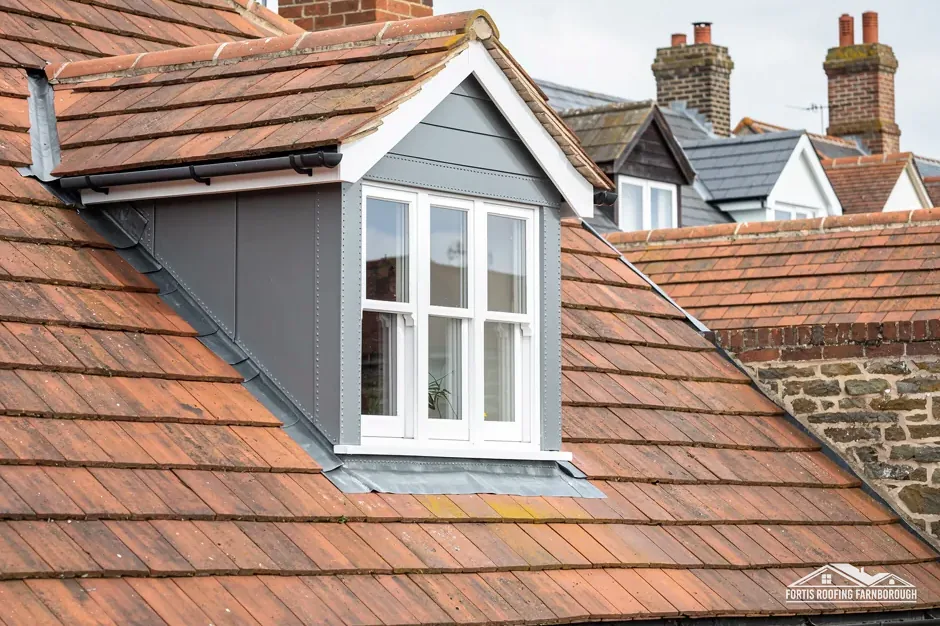
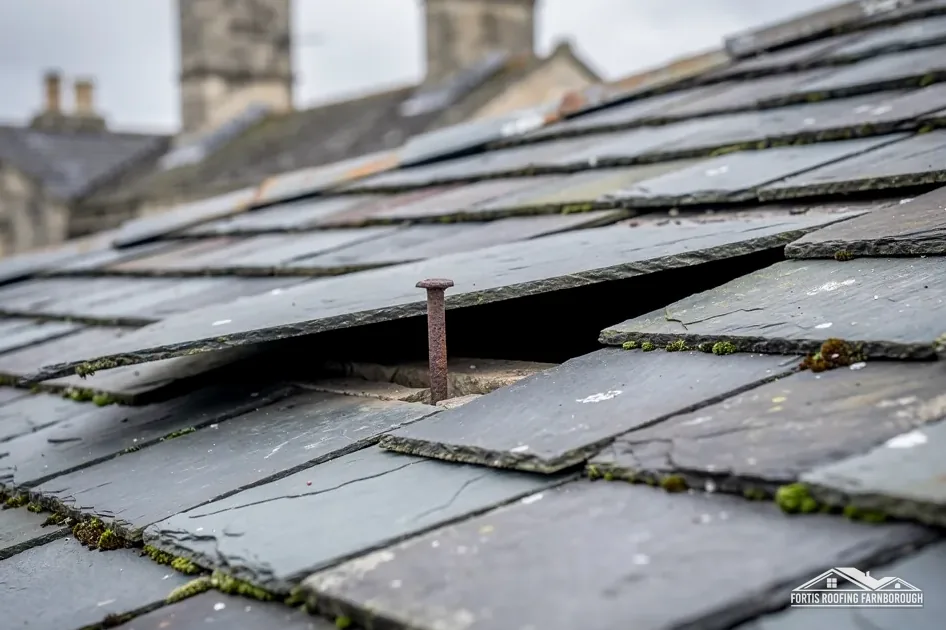
Handmade plain clay tile
Guildford's appraisal says the commonest roof covering is plain clay tile with a rough, sandy texture.
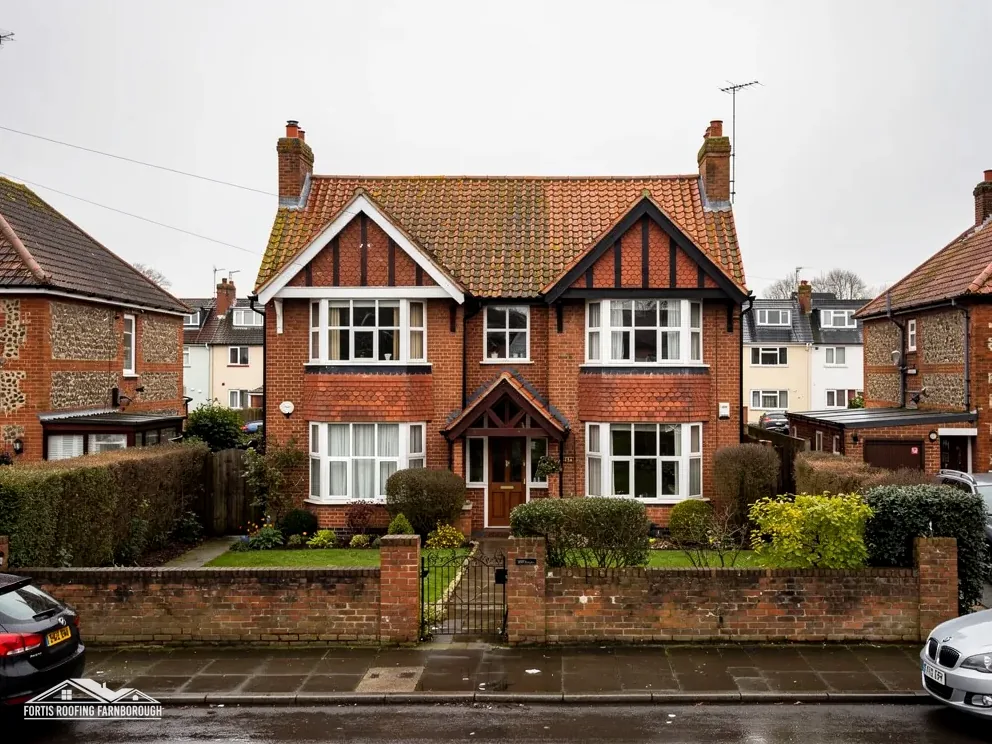
Roofs of handmade clay tile, tile-hanging and Bargate stone
Guildford's Shere appraisal names handmade orange-red plain clay tile roofs and tile-hanging, with Bargate stone walls. We survey and match each slope with care.
Guildford's appraisal says the commonest roof covering is plain clay tile with a rough, sandy texture.
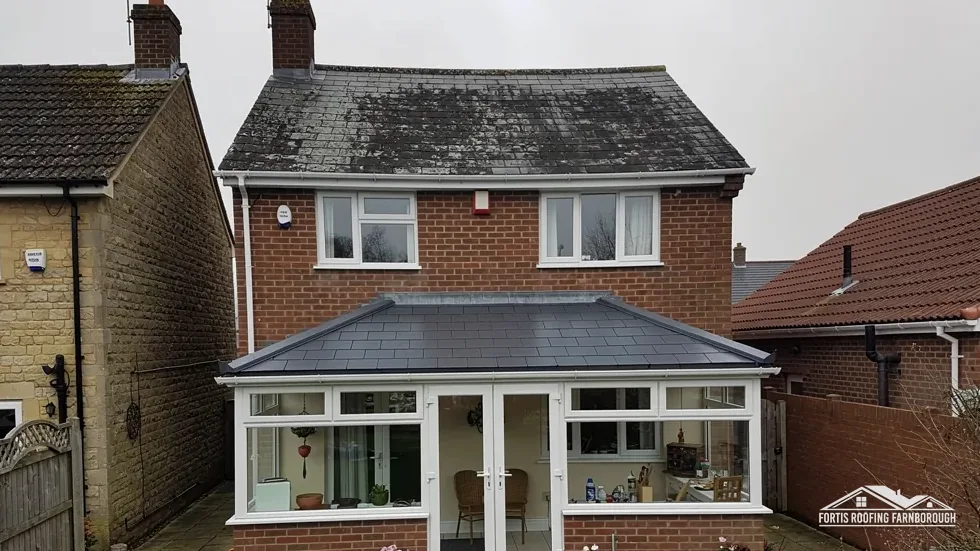
The old parsonage house at the west end of the village is an ancient timber-framed building.

Partly 16th-century, the inn looks toward the church with its tall timber spire and lych-gate.
Map of Shere with Gomshall, Albury, Peaslake, Chilworth marked around it.
Map data © OpenStreetMap contributors. Loads only when you ask for it.
Gomshall is the next village east and Albury the next west; Peaslake is to the south, with West Horsley to the north, and Farnborough lies far off beyond Albury.
About 17.3 road miles south-east of Farnborough · Guildford Borough Council and Surrey County Council.
Shere, clay tile and council record
How the weight and fire-performance tests apply to a new covering in Shere, what Guildford's character appraisal and the 1911 county history say about its handmade tiles and timber frames, and how 49 listed buildings shape repairs.

| No. | Chapter | The figure it turns on |
|---|---|---|
| 01 | Matching clay: the weight and fire tests | 15% heavier, or a different fire rating |
| 02 | Handmade tile, tile-hanging and a timber spire | Plain clay tile, per the council |
| 03 | Forty-nine listed buildings within reach | 49 listed buildings within 500 m |
Chapter 01 of 03
| Question | Answer for Shere addresses |
|---|---|
| Weight test for a new covering | 15 per cent or more heavier needs approval |
| Fire test for a new covering | Significantly different fire performance needs approval |
| Planning authority | Guildford Borough Council |
| Building control | Guildford's own service |
| Scaffold licence on the highway | Surrey County Council (until April 2027) |
Shere sits inside the Surrey Hills, 17.3 road miles south-east of Farnborough, with planning in the hands of Guildford Borough Council, which also provides its own building control. Highways and scaffold licences come from Surrey County Council until 31 March 2027, with West Surrey Council following on 1 April 2027. For a roof in a village of clay tile, the sharper question is what goes back on it.
The Planning Portal names two ways a new roof covering draws in Building Regulations approval. The first is weight: the new covering adds 15 per cent or more to the weight carried by the roof. The second is fire: the new covering would perform significantly differently from the old one if a fire broke out. Where the weight question is open, the Portal suggests putting it to a structural engineer or a surveyor first.
A handmade clay plain tile roof on a Shere house is the baseline. Swap it for a heavier tile and the first test is tripped; swap it for a covering with another fire rating and the second may be. Like-for-like clay normally trips neither. So we begin by identifying the covering that is there, set it against whatever is proposed, and put both weights on the plan. If approval is needed, Guildford's team, or a registered building control approver, hears before work starts.
Surrey's scaffold fee is £208 for each 28-day period, and its page wants applications in at least 10 working days before the start. Nothing there says who files the application, so we agree it with the scaffolder before you are given any dates. Guildford's appraisal calls tile-hanging common on first floors in the conservation area, and where hung tile meets the roof edge, and the flashing at that line is a repair of its own. Our pitched roofing page describes how clay tiles are refixed and replaced, and the survey names each course that needs work.
A scaffold with a proper edge is also what protects a clay tile roof while the repair is under way, so the layout is drawn up with the scaffolder after the first visit, and any tile that is sound is left alone.
Chapter 02 of 03
Shere's building record in four items
Guildford's Shere Character Appraisal describes handmade orange-red plain clay tile roofs, tile-hanging, timber framing and Bargate stone. It says the commonest roof covering is plain clay tile with a rough, sandy texture, with some natural grey slate, and that Bargate stone, often galleted with ironstone, gives the village its mellow colour. A plain tile is a small flat clay tile laid in overlapping courses, and galleting is the pressing of tiny stones into mortar joints.
Handmade clay tiles are not uniform. Their surface is rough, their colour varies from tile to tile, and an old roof has weathered into a mix that a new batch does not copy at once. Matching starts with measurement: the tile size, the thickness, the lap at the eaves and the courses either side of a repair. We photograph a sample of the existing tiles beside the proposed ones and show you the difference before anything is ordered.
The 1911 county history adds the Black Horse Inn, partly 16th-century with a great open fireplace, and calls the view past it to the church's tall timber spire and lych-gate far-famed. It mentions an old parsonage house at the west end of the village, an ancient timber-framed building, and an ancient mill, and it describes the parish as essentially agricultural. Timber frames carry roofs that move a little, and a flashing at a tile-hung wall has to move with them.
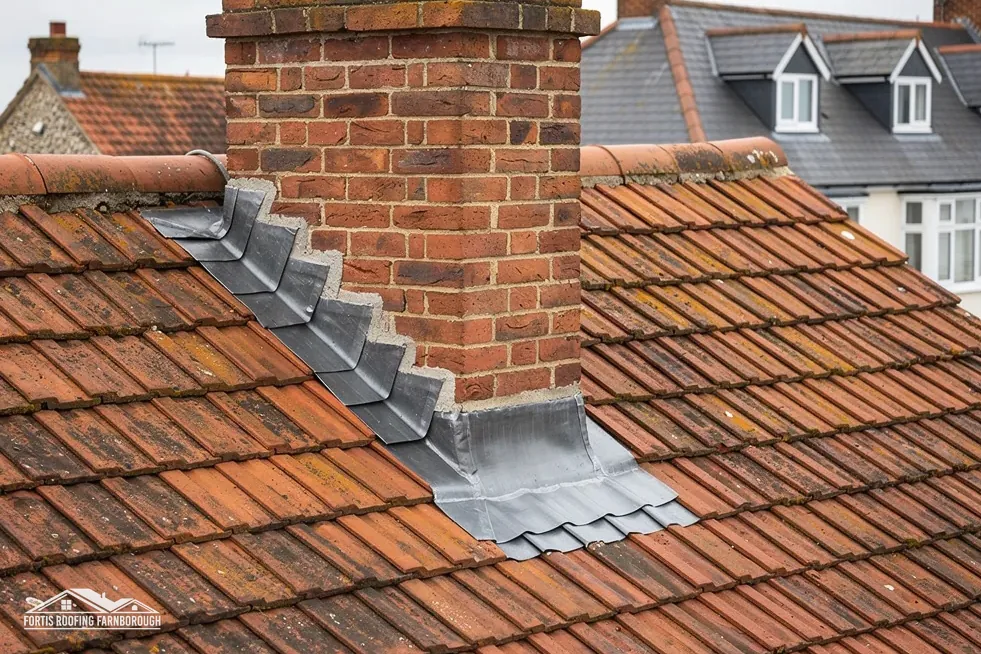
Tile-hanging means clay tile fixed to a wall rather than a roof. Where it reaches the eaves, a bay window or a dormer, lead or zinc flashing passes the water out over the roof tiles, and old damage can lie hidden along that line. We lift the lowest hung courses at the junction and photograph what is behind. If the tiles across a whole slope are worn out, a re-cover is described stage by stage on our roof replacement page, and the survey photographs show whether it is warranted. Where the existing tiles are sound but tired, a blended repair keeps more of the old roof than a re-cover would.
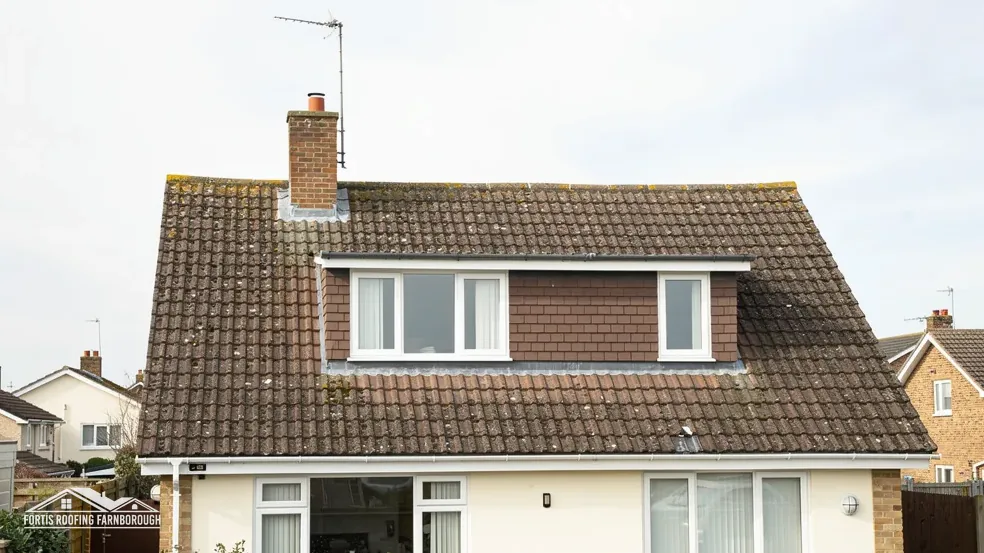
A re-cover of a Shere house is not a matter of ordering whatever tile happens to be in stock. It is a question of colour, texture and course lines, and it is easier to settle with a sample on a table than with a drawing.
Chapter 03 of 03
| Designation | In Shere | For roof work |
|---|---|---|
| Conservation area | Shere | Changes to the look checked with Guildford |
| Surrey Hills National Landscape | Shere lies inside | Dormer and other permitted-development limits: ask Guildford |
| Grade I listed church in use | The Church of St James (NHLE 1377794) | Church of England faculty, not listed building consent |
| Grade II listed | 1 and 2, Lower Street (NHLE 1189449) | Listed building consent for works affecting its character |
| Grade II listed | Bank Terrace (NHLE 1029477) | Listed building consent for works affecting its character |
Historic England's list shows 49 listed buildings within about 500 m of the village point. The Church of St James has held a Grade I listing since 14 June 1967, and 1 and 2, Lower Street was first listed Grade II on 21 May 1985. Anchor Cottage and Bank Terrace are also Grade II. For a listed house, where the work would affect the building's character, listed building consent has to be in hand before the first tile comes off.
St James' roof is a matter for the Church of England's faculty jurisdiction, because the church is in use for worship. It makes no difference to the houses around it, yet it explains why ownership and use are established before anyone says which approval a building needs. Guildford's character appraisal records that the Shere conservation area was designated on 31 July 1973, and that it holds 61 listed buildings within its boundary.
On Guildford's Article 4 map, any address marked as covered may not take down or alter a chimney without permission, so a Shere stack that needs rebuilding is looked up there first. Our chimney repairs page covers the lighter work of repointing and renewing the flaunching, which keeps a stack as it was. Shere sits within the Surrey Hills National Landscape, which limits what may be added to a roof, a dormer included, without Guildford's say, and the council decides individual cases.
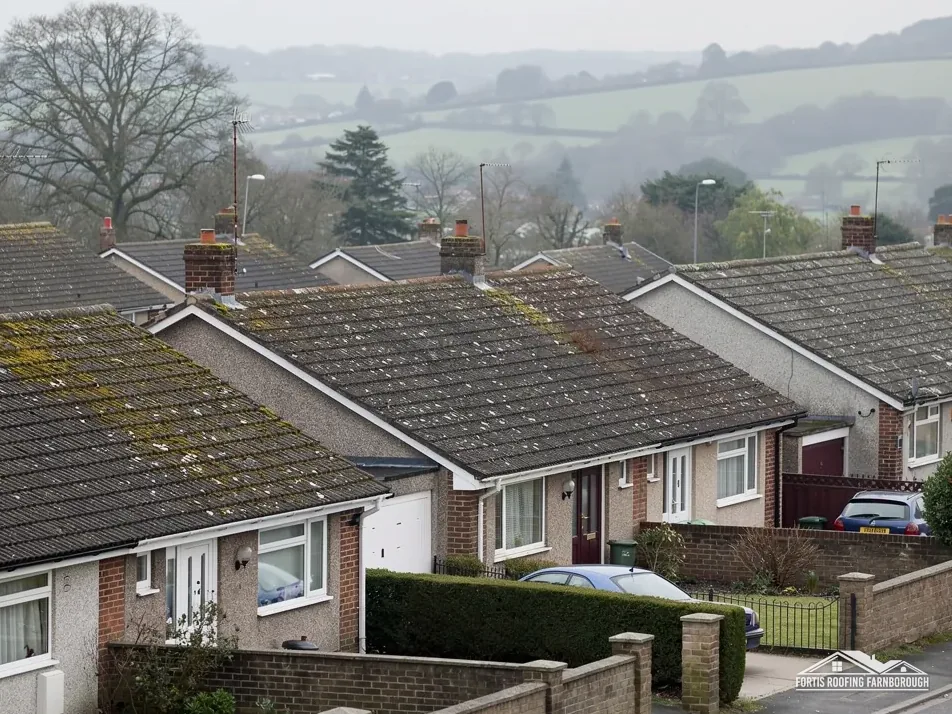
On a street with this many listed buildings, the repair is as careful as the paperwork. Photographs of the ridge, verges, stacks and tile pattern are taken before work, the repair matches, and the record is filed. It serves the council, a buyer or a neighbour later, and it protects the owner if anyone asks what was done.
Where a roof is not listed and no designation applies, the process is simpler but not different: a survey, a plan, photographs and one price. Even then we look at the neighbouring roofs from the road, because a new ridge or a bright new tile beside old weathered ones is visible along a whole lane, and it is kinder to the neighbours to blend it. We also say how the colour is likely to settle over the first winters, so no one is caught out.
Guildford's appraisal says the commonest covering is plain clay tile with a rough, sandy texture. We measure the tile size, thickness and lap, photograph a sample beside the proposed tiles and show you the difference in colour and texture before anything is ordered. A repair is then blended across the slope so the join does not show as a line, and sound old tiles are kept wherever the evidence allows.
Possibly. The Planning Portal says Building Regulations approval is needed if a new covering raises the roof's weight by 15 per cent or more, or if its fire performance would be significantly different. Guildford runs its own building control. The first visit weighs old against new, and you hear in writing if either test is tripped.
Guildford's Article 4 map shows which addresses cannot take a chimney down or change it without permission, so look yours up. Repointing and new flaunching leave a stack as it was. A listed house needs listed building consent for a change that affects its character, and we check the list before agreeing a start.
It can. Work that changes how a listed building looks calls for listed building consent, and planning permission may be wanted as well. A repair matching the existing covering is the lighter case. With so many listed buildings in Shere, we check the list for your address before we agree a start date.
Get your free roof quote
Tell us your Shere lane and the state of the tiles, and a survey visit gets booked.
10-year workmanship guarantee, in writing.