Half-timber cottages
The 1911 county history names many half-timber cottages and farmhouses, including Madgehole, Jelleys and Colman's Hollow.
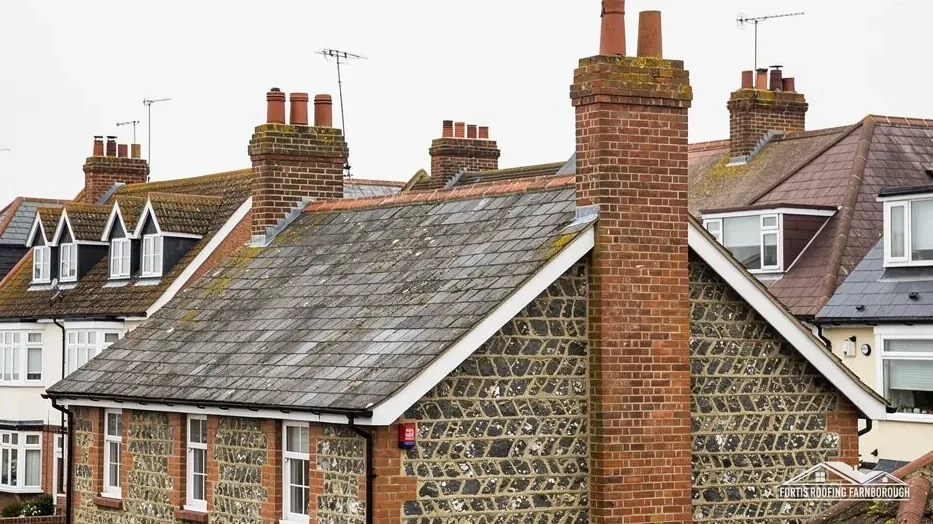
Roofs of half-timbered cottages and 1950s semis in the Surrey Hills
Albury's village moved west to the hamlet of Weston Street, and the 1911 county history found half-timber cottages across the parish. We survey each roof for what it carries.
The 1911 county history names many half-timber cottages and farmhouses, including Madgehole, Jelleys and Colman's Hollow.

In 1911 the old church roofs combined Horsham slabs, tiles and slates, with a domed covering on the tower.
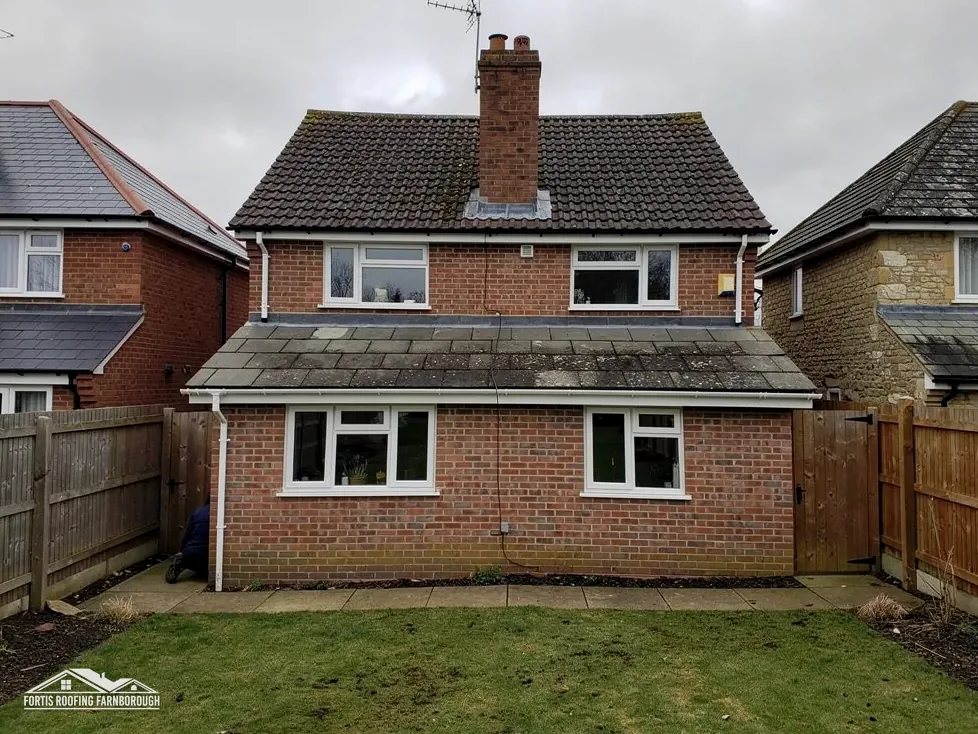
Guildford's settlement profile notes an area of 1950s semi-detached houses south of the village.
Map of Albury with Shere, Chilworth, Gomshall, Merrow marked around it.
Map data © OpenStreetMap contributors. Loads only when you ask for it.
Chilworth lies to the west, Shere and Gomshall to the east, Merrow to the north-west, Wonersh and Shamley Green to the south-west, with Farnborough further north-west.
About 17.3 road miles south-east of Farnborough · Guildford Borough Council and Surrey County Council.
Albury, estate village record
How Guildford and Surrey divide the rules for an Albury roof, how Captain Finch's move to Weston Street and a large estate shaped the housing, and what a village wholly inside the National Landscape means for repairs.
| No. | Chapter | The figure it turns on |
|---|---|---|
| 01 | Guildford's building control and Surrey's scaffold licence | 28-day periods for the Surrey licence |
| 02 | Weston Street, an estate and half-timber cottages | 1,175 residents in Albury |
| 03 | A village wholly inside the Surrey Hills | 100% inside the Surrey Hills National Landscape |
Chapter 01 of 03
| Matter | Office for Albury addresses |
|---|---|
| Planning | Guildford Borough Council |
| Highway authority (until April 2027) | Surrey County Council |
| Building control | Guildford Borough Council's own service |
| Scaffold licence on the highway | Surrey County Council |
| From 1 April 2027 | West Surrey Council replaces both |
Albury sits east of Guildford, 17.3 miles by road south-east of Farnborough, and it answers to two Surrey councils until the reorganisation next spring. Guildford Borough Council is its planning authority and runs building control itself. Surrey County Council keeps the highways until 31 March 2027, when West Surrey Council becomes the successor to both.
Guildford describes its building control as independent, impartial and not for profit, and it names no partner. For a roofing job that is useful to know, because the people who inspect a re-cover are the council's own. Whether a job reaches them depends on its size. A repair that stays under 25 per cent of the building envelope and under 50 per cent of the roof is not what the Planning Portal sends to building control, and Guildford gives no percentage of its own.
A heavier covering is a different test. Take a covering that outweighs the old one by 15 per cent or more: the roof structure has to be shown to cope, and that brings in building control or a registered building control approver whatever the size of the job. Weights are worked out from what is on the roof now, so we write them down when we open it up.
Surrey County Council's page puts the fee at £208 for each 28-day period, with the same sum for a renewal, and wants the application lodged 10 working days or more before the poles go up. It names nobody as the applicant. We therefore agree with the scaffolder who submits it, and the start date you are given already allows for the notice period.
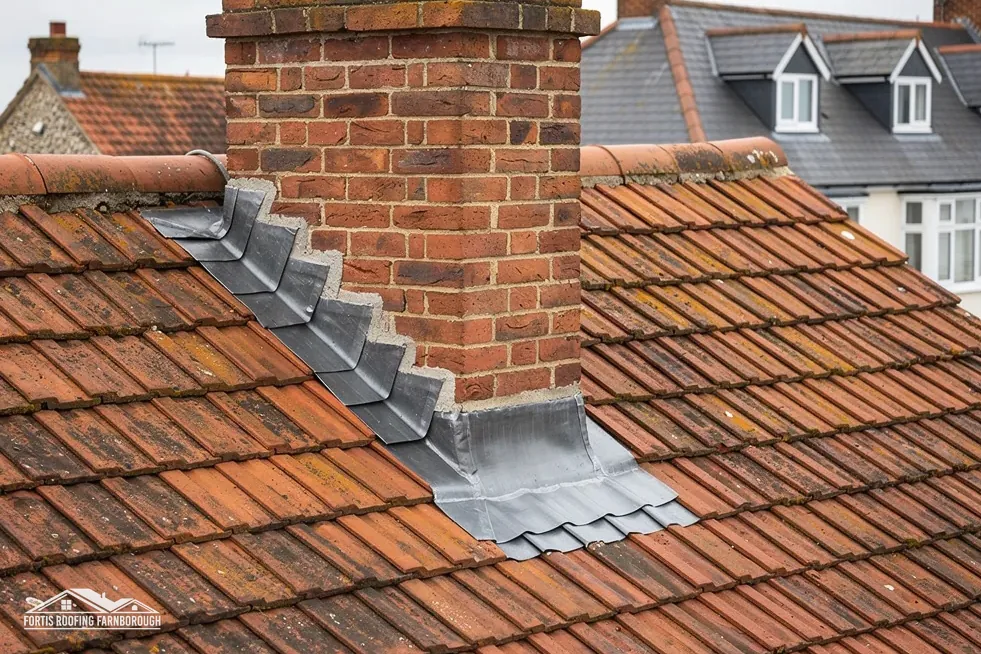
A scaffold on a village street needs to leave the footway usable, and the plan we draw shows how. Our chimney repairs page describes the stack work such a scaffold allows, and any chimney on the house is worth inspecting while the poles are up. We also photograph the lead and the flaunching from the scaffold, since both are hard to judge from the ground. If either is worn, the repair goes into the same plan as the covering.
Chapter 02 of 03
What the record gives for Albury
Guildford's settlement profile explains that the present Albury grew from the hamlet of Weston Street. Captain Finch bought the mansion and surrounding land, and from 1780 onwards the residents of the original village, a mile to the east, moved there. The 1911 county history dates the decisive step to 1842, when Mr Drummond moved the old village about half a mile west and built a new parish church in it. Much of the land is managed from the Albury Estate office, and although the Estate still owns many homes, some are now in private ownership. The 2021 Census counted 1,175 usual residents in the parish.
Where an estate owns the home, the owner usually arranges roof repairs, so the person who needs a survey may be a land agent, a tenant or a householder. We survey for any of them and write the report so that it makes sense to someone who has never seen the roof: covering, ridge, verges, valleys, flashings and gutters, each photographed and described. Tenants can pass it to the owner as it stands.
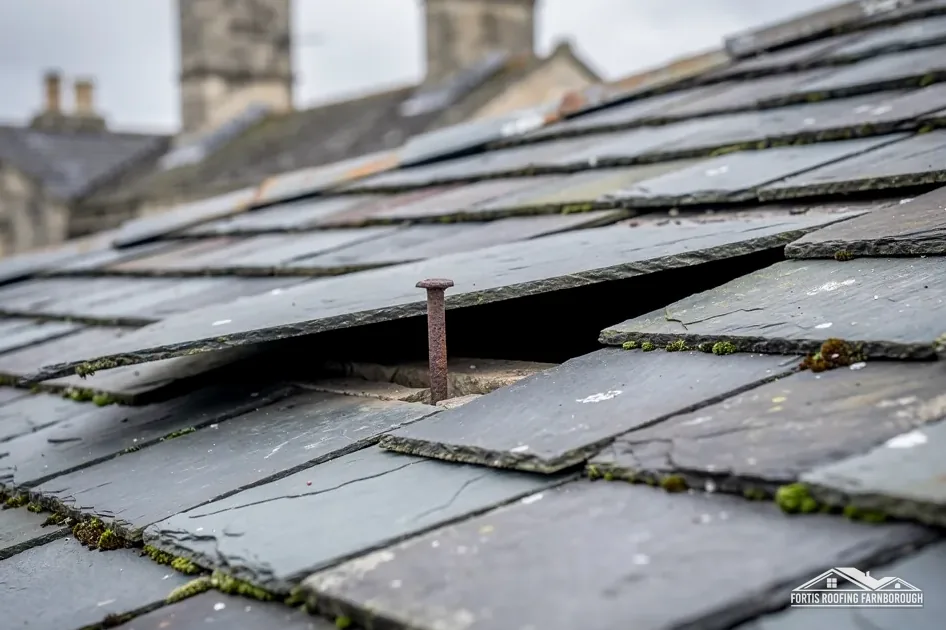
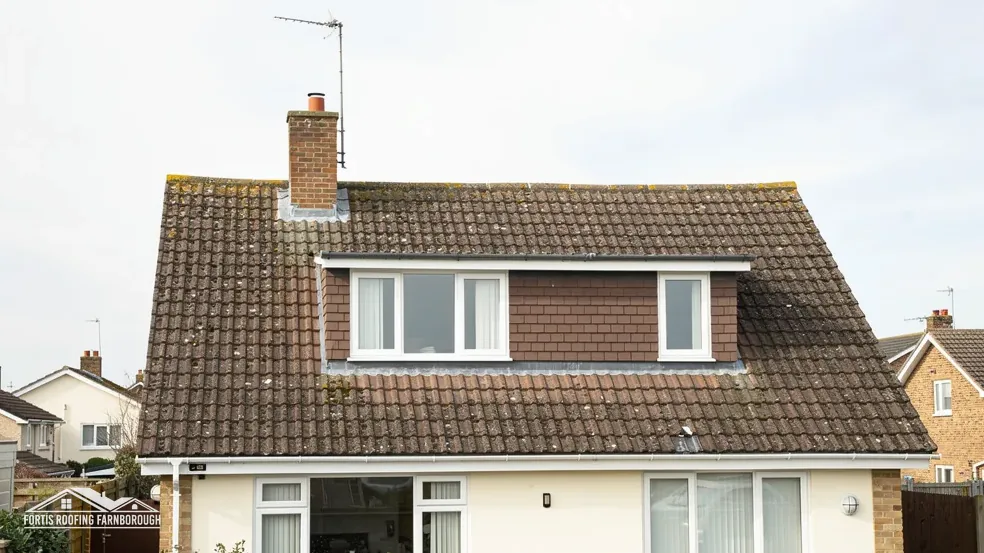
The 1911 county history noted many half-timber cottages and houses in and around Albury, among them Madgehole, Jelleys, Colman's Hollow, Mayor House Farm and Shophouse Farm. The settlement profile adds an area of 1950s semi-detached houses south of the village. Those two kinds of building ask for different surveys. A half-timber cottage needs the roof edge and the wall frame looked at together. A 1950s semi is judged on covering, ridge, verges and gutters, because those are where age shows.
The history also describes the old church in 1911 with four different coverings: Horsham slabs on part of the nave, tiles on the aisle and porch, slates on the transept, and a domed covering of lead and timber on the tower. It shows why we record each section of a roof on its own.

The 1950s semis south of the village are a different story. Built to a pattern, they share a roof design with their neighbours, so a fault found on one is worth asking the next house to check, and we tell you what to look for from the ground, without entering anyone's land. Our pitched roofing page lists what a survey covers on a house of that kind. Where a covering has run out of life across a whole slope, our roof replacement page sets out how a re-cover proceeds. The photographs from the survey decide whether that, or a repair, is the right answer.
Chapter 03 of 03
| Designation | In Albury | For roof work |
|---|---|---|
| Surrey Hills National Landscape | Whole village inside | Dormer and other permitted-development limits: ask Guildford |
| Conservation area | Albury | Changes to the look checked with Guildford |
| Article 4 direction | Where one applies to the address | Chimneys cannot be removed or altered without permission |
| Grade II listed | 6, the Street (NHLE 1188226) | Listed building consent for works affecting its character |
| Grade II listed | Albury House (NHLE 1377727) | Listed building consent for works affecting its character |
Every part of the 1.5 km box around Albury lies inside the Surrey Hills National Landscape, formerly an AONB, so the whole village is on land where the usual planning rights are narrower. Roof extensions such as a new dormer are a question for Guildford's planners there, and our guide to planning permission for roof work sets out the detail. Repairs that restore what is there are not affected, and a new covering is judged by its look rather than by the designation alone.
The national planning dataset also places the Albury conservation area near the village centre. Guildford publishes its conservation areas with appraisals and a map, and the map is the place to look up a house. Inside one, section 55 of the Town and Country Planning Act 1990 puts a matching repair outside planning control. A new covering, ridge or chimney does not fall there, and we ask Guildford before we price it.
Guildford's page says that where an Article 4 direction applies, a chimney cannot be removed or altered without permission, and it tells owners to look up an address on the map by selecting Article 4 Direction. We follow that for any Albury chimney job that would change a stack's height or outline. Repointing and fresh flaunching restore a stack and do not alter it.

6, the Street is listed Grade II, first listed on 21 May 1985, and Albury House and Bettswy Cottage are listed Grade II as well. Historic England's list shows 17 listed buildings within about 500 m of the village point. A change to the character of a listed building needs listed building consent, in addition to planning permission where that applies, and the consent is in hand before any covering comes off.
On a house in a protected landscape, matching matters more than speed. We note tile size, colour and texture, the lap at the eaves, the ridge type and whether the verges are bedded in mortar or held by dry-fix clips (the mechanical system tested to BS 8612). Where an exact match is not available, we show you the nearest choices and say how they differ.
Where a slope is only partly re-covered, new tiles are blended across it so the join is not a hard line, and the photographs we take first are the record if anyone asks later.
Yes. On a half-timbered cottage we look at the roof edge and the wall frame together, because movement at that junction opens gaps. On a 1950s semi the survey concentrates on covering, ridge, verges, valleys and gutters, the places where that age shows. Each is photographed and written up separately.
The whole village sits inside the Surrey Hills National Landscape, where the planning rules for roof extensions are narrower, so a dormer is a question for Guildford. We would raise it with the council before drawing anything up. A repair that restores existing roofing is a different question and is not affected in the same way.
Not without asking Guildford first where an Article 4 direction applies, because the council's page says a chimney cannot be removed or altered without permission there. Its map shows which addresses are covered. Repointing and a new flaunching restore a stack without altering it, and we price those first, so you can see what the lighter-touch route involves.
Guildford's own building control service, described on its page as independent, impartial and not for profit, or a registered building control approver if you prefer a private route. A heavier covering, 15 per cent or more above the old one, or a full re-cover, needs one of them. We tell you which applies.
Get your free roof quote
Tell us your Albury address and what the roof looks like, and we will arrange to photograph it.
10-year workmanship guarantee, in writing.