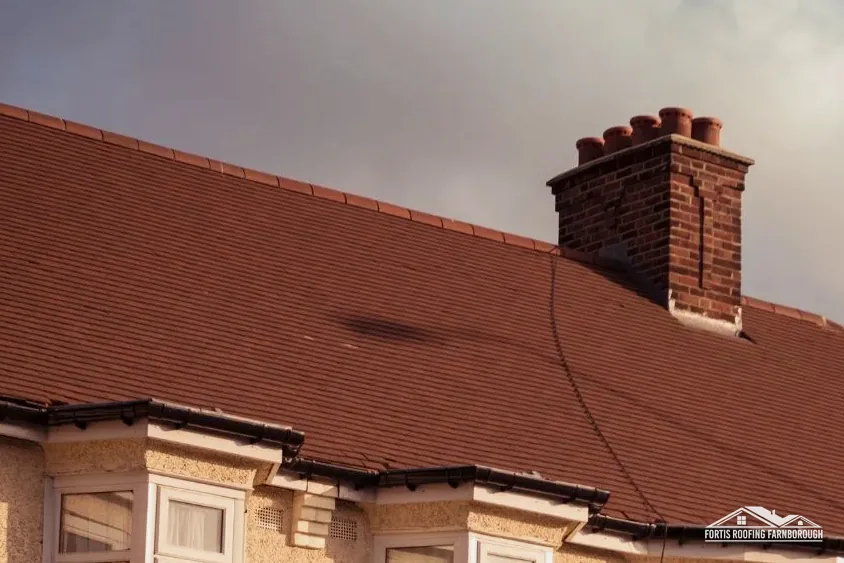
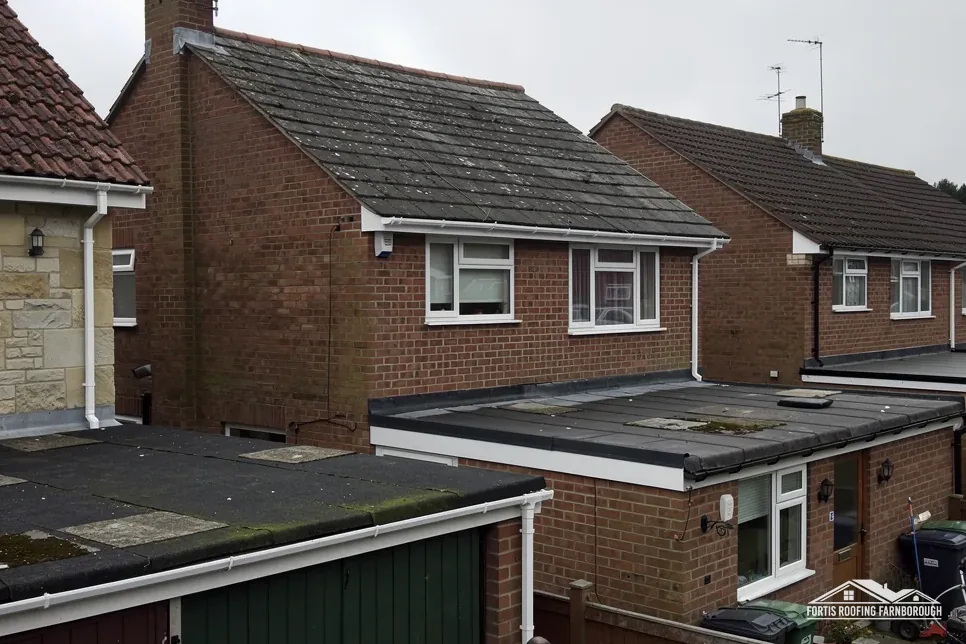
Old workmen's houses
Some old houses in the hamlet are probably due to workmen settled there in Elizabeth I's reign to make gunpowder.
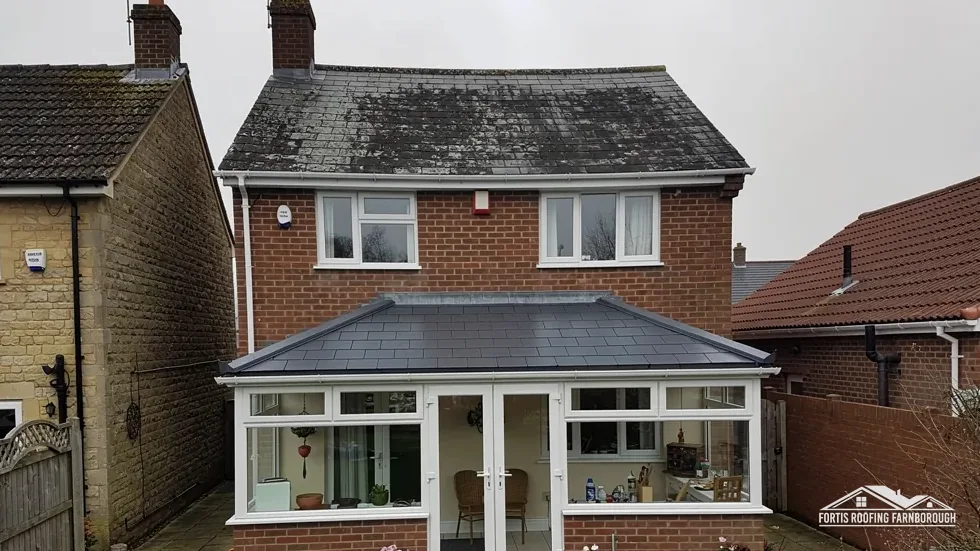
Roofs in the gunpowder valley below St Martha's Hill
Chilworth's gunpowder works closed in 1920, and by the Second World War bungalows and houses had spread toward Blacksmith Lane. We survey each roof slope.
Some old houses in the hamlet are probably due to workmen settled there in Elizabeth I's reign to make gunpowder.
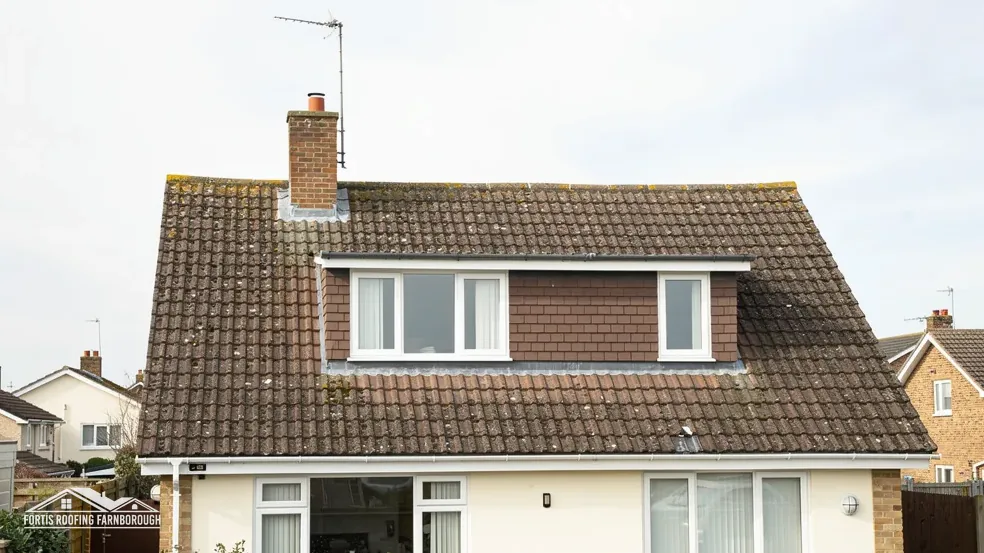
By the Second World War there was suburban development of bungalows and houses toward Blacksmith Lane.
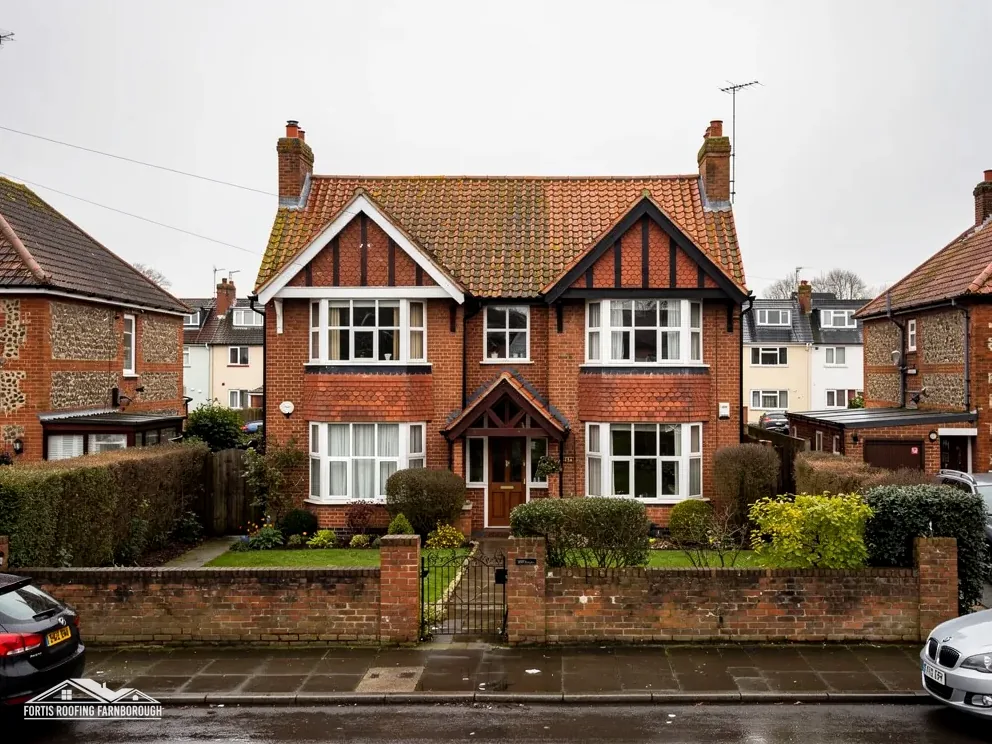
The council appraisal says the Halfpenny Close estate followed after the war.
Map of Chilworth with Wonersh, Shalford, Albury, Bramley, Waverley marked around it.
Map data © OpenStreetMap contributors. Loads only when you ask for it.
Wonersh lies to the south-west, Shalford to the west, Albury to the east, Bramley to the south-west beyond Wonersh and Merrow to the north, with Farnborough to the north-west.
About 18 road miles south-east of Farnborough · Guildford Borough Council and Surrey County Council.
Chilworth, gunpowder valley record
What the Party Wall Act and building control say when a Chilworth chimney breast is altered, how a gunpowder works shaped the village, and how a conservation area, a Surrey Hills edge and Grade II cottages affect repairs.

| No. | Chapter | The figure it turns on |
|---|---|---|
| 01 | Chimney breasts, party walls and the bungalow loft | 2 months' notice before party wall work |
| 02 | Gunpowder, a closure and the post-war streets | Works closed in 1920, sold in 1922 |
| 03 | Gunpowder Mills conservation area and a Surrey Hills edge | 46% inside the Surrey Hills National Landscape |
Chapter 01 of 03
| Question | Published position |
|---|---|
| Removing a chimney breast | Building regulations approval always applies, because it is part of the structure |
| Cutting away part of a party wall | The Party Wall etc. Act 1996 gives a right to cut away a projecting chimney breast, jamb or flue |
| Notice | At least two months before the proposed work begins |
| No reply from the neighbour | You cannot assume that no response means they agree |
| If you cannot agree | A party wall surveyor must be appointed; building control does not decide it |
Chilworth lies in the Tillingbourne valley below St Martha's Hill, 18 road miles from Farnborough, in the south-east direction, with the distance taken from the A325 Farnborough Road. Guildford answers for planning and building control here, Surrey County Council answers for the highway, current until 31 March 2027, after which Guildford addresses join the new West Surrey Council. For bungalows and small houses, the roof question that recurs is a loft and its chimney.
A chimney breast is the masonry that projects into a room beneath the stack. The Planning Portal's rule is blunt: the approval route under the Building Regulations applies every time one is removed, because the breast is part of what holds the building up, and no job is too small for the rule to apply. Where the breast is shared with next door, a second system applies, and it works separately: building control examines the structure, and the Party Wall etc. Act 1996 governs the neighbour relationship.
Under the Act an owner may cut back a projecting breast, jamb or flue in a party wall, provided notice is served two months or more before work starts. GOV.UK points out that silence from a neighbour is not consent. If the two owners cannot agree, a party wall surveyor has to be appointed. That is a surveyor's job, not building control's.
A roofer's part is the roof: we survey it, photograph the stack above the breast from the roof and from inside the loft, and describe the loft and its structure so that your engineer and your surveyor have accurate facts. If a stack is to be taken down above the roofline, the slope is made good with matching covering, and the plan says so. A loft conversion in a bungalow also raises the question of what the existing rafters can carry, which the engineer decides from our measurements of rafter size and spacing.
Our chimney repairs page covers the top and base of a stack, and our pitched roofing page covers the roof around it. Each plan names every step and the order, and marks those that depend on a notice or an approval.
Chapter 02 of 03
Chilworth's story in four published dates
Guildford's appraisal of the Chilworth Gunpowder Mills conservation area says the village grew little in the 19th century despite the 1849 railway, but by the Second World War there was suburban development of bungalows and houses toward Blacksmith Lane, and the Halfpenny Close estate followed after the war. The Chilworth Gunpowder Company told its workers in June 1920 that the works would close, and the land was sold at auction in 1922.
The 1911 county history says the Tillingbourne valley at Chilworth has long used the stream's water-power: there was a mill in Domesday, and gunpowder mills operated from before 1589 and were still working in 1911. It adds that some of the old houses in the hamlet are probably due to workmen settled there in Elizabeth I's reign to make gunpowder, under Sir Polycarp Wharton.
Those old houses and the 20th-century bungalows are very different roofs. An old cottage may have had many rounds of repair, with mixed coverings and a frame that has moved. A bungalow has a single long roof with a ridge, hips and a lot of eaves, and its main faults sit at the ridge, the hips and the gutters. We survey each as what it is. Where an old cottage, a pre-war bungalow and a post-war house stand on the same lane, each roof is its own case. Each has different junctions and different faults, which is why a leak in one house says little about the house beside it, and no house is surveyed from another house's checklist.
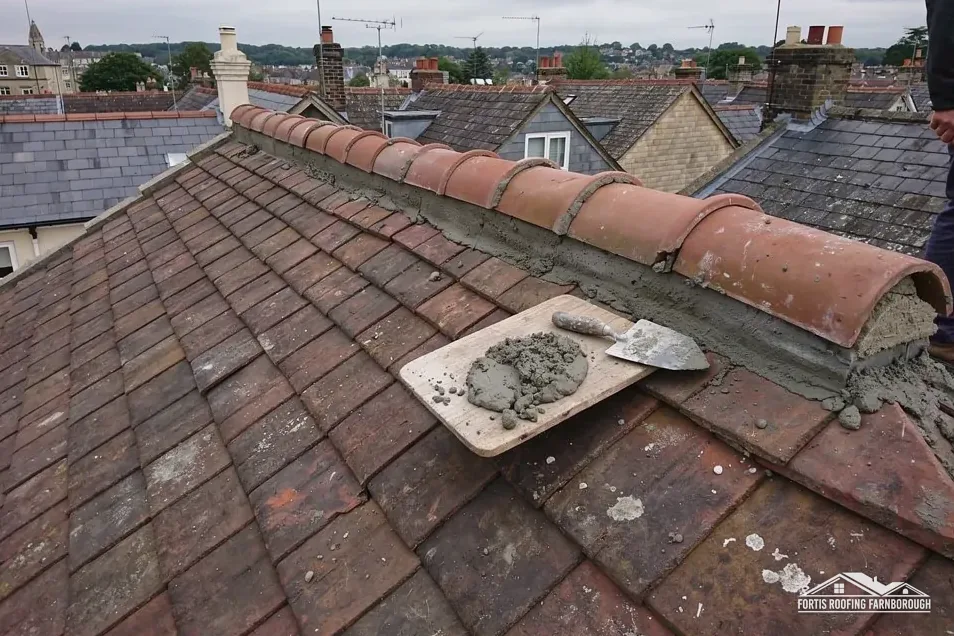
A bungalow roof is a large area under one ridge, so a single slipped ridge tile or failed hip can let water into the whole loft. The loft in a bungalow sits directly above the ceilings, so a leak can reach them without delay. We photograph the ridge and hips along their full length and the gutters at every joint, and we look into the loft for daylight and damp, noting any sagging purlin or notched rafter we can see.
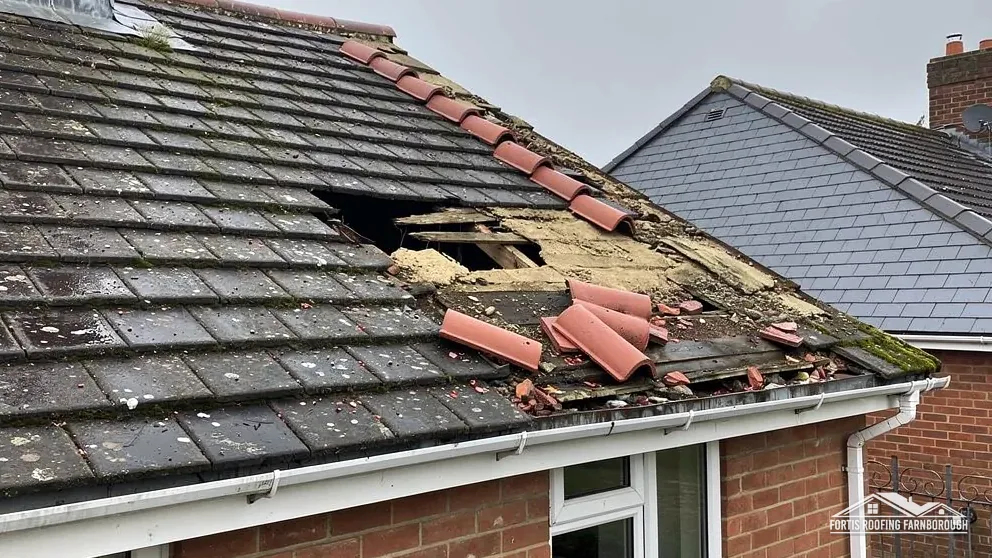
Where a covering has failed across a whole slope, our roof replacement page lays out how a whole roof is renewed, and the survey photographs show whether a whole-roof job or a smaller repair is called for.
Chapter 03 of 03
| Designation | In Chilworth | For roof work |
|---|---|---|
| Conservation area | Chilworth Gunpowder Mills | Changes to the look checked with Guildford |
| Surrey Hills National Landscape | Edge of Chilworth, partly inside | Dormer and other permitted-development limits: ask Guildford |
| Grade II listed | Meadow Cottage (NHLE 1393796) | Listed building consent for works affecting its character |
| Grade II listed | Rose Cottage, the Old Cottage (NHLE 1029551) | Listed building consent for works affecting its character |
| Grade II listed | The Old Manor House (NHLE 1377758) | Listed building consent for works affecting its character |
The planning dataset puts the Chilworth Gunpowder Mills conservation area within about 0.75 km of the centre of Chilworth, and the 1911 county history notes that Chilworth and Albury station, opened in 1849, stands just inside the parish. The Surrey Hills National Landscape, formerly an AONB, reaches the edge of the village: the village point is outside, but 46 per cent of the 1.5 km box around it is inside. On National Landscape land a dormer window must have planning permission, which matters for a bungalow loft conversion, and the council's map shows which addresses are affected.
In a conservation area, putting back the original is not development under section 55 of the Town and Country Planning Act 1990, whereas choosing a new covering or ridge alters the appearance and goes to Guildford's planners first. Guildford's map is where an address is checked, and the same map answers whether an Article 4 direction on chimneys applies, which matters before any stack is taken down or rebuilt.
Meadow Cottage has been Grade II listed since 13 January 2010. Rose Cottage, the Old Cottage, and The Old Manor House are also Grade II. Historic England's list counts 4 listed buildings within about 500 m of the village point. Anyone who owns a listed house needs listed building consent ahead of work altering its character, and the paperwork is checked before any date is fixed. Because Meadow Cottage was listed as recently as 2010, an older house's listing status is never assumed from memory: the national list is searched afresh for each address before a quotation is written.
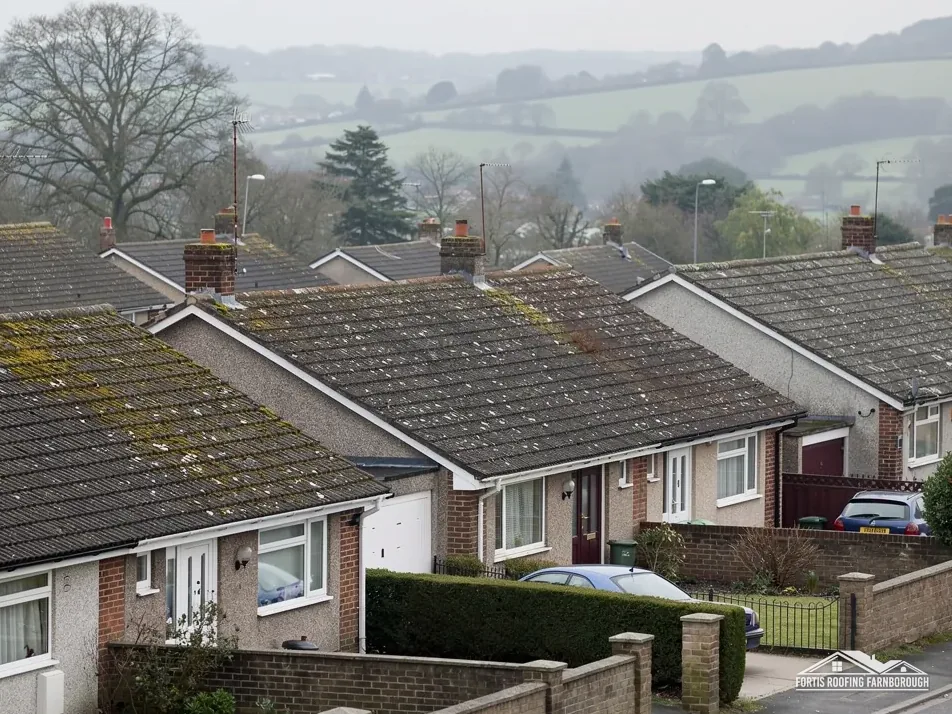
For a bungalow in a conservation area or inside the National Landscape edge, the loft conversion question is a planning question first, then a building control question about escape, stairs and insulation. We survey the roof for the designers and leave the design to them. When a family wants a bigger bungalow, the sequence is: check the address on Guildford's map, speak to the planners about a dormer, then design for building control. The survey comes first, because the existing roof decides what is possible: its pitch, its rafter size and the position of its chimneys, all of which we measure and mark on a plan for the designer.
A bungalow has one long ridge and hips over a large area, so a single slipped ridge tile or a failed hip bedding can let water into the whole loft. We photograph the ridge and hips along their full length, check the fixings, and say whether a refix or a re-bed is the right repair.
Yes, formally. The Party Wall Act asks for notice at least two months before work, and GOV.UK says you cannot assume that no reply means agreement. If you cannot agree, a party wall surveyor must be appointed. Building regulations approval always applies when a chimney breast is removed.
A dormer window needs planning permission on National Landscape land, and 46 per cent of the 1.5 km box around Chilworth is inside the boundary. Guildford's map settles individual addresses. Escape, stairs and insulation are then separate building control questions, and our survey gives the designer an accurate account of the roof.
Meadow Cottage was first listed Grade II on 13 January 2010, which is the date on the national list. Listed building consent comes before any work that changes its character. Rose Cottage, the Old Cottage, and The Old Manor House are also listed Grade II.
Get your free roof quote
Send your Chilworth address and any signs of leaks or loft plans, and we will arrange a survey.
10-year workmanship guarantee, in writing.