
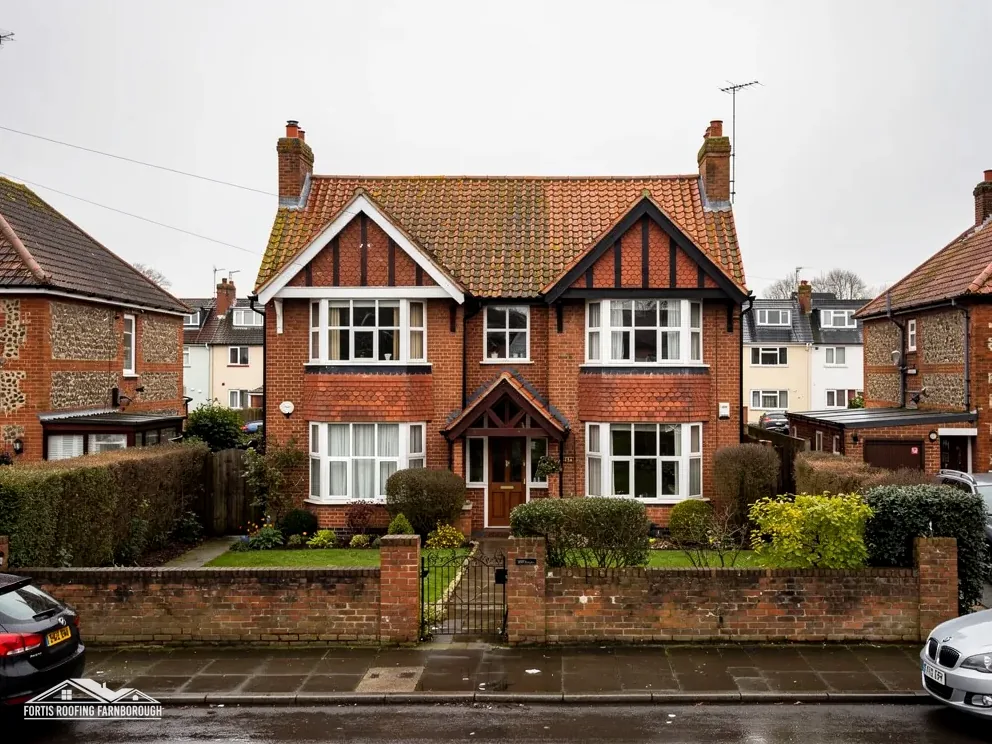
Bargate stone houses
Bargate stone is much used in Bramley, and Holy Trinity Church is the largest example, with red brick quoins.

Roofs above Bargate stone and tile-hung timber frames
Waverley's appraisal says Bramley grew after the railway, with Bargate stone, galleted mortar and a tradition of tile-hanging. We survey each roof slope.
Bargate stone is much used in Bramley, and Holy Trinity Church is the largest example, with red brick quoins.

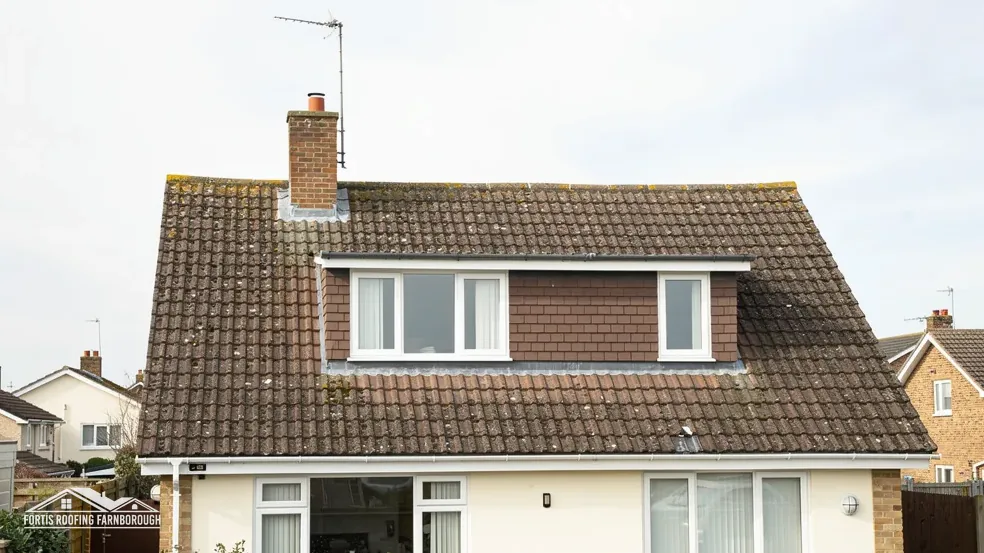
Tile-hanging, usually on upper floors only, is a local tradition that clad timber-framed walls.
East Manor House has held a Grade II* listing since 9 March 1960.
Map of Bramley, Waverley with Wonersh, Shalford, Shamley Green, Chilworth marked around it.
Map data © OpenStreetMap contributors. Loads only when you ask for it.
Wonersh lies just to the east, Shalford to the north, Shamley Green to the south-east and Godalming to the west, with Farnborough to the north-west.
About 17.8 road miles south-east of Farnborough · Waverley Borough Council and Surrey County Council.
Bramley, stone and tile record
What the law says about bats and nests when a Bramley roof is repaired, how the railway shaped the village and left its Bargate and tile-hung houses, and how two conservation areas and a Surrey Hills edge affect repairs.
| No. | Chapter | The figure it turns on |
|---|---|---|
| 01 | Bats, nests and a Bramley roof repair | 3 laws touch bats, nests and roofs |
| 02 | The railway, Bargate stone and tile-hanging | Railway closed in 1965 |
| 03 | Two conservation areas and a Surrey Hills edge | 30% inside the Surrey Hills National Landscape |
Chapter 01 of 03
| Law | What it says in outline |
|---|---|
| Wildlife and Countryside Act 1981, birds | An offence if a person intentionally takes, damages or destroys a wild bird nest in use or being built |
| Wildlife and Countryside Act 1981, bats | Intentionally or recklessly disturbing a bat in its shelter, or obstructing access to it, is an offence |
| Habitats Regulations 2017 reg 43(1) | Deliberately disturbing a bat, or damaging or destroying a breeding site or resting place, is an offence |
| GOV.UK bat guidance | Activities that can affect bats include repairing or replacing a roof |
Bramley is a village on the A281 south of Guildford, 17.8 miles by road to the south-east of Farnborough, counted from the A325 Farnborough Road. Waverley Borough Council takes the planning decisions and keeps its own building control team; scaffold licences on the highway come from Surrey County Council, current until 31 March 2027; Waverley addresses then fall under the new West Surrey Council. A village of this age has another matter for a roofer to weigh: the creatures that use the roof.
GOV.UK describes every bat species, together with its breeding sites and resting places, as fully protected by law, and names roof repair or replacement as one activity that can affect bats. The Habitats Regulations 2017 make it an offence to deliberately disturb a bat, or to damage or destroy a breeding site or resting place, and for damage no deliberate intent is needed. The Wildlife and Countryside Act 1981 adds an offence of intentionally or recklessly disturbing a bat while it occupies a shelter, or obstructing access to it.
For birds, the same Act is aimed at a person who intentionally takes, damages or destroys a wild bird's nest that is in use or being built. Intent is the key word there. We describe the law as it is written and give no dates or seasons, because a nest in use is a matter of fact on the day.
On a survey we look for signs of occupation: droppings in a loft, staining at an access point, old nests under the eaves. If we find any, work stops until you have had advice from the right body, and we tell you so in writing. That is a stop on our side, not a threat to your roof. A roof with bats is still repaired, but the plan is made with the advice in hand and the timing agreed around it, so the work can go ahead lawfully and the animals are not harmed.
Our pitched roofing page describes the repairs a scaffold makes safe to reach. Surrey wants 10 working days' notice for a scaffold licence, and charges £208 for each 28-day period, so a plan that has to wait for wildlife advice also has to time its licence.
Chapter 02 of 03
Bramley's building story in four facts
Waverley's conservation-area appraisal says Bramley grew significantly after the railway arrived, while its historic core along the valley of the Cranleigh Water survived, and that the railway closed in 1965. The 2021 Census counted 3,538 usual residents in the parish. The 1911 county history adds that Bramley was originally part of Shalford ecclesiastical parish, with its own chapel probably since the 11th century, and was separated in 1844.
Bargate stone is much used in Bramley, the largest example being Holy Trinity Church. Quoins and window surrounds are sometimes picked out in red brick, and some mortar is galleted with ironstone, which means small pieces of ironstone are pressed into the mortar joints. These details sit in walls, but they meet the roof at gables and chimneys, and a stone gable with a brick quoin is a junction where the verge has to be detailed with care.
The appraisal calls tile-hanging, usually on upper floors only, a local tradition: once clay roofing tiles became cheap they were used to clad timber-framed walls. Tile-hanging is the same clay tile fixed to a wall instead of a roof. Where it meets the eaves, a bay or a dormer, a lead flashing carries the water out onto the roof tiles, and the survey lifts the lowest hung courses to see what is behind.
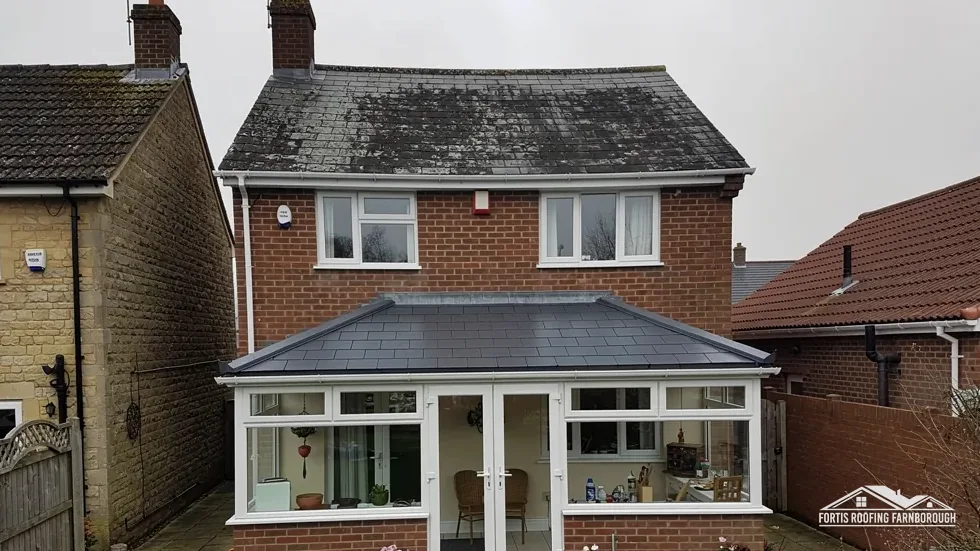
Where the covering across a slope has worn out, our roof replacement page sets out each step of a re-cover, and the photographs show whether it is needed. Lead at chimneys and valleys is covered on our lead roofing and lead work page. The appraisal notes that a road, a canal and a railway were all built along the valley, and that only the road, the A281, survives; it also names brick buildings, Georgian houses at the southern end of the village and modern closes. We never assume what is on a slope; it is named from what we find, and the repair is matched to that. Hung tiles weather as roof tiles do, so a stone or brick wall that carries them gets a photograph at every junction, and a replacement on a hung wall is chosen to suit the courses either side in colour, size and shape.

Chapter 03 of 03
| Designation | In Bramley | For roof work |
|---|---|---|
| Conservation areas | Bramley; Wonersh | Changes to the look checked with Waverley |
| Surrey Hills National Landscape | Edge of Bramley, partly inside | Dormer and other permitted-development limits: ask Waverley |
| Grade II* listed church in use | Church of Holy Trinity (NHLE 1044581) | Church of England faculty, not listed building consent |
| Grade II* listed | East Manor House (NHLE 1249485) | Listed building consent for works affecting its character |
| Grade II listed | Bramley Manor House (NHLE 1249457) | Listed building consent for works affecting its character |
The national planning dataset names two conservation areas near Bramley, Bramley itself and Wonersh, and Waverley's appraisal says the Bramley conservation area was designated on 26 March 1974. Waverley counts 44 conservation areas across the borough, and its online map shows whether a given house is inside one, which we look at before the survey visit so that nothing surprises you afterwards. Where one is, section 55 of the Town and Country Planning Act 1990 treats putting back the original as no development, whereas a different covering or ridge is a change of look, and Waverley's planners are asked first.
The Surrey Hills National Landscape, formerly an AONB, reaches the edge of Bramley. The village point lies outside it, but 30 per cent of the 1.5 km box around the village is inside. On National Landscape land a new dormer needs planning permission, so Waverley's map is consulted before any dormer is sketched.
Holy Trinity carries a Grade II* listing from 9 March 1960 and is still used by the Church of England, so its roof is a faculty matter. East Manor House is Grade II* and was listed on that date too. Birch House (Bramley Lodge) and Bramley Manor House are listed Grade II. Historic England's list counts 24 listed buildings within about 500 m of the village point, so a Bramley house may well stand beside a listed building, and we look at that before planning a scaffold.
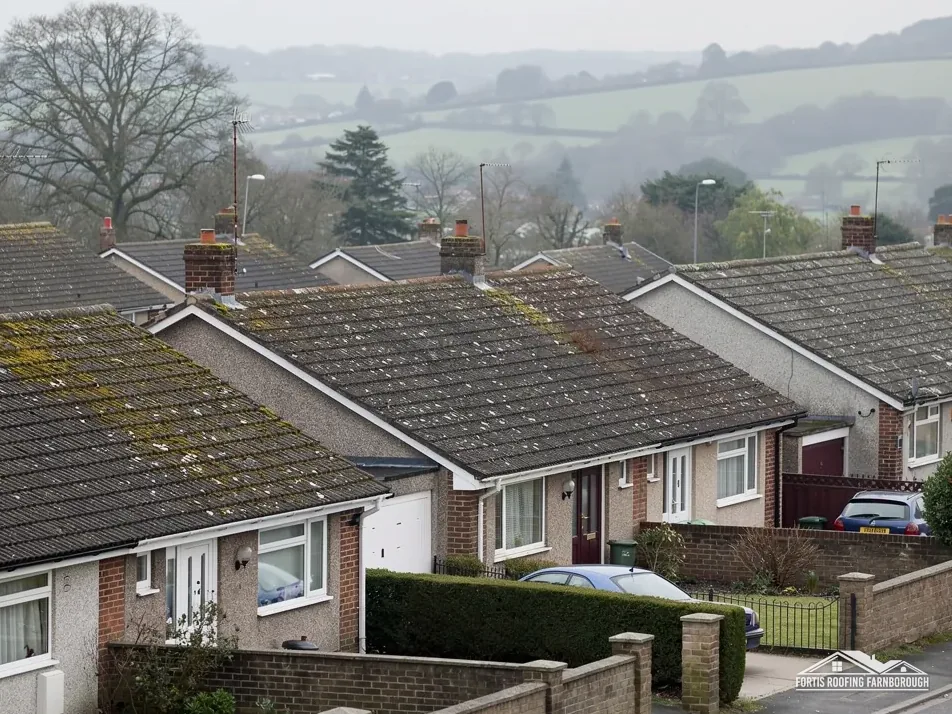
Alteration of a listed building's character needs listed building consent beforehand, and we ask to see it before a start date is agreed. On any Bramley house we photograph covering, ridge, verges, stacks and hung tile before work, match the repair and keep the file for the council or a buyer.
In a conservation area the most useful evidence is a photograph of the existing roof next to a sample of the proposed material, with a note of how the two differ. We prepare both, and the council sees them together, so the officer can judge the match without visiting, and the application is stronger for it. Where a house is let, the owner's consent matters as well as the occupier's, and both receive the report directly.
No. Tile-hanging is wall cladding, and Waverley's appraisal calls it a local tradition on upper floors. A roof covering is separate work. Where the two meet, the flashing is renewed if it has failed, and the lowest hung courses are lifted to check the battens, so only the worn junction is dealt with.
Work stops until advice is taken. GOV.UK says bat roosts are fully protected and that repairing a roof can affect bats, and the Habitats Regulations make damaging a resting place an offence without intent. We tell you in writing and plan the repair around the advice, so the roof is still repaired.
The planning dataset names Bramley and Wonersh conservation areas near the village, and Waverley's map shows whether your house is inside one. Under section 55 of the Town and Country Planning Act 1990, a repair in matching material is not development. A new covering or ridge changes the look, and Waverley's planners are asked first.
Not for a repair that restores what is there. A new dormer needs planning permission on National Landscape land, and 30 per cent of the 1.5 km box around Bramley is inside the boundary. Check your address on Waverley's map, and we will ask the council if the answer is unclear.
Get your free roof quote
Send your Bramley address and a note of any damp or slipped tiles, and we will arrange a survey.
10-year workmanship guarantee, in writing.





