The tile-hung watermill
The 1911 county history described the little watermill as tile-hung almost to the ground, with a large projecting upper storey.
Roofs by the Wey, a tile-hung mill and the Surrey Hills edge
Shalford's little watermill is tile-hung almost to the ground, and part of the village edge touches the Surrey Hills. We survey each roof slope.
The 1911 county history described the little watermill as tile-hung almost to the ground, with a large projecting upper storey.
Built in stone and brick on a site called the Timber Yard, according to the 1911 county history.

Rebuilt in 1789 with a domed copper roof, then entirely demolished in 1847 to make way for the present church.
Map of Shalford with Bramley, Waverley, Wonersh, Chilworth, Guildford marked around it.
Map data © OpenStreetMap contributors. Loads only when you ask for it.
Guildford is the town to the north, with Merrow north-east, Chilworth east, Wonersh and Bramley south and Farncombe south-west, and Farnborough is a long way beyond Guildford.
About 16.3 road miles south-east of Farnborough · Guildford Borough Council and Surrey County Council.
Shalford, rules and records
Which offices answer for a Shalford roof, what the 1911 county history records of its mill, house and church, and what the conservation area, the Surrey Hills edge and the Grade II buildings mean for a repair.

| No. | Chapter | The figure it turns on |
|---|---|---|
| 01 | Guildford's own building control, Surrey's scaffold licence | 10 working days' notice for scaffold |
| 02 | Canal, mill and church in the 1911 record | 1813 canal; 1847 church rebuilt |
| 03 | Shalford's conservation area and the Surrey Hills edge | 15% inside the Surrey Hills National Landscape |
Chapter 01 of 03
| Question | Body for Shalford addresses |
|---|---|
| Planning authority | Guildford Borough Council |
| Highway authority (until April 2027) | Surrey County Council |
| Building control | Guildford Borough Council's own service |
| Scaffold licence on the highway | Surrey County Council |
| From 1 April 2027 | West Surrey Council replaces both |
Shalford lies just south of Guildford, 16.3 road miles south-east of Farnborough along the route measured from the A325 Farnborough Road. Planning here is Guildford Borough Council's job, and so is building control, which it provides without a named partner. The highway powers stay with Surrey County Council until 31 March 2027. West Surrey Council, whose area will include Guildford, replaces both on 1 April 2027, so a roof booked this winter is governed by today's offices.
Most Shalford roof jobs ask only whether building control is involved, and the Planning Portal's test settles that. A job that stays under 25 per cent of the building envelope and under 50 per cent of the roof is not normally a building control matter. A handful of slipped tiles or a fresh run of ridge sits inside both limits; stripping the entire roof and re-covering it does not. Guildford's pages publish no percentage of their own. We measure each slope and note the area, so the question is answered from numbers.
If the work does need Guildford's building control, or a registered building control approver, you hear it from us before the date is booked. A heavier covering, 15 per cent or more above the old weight, needs approval whatever share of the roof it covers, which is one more reason to identify the existing covering before a new one is chosen.
Section 169 of the Highways Act 1980 makes scaffold that obstructs a highway subject to a licence from the highway authority. Surrey wants the application in at least 10 working days ahead, and its fee is £208 per 28 days, renewals included. Where a structure is dangerous, the page allows an emergency licence by phone, earlier than that window.
That guidance leaves open whose job it is to submit the form, so the scaffolder and we settle it and the dates are passed on to you. Where water is already getting in, the first visit is a make-safe, and the lasting repair follows once access is in place. What a make-safe involves, and what comes after it, is described on our emergency and general roof repairs page. A temporary cover is only a stop-gap, so the make-safe is photographed and the lasting repair is written up from the same visit.
Chapter 02 of 03
Shalford's record in four dates and figures
Shalford's working past comes from Surrey's 1911 volume of the Victoria County History. The Wey and Arun canal, made in 1813, left the Wey in the parish, became unnavigable about 1870 and was quite abandoned by 1911, and the parish also had chalk pits and lime kilns on the downs. The 2021 Census counted 4,180 usual residents in the larger parish of Shalford, Peasmarsh and Chilworth, so the number is for a wider area than the village alone.
The same history describes the little watermill as tile-hung almost to the ground, with a large projecting upper storey carried on wooden pillars. It dates Shalford House to 1608 to 1610 and says it was built in stone and brick on a place called the Timber Yard. It records the church as rebuilt in 1789 in local stone rubble with brick dressings, with a squat tower under a domed copper roof, and mentions a 1780 view that showed the earlier church with a central tower and a shingled spire. The 1789 church did not last: in 1847 it was entirely demolished to make way for the present structure, which the same history calls an example of the 13th-century style.
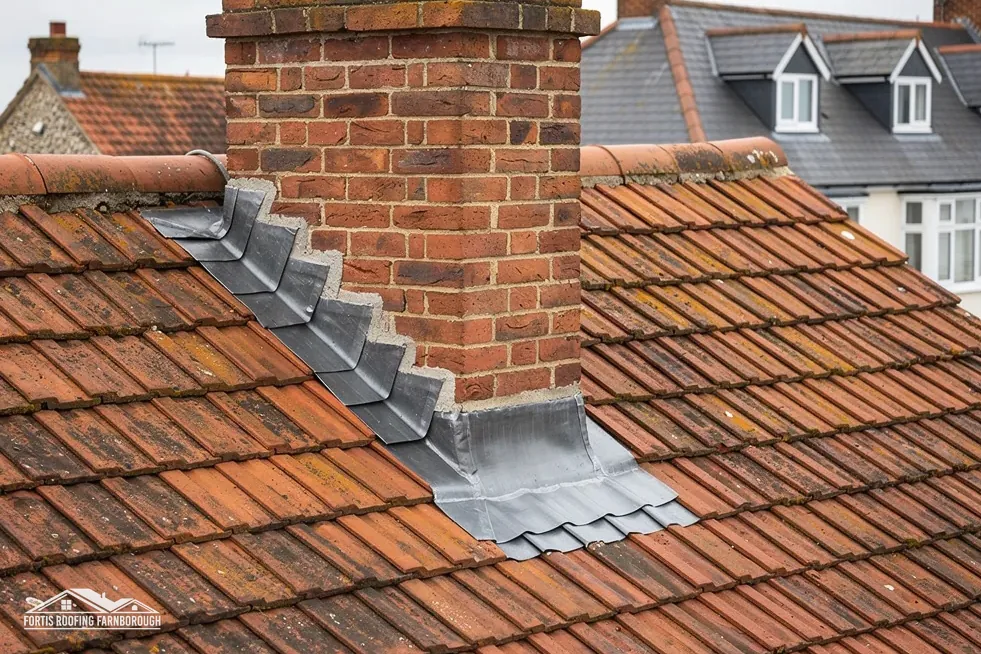
That record cannot say what covers any Shalford house now, and the survey never assumes it. What it shows is the range of materials in one parish: stone, brick and hung tile. A roof survey here has to be ready for any of them, and for the places where one meets another, such as the line where hung tile reaches the roof edge. That junction needs its own flashing, and it is a common place for old water damage to sit unseen behind the hanging.

Shalford stands on greensand beside the Wey and the Tillingbourne, with a large common. We mention the water because a house near a river valley may have trees close by, and trees put leaves, moss and seed into valleys and gutters. Clearing those is routine work that our gutters, soffits and fascias team can do, and the survey marks where leaves have already lodged.
When the covering on a Shalford house has come to the end of its life, our roof replacement page follows a re-cover from the strip through battens and underlay to the ridge, and the photographs have to justify it first.
Chapter 03 of 03
| Designation | In Shalford | For roof work |
|---|---|---|
| Conservation area | Shalford; Wey and Godalming Navigations | Changes to the look checked with Guildford |
| Surrey Hills National Landscape | Edge of Shalford, partly inside | Dormer and other permitted-development limits: ask Guildford |
| Grade II listed | 2 Pound Place, including 69 Station Road (NHLE 1294443) | Listed building consent for works affecting its character |
| Grade II listed | County First School (NHLE 1029503) | Listed building consent for works affecting its character |
| Grade II listed | Fosters Row (NHLE 1029494) | Listed building consent for works affecting its character |
In the planning dataset the Shalford conservation area lies within about 0.75 km of Shalford's middle, and the Wey and Godalming Navigations conservation area falls within the same search. Guildford lists its conservation areas with appraisals on its website, and the council's map is where to check an address. The Surrey Hills is a separate layer: the village point lies outside the National Landscape, formerly the AONB, but 15 per cent of the 1.5 km box around it falls inside.
National Landscape status narrows what a householder may add to a roof without an application, so we put any new dormer to Guildford's planners first, and our planning permission guide explains why. The council's map shows which side of that line a house stands on, and the question is asked before any job that would add a dormer or change the roof shape is drawn up. For repairs that restore what is there, the line matters much less.
The council adds that where an Article 4 direction applies, a chimney needs permission before it is taken down or changed, and owners can look up an address on the Article 4 layer of its map. We follow that: if a Shalford chimney is to be taken down or rebuilt differently, the check comes first. Our chimney repairs page covers repointing and flaunching, which restore a stack without altering it.
Three buildings near the village centre are listed Grade II: 2 Pound Place with 69 Station Road, the County First School and Fosters Row. Anyone who owns a listed building has to get listed building consent before work that alters it, together with planning permission if that is also required. Historic England's list shows 8 listed buildings within about 500 m of the village point, so it is worth checking your own house on the list before booking.
Whatever the designation, the method is the same. We photograph the existing covering, ridge, verges and stacks, repair like for like and file the record, so a repair in a conservation area or beside a listed building can be shown to follow what was there. A neighbour, a buyer's surveyor or the council may ask years later what was done, and the file answers.
Yes. Wall cladding is separate work from the roof covering. Where the hung tile meets the roof edge we strip back the flashing, check the battens and the wall behind for damp, and renew the junction to match. The survey photographs show the condition of that line before we price the job.
Not where a repair puts back what was already there. It matters when a job would add to the roof, a dormer being the usual example, because the designation narrows what can be built without an application. About 15 per cent of the 1.5 km box around Shalford falls inside the boundary, so check your address on Guildford's map and we will ask the council if the answer is unclear.
Not where an Article 4 direction applies, since Guildford says permission must be given before a chimney there is taken down or altered. Its map shows which addresses are covered. Repointing, new flaunching and fresh flashing renew a stack without altering it, and those repairs are priced first.
Surrey County Council's page offers an emergency scaffolding licence by phone where a structure is dangerous, instead of the usual wait of 10 working days. Meanwhile the roof is made safe with a temporary repair and photographs, and the full repair is planned afterwards, with the access and dates agreed in writing.
Get your free roof quote
Give us the Shalford road and the problem you have seen, and a survey day gets fixed.
10-year workmanship guarantee, in writing.