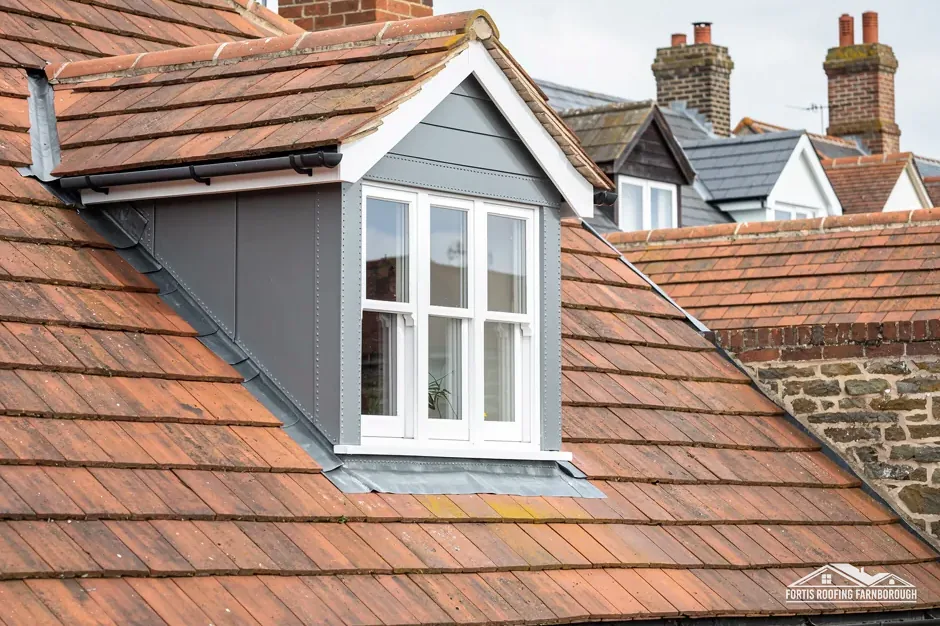
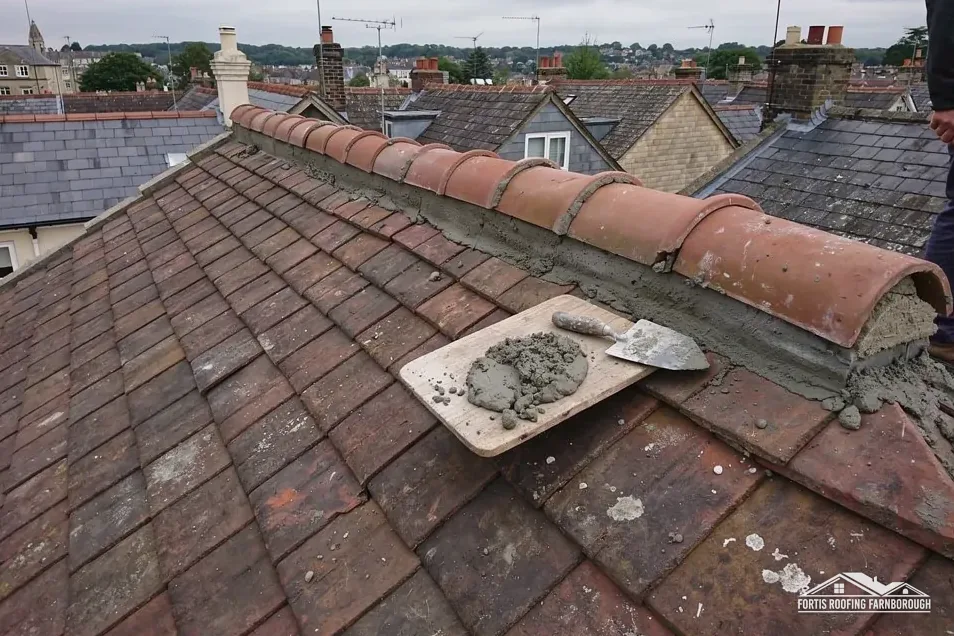
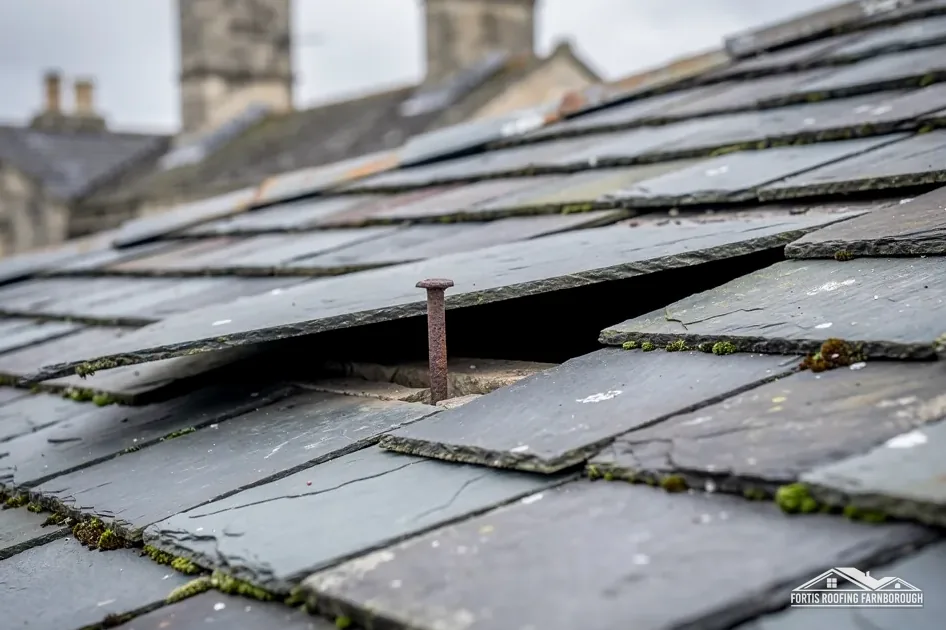
St Mark's Weald stone
St Mark's is of Weald stone, with an apsidal chancel and a wooden bell-turret, says the 1911 county history.
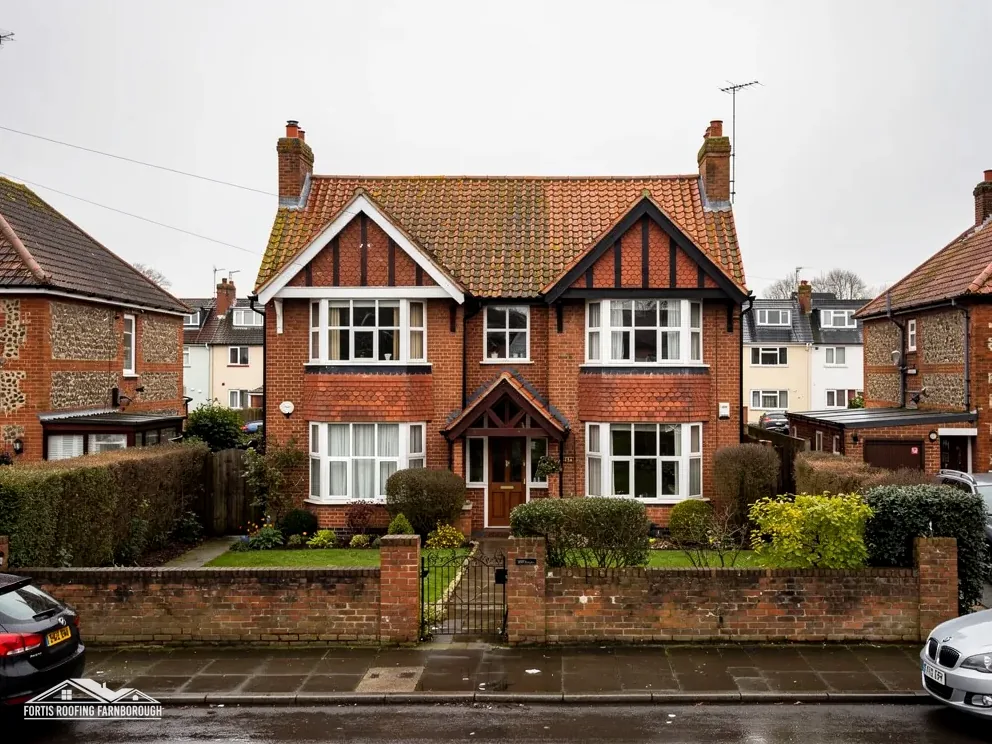
Roofs in Peaslake's valley, where five roads meet below the Hurtwood hills
Peaslake clusters loosely where five roads meet in a small valley, reached by narrow sunken lanes. We plan access first, survey every roof and price once in writing.
St Mark's is of Weald stone, with an apsidal chancel and a wooden bell-turret, says the 1911 county history.

A Working Men's Institute was built in 1891, and several new houses had gone up by 1911.
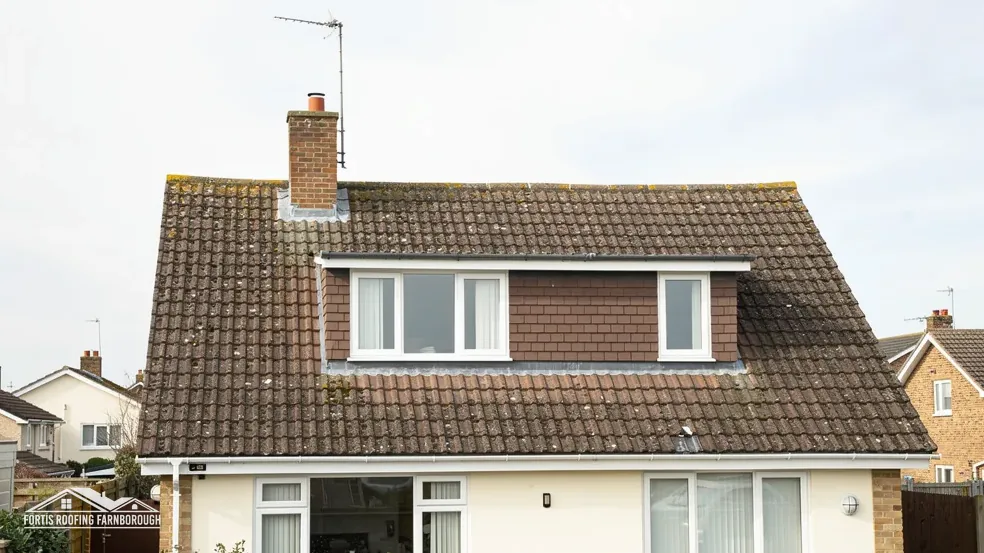
Hazel Hill and its former stables to the rear are listed Grade II, as are East View and Lindeth Cottage.
Map of Peaslake with Holmbury St Mary, Gomshall, Abinger, Shere marked around it.
Map data © OpenStreetMap contributors. Loads only when you ask for it.
Holmbury St Mary lies to the east, Gomshall to the north, Abinger to the east, Shere to the north-west, Ewhurst to the south and Albury beyond Shere.
About 20 road miles south-east of Farnborough · Guildford Borough Council and Surrey County Council.
Peaslake, a hamlet in the hills
How a hillside hamlet's narrow lanes shape a roof job, what the 1911 county history and Guildford's settlement profile say about Peaslake, and how Guildford's chimney rules and the Surrey Hills designation apply.
| No. | Chapter | The figure it turns on |
|---|---|---|
| 01 | Five roads and narrow sunken lanes | 820 residents, five roads meet |
| 02 | A valley that was once hard to reach | Road from Ewhurst made only recently, 1911 |
| 03 | Listed cottages, stables and Guildford's chimney rule | Four Grade II listings, chimneys controlled |
Chapter 01 of 03
Peaslake: people, roads and listings
Peaslake is a hamlet in a small valley in the Hurtwood hills, south of Shere, where the 2021 Census recorded 820 residents of the built-up area. Guildford's settlement profile says it clusters loosely where five roads meet in the valley, approached by narrow sunken lanes. That one sentence explains most of what makes a roof job here different: getting to the roof.
A sunken lane has high banks and little room. A delivery lorry may not reach the house, a skip may have to sit at the top of the lane and a scaffold lorry may need a shorter wagon. Materials can come in small loads, or be carried or lifted across a distance, and every extra handling step costs time.
So a survey here starts with the approach and not the roof. We drive or walk the lane, measure its narrowest point, note where a vehicle can stand and ask about neighbours' drives. The access plan is written down and shown to you before any date is set, and the single written price reflects what that plan involves.
Planning decisions belong to Guildford, whose own building control service calls itself independent, impartial and not for profit. Roads are Surrey County Council's until 31 March 2027, and from 1 April 2027 a new body, West Surrey Council, replaces them both. The village lies inside the Surrey Hills National Landscape, a designation once named Area of Outstanding Natural Beauty that counts as article 2(3) land, and the Peaslake conservation area covers part of it.
The Planning Portal's national test is the yardstick for a re-roof: building control is not normally involved while work touches under 25 per cent of the building envelope and under 50 per cent of the roof.
Putting a roof back as it was is repair. A dormer, a new rooflight or a changed ridge is alteration, and designated land tests alteration more strictly, so Guildford is consulted first. The planning permission guide explains why.
A neighbour's drive may be the only place for a skip, so we ask before we assume, and we leave the lane passable at the end of every day. If a leak cannot wait for the planned access, a temporary cover goes on first from a ladder or tower, and the permanent repair follows once the lane and the dates are sorted.
Chapter 02 of 03
| Subject | Record |
|---|---|
| The road from Ewhurst | Fit for wheeled traffic only since district councils were set up |
| The Working Men's Institute | Built in 1891 |
| New houses | Several built of late, by 1911 |
| The hamlet's setting | At the bend of the valley between Holmbury and Ewhurst Hills |
| The valley's past | Formerly shared the inaccessibility and wild character of Felday |
In 1911 the county history of Surrey reported that a road from Ewhurst fit for wheeled traffic had reached Peaslake only since district councils were set up, that a Working Men's Institute went up in 1891 and that several new houses had been built of late. It places the hamlet, part of Shere, at the bend of the valley between Holmbury and Ewhurst Hills, a place that once shared the inaccessibility and wild character of Felday.
St Mark's itself opened as a chapel of ease to Shere in 1889, in the same years. A survey tells us what each house roof carries.
A house built in the 1890s is now around 130 years old. Its roof has seen generations of weather, and the weak points are the usual ones: ridge bedding, verges, flashings, valleys and underlay. A hillside house also sheds water from a sloping plot, and an overflowing gutter can run water down a bank towards the foundations. Houses cut into a bank may have an eaves line close to the ground at the back, so the rear gutter and the first tile courses are checked from ground level and from above.
Every gutter and downpipe is photographed, and we follow each to see where its water ends up. A downpipe that discharges against a wall or over a path makes damp that no repair to the roof can cure, so it is reported separately.
A house on a slope is often seen from the lane above, which means its roof is on show. Matching tile colour and ridge detail matters more than on a house seen only from the front, and we plan the repair so it reads well from above.
Trees close to the house drop leaves into valleys and gutters, and shade encourages moss, so we check the valleys, the gutters and the lowest tile courses, where debris collects and staining shows first.

Because help is not always close, a roof is never left half open. A repair that cannot be finished in a day is stopped at a weathertight point, and you are told what that means for the night and the forecast.
The pitched roofing page describes tile repairs, and the gutters, soffits and fascias page covers the roofline.
Chapter 03 of 03
Peaslake's listed buildings
East View, Hazel Hill with its former stables, Lindeth Cottage and St Mark's church are each listed at Grade II, and ten listed buildings stand within about 500 metres of the centre. St Mark's remains in Anglican use, so under the ecclesiastical exemption its roof work follows the faculty system. For the other buildings, any work touching their character needs listed building consent.
Guildford says it relies on Article 4 directions to manage change in conservation areas, and that a chimney under one needs the council's consent before it is dismantled or reshaped. The council tells owners to look up their address on its map. So whether a direction reaches a Peaslake house is a question for Guildford, and we put it to the council before any work on a stack.
Chimneys are among the most common roof repairs. A stack may need repointing, new flashings or a new cap, and a stack taken down to the roofline and never rebuilt alters a house's look. Where a direction applies, even a rebuild needs thought.
St Mark's is a reminder of how small features carry water. It is built of Weald stone with an apsidal chancel, a curved end wall, and a wooden bell-turret. A curved apse roof and a turret both need careful flashings, and those are exactly the details that need a specialist's eye on any similar small structure in the valley.
The former stables at Hazel Hill belong to a kind of building whose roof is large, plain and easily forgotten. A stable roof is surveyed like any other: covering, battens, ridge, verges and the junction with the main house. Many such buildings now serve as garages, studios or homes, and a change of use changes the question, since a heated studio under an old roof raises ventilation and insulation points.
We record the roof before any new use is designed, so the person drawing it up knows exactly what the roof is. The photographs and measurements go to whoever needs them, and you keep a copy.
Our chimney repairs page explains how stacks are repaired once the consent position is clear.
Houses in the valley that are not listed may still stand in the conservation area, and the survey notes which category each falls into.
Materials can arrive in smaller loads, be carried the last stretch or be lifted from a nearby stand. We measure the narrowest part of the lane, note where vehicles can stand and write the access plan before any date is fixed, and the one written price reflects that plan, so nobody is caught out when the lorry arrives.
It depends on your address. Guildford says a chimney under an Article 4 direction needs permission before it is dismantled or modified, and it asks owners to check its map. We put your address to Guildford before proposing any chimney work, and the reply goes into your file.
The whole village sits inside it, and part of Peaslake also lies in its own conservation area. Matching repairs keep the look, while a new dormer, a rooflight or a raised ridge faces tougher scrutiny. Guildford is asked before any alteration to the roof is priced, and the reply comes to you.
No. St Mark's has a Grade II listing and is in Anglican use, so the ecclesiastical exemption points to the faculty system. Listed building consent from Guildford is the route for East View, Hazel Hill and Lindeth Cottage, and each owner applies.
Get your free roof quote
Send your Peaslake address and the fault, and we will walk the lane first, then photograph every slope.
10-year workmanship guarantee, in writing.