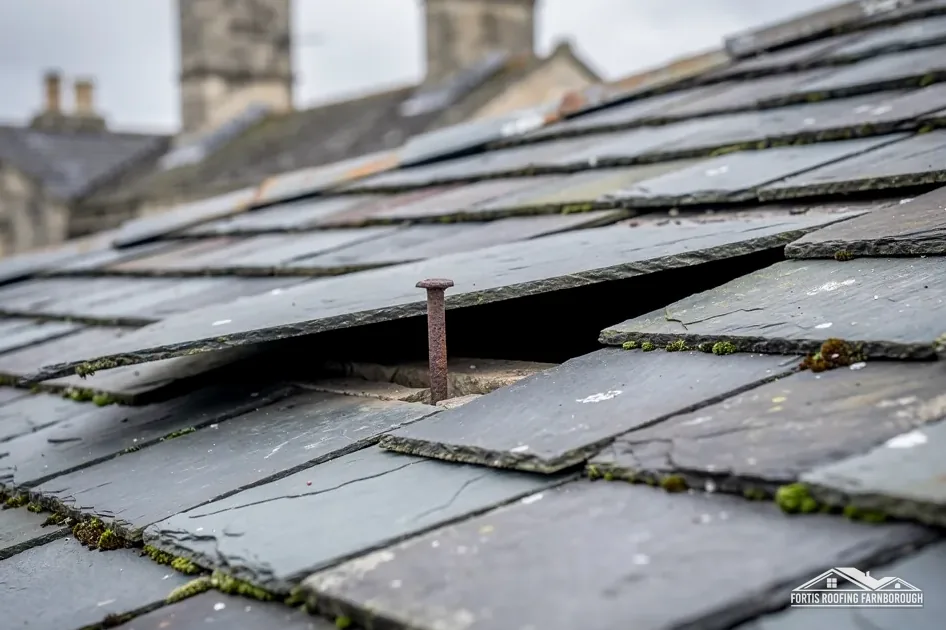
St James's old nave roof
The nave roof is old, with canted, boarded sides, perhaps 17th century; chancel and north chapel roofs are modern.
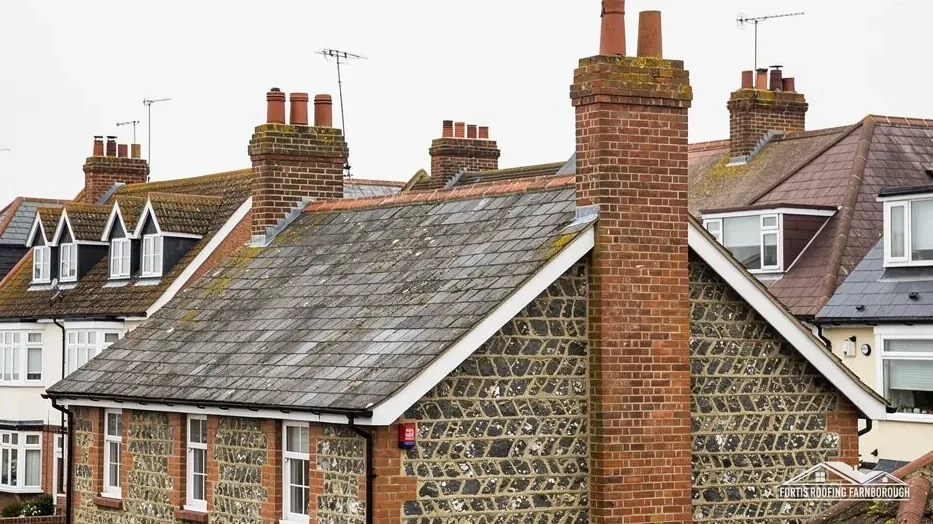
Roofs on the slopes of the Surrey Hills west of Dorking
Abinger is a parish on the Surrey Hills slopes whose church, manor and pub are all listed. We read each roof on site before anyone talks about a price.
The nave roof is old, with canted, boarded sides, perhaps 17th century; chancel and north chapel roofs are modern.

In 1911 the Victoria County History described the church roofs as covered with Horsham slates.

Abinger Manor, the Abinger Hatch and the Common war memorial are all listed Grade II.
Map of Abinger with Holmbury St Mary, Peaslake, Westcott, Gomshall marked around it.
Map data © OpenStreetMap contributors. Loads only when you ask for it.
Holmbury St Mary lies south-west, Peaslake west, Gomshall and Shere north-west, Westcott and Dorking north-east, and Ewhurst further south-west.
About 25.1 road miles south-east of Farnborough · Mole Valley District Council and Surrey County Council.
Abinger, hills and old roofs
How Mole Valley and Surrey County Council divide a roof job in Abinger, what a 1911 history records about the church's nave and its slates, and what the Surrey Hills designation and the listed buildings change.
| No. | Chapter | The figure it turns on |
|---|---|---|
| 01 | Mole Valley plans, Surrey issues the scaffold licence | 10 working days for a Surrey licence |
| 02 | A hill church, its old nave and Horsham slates | Horsham slates on the church in 1911 |
| 03 | Surrey Hills landscape, listed buildings and nearby conservation areas | All 1.5 km inside the Surrey Hills |
Chapter 01 of 03
An Abinger roof job in four published figures
For planning, Abinger answers to Mole Valley District Council. For the road and pavement in front of the house it answers to Surrey County Council, at least until 31 March 2027, when East Surrey Council takes over the work of both. Until that date nothing changes in how a roof job is arranged, and we plan around the arrangements that stand today.
Under section 169 of the Highways Act 1980, a scaffold that obstructs the highway needs the highway authority's licence. Surrey County Council's rate is £208 for each 28-day period, and its page says to apply at least 10 working days before the date you want the scaffold up. It adds that it processes applications within 10 days. The page is silent on who files the form, so we find out who applies before the booking and settle the licence paperwork with the scaffolder.
A roof on a sloping lane can be awkward to reach, and the ground under a scaffold needs thought as much as the licence. We look at the gradient, the verge and the nearest place a delivery can stop, so that the licence covers the right length of road. Scaffold standing wholly inside your boundary needs no highway licence, which on a larger plot may be the simpler plan. On a steep drive the base plates and boards matter more than the licence, and the written plan records both.
If a structure is unsafe or the risk is significant, Surrey County Council says you can phone for an emergency scaffolding licence before the 10 days are up. That is the only exception its page gives, and we do not rely on it for ordinary jobs, because a planned job should never need to jump the queue.
For re-roofing, the Planning Portal's two limits are the national guide: a job affecting under 25 per cent of the building envelope and under 50 per cent of the roof does not normally need Building Regulations approval. A covering at least 15 per cent heavier does, with a structural check. If approval is needed, a registered building control approver is the private alternative to the council's team. We measure each slope at the survey and tell you the result, so that the question is answered in writing before any date goes in the diary.
Chapter 02 of 03
| Subject | What the history records |
|---|---|
| Church roofs | Covered with Horsham slates in 1911 |
| Nave roof | Old, with canted, boarded sides, perhaps of 17th-century date |
| Chancel and north chapel | Roofs modern by 1911 |
| Position | About 550 ft up: the highest old parish church in Surrey after Tatsfield |
| Roman villa | Found near Abinger Hall in 1877; Charles Darwin used its mosaic floors in his earthworm observations |
The Victoria County History of Surrey gives a close description of Abinger's church. The chancel and north chapel have modern roofs, as of 1911, while the nave roof is old, with canted, boarded sides, perhaps of the 17th century. It also describes the roofs of St James's as covered with Horsham slates, and says the nave belongs to an early 12th-century church.
A church roof that has been worked on in several centuries is a fair record of how roofs age: the oldest timbers sit under the newest coverings, and the joints between each phase are the weak points. The same applies to houses in the parish, where a long life is likely to mean repair after repair. A cottage altered over generations may have a slate slope next to a tile one, a lead valley that was replaced once and a chimney that was rebuilt twice. We record each phase, because a repair that suits one part may not suit its neighbour.
The history also puts the church about 550 ft up, the highest old parish church in Surrey after Tatsfield. We draw no conclusion about weather from that, and make none. What a hillside setting does mean is that rain runs off a long slope fast, so gutters and downpipes on a lane that falls away need to be sized and fixed with care. Our gutters, soffits and fascias page explains the checks.
Where a house does carry natural slate, our slate roofing page describes how single slates are replaced and how nails and clips are chosen. The history's mention of Horsham slates on one church tells us nothing about your house, which is why the survey names the covering slope by slope. A hip or a valley that was relaid in a different material from the main slope is a common cause of trouble, and we mark every one.
From the history
The record also mentions a Roman villa found near Abinger Hall in 1877, whose mosaic floors Charles Darwin used for his observations on earthworms. It is a reminder that the parish has been lived in for a very long time, and that old ground and old buildings call for patient work. For an Abinger homeowner the practical lesson is simple: ask for the roof to be looked at in sections, not as a single surface, and expect a report that treats each section on its own terms.
Chapter 03 of 03
Designations in and around Abinger in four figures
The whole of the 1.5 km area around Abinger lies inside the Surrey Hills National Landscape, formerly the AONB. Repairs carry on here as anywhere else, but a dormer, a new roof shape or a different covering is the kind of change to raise with Mole Valley's planners before anything is drawn up. Our planning permission for roof work guide explains what that does and does not catch.
The national dataset names three conservation areas within about 2.5 km of Abinger: Abinger Hammer, Holmbury St Mary and Westcott. None reaches the 1.5 km area round the village centre, so a house at the heart of the parish may be outside all three. Whether yours is covered is a question for Mole Valley's map, and so is whether an Article 4 direction applies to it. A phone call or an email to the planning team usually settles it in a single exchange.
St James's is listed Grade II* and still in Church of England use, which puts its roof under the ecclesiastical exemption and the faculty system instead of the council's consent route. Ask the person responsible for the building which path applies before any contractor is approached. Abinger Manor, the Abinger Hatch and the Abinger Common war memorial are each listed Grade II, and the national list records 5 listed buildings within 500 m of the centre. For any listed building, listed building consent covers work that alters its character. We take that question to the council before we price anything beyond a plain repair, since the answer can change the materials, the method and the time the job takes.

Like-for-like repair is the ordinary case on an unlisted house in this setting. Section 55 of the Town and Country Planning Act 1990 puts works that leave a building's outward look materially the same outside the definition of development. A change to the covering, the ridge or the chimney is where the landscape designation and the conservation questions begin, and our chimney repairs page shows what a like-for-like stack repair involves. Anything you plan to alter, tell us before the survey so that we photograph the existing detail first.
Usually, if the slates around the damage are sound enough to lift and refix. We check the nails and fixings first, because one slipped slate can point to a tired fixing along the whole course. The survey photographs show which slates can stay and which should come off, so the repair matches the rest of the slope.
Yes. All of the 1.5 km area round the village centre is within it. A dormer or other change to the roof's shape is a question for Mole Valley's planners before any drawing is made, and our planning guide explains why. Like-for-like repairs sit differently, and we raise any change of appearance with the council before pricing.
St James's holds a Grade II* listing and remains in Church of England use, so the ecclesiastical exemption applies and its repairs follow the faculty route. The Grade II manor and the Abinger Hatch are different, because Mole Valley's listed building consent applies to work that affects their character, and we raise it before pricing.
Surrey County Council charges £208 for each 28-day period and asks for the application at least 10 working days before the scaffold goes up. Its page does not say who applies, so we ask before booking and write the dates into the plan. A scaffold kept wholly inside your own boundary needs no highway licence at all.
Get your free roof quote
Give us your Abinger address and what you have seen on the roof, and we will arrange a survey.
10-year workmanship guarantee, in writing.