
Old Rudgwick on Church Street
Old Rudgwick stood at the top of Church Street, mostly on the west side, and is now a Conservation Area.

Roofs around a Grade I church on the Sussex border
Rudgwick's Holy Trinity church stands on a ridge on the old parish boundary, and a photograph of about 1905 shows it roofed in Horsham stone.
Old Rudgwick stood at the top of Church Street, mostly on the west side, and is now a Conservation Area.
A photograph of about 1905 shows Holy Trinity with its Horsham stone roof; its tower dates from the 13th century.
Autumn Cottage, Elmfield Cottage and Horshoe Cottage are each listed Grade II.
Map of Rudgwick with Alfold, Loxwood, Cranleigh, Ifold marked around it.
Map data © OpenStreetMap contributors. Loads only when you ask for it.
Rudgwick is a Low Weald village on the Sussex-Surrey border, west of Horsham, and the A325 at Farnborough is 28 road miles from it, in a north-westerly direction.
About 28 road miles south-east of Farnborough · Horsham District Council and West Sussex County Council.
Rudgwick, stone, storms and records
What to do about storm damage on a Rudgwick roof and where the councils sit, what the church's Horsham stone roof and restorations tell a surveyor, and which designations shape a repair.
| No. | Chapter | The figure it turns on |
|---|---|---|
| 01 | Storm damage, your insurer and Horsham | Tell your insurer first |
| 02 | A ridge church and its Horsham stone roof | Holy Trinity restored in 1843 to 1847 |
| 03 | A Grade I church, a conservation area and cottages | Grade I church; five listings within 500 m |
Chapter 01 of 03
| Question | Who handles it in Rudgwick |
|---|---|
| Planning authority | Horsham District Council |
| County council | West Sussex County Council |
| Building control | Horsham District Council's service, or a registered approver |
| Insurance claim for storm damage | Your insurer first, by its own storm definition |
| Complaint about a claim | Financial Ombudsman Service, 0800 023 4567 |
Rudgwick answers to Horsham District Council for planning and to West Sussex County Council above it. Ordinarily you meet neither. The call you are likelier to make after a wild night is to your insurer, and the order in which the calls are made matters more than owners expect.
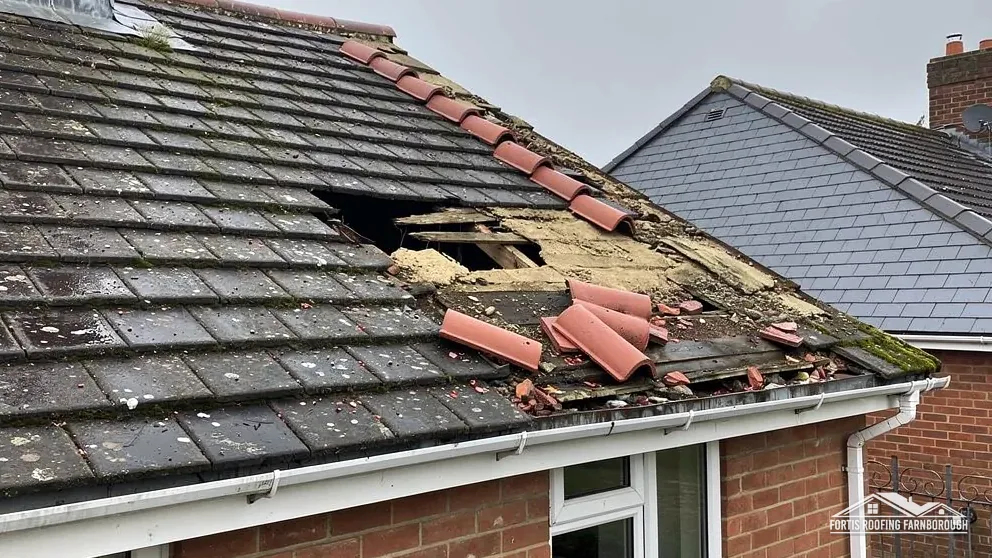
Ring the insurer before anything else. Then stop further damage by making the roof safe, and keep the photographs and every receipt. Our first visit to a leaking roof is about stopping the water, and pictures of the damage are taken as part of that, so evidence for the claim exists without anyone going back up a ladder, and the pictures are yours to send to the insurer with our written findings. A temporary repair is not a permanent one, and the claim should say which you have had. Ask the insurer whether it wants to see the damage or the photographs before anything is taken away.
Your policy's wording decides what counts as a storm. On storms the Financial Ombudsman Service is not wedded to gales, and it accepts that a deluge of rain, hail or snow can qualify. When it reviews a refused claim it looks at three things in turn, namely whether a storm took place, whether the damage fits that kind of weather, and whether the weather was the real cause. A roof that was tired already, with the storm merely showing up an old fault, gives an owner a weaker case.
That last point is why a record helps. A survey showing the state of the covering, the ridge and the flashings before a storm is better evidence than anyone's memory. You receive our findings and photographs, and the claim itself stays between you and the insurer.
When an insurer has sent no final response after 8 weeks, the Ombudsman will look at the complaint, on 0800 023 4567, free of charge. After the final response, the window to complain is 6 months.
Building control and planning come second. Repair after a storm normally needs neither, since it stays far below the Planning Portal's 25 per cent of the building envelope and 50 per cent of the roof, and a like-for-like replacement is the simple answer.
Chapter 02 of 03
Rudgwick's church and parish, four figures
Holy Trinity Church is a Grade I listed building whose tower dates from the 13th century, and it stands on the ridge, right on the old parish boundary. A photograph of about 1905 shows it with its Horsham stone roof, a covering of heavy stone slabs from the Horsham area. The church was restored in 1843 to 1847 by J. P. Harrison, and again in 1887 to 1888 by J. P. St Aubyn, who put in the tie-beam roofs and repaired the tower.
A tie-beam roof has a horizontal beam spanning the walls beneath the rafters, holding the walls from spreading under the weight above. Horsham stone is heavy, so the timbers that carry it have to be strong, and that matters for any later change. Swapping a heavy covering for a lighter one lowers the load. Moving the other way raises it, and a covering adding 15 per cent or more in weight brings Building Regulations approval along with a structural check.
The church is a special case and cottages are a different matter. What the account does show is that Rudgwick has a record of stone slab roofing, and a surveyor who meets old slabs asks the right questions. How are they fixed? How heavy are they? Can matching ones still be found? We ask all three, and we look at the timbers beneath, before offering any view on repair.
The Rudgwick Preservation Society describes Old Rudgwick as standing at the top end of Church Street, almost all on the west side, and says the area is now a Conservation Area. With 2,968 usual residents at the 2021 Census, the parish has grown far past that old street.
Parish and church
On a Rudgwick survey the roof in front of us is what counts, not what the street's history might suggest. Every slope's covering is photographed, and the area affected is measured. If matching old slabs or tiles cannot be found, you are told so plainly, and the council's planners are asked before any substitute material is chosen. A different covering changes the load as well as the look.
Chapter 03 of 03
| Record | In Rudgwick | For roof work |
|---|---|---|
| Conservation area | Rudgwick, within about 0.75 km of the centre | Matching repairs; ask Horsham about changes |
| Grade I listed | Holy Trinity Church | Route depends on denomination and use |
| Grade II listed | Autumn Cottage (NHLE 1285685) | Listed building consent for work affecting character |
| Grade II listed | Elmfield Cottage (NHLE 1354194); Horshoe Cottage (NHLE 1194448) | The same consent route |
| Listed buildings nearby | 5 within 500 m of the village centre | Check before work on an older home |
Horsham District Council's planners keep the boundary of the Rudgwick conservation area, which the dataset puts within 0.75 km of the middle of the village; the Preservation Society places Old Rudgwick inside it. Within a conservation area, a repair in matching materials and details is the simple case, and a change of covering needs raising with the planners beforehand. The council knows whether an Article 4 direction reaches your address, and the question goes to Horsham ahead of any pricing.
Five listed buildings stand within 500 metres of the village centre, a small number that makes each one easy to check. Autumn Cottage has been listed Grade II since 28 November 1980, and Elmfield Cottage and Horshoe Cottage carry the same grade. A listed house keeps its permitted development rights, but anything that affects its character also needs listed building consent. Our planning permission and roof work guide draws the line between a repair and an alteration.
Holy Trinity is listed Grade I. Which route its roof takes depends on the congregation and how the building is used. Anglican worship brings the faculty system, and any other body would seek listed building consent from the council.
The Rudgwick Preservation Society's account links the church, the ridge and the old street into one village story, and a repair that respects that story is usually simpler to agree with the planners. Our survey notes include the distance of the roof from the road and from neighbouring buildings, which helps when scaffold, access or a planning officer's site visit has to be arranged.
Whether the house is a cottage or a farmhouse, we photograph ridges, verges, chimneys and valleys before work and again after, and the record comes to you with the price. If a planner later asks what stood there, dated pictures answer the question, and they do the same job for an insurer asking how the roof looked before.
Our pitched roofing page shows how tiled slopes are mended and re-covered, while chimney repairs covers stacks, where repair can shade into alteration. If a stack is shared or has lost its flashing, the survey records that as well, because the weakest joint leaks first and tends to show itself somewhere else in the house, often a room away.
Sometimes, and we never promise it before looking. We photograph the slabs, note how they are fixed and measure the area affected, then say plainly whether matching stock can be found. Where it cannot, we raise the question of a substitute with Horsham's planners before pricing, because the choice changes how the roof looks.
Tell your insurer first, then make the roof safe, keep photographs and every receipt. Whether it counts as storm damage depends on the wording of your policy. The Financial Ombudsman Service, free on 0800 023 4567, can look at a refused claim. Our part is making a leaking roof safe and recording what we find.
The Preservation Society says Old Rudgwick, at the top end of Church Street, is now a Conservation Area, and the national dataset puts the designation within about 0.75 km of the centre. Horsham's planners hold the exact line, and we confirm your address with them before pricing any visible change.
Either can. Horsham District Council's building control is the default, and a privately run registered building control approver is the alternative route. The Planning Portal's limits of under 25 per cent of the building envelope and under 50 per cent of the roof decide whether you need an application at all.
Get your free roof quote
Send us your Rudgwick address and a line on the damage, and we will arrange a survey.
10-year workmanship guarantee, in writing.





