Wealden clay brick walls
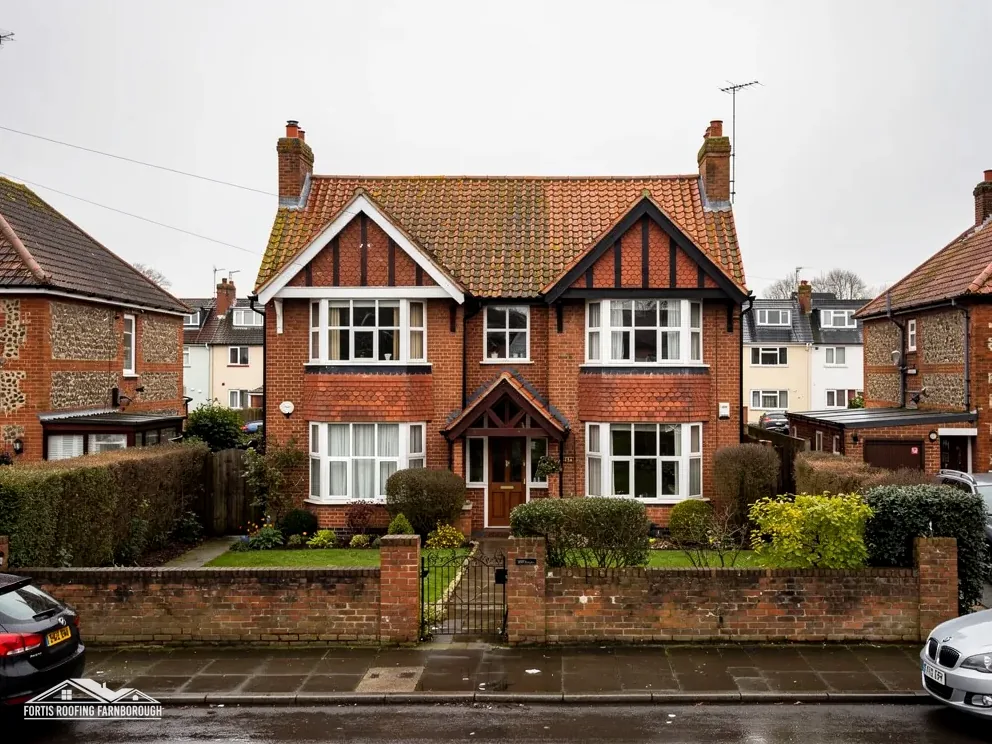
Waverley's appraisal records reddish-brown brick made from the Wealden clay beneath the village.
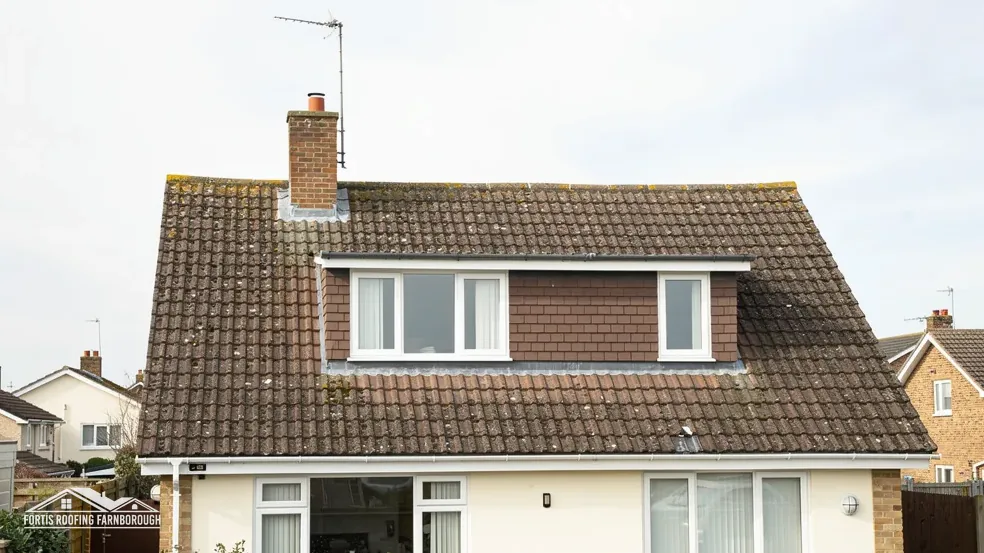
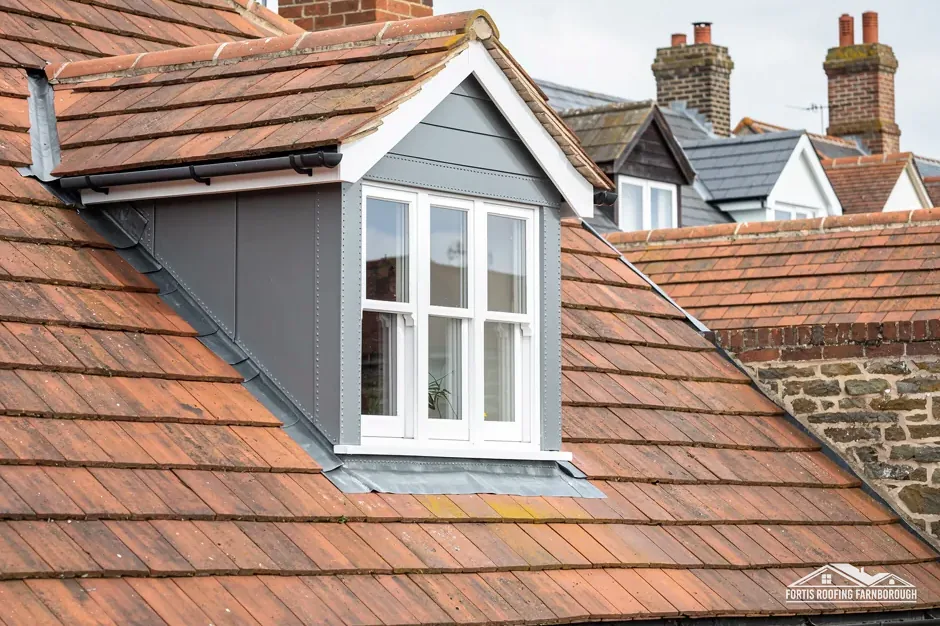
Roofs of Wealden clay brick, Swallow tiles and tile-hanging
Cranleigh's conservation area appraisal records Wealden clay brick, tile-hanging, plain clay tiles and slate. We read each slope closely, then price the work in writing.
Waverley's appraisal records reddish-brown brick made from the Wealden clay beneath the village.

Plain clay roof tiles in the village are often by Swallow, a local tile maker that began in 1860.
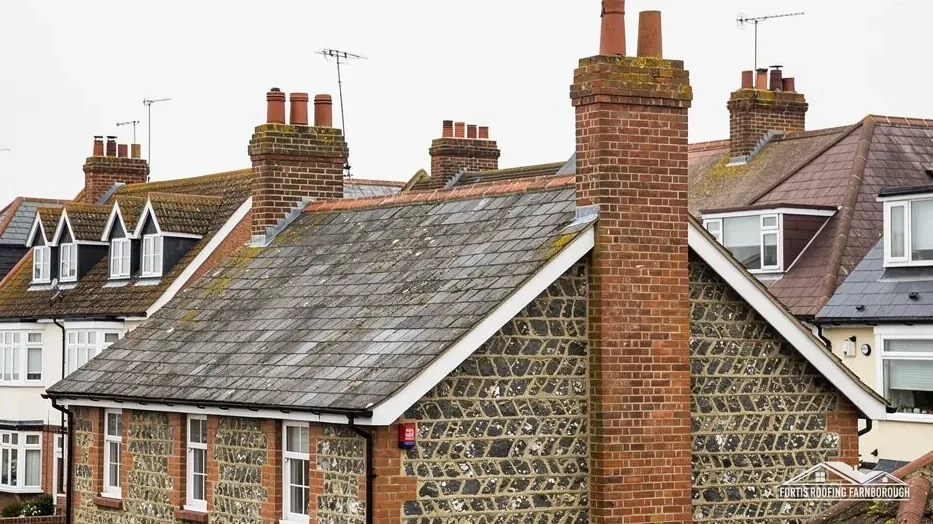
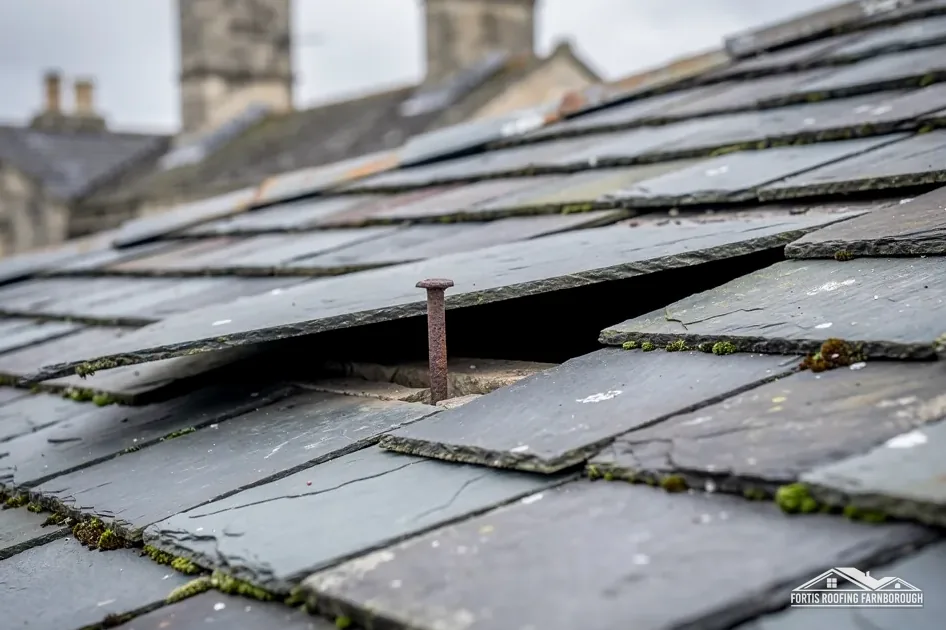
The same appraisal notes slate on shallower pitches, alongside tile-hanging on the walls below.
Map of Cranleigh with Ewhurst, Alfold, Shamley Green, Dunsfold marked around it.
Map data © OpenStreetMap contributors. Loads only when you ask for it.
Ewhurst lies to the east, Alfold and Dunsfold to the south-west, Shamley Green to the north-west, Rudgwick to the south-east and Peaslake to the north-east.
About 23.2 road miles south-east of Farnborough · Waverley Borough Council and Surrey County Council.
Cranleigh, the village record
Who handles what on a Cranleigh roof job, what Waverley's appraisal records of its clay, tile and slate, and how the conservation area and listings bear on a repair, with a source for each.

| No. | Chapter | The figure it turns on |
|---|---|---|
| 01 | Waverley, Surrey and a storm-damaged roof | Flood Zone 3 within about 250 m |
| 02 | Wealden clay, Swallow tiles and the railway | Plain clay tiles, often by Swallow |
| 03 | The conservation area and Buildings of Local Merit | St Nicolas, Grade II*, and 17 listed |
Chapter 01 of 03
| Role | Body for Cranleigh |
|---|---|
| Borough council and planning authority | Waverley Borough Council |
| County council and highway authority | Surrey County Council, until 31 March 2027 |
| Building control | Waverley Building Control, its own service |
| Flood map | Flood Zone 3 within about 250 m of the centre |
| Planned from April 2027 | A new West Surrey Council, under a 2026 Order |
Cranleigh is a large village in Surrey, 23.2 road miles south-east of Farnborough, a distance counted from the A325. Waverley Borough Council holds planning for the village and also runs building control itself. Surrey County Council is the highway authority. Under Surrey's reorganisation a new West Surrey Council is due to take over Waverley's work and the county's from April 2027, and until that date the county says services run as before. We name the council that holds your job in all of our paperwork.
The Environment Agency's flood zone layer, read through planning.data.gov.uk, shows Flood Zone 3 within about 250 m of the centre of Cranleigh. A flood zone describes the risk of water rising from the ground. A roof leak is a different event, and for an insurer it is a question of storm or wear. The Ombudsman's guidance treats a storm as, usually, violent winds with rain, hail or snow, accepts that extreme rain, hail or snow can qualify without strong wind, and takes the Beaufort scale into account. The wording in your own policy settles the rest.
The Ombudsman has also said that a policyholder whose roof was already in poor condition, as they knew, is unlikely to succeed, since the storm merely exposed a problem that existed. So the order of events matters. Notify your insurer first, get the roof made safe, and keep photographs and receipts. A leaking roof is made safe before anything else, and our survey photographs record what we found, though they cannot decide a claim. We check each slope, the gutters and the flashings, and tell you whether the water came in through a single event or through long wear, since the difference matters to an insurer.
A scaffold standing on the carriageway or footway falls under the highway authority's licensing. Surrey County Council asks for applications at least 10 working days ahead, and for an unsafe structure or a significant safety risk it asks you to phone for an emergency licence. Ask the scaffolder who is applying. Poles on your own land stand outside the licence rules, so a rear-garden scaffold moves faster than one on the High Street.
Chapter 02 of 03
Cranleigh's building story in published figures
Waverley's conservation area appraisal lists the materials of Cranleigh: reddish-brown brick of the Wealden clay, tile-hanging, plain clay roof tiles, often by Swallow, a local tile maker that began in 1860, and slate on shallower pitches. The Victoria County History in 1911 recorded extensive brick and tile works on the clay. The 2021 Census counted 12,702 usual residents in the parish.
A roof is not just a covering. Each material has a lowest pitch below which it should not be laid. For natural slate the least pitch BS 5534 indicates is 20 degrees, and Cupa's guidance is to avoid hooks on anything under 25 degrees. Marley's clay plain tiles start at 40 degrees for its Canterbury tile and 35 degrees for Ashdowne. A slate on a shallower pitch is therefore a deliberate choice that we measure before we quote, not an assumption.
HomeBuilding gives clay tile 60-80 years as a typical life, and Marley reports a BRE minimum of 60 years for clay only. Natural slate, in HomeBuilding's table, runs from 50-80 years for reclaimed Welsh slate to 100+ years for new Welsh slate. These are typical ranges and not promises. Our survey looks at the tiles themselves, the nibs (the small lugs that hang each tile on its batten), the battens and the underlay, then tells you what a repair would fix.
When tiles are replaced, a sample is compared for size, colour and thickness before any are ordered. New and old clay tiles rarely match exactly at first, so we agree where the replacements go, usually on the rear slopes, before the work begins. Our slate roofing page covers the repairs that suit slate on those shallower pitches.
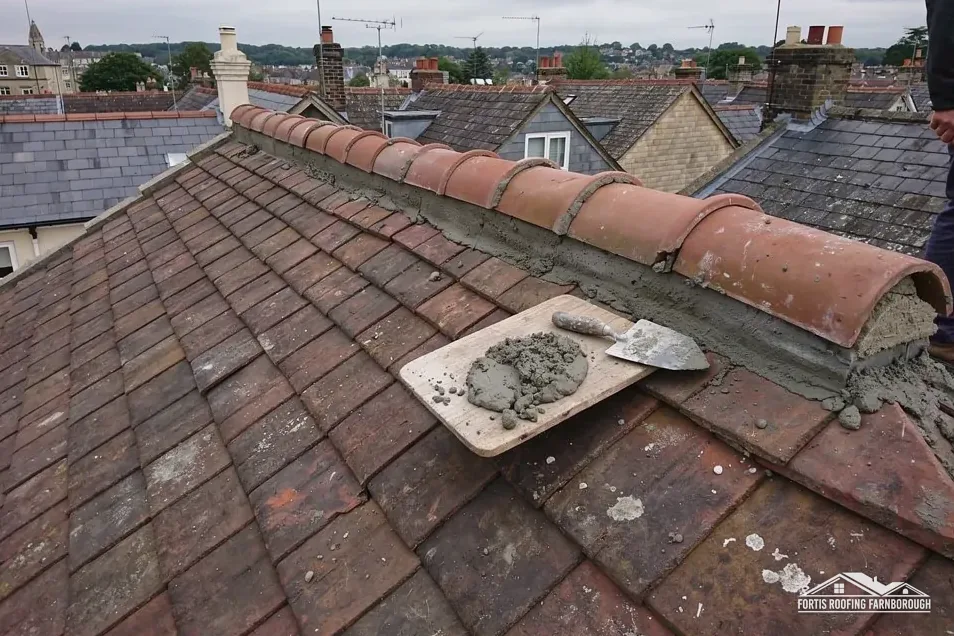
The ridge is a common weak point on a clay roof. Since BS 5534's 2014 revision, Marley says, mortar alone is not trusted to hold ridge or hip tiles in place, and BS 8612 tests the dry-fixed alternatives. Installing to BS 5534 is not required by law, so on the survey we record whether a ridge is bedded, fixed mechanically, or both.
The railway reached Cranleigh in 1865, and the appraisal says the population almost doubled by the end of the 19th century. The line closed in 1965, which led to the creation of Stocklund Square. Houses from the growth years are now old enough for original flashings, valleys and gutters to be the weak points.
Chapter 03 of 03
| Designation | At Cranleigh | For roof work |
|---|---|---|
| Conservation area | Cranleigh (23 October 1973 and 23 October 1983) | Changes to the look checked with Waverley |
| Buildings of Local Merit | About 130 more adopted across the village | Ask Waverley what the entry means |
| Article 4 direction | Barhatch Lane (1988) and Norley Farm (2005, flagged as ended) | Named land sites; confirm with Waverley |
| Grade II* listed | Church of St Nicolas (NHLE 1044371) | Denomination's route or listed building consent |
| Grade II listed | 121 and 123 High Street (NHLE 1044367) | Listed building consent |
Waverley's appraisal gives the designation dates of the Cranleigh conservation area as 23 October 1973 and 23 October 1983. Within and around it, Waverley adopted about 130 more Buildings of Local Merit after a review by the community, the parish council and the borough. Local merit is not the same as listing. Before changing how a house looks, ask Waverley what its entry means, because a change to the street view is a planning-team question first. Our planning permission for roof work guide shows how to put it.
Waverley's Article 4 list names two entries for Cranleigh: land south of Winterfold House, Barhatch Lane (1988), and land at Norley Farm, Horsham Road (2005). The council's own data flags the Norley Farm entry as ended in 2006. Neither is a roof direction for houses in the village, and Waverley's list carries no conservation-area-wide residential direction. Confirm your own address with the council, though, because we cannot read a direction from the street.
Historic England lists the Church of St Nicolas at Grade II*, first listed on 9 March 1960, and 121 and 123 High Street and 35 High Street at Grade II. It records 17 listed buildings within 500 m of the centre. Who approves roof work on a church depends on its denomination and use: the ecclesiastical exemption can take a church in use out of listed building consent, and the parish can say which route applies to St Nicolas. Altering a listed house's character calls for listed building consent.
Lead is graded by code. Royston's brochure puts Code 3 to soakers alone, Code 4 to soakers, flashings, pitched valleys and dormers, and Codes 5 and 6 to flashings, valleys, parapet gutters and dormers. MyJobQuote's over-80-years figure for lead flashing is a floor, not a forecast, so an old flashing is judged on its condition.
Listings at a glance
Next to listed buildings the practical aim is a record that shows what is original. We photograph ridges, valleys, verges and chimneys before anything is touched, and we note which tiles are Swallow, which are later and which have been replaced with a near match. For a chimney, our chimney repairs page explains how a stack is rebuilt in character.
Often to a close degree. Waverley's appraisal records plain clay roof tiles, often by Swallow, so we take a sample and compare size, colour and thickness before ordering. New and old clay tiles seldom look identical at first, so we agree with you where the replacements go before the work begins.
The Environment Agency's flood zone layer shows Flood Zone 3 within about 250 m of the centre. Flood zones map water arriving from the ground, and a leak from above is another matter, so a roof leak is a storm or wear question for your insurer. Tell the insurer first, make the roof safe, and keep photos and receipts.
Waverley adopted about 130 more Buildings of Local Merit across the village after a review with the community and the parish council. Local merit is not the same as listing, so ask Waverley what your house's entry means before changing how the roof looks. Our survey records the roof exactly as it stands.
Surrey County Council asks for licence applications at least 10 working days ahead, but for an unsafe structure or a significant safety risk it asks you to phone for an emergency licence. Our first step on a leaking roof is to make it safe, then we plan the longer repair and the scaffold dates together with you.
Get your free roof quote
Give us your Cranleigh road and the symptom you have spotted. We will survey, photograph and write one price.
10-year workmanship guarantee, in writing.