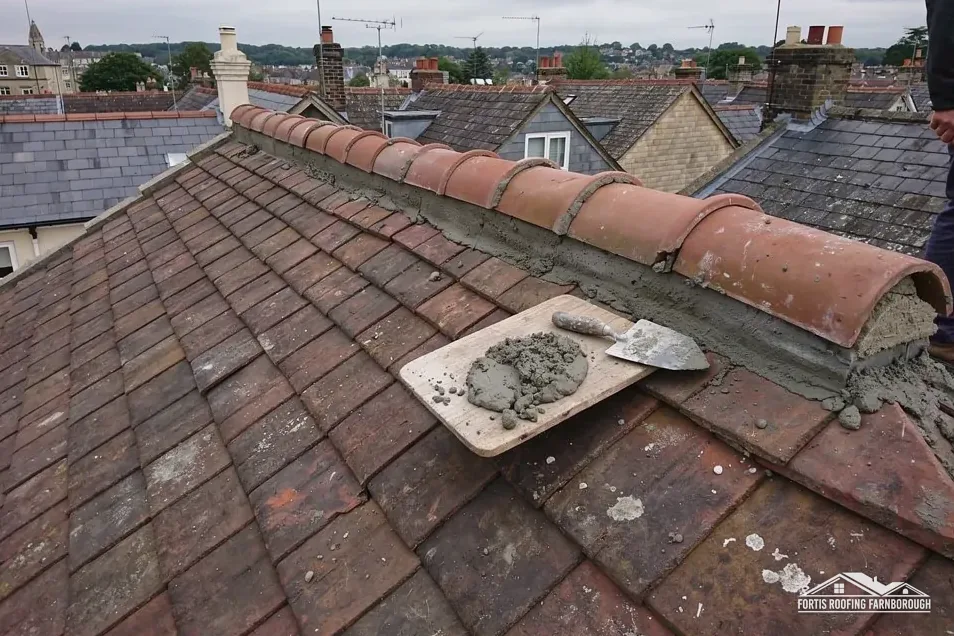
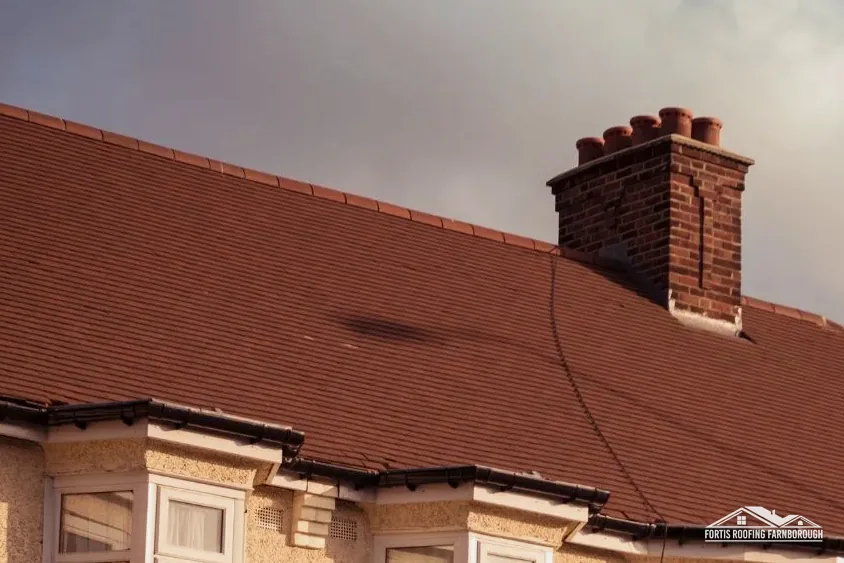
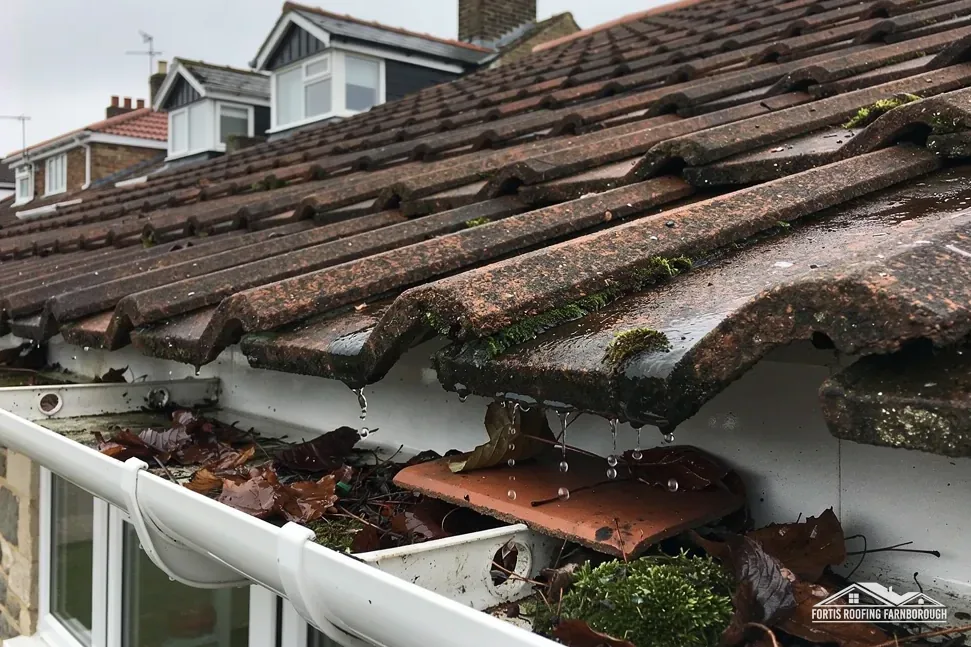
Handmade plain clay tiles
The council's appraisal lists handmade plain clay tiles among Plaistow's traditional materials, with timber framing and weather-boarding.
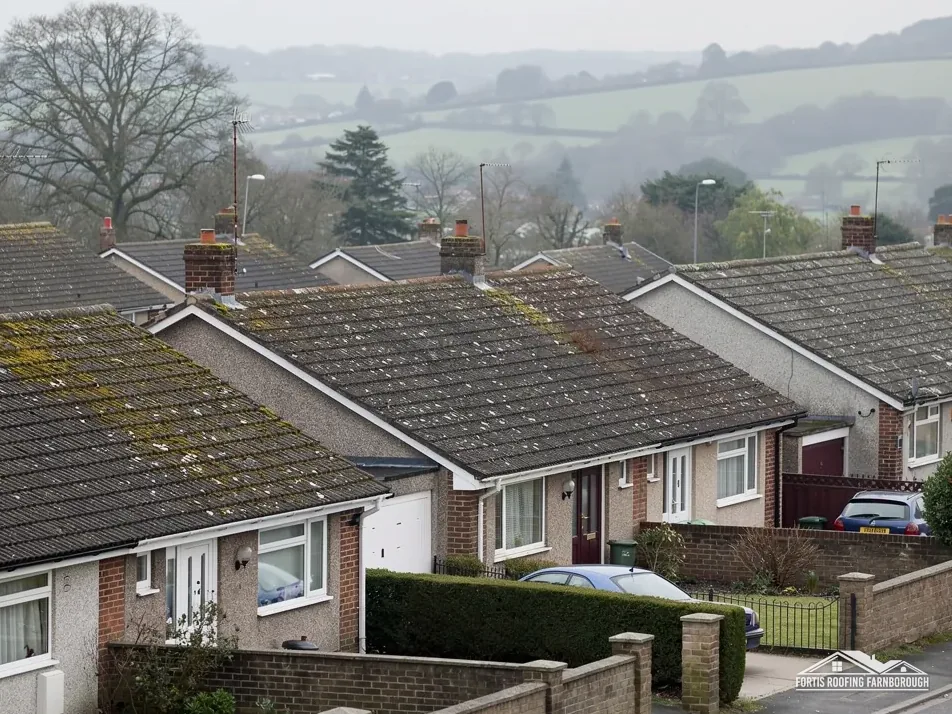
Roofs in a Low Weald village of clay tile and timber frame
Plaistow is a Low Weald village north of Petworth, close to the Surrey border, with nearly 30 listed buildings in its conservation area. Our surveys read each slope closely.
The council's appraisal lists handmade plain clay tiles among Plaistow's traditional materials, with timber framing and weather-boarding.
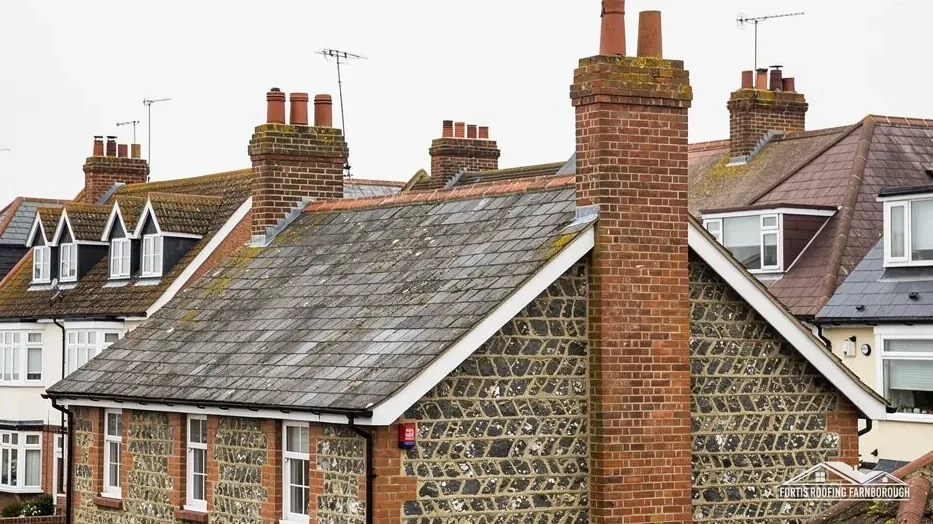
Stone House is the only stone-faced building in the conservation area and the only one roofed in Horsham stone slates.

Holy Trinity was rebuilt in the early 1850s in local sandstone, with a wooden belfry and spirelet.
Map of Plaistow with Ifold, Loxwood, Kirdford, Alfold marked around it.
Map data © OpenStreetMap contributors. Loads only when you ask for it.
Ifold lies east of Plaistow, Loxwood further east, Kirdford south, Alfold north-east, Dunsfold north, Northchapel west and Chiddingfold north-west.
About 25.6 road miles south-east of Farnborough · Chichester District Council and West Sussex County Council.
Plaistow, tile, frame and stone
Which councils stand behind a Plaistow roof job in West Sussex, what the 2013 council appraisal records about clay tile, timber frames and Horsham stone, and how nearly 30 listings shape repairs.

| No. | Chapter | The figure it turns on |
|---|---|---|
| 01 | Chichester plans, West Sussex keeps the roads | A West Sussex village by the Surrey border |
| 02 | Plain clay tile, timber frame and Horsham stone | Handmade plain clay tiles, listed as traditional |
| 03 | A conservation area with nearly 30 listed buildings | 28 listed buildings within 500 m |
Chapter 01 of 03
| Role | Body for Plaistow addresses |
|---|---|
| Planning authority | Chichester District Council |
| County council | West Sussex County Council |
| Building control | Your building control body: the council's service or a registered approver |
| Scaffold on a road or pavement | A licence from the highway authority; applicant to be confirmed |
| Civil parish | Plaistow, 2,031 usual residents at the 2021 Census |
| Distance from our base | 25.6 road miles south-east of Farnborough, from the A325 |
Plaistow stands just inside West Sussex, and a few miles north the county is Surrey. That matters for a roofer working from Farnborough: an identical fault on an identical roof can fall under a different council from one parish to the next. In Plaistow it is Chichester District Council that decides planning, with West Sussex County Council keeping the county roads. Neither is a body we deal with at home in Hampshire, so we read their guidance before we price, and we say in the report which council's rule we are applying.
The conservation area adds a second layer. A Plaistow roof can be subject to planning rules, building control rules and the council's conservation guidance at once, and they ask different questions.
Two limits from the Planning Portal frame the answer. Normally no Building Regulations application is needed for a re-roof confined to under 25 per cent of the building envelope and under 50 per cent of the roof; a covering that is 15 per cent or more heavier than what it replaces, or reacts to fire in another way, brings approval into play. If you are thinking of changing the covering, the weight of the new material against the old is the figure that counts.
Where an application is needed, your building control body is the council's service or a registered building control approver of your choosing. We say which route we would recommend at the survey, and we leave a gap in the programme for the inspector to see the bare roof structure.
Scaffold set up on a road or verge falls under the highway authority's licensing power, which section 169 of the Highways Act 1980 provides for, and the county's own page is the place to learn the fee and the notice. We ask the right office, confirm the applicant, and record the lead time in the plan before booking. Scaffold on private land is exempt from the highway licence, and a wide garden can allow a safer layout than a narrow lane. On a village lane with no pavement, the verge may be the only standing room, and we plan around what the authority allows.
Chapter 02 of 03
Plaistow's materials and buildings in four published figures
Chichester District Council's 2013 character appraisal for Plaistow counts nearly 30 listed buildings in the conservation area, many dating to the 17th century or earlier, though later brick frontages often conceal their true origins.
The appraisal lists traditional materials: handmade plain clay tiles, timber framing with painted panels or stained weather-boarding, and local Wealden greensand stone. It adds that Stone House is the only stone-faced building in the conservation area and the only one roofed in Horsham stone slates.
When a few handmade tiles slip or crack, the repair should use tiles that sit comfortably beside the old ones, and that is a matter of looking at the existing roof closely. On each slope we raise a few tiles, record their size and nibs, and look at the battens and fixings beneath. Our pitched roofing page describes the work that comes next, be it a few slipped tiles or a valley, once the roof has been read.
Where tiles are sound but a hip or valley leaks, the fault may lie in the flashing or the bedding, and the repair there can be small.
The appraisal's warning that brick frontages can hide older buildings is worth heeding. A house with a Victorian front may have a much older frame and roof behind it, so we survey the whole building, back and sides as well as the street face. Roofs of this kind may have been re-covered several times, so one slope can hold more than one age.
Stone House's Horsham stone slates are a rarity within the village, since the appraisal says no other building in the conservation area has them. A slab roof of that kind is repaired with salvaged or matching slabs, and sizing, fixing and weight are all different from tile.

Holy Trinity Church is not listed. It was rebuilt in the early 1850s, with 1851 given by the National Churches Trust and 1853 to 1854 by Sussex Parish Churches, in local sandstone, with a wooden belfry and spirelet, and its clock was erected in 1887. The appraisal does not describe its roof, so we say nothing about it. For a homeowner the point is that the village was rebuilt in parts, each with its own age.
Chapter 03 of 03
| Designation | In Plaistow | For roof work |
|---|---|---|
| Conservation area | Plaistow, within about 0.75 km of the centre | Ask Chichester before changing a roof's look |
| Grade II listed | Back Lane Cottage (NHLE 1226525) | Listed building consent where character is affected |
| Grade II listed | Barn adjoining Todhurst, south-east (NHLE 1226914) | Listed building consent where character is affected |
| Grade II listed | Barn adjoining Todhurst, south-west (NHLE 1226742) | Listed building consent where character is affected |
| Unlisted church | Holy Trinity, rebuilt in the early 1850s | Not listed; the conservation area still applies |
A conservation area called Plaistow reaches within about 0.75 km of the village centre, and 28 listed buildings are on the national list within 500 m. With that many listings close together, a Plaistow roof may well belong to, or sit beside, a listed building. Chichester's planning team holds the map, and a quick call settles whether your house is inside the area and whether an Article 4 direction applies to it. If a bigger change is on your mind, such as a loft room, mention it when you ring so that we measure for it.
Back Lane Cottage and the two barns adjoining Todhurst are each listed Grade II. Barns are easy to forget in a village, but a listing covers them, and a barn roof repair is a listed building matter like any other. Any work that would alter a listed building's character needs listed building consent, so the council is asked before we price. The survey logs the ridge line, the verge details and the tile courses, giving an application real detail to work from, so that whoever decides can see what is proposed against what exists.
In a village, old buildings share rooflines, walls and boundaries, so we also look up and down the street, not only at your house, and record what a neighbouring roof does to yours, for instance throwing water across a valley.
Holy Trinity is not listed, yet the conservation area still counts for the houses around it: a new dormer, or any other change to a roof that shows from outside, should be taken to Chichester before work begins. For an unlisted house, section 55 of the Town and Country Planning Act 1990 sets aside works that leave the outer appearance materially unchanged, which puts a matching repair in the plain category. Our planning permission for roof work guide explains the rules.
A chimney can carry as much of a cottage's character as its roof, and a village street shows it. A stack that leans or has open joints is a repair job first, and our chimney repairs page covers pointing, flashing and rebuilding, while the survey logs the stack before it is touched.
Usually, if the surrounding tiles and battens are sound enough to keep. On each slope we raise a few tiles, note their size, colour and nibs, and look at the battens beneath. A repair then uses tiles chosen to sit beside the old ones, and the survey pictures show the match before any work starts.
Chichester's 2013 appraisal counts nearly 30 in the conservation area, many dating to the 17th century or earlier, and the national list shows 28 within 500 m of the village centre. Whether your own house is one depends on the address, and Chichester's planning team or the national list can confirm it, usually quickly.
No. Holy Trinity was rebuilt in the early 1850s in weathered local sandstone and is not on the national list, though it stands in the conservation area. The listed buildings nearby include Back Lane Cottage and two barns adjoining Todhurst, each Grade II, and work on those needs listed building consent from Chichester.
A scaffold that obstructs a road or verge needs the highway authority's licence, which section 169 of the Highways Act 1980 provides for. Which office issues it, what it costs and who applies are things we confirm before booking. Poles kept entirely on your own ground do not call for the highway licence, and the survey works out whether yours can stay there.
Get your free roof quote
Tell us your Plaistow address and the fault you are seeing, and we will book a visit.
10-year workmanship guarantee, in writing.