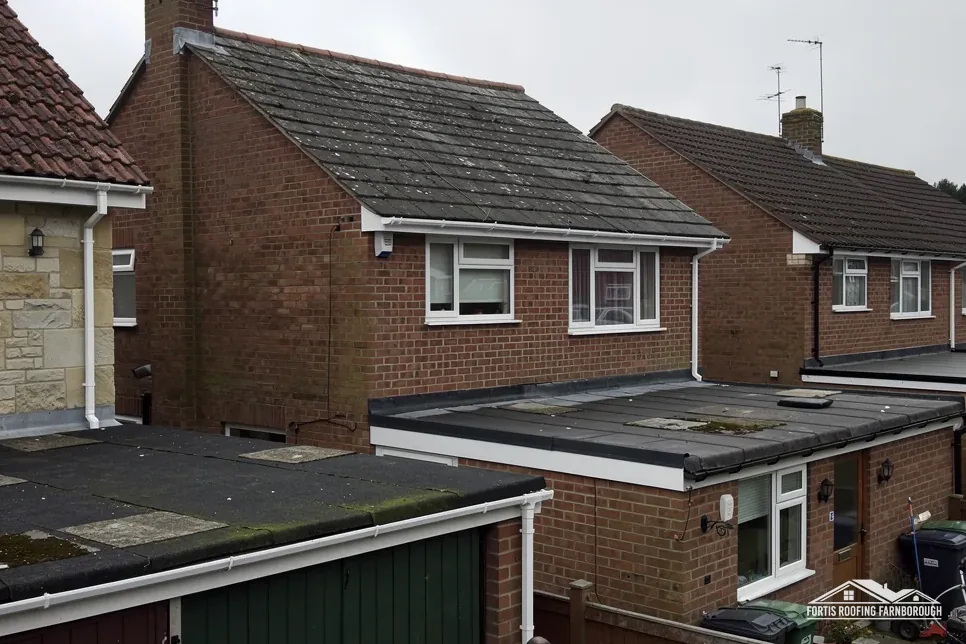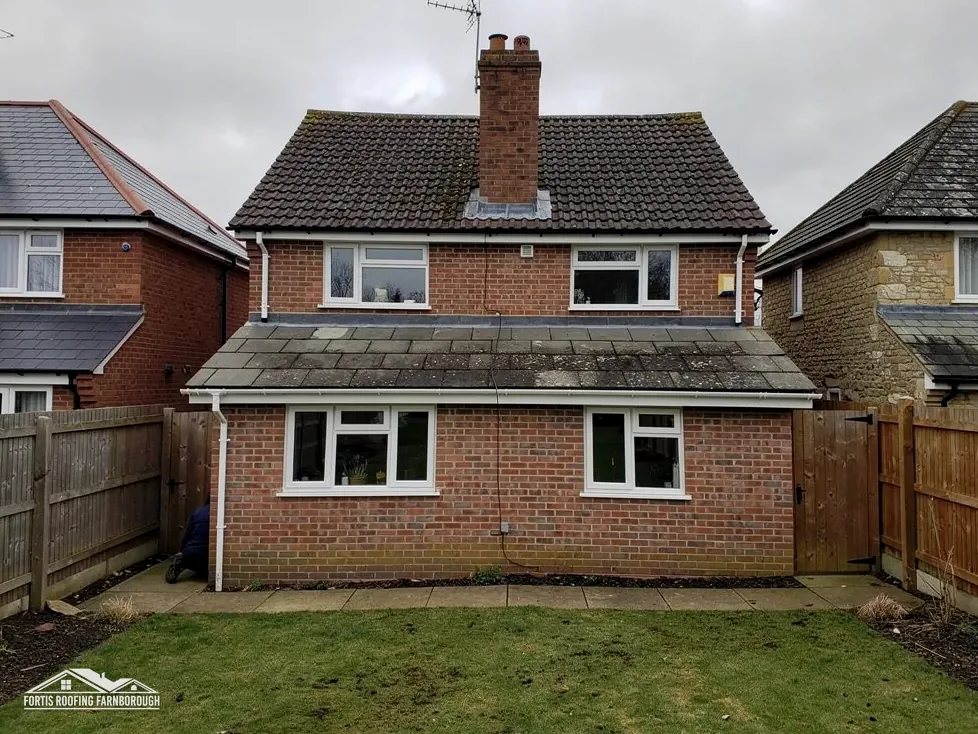
1950s and 1960s housing
Rushmoor's conservation overview records new housing developments at Cove in the 1950s and 1960s.
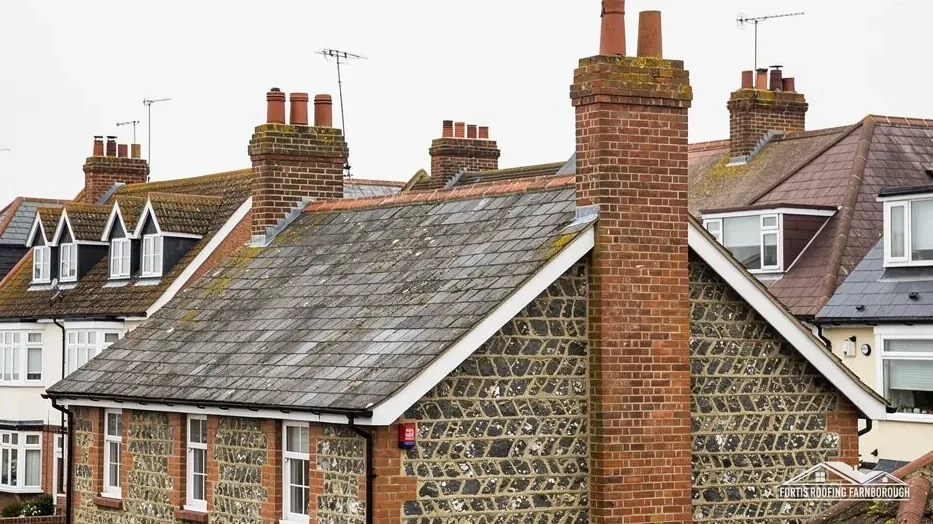
Roofs beside Cove Brook, from chapel and pottery land to 1960s streets
Cove is the western side of Farnborough, around Cove Road, beside Cove Brook and the airport. We survey every slope, photograph it and give one written price.
Rushmoor's conservation overview records new housing developments at Cove in the 1950s and 1960s.

The brook flows through the centre of the old parish, so we check where each roof's water finally drains to.

A Primitive Methodist chapel was built here in 1888, and many pottery sites are recorded in Cove.
Map of Cove with West Heath, Southwood, Frimley, Hawley, Farnborough marked around it.
Map data © OpenStreetMap contributors. Loads only when you ask for it.
West Heath lies just to the south-east, Southwood to the south-west, Hawley and Blackwater to the north, Frimley to the north-east, and Frimley Green to the east.
About 1.6 road miles west of Farnborough · Rushmoor Borough Council and Hampshire County Council.
Cove, parish to estate
What published histories say about Cove, which councils and consents sit behind a roof job here, and how much rain the roofs and gutters are asked to handle.

| No. | Chapter | The figure it turns on |
|---|---|---|
| 01 | Cove Brook, the chapel and the pottery sites | Parish 1838; chapel 1888 |
| 02 | Rushmoor's three questions and Hampshire's scaffold terms | 15 per cent heavier needs approval |
| 03 | Wet days, frost days and where Cove's rain goes | Rainfall about 715 mm; 118 wet days |
Chapter 01 of 03
Cove in four dates from published histories
Cove's published record is older and more rural than its 1950s housing suggests. The Victoria County History of 1911 says that Cove, together with part of Hawley, was made an ecclesiastical parish out of Yateley in 1838. Cove Brook ran through its centre, and its chief crops were potatoes and roots. Inclosures were made there in 1859, and a Primitive Methodist chapel was built in 1888. These are scraps of a village history, and they show a farming parish with a brook at its heart long before the post-war streets arrived.
Rushmoor's conservation overview adds a different strand. It says a pottery industry, using clay from the local Reading and London beds, is known to have developed in the area from as early as the fourteenth century, and that many pottery sites are recorded in Cove. Pottery is a different trade from roofing, and a kiln site centuries old tells you nothing about the tiles on a Cove house today. A long human history sits behind these records, and no single decade explains every Cove roof.
The survey therefore deals with the roof in front of us. We note the covering on each slope, lift a few tiles to see the battens and underlay beneath, and photograph the ridge, the verges, the valleys and the junctions with any chimney or wall. Roofs that have been altered or extended over the years can carry coverings of different ages under one ridge line, and the report says so slope by slope.
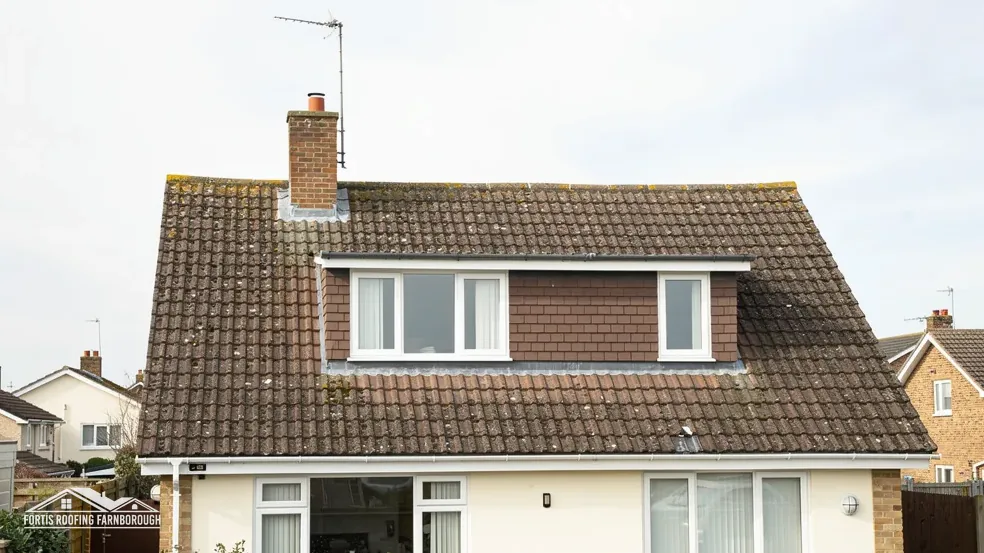
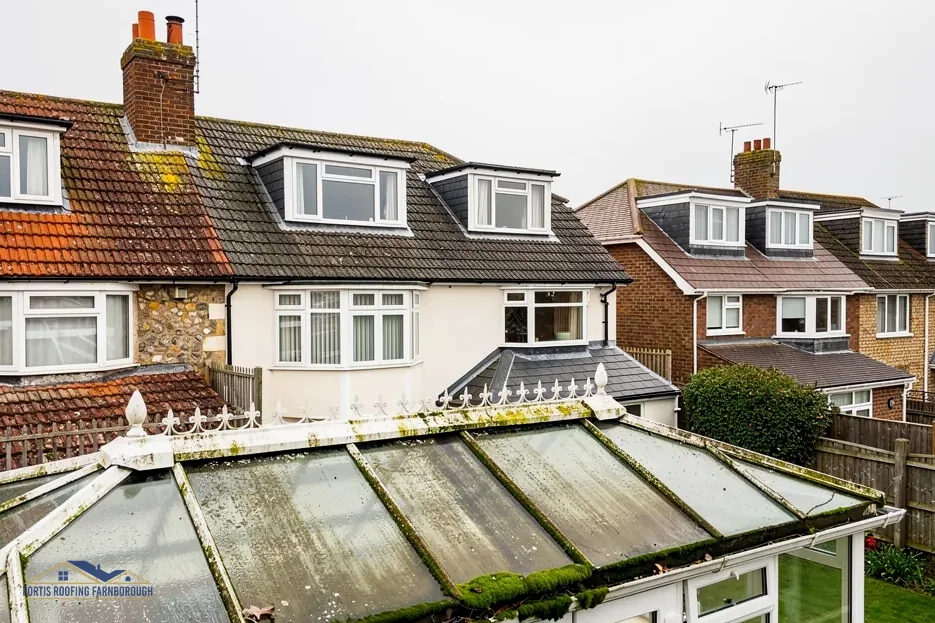
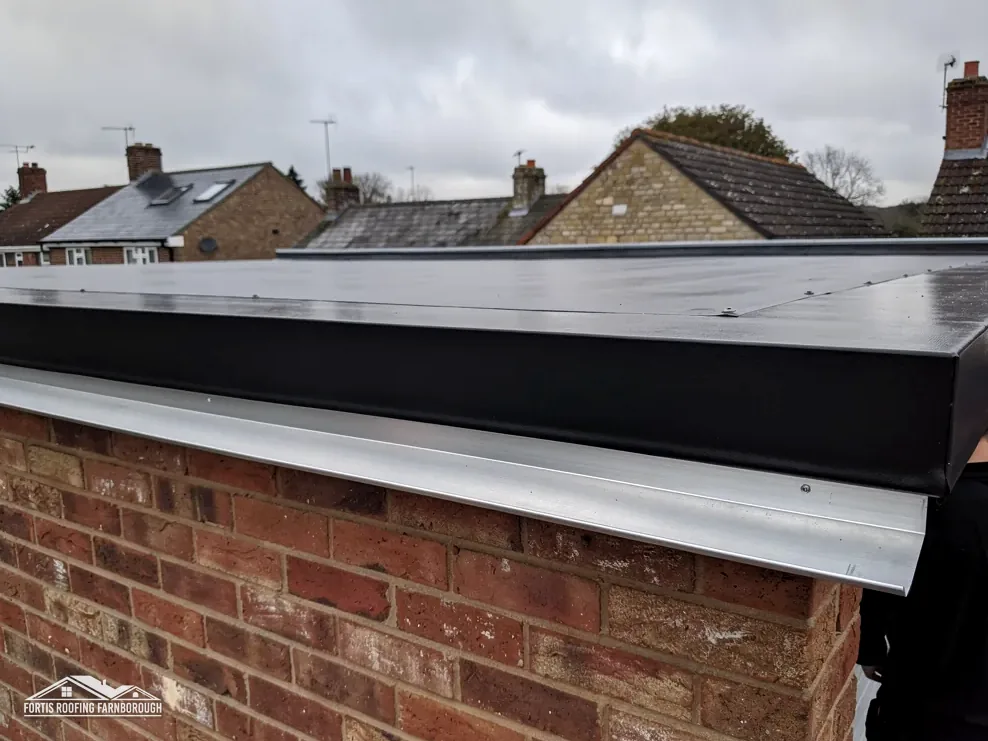
Cove has two stories, one rural and one suburban, so houses here can differ a great deal from one street to the next. We avoid generalising in either direction. A 1960s house with its first covering and a house re-covered more recently will each tell you something different once the tiles are lifted, and our job is to read it correctly. If the roof proves sound apart from a few failed parts, that is what you are told, and you are quoted for the repair. Our pitched roofing page explains how slipped tiles, cracked ridge tiles and failed valleys are put right. Garages and extensions are often added later and covered differently from the main house, so each gets its own page of the report. A flat-roofed extension or garage is surveyed separately, with its own covering, falls and outlets recorded, and our flat roofing page covers those.
Chapter 02 of 03
| Question | Body that answers it |
|---|---|
| Does the work need building control? | Hart and Rushmoor Building Control Partnership, or a registered approver |
| Will the roof look different? | Rushmoor Borough Council planning team |
| Is a scaffold licence needed on the road? | Hampshire County Council; the scaffold firm applies |
| Who owns the roads and pavements? | Hampshire County Council, the highway authority |
Three questions come up on most Cove roof jobs, and each has a different answer from a different body. One is whether the job needs building control at all. The second is whether the way the roof looks will change enough to interest the planners. The third is whether scaffold will have to stand on the road.
Rushmoor and Hart run one shared team, the Hart and Rushmoor Building Control Partnership, working from the council offices in Farnborough on 01252 398715. A registered building control approver is the private alternative, a status private firms have needed since 6 April 2024. Whether either is needed depends on how much roof you touch. The Planning Portal's rule of thumb is that jobs touching under 25 per cent of the building envelope and under 50 per cent of the roof normally need no application. It also says that a covering raising the weight of the roof by 15 per cent or more needs approval, and it advises a structural check by an engineer or surveyor before the work starts. For a Cove homeowner the practical result is a short conversation and not a pile of paperwork: we tell you the share of the roof affected, you decide whether to ring the partnership or ask us to, and nothing is booked until that is settled.
The planning question is whether the roof will look different, and planning questions for Cove go to Rushmoor Borough Council. A repair in the same material, laid the same way, is unlikely to trouble anyone, while a switch to a different covering is the kind of change we put to Rushmoor's planning team before pricing it. Our planning permission and roof work guide sets out how the question is framed.
Under section 169 of the Highways Act 1980, Hampshire County Council licenses scaffold on the public highway, and its page tells scaffolding companies to apply on behalf of their customers. Hampshire County Council asks for 10 clear working days of notice and charges £211.90 for the first 2 weeks and £72 for each further 2 weeks. Scaffold on a private road needs no licence. We write the licence dates into the programme we agree with you, so the roof and the scaffold finish together.
Chapter 03 of 03
Rain and frost at the nearest Met Office station
Cove has no climate station of its own, so we use the Met Office's South Farnborough averages for 1991 to 2020. They give annual rainfall of about 715 mm spread over 118 days with 1 mm or more, and around 53 days of air frost a year. That is the weather every Cove roof and gutter is built to handle, and it is the reason we look at water first on any survey. Rain is rarely a problem for the covering itself. It becomes a problem at the weak points: valleys, flashings, cracked ridge tiles and joints in the guttering.
Frost gives that water a second job. Where rain has found a crack in a tile or a gap in pointing, a night of frost can freeze it, widen the gap and let in more next time. That is simple physics and not a forecast for any one house, but it is why we photograph small cracks that look harmless from the ground.
A roof that sheds water onto a blocked gutter has not solved anything. The overflow runs down the wall and soaks the brickwork and the fascia, and a damp patch indoors is blamed on the roof. So the survey follows the water the whole way: from the slope to the gutter, along the run to the outlet, down the downpipe and away. We photograph the joints and any sagging section. Our gutters, soffits and fascias page covers repairs and replacements.
The national dataset names the Basingstoke Canal, and Hawley Park and Green, as the conservation areas nearest to Cove, within about 2.5 km. Neither reached the 1.5 km box around the place point. Your own address is still worth checking, and we ask Rushmoor Borough Council's planning team, or Hart for Hawley Park and Green, before pricing any change to the way a roof looks. A like-for-like repair needs no such conversation, and the survey simply records what is there.
If you are unsure whether a stain on a ceiling comes from the roof, the gutter or condensation, tell us where it is and when it appears. The survey starts from that, and the report separates what we saw on the roof from what we saw only from inside the loft.
A building's decade settles little; the roof's own condition settles it. Rushmoor dates the Cove developments, and the covering on any one of them is something we check on the roof itself. At the survey we lift a few tiles, check the battens and underlay, and photograph the ridge, verges and valleys, then recommend a repair if a repair will do.
Often, yes. A leak at a stack usually comes from the flashing, the flaunching on top or the pointing, not from the covering around it. If the survey finds that, the job is a repair at the stack. A whole re-roof is recommended only when the evidence across the slopes says so.
The national dataset places the Basingstoke Canal and Hawley Park and Green areas within about 2.5 km of Cove, but neither reached the 1.5 km box around the place point. Whether your address falls inside one is a question for Rushmoor, or Hart for Hawley Park and Green, and we ask before pricing.
Met Office averages for South Farnborough, the nearest station, give annual rainfall of about 715 mm over 118 wet days. A gutter that sags or leaks at a joint sends that water down the wall instead of away, so on every survey we photograph each joint, each outlet and the fall of the whole run.
Get your free roof quote
Send us your Cove road and what you have noticed. We arrange the survey, then your single written price follows.
10-year workmanship guarantee, in writing.