Weatherboarded cottages in yards
In the 18th century most inhabitants lived in weatherboarded cottages crammed into yards and alleys behind the High Street.
Roofs from weatherboarded yards to council estates by the Thames
Brentford's 18th-century weatherboarded cottages gave way to slum clearance from 1892 and council housing. We survey each roof we are asked about, slope by slope.
In the 18th century most inhabitants lived in weatherboarded cottages crammed into yards and alleys behind the High Street.

Systematic slum clearance began in 1892, and in 1899 the urban district council started four schemes for 762 council houses.
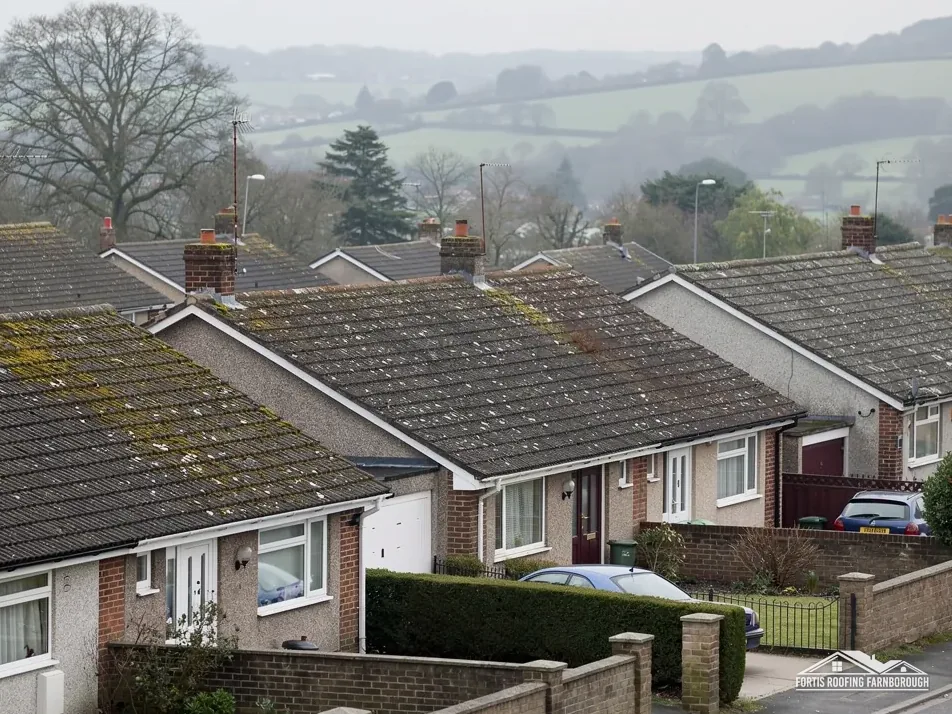
The Great West Road of the 1920s opened more estates, with 430 houses planned at Gunnersbury Park in 1925.
Map of Brentford with Isleworth, Richmond, Hounslow, Twickenham marked around it.
Map data © OpenStreetMap contributors. Loads only when you ask for it.
Brentford is a riverside town where the River Brent meets the Thames, opposite Kew, and Farnborough lies 29 road miles away, south-west of the town.
About 29 road miles north-east of Farnborough · London Borough of Hounslow (unitary).
Brentford, cleaning and clearance
What is safe and lawful when a roof is cleaned of moss, how Brentford grew from weatherboarded yards to council estates, and where its conservation areas, Quaker meeting house and Grade I manor shape a repair.

| No. | Chapter | The figure it turns on |
|---|---|---|
| 01 | Cleaning a roof: what is safe and lawful | Marley does not recommend jet washing |
| 02 | From yards and alleys to 762 council houses | 762 council houses from 1899 |
| 03 | Quaker meeting house, Grade I manor and conservation areas | Five conservation areas in the dataset |
Chapter 01 of 03
| Question | The published answer |
|---|---|
| Cleaning method for tiles and slate | Marley does not recommend jet washing: it can damage the surface |
| A biocide meant only for professionals | The public should never use one (HSE) |
| Any biocide on a roof | Must be used as its authorisation says |
| A product with no approval | An offence to advertise, sell, supply, store or use it |
| Planning and building control | London Borough of Hounslow (unitary) |
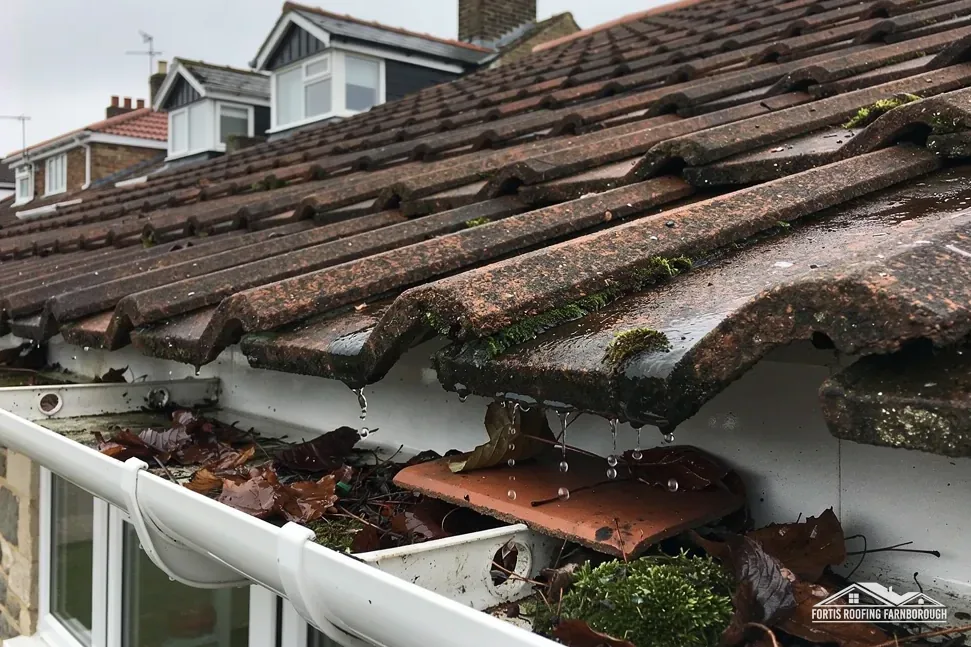
Moss, algae and lichen make a Brentford roof look tired, and the usual question is how to clean it. The answer begins with what not to do. Marley's guidance is that high-powered jet washing is not recommended, because a hard jet can scour the surface and bring a covering's end forward. A tile with its surface blasted away holds more water, grows more moss and fails sooner than one that has been brushed.
Moss holds water against the covering, can block valleys and gutters, and usually grows where a roof stays damp, in shade or under overhanging branches. Removing it is often worth doing, but how is the important part. We brush or treat gently, clear the gutters of what comes down and photograph the result. Our roof cleaning and moss removal page explains the method.
Biocides, the products that kill moss and algae, are regulated. Under the Biocidal Products Regulation a biocide must be used in line with the terms of its authorisation. HSE's line is that products made for professional users alone are not for householders at all, and that advertising, selling, supplying, storing or using a product without approval is an offence. A can bought from a trade counter is therefore not a safe choice for a Brentford homeowner.
That leaves two sensible routes. One is gentle brushing with no chemicals, which suits many roofs and costs the least. The other is an approved treatment applied by someone who knows the product's conditions. Either way you are told which method we propose and why, with a photograph of the roof's present state beside it, and a treatment is only applied after checking that it is permitted on the surface in question.
Roof access matters too. Weatherboarded outbuildings, flat sections and old glazing are all fragile, and we do not walk on them. On the survey we flag any roof that cannot safely be cleaned on foot, and say what access it would need.
Trees overhanging a roof are the usual cause of repeated moss. Pruning is for the tree's owner, and in a conservation area the council may need notice first, so we simply report what overhangs.
Chapter 02 of 03
Brentford's housebuilding, in published figures
The Victoria County History of 1982 says that in the 18th century most of Brentford's inhabitants lived in weatherboarded cottages crammed into yards and alleys behind the High Street, such as Spring Gardens. Systematic slum clearance began in 1892, and in 1899 the urban district council started four schemes for 762 council houses east of Ealing Road on either side of the railway.
The building of the Great West Road in the 1920s brought more estates onto the market: 430 houses were planned for the Gunnersbury Park estate in 1925. Brentford urban district council built 118 houses in Lionel Road in 1928 to 1929 and 428 on the Syon estate at Brentford End.
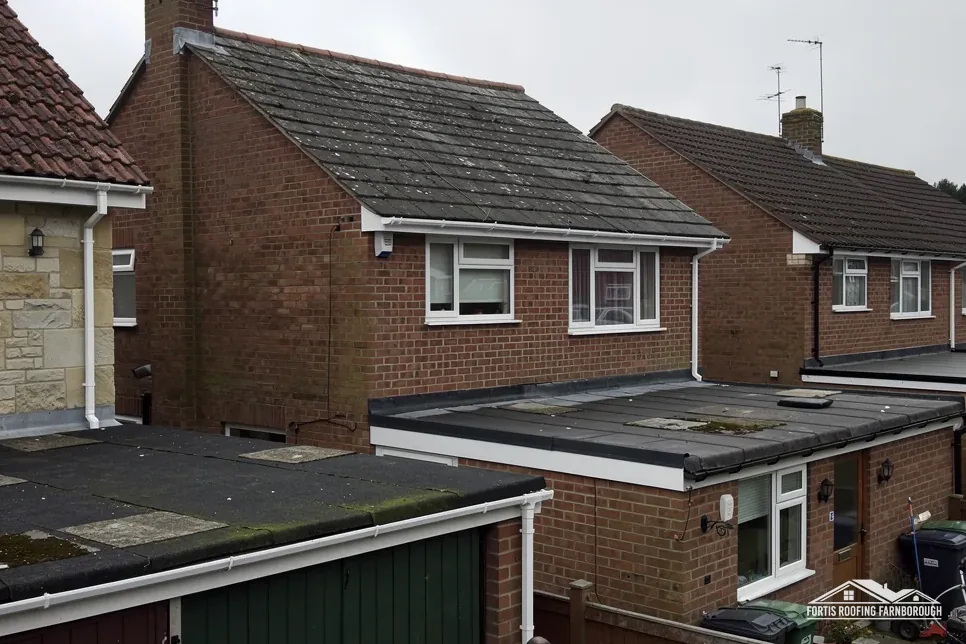
None of those accounts says what the houses were roofed in, and we do not say it for them. What they do show is that Brentford has terraces and estates of distinct periods: the council schemes of 1899, the interwar estates of the 1920s and the older streets that survived clearance. Each period has its own habits of construction, so our notes name the covering on every slope rather than assuming one.
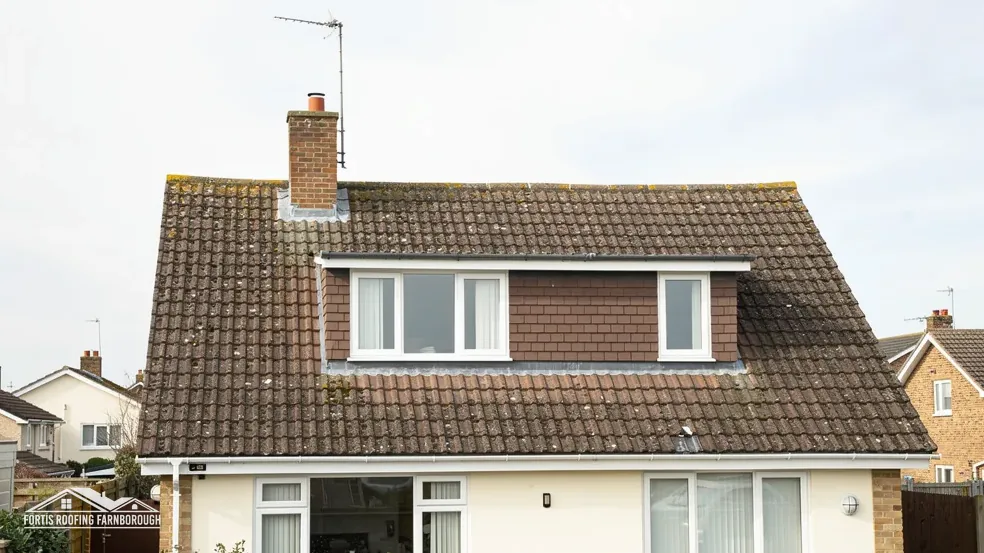
A council house from 1899 is now well over a century old, and its roof has probably been renewed at least once. In a terrace of that age, houses may share a chimney stack or a party wall, so a repair on one can matter to the next. Shared parts are photographed from our own side and reported to you.
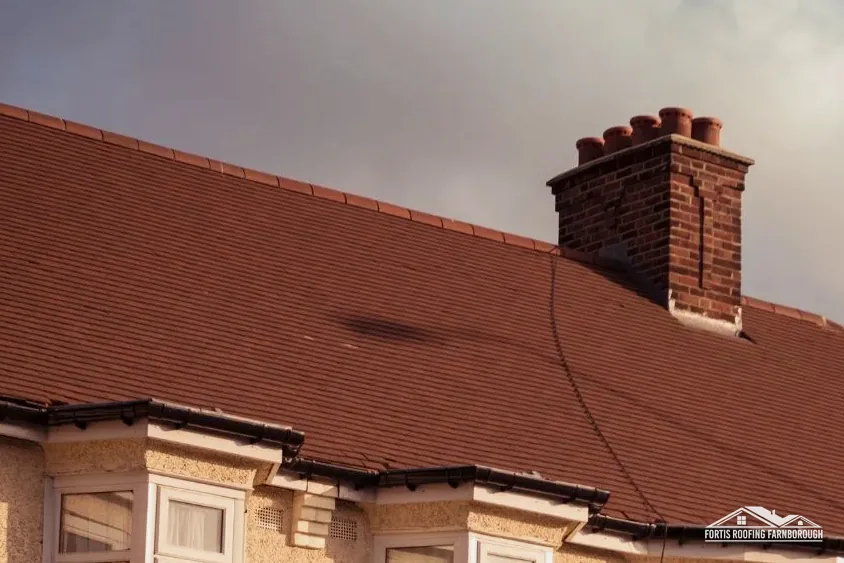
Interwar estates can have hipped roofs, which slope on all four sides, with ridges and hip tiles that were originally bedded in mortar. Marley's view is that a mortar bed cannot be left to hold those alone, and dry-fixed systems tested to BS 8612 are used instead, a point we explain if a ridge needs rebuilding.
Clearance and council housing
Brentford's yards and alleys are gone, but their lesson still holds for anyone working on a close-built terrace: where houses stand close, access for ladders and scaffold has to be planned before work starts, and neighbours told. A short note through the next-door letterbox, with dates, heads off disputes, and we draft one for you if you wish.
Chapter 03 of 03
| Record | In Brentford | For roof work |
|---|---|---|
| Conservation areas | 5 in the dataset: St Paul's Brentford; Grand Union Canal and Boston Manor; Isleworth Riverside; Osterley Park; The Butts | Ask Hounslow which covers your address |
| Grade I listed | Boston Manor House (NHLE 1079603) | Listed building consent for work affecting character |
| Grade II* listed | Brentford and Isleworth Quaker Meeting House (NHLE 1240256) | Listed building consent, not an exempt church |
| Grade II listed church in use | Church of St Francis of Assisi (NHLE 1260608) | Church of England faculty system |
| Grade II listed | 17 Somerset Road (NHLE 1240571) | Listed building consent for work affecting character |
The national dataset lists five conservation areas around Brentford: St Paul's Brentford, Grand Union Canal and Boston Manor, Isleworth Riverside, Osterley Park and The Butts. Whether any of them takes in your street is for Hounslow's planners to say, and we check it first on an older Brentford house. Our planning permission and roof work guide explains how repair and alteration are treated.
Boston Manor House has been listed Grade I since 11 July 1951, and listed building consent applies to work that changes its character. Grade II* is the listing of the Brentford and Isleworth Quaker Meeting House. Quaker buildings are not covered by the ecclesiastical exemption, so listed building consent from the council is the route for their roofs. St Francis of Assisi church is Anglican and in use, and goes through the faculty system.
Thirty-five listed buildings stand within 900 metres of the centre, including 17 Somerset Road, listed Grade II. Listing leaves permitted development in place, though anything touching a listed house's character also needs listed building consent. For a flat or maisonette in a converted house, there are no permitted development rights, so planning permission is needed for any alteration to the roof's appearance.
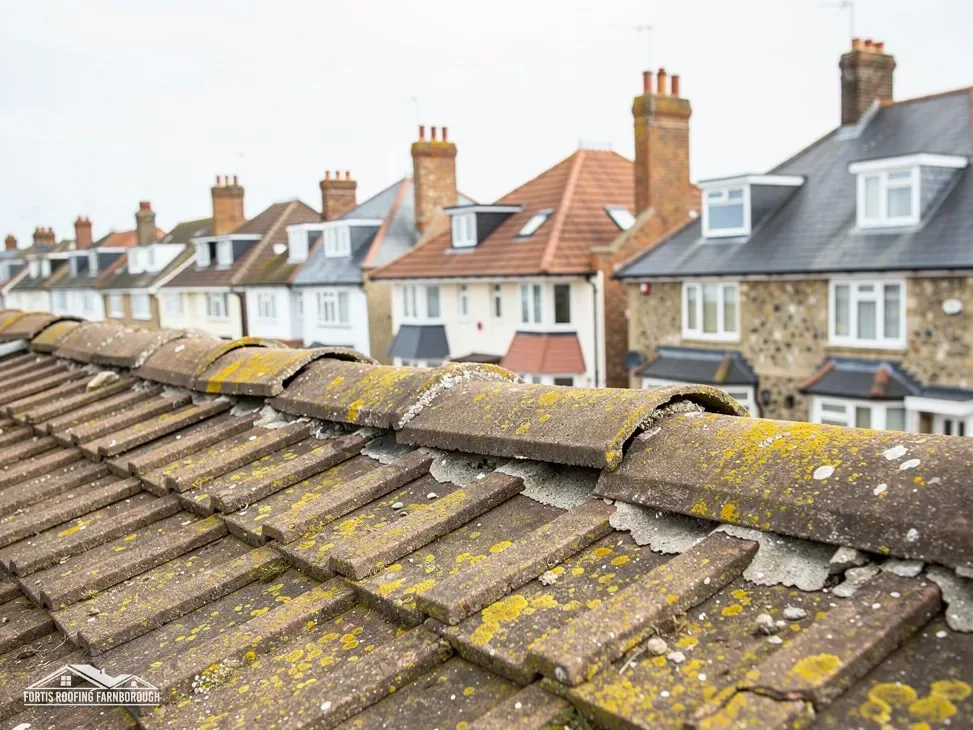
Whatever the building, we keep dated photographs of ridges, hips, flashings and chimneys, taken before and after the work, and a copy goes to you along with the written price. Our pitched roofing and flat roofing pages explain how slopes and flat sections are repaired.
A scaffold frame on a Brentford pavement, which is often the only way to reach a front slope, requires the highway licence that section 169 of the Highways Act 1980 provides for, and it is laid out around neighbours' doors and any boundary wall.
Boston Manor House is a reminder of how large and complex some roofs here are, and of how much a survey must record before a repair can be specified. If your Brentford home is a flat, the roof is probably the freeholder's responsibility. We can report on it, with photographs, in a form you can forward to the managing agent, which usually speeds up a decision.
By brushing or gentle treatment, not by jet washing, which Marley advises against for slate and tile, because a high-powered jet scours the covering and cuts its working life. We clear the gutters of what comes down and photograph the result. A chemical treatment is only worth using where an approved product suits the covering and the conditions.
Products made for professionals alone are not for householders, says HSE, and advertising, selling, supplying, storing or using an unapproved product is an offence. The safest do-it-yourself route is a dry brush from a safe position, and a survey will tell you whether the roof can be walked on safely, which no one should assume from the ground.
Yes. Quaker buildings are not covered by the ecclesiastical exemption, so a roof repair that affects the building's character needs listed building consent from the London Borough of Hounslow, in addition to any other approval. The meeting house is Grade II* listed, and the question would go to the council before any roof was priced.
The national dataset lists five: St Paul's Brentford, Grand Union Canal and Boston Manor, Isleworth Riverside, Osterley Park and The Butts. Hounslow's planners hold the boundary maps and can say if an Article 4 direction applies, so they are asked before a price is set for anything that would change the roof's appearance.
Get your free roof quote
Give us your Brentford address and say whether you have moss, leaks or loose tiles, and we will book a survey.
10-year workmanship guarantee, in writing.