The short answer
Yes, lead suits modern homes as well as old ones. It still turns up at chimney stacks, bay and porch roofs, dormers and wherever a roof meets a wall. Some builders use other flashing products instead. If your home is new, check the warranty before anyone else works on the roof: NHBC Buildmark cover starts with the builder for two years, then eight years of insurance for certain parts.
Where lead appears on a newer house
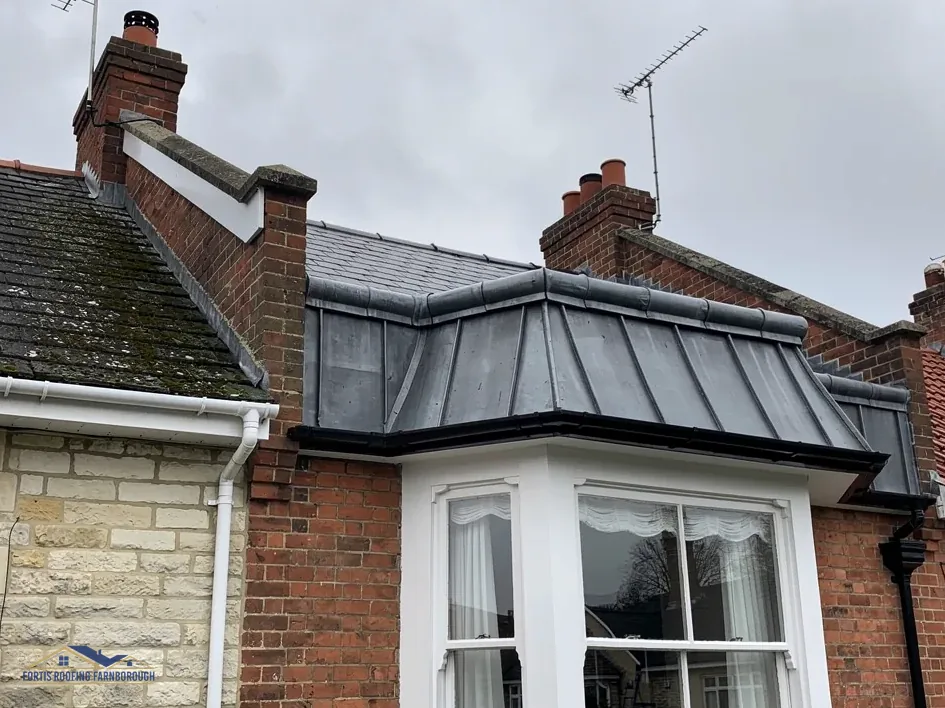
People associate lead with old slate roofs, yet it is still fitted on houses built in recent decades, because the junctions it protects have not changed. A roof still meets a wall, a chimney stack still rises through a slope and a bay window still has a small roof of its own.
On a modern house, lead is likely to be found at:
- chimney flashings and back gutters, on houses that have a stack;
- the junction where a garage, extension or porch roof meets the main wall;
- bay window roofs and canopies;
- dormer cheeks, where a house has a room in the roof;
- valleys between two slopes.
The same codes apply as on older homes. Royston Lead's cast-lead brochure lists Codes 4 to 6 for flashings, 4 to 8 for valleys and dormers, and 5 to 8 for box gutters. Our page on how thick roofing lead is gives the table.
Newer lead is not immune to failure. Poor fixing can split a flashing within a few seasons, whatever the age of the house, so a damp patch beside a chimney on a young house is worth investigating promptly.
Alternatives builders use
Not every new roof uses lead. Some builders choose other materials at the same junctions, such as mortar fillets or flexible flashing strips, and you may find one on your own roof.
These alternatives are not all equal. A mortar fillet, a ribbon of mortar along the wall, can crack as the wall and the roof move at different rates, which opens a path for water. A flexible strip depends on its adhesive and its edges staying sealed. Lead depends on its fixing and on being free to move.
Our page on lead flashing alternatives compares them in detail, and lead is the traditional answer when a failed alternative has to be replaced with something that will last.
Finding one is not a cause for alarm. It is a reason to look at its condition, and the survey photographs tell you whether it is sound.
On a house with a conservation or listed status, the material needs to match what is already there, and that usually means lead.
NHBC cover and defects in a new home
If your house was built recently, it may have an NHBC Buildmark warranty. NHBC says the cover runs for two years after completion with the builder, and then "eight years of insurance cover" for certain parts of the home. That makes it a two-year builder commitment followed by eight years of insurance, not ten years from the builder.
What this means for a leaking flashing is practical. In the first two years, the builder is the first call. After that, the insurance cover is for certain parts of the home only, and whether a flashing falls within it depends on the policy terms. Read your documents, and ask NHBC or your warranty provider.
It is wise to speak to the warranty provider before anyone else works on a roof still under cover. Independent work can affect a claim, and a provider may want to see the defect first. We can photograph the fault for you, which is useful evidence, without altering it.
Whether a claim succeeds is for the provider to decide. What we can do is tell you what we see, in plain words, with photographs.
Where cover has ended, or the builder no longer trades, the repair is yours to arrange, and the lead roofing hub explains how we approach it.
Older and newer homes: what is the same
The question is often asked as if lead behaves differently on a new house. It does not. It is the same metal, laid in the same way, with the same demands on its fixing and its freedom to move.
What differs is how much of the roof is original, and who is responsible. On an older house, the lead may have been patched in the past, and the surrounding brick and pointing are a likely cause of trouble. On a newer one, a flaw in the first fixing is more likely, and the wall behind is sound.
For either, the survey is the same. We photograph the junction, the lead and the pointing, measure what is there and explain the findings. The advice is a repair where a repair works and a new flashing where it does not.
If a younger roof needs lead, the same codes and the same method apply, and our page on how lead flashing is fixed explains them.
We work across Farnborough, Fleet, Camberley and the surrounding villages, on homes of every age. One total price in writing follows each survey, and the roof is left tidy.